City Medical Centre · multi-specialty surgery clinicOpen 24/7

Tummy tuck

Tummy Tuck for Patients from Palma

Free consultation

from $2,400

The price is fixed in the contract before surgery

Message us on WhatsApp

Free online consultation · Reply within 15 minutes
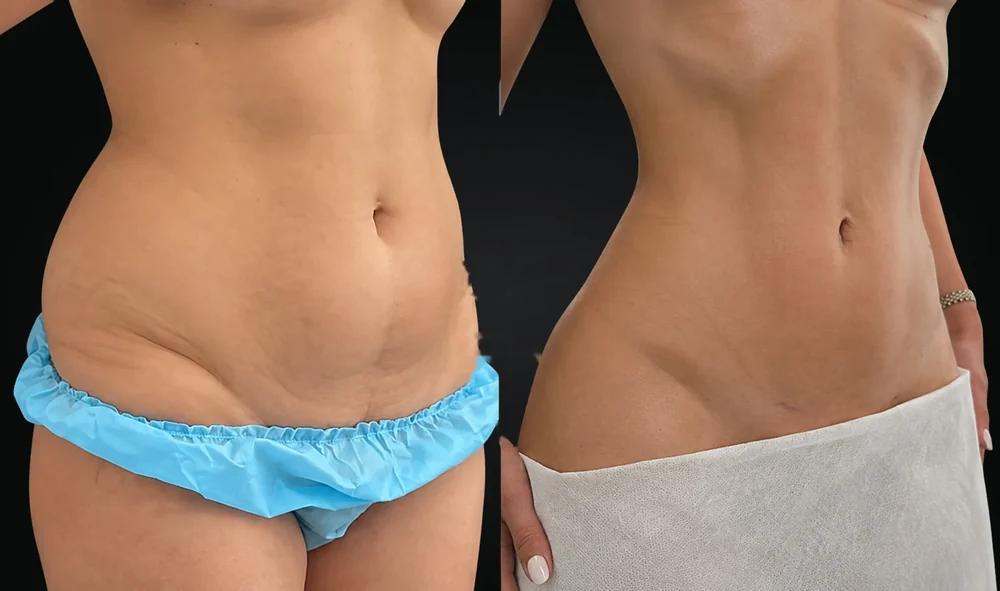
Real case
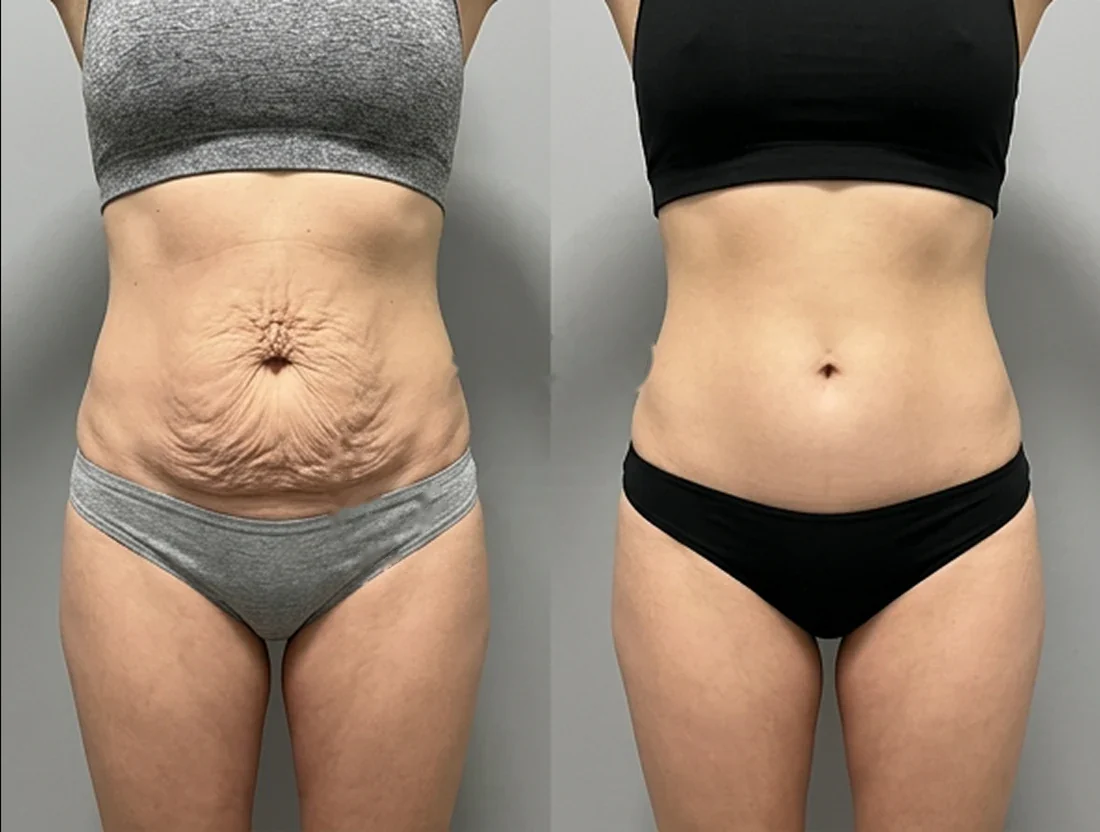
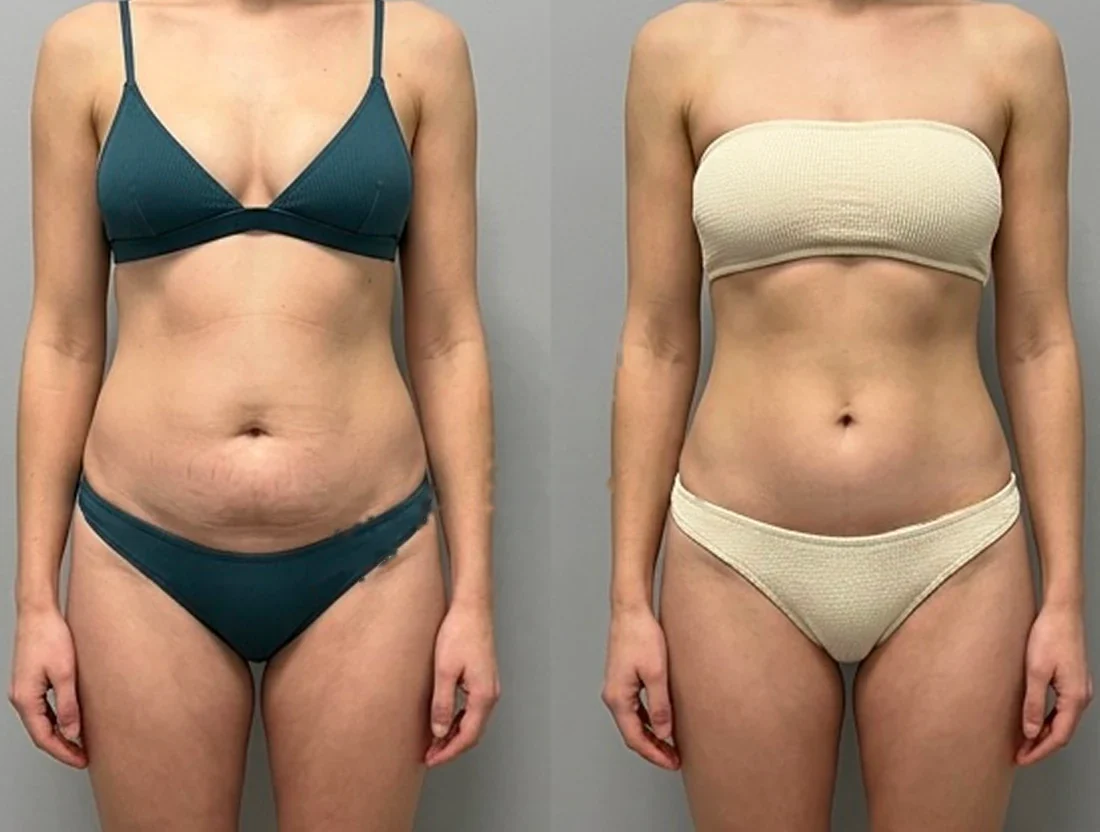
Tummy tuck: a patient's abdomen before and after surgery before after
A flat tummy and a toned silhouette in one operation. Your individual surgical plan and the expected result are discussed at the consultation

Message our coordinator

Free online consultation · Reply within 15 minutes

Message us on Telegram

By messaging us, you agree to our Privacy Policy

Tummy tuck (abdominoplasty) in Palma: price and key facts

Tummy tuck for patients from Palma at City Medical Centre: the price is named at the free online consultation and fixed in the contract with no hidden extra charges.

Duration
2–4 hours
Anesthesia
general
Stay
1–3 days
Recovery
back to work after 2–3 weeks
Final result
6–12 months after surgery
How it works
Send photos on WhatsApp or Telegram, get a free doctor assessment and the price, then confirm the plan and dates before anything is booked.

How it works · Tummy tuck prices

Information current as of 24 October 2026

Free online consultation on WhatsApp and Telegram

Results

Tummy tuck (abdominoplasty) results
of our patients

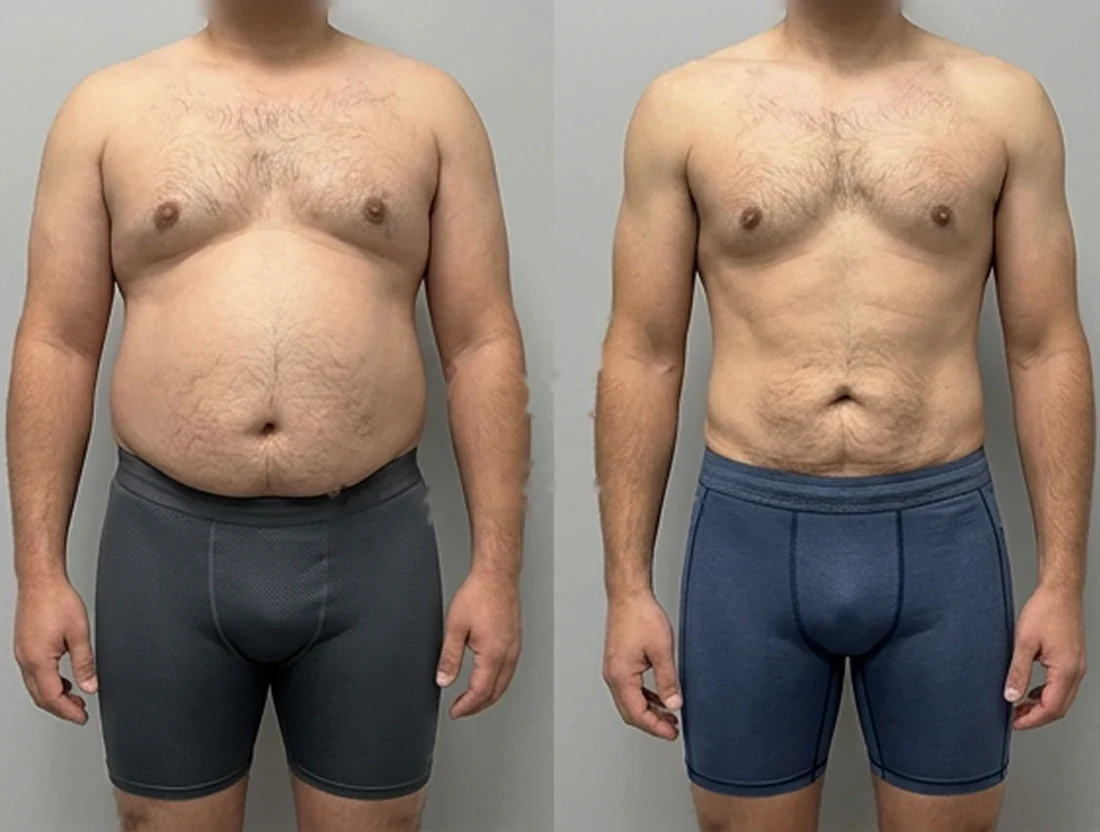
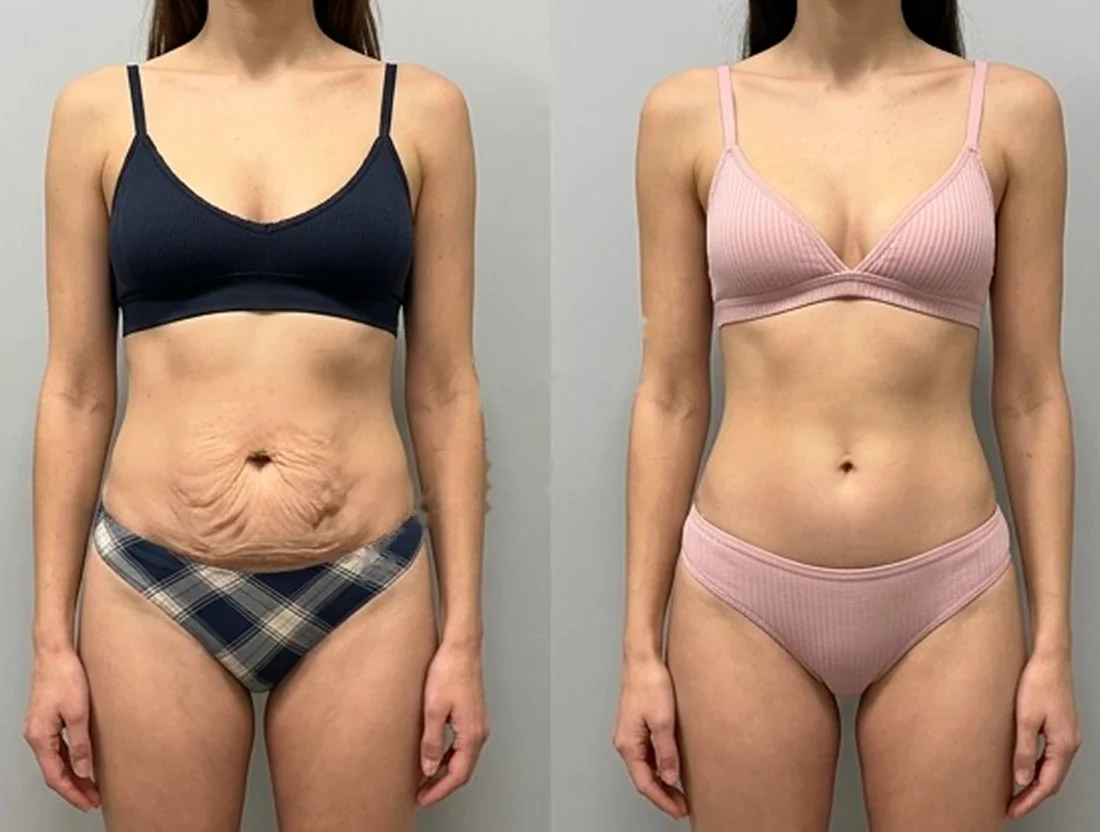
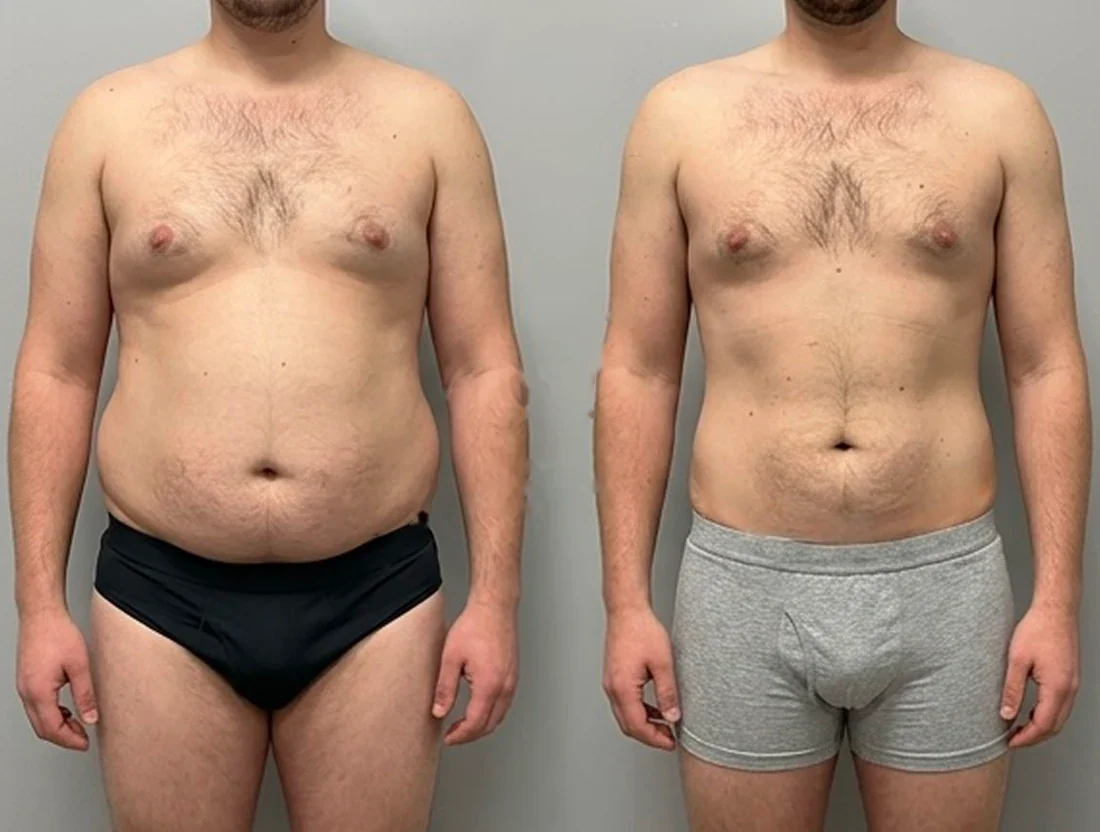
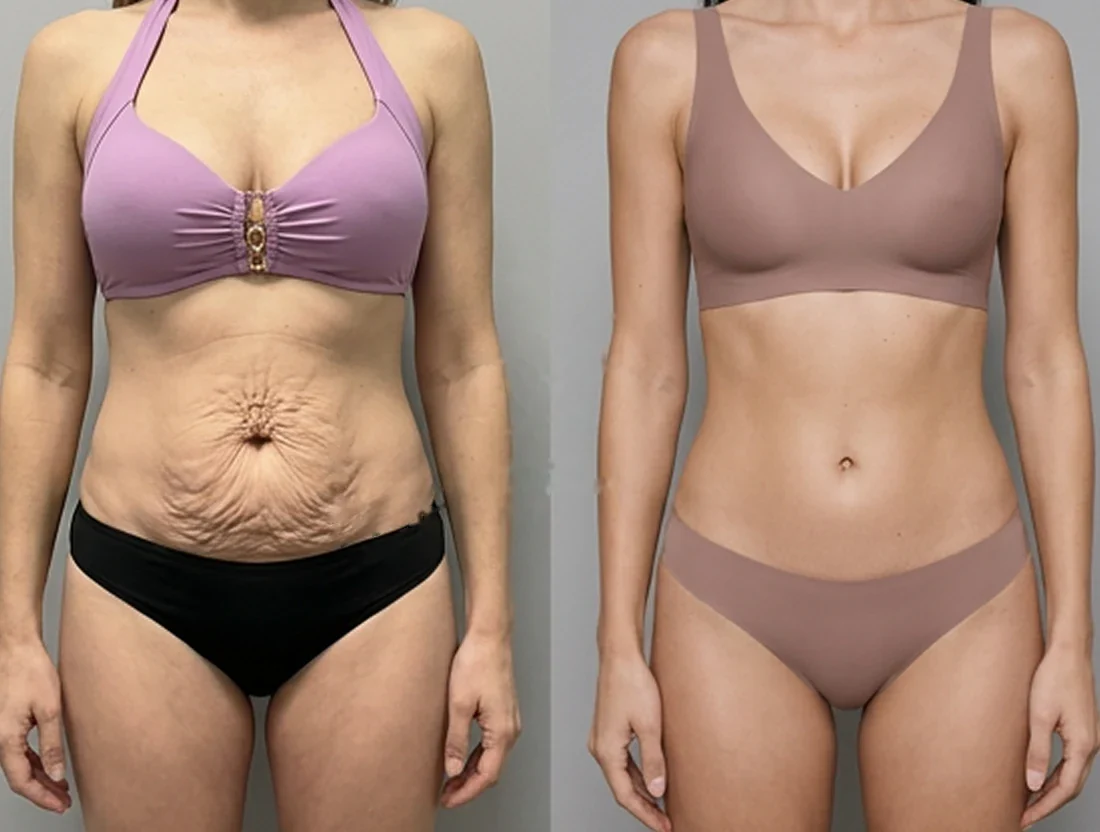
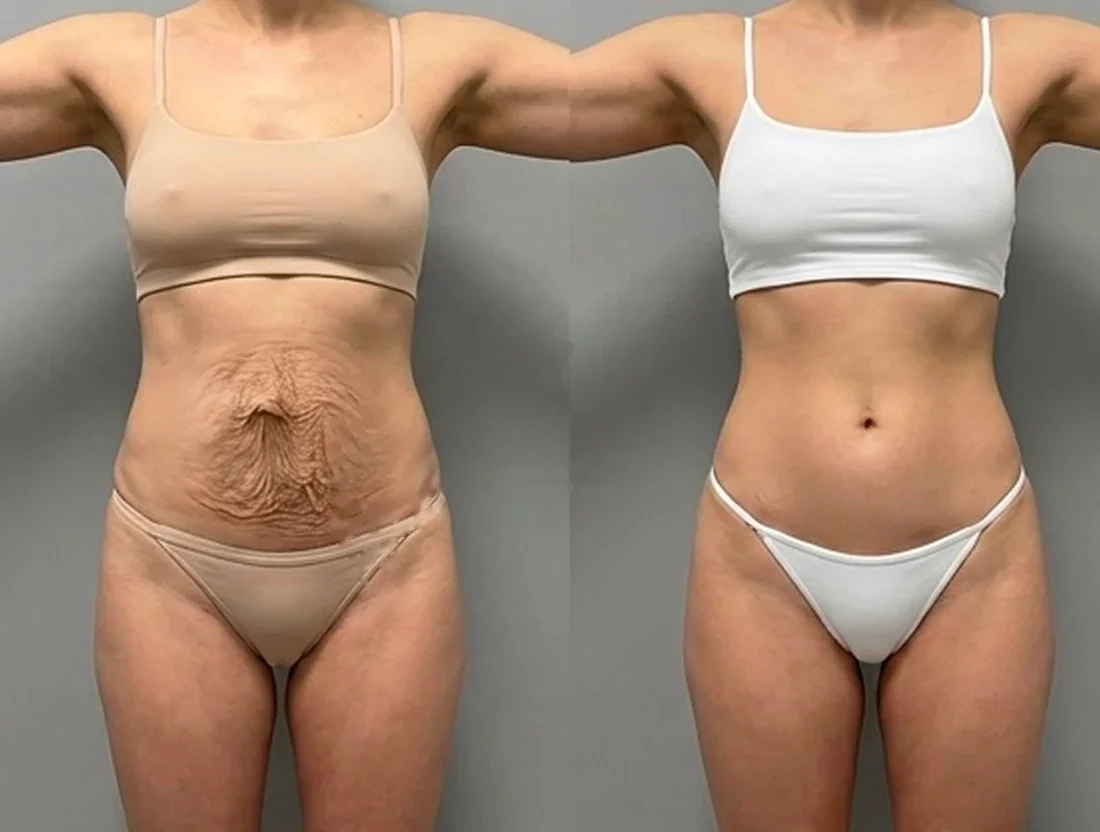
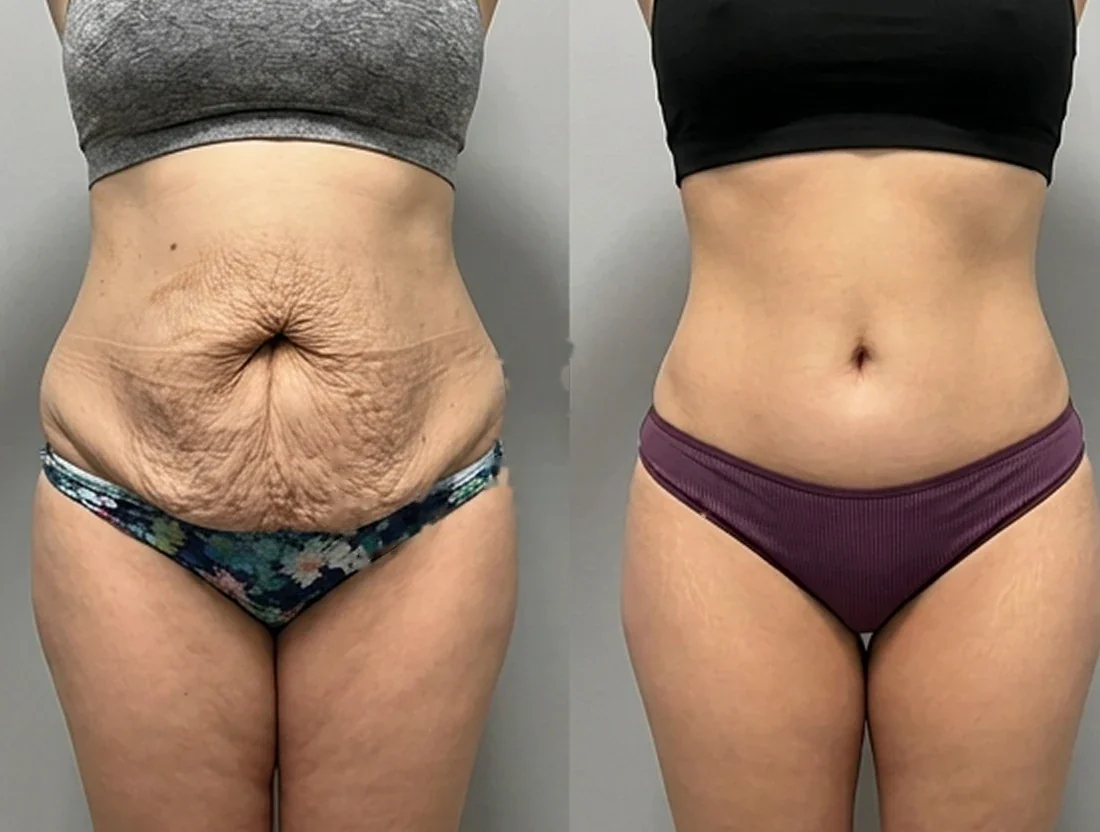
All cases are real patients. Faces and identifying details are hidden.

Tummy tuck: a female patient's abdomen before and after surgerybeforeafter
Tummy tuck: a male patient's abdomen before and after surgerybeforeafter
Tummy tuck: a female patient's abdomen before and after surgerybeforeafter
Tummy tuck: a male patient's abdomen before and after surgerybeforeafter
Tummy tuck: a female patient's abdomen before and after surgerybeforeafter
1 of 8

Comparison

Tummy tuck techniques

A tummy tuck is done as a full (classic) or mini operation, or combined with liposuction as lipoabdominoplasty. Compare the scope of surgery, the indications and the expected results to choose the right technique together with your surgeon.

Tummy tuck

Removal of excess skin, abdominal muscle tightening
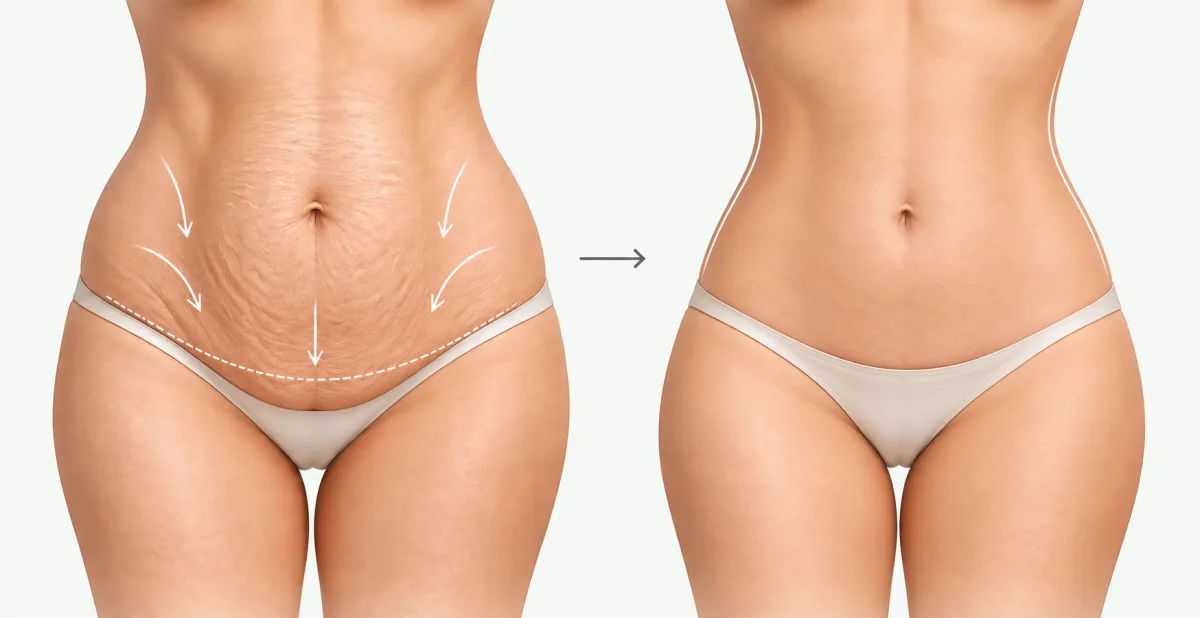
Tummy tuck diagram: the abdomen before surgery with the incision line, and the result
Main goal
Removal of excess skin, diastasis repair
When it is done
Excess skin after childbirth or weight loss
Anaesthesia and stay
General anaesthesia, up to 3 days in hospital

Lipoabdominoplasty

Tummy tuck with added liposuction
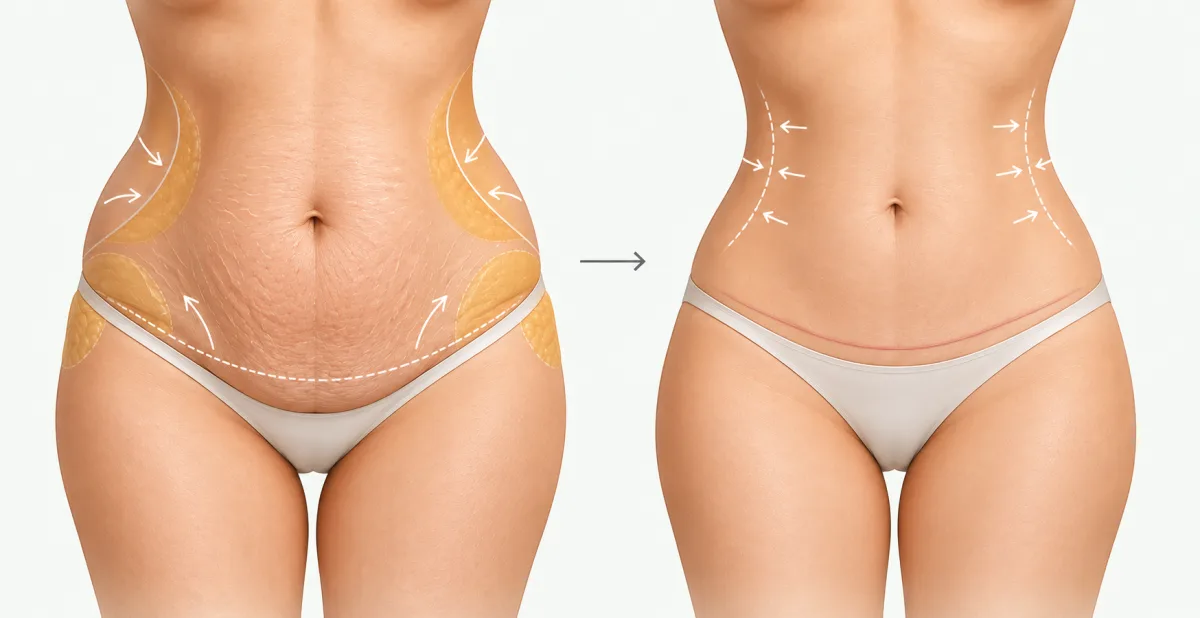
Lipoabdominoplasty diagram: the abdomen with fat on the flanks before surgery, and the result
Main goal
Tummy tightening and waist contouring
When it is done
For fat deposits on the flanks and waist
Anaesthesia and stay
General anaesthesia, up to 3 days in hospital

The benefits and recovery times shown are averaged for each technique and given for guidance: the scope of correction and rehabilitation depend on your anatomy and individual features, and the surgeon confirms them at the consultation.

At the consultation the surgeon draws up a plan for your case and explains how your tummy tuck will go.

Free, before surgery and with no obligation.

Book a consultation

Tummy tuck from the inside

About the clinic

A clinic where you can feel at ease

Modern equipment, comfortable rooms and care for every patient
A doctor and a patient in a clinic ward

Contact us the way that suits you

We will answer your questions and find a convenient time for a consultation

By messaging us, you agree to our Privacy Policy

A tummy tuck is not for everyone

If your case can be solved without surgery, the doctor will tell you so at the consultation — and you will not spend money for nothing.

Suitable
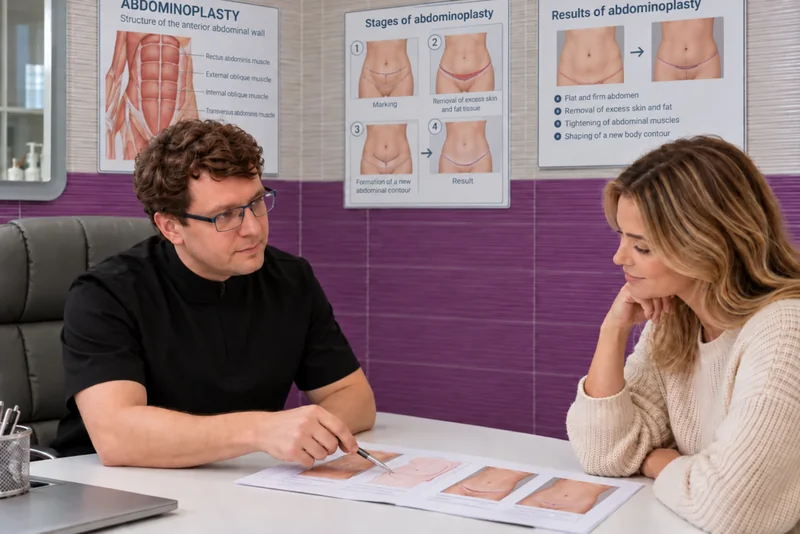
A surgeon shows a patient on a model and a monitor how the abdominal contour changes after a tummy tuck
  • Rectus abdominis diastasis
  • Skin folds after weight loss
  • Loose abdominal skin
  • Stretched skin after pregnancy
  • A distorted abdominal contour

Not suitable
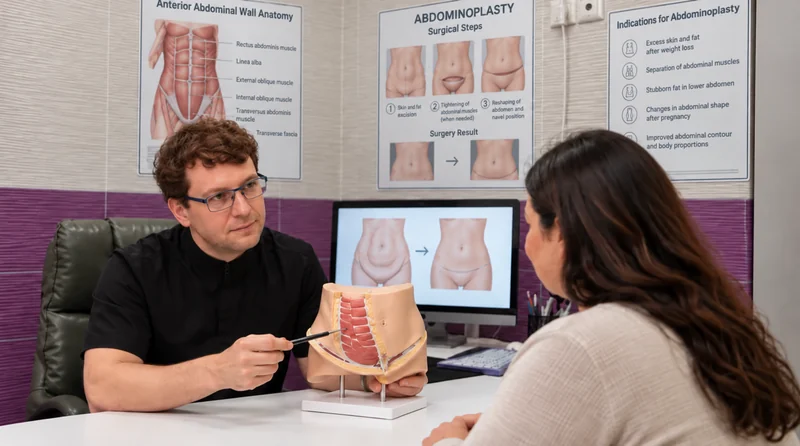
A surgeon discusses the indications and contraindications for a tummy tuck with a patient
  • Acute infections
  • Severe disease of the heart, kidneys or liver
  • Disorders of blood clotting
  • Under the age of 18
  • Decompensated diabetes
  • Cancer
  • Skin inflammation in the surgical area
  • Currently pregnant or breastfeeding

Not sure the surgery is right for you?

Message us — the coordinator will ask for your photos in the messenger, and the surgeon will tell you whether a tummy tuck suits you. No surgery booking needed.

Find out if it suits me
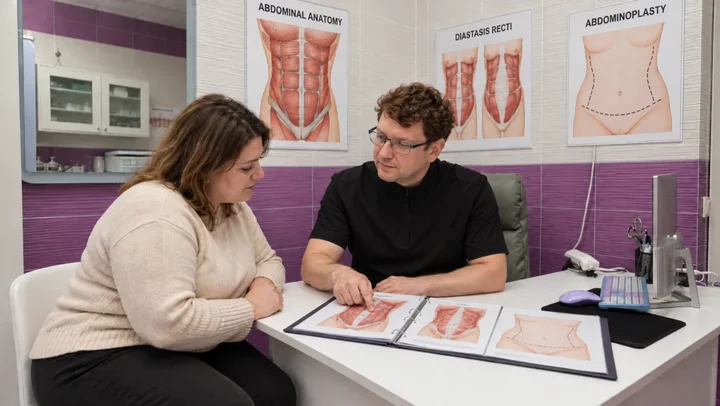
A surgeon goes through a tummy tuck diagram with a patient at the consultation

Prices

You know the price
before surgery

The price is set at the consultation and fixed in the contract.

Other services

  • First consultationFree
  • Liposuction of the abdomen and flanksfrom $1,700
Book a consultation

Find out your tummy tuck plan and price

The surgeon assesses your abdominal skin and muscles, listens to your wishes and chooses the right correction technique.
The price is set at the consultation and fixed in the contract.
A nurse talks to a patient in a clinic ward

Message our coordinator

Free online consultation · Reply within 15 minutes

Message us on Telegram

By messaging us, you agree to our Privacy Policy
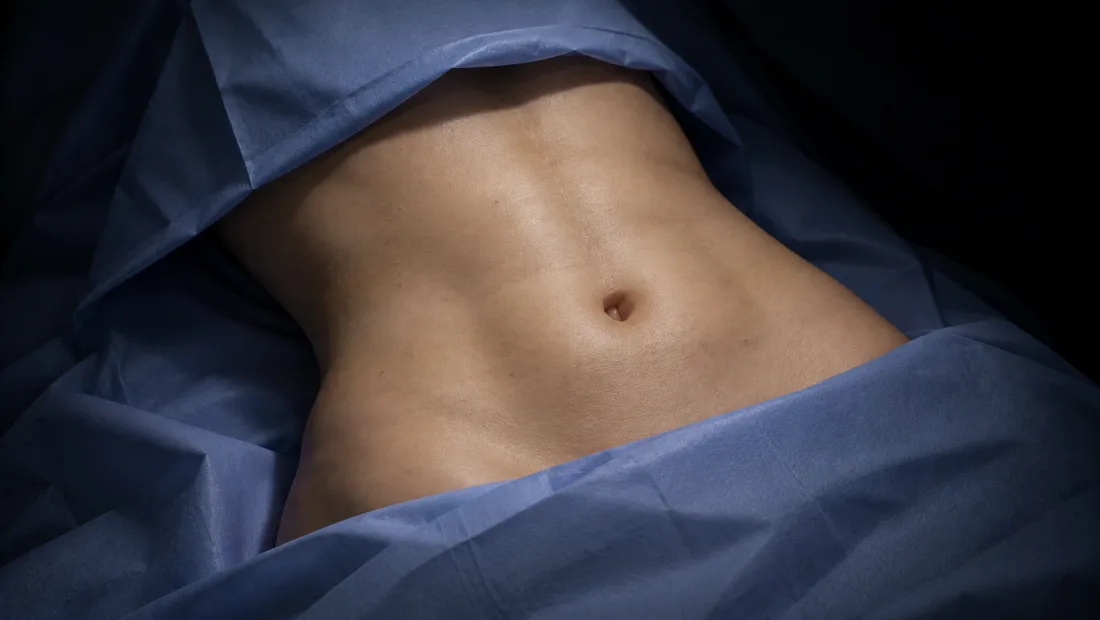
A patient's abdomen before a tummy tuck in the operating room

all inclusive

What the price includes

From preparation for surgery
to post-op check-ups.

  • All scheduled dressings
  • Scheduled post-op check-ups
  • A personal coordinator on call
  • Compression garments fitted on the day of surgery
  • A stay in a comfortable
    hospital ward with meals
  • Individual recommendations
    for recovery
  • Remote progress monitoring
    by photos

How it works

Three days at the clinic —
from preparation to discharge

An agreed correction plan, inpatient observation and post-op check-ups.
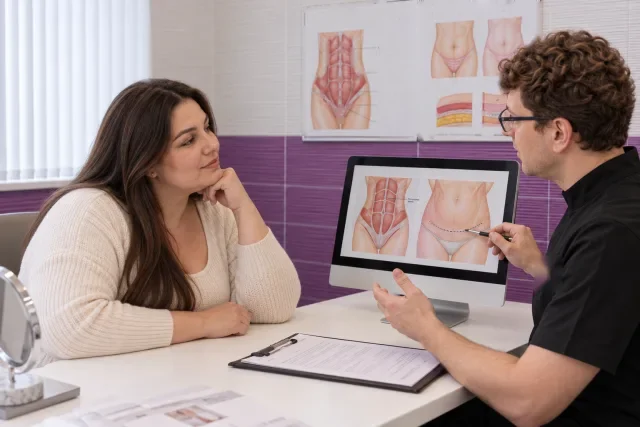
A doctor shows a patient a tummy tuck diagram on a monitor1

Consultation
and the surgical plan

The surgeon assesses your abdominal skin and muscles and checks for diastasis, listens to your wishes and chooses the right correction technique.

Paying the deposit by card at the clinic reception2

Booking the date
of surgery

We reserve a surgery date for you: the deposit can be paid by card at the clinic or online by bank transfer. The terms are fixed in the contract for medical services
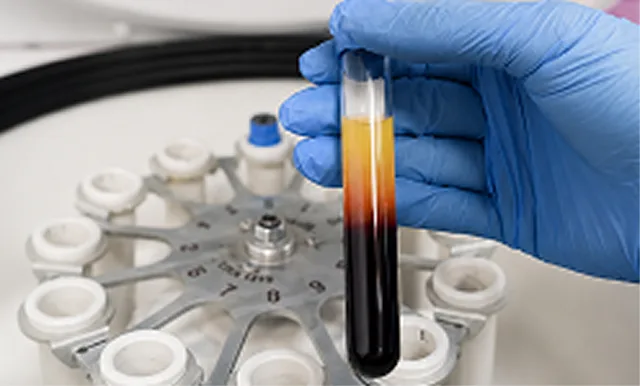
A blood sample tube for tests before a tummy tuck3

Check-up before
surgery

Before surgery you complete a full lab check-up: blood tests, an ECG, a chest X-ray and reports from the required specialists.
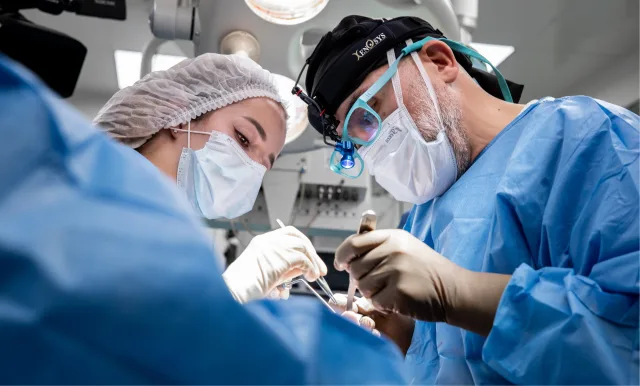
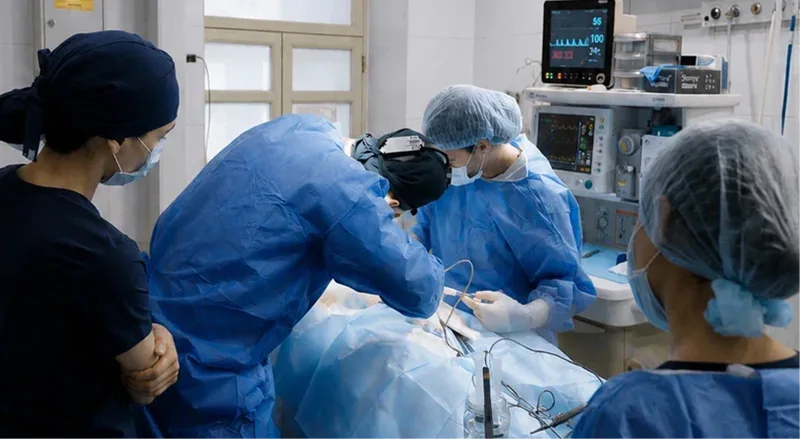
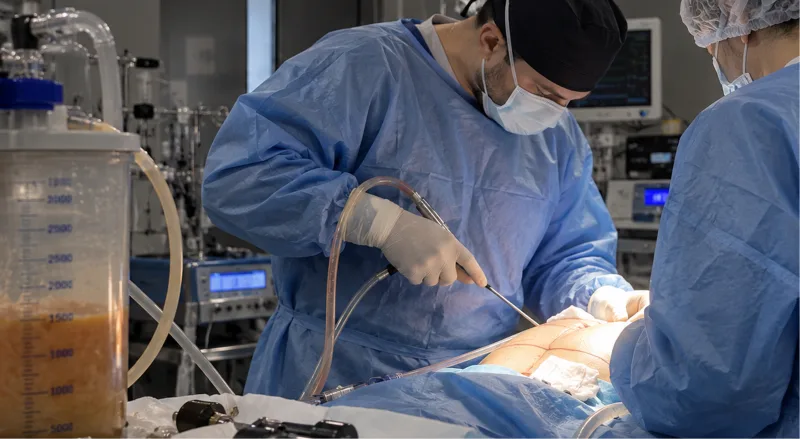
The surgical team during the operation4

Surgery

The surgeon performs the tummy tuck with the chosen technique, repairs diastasis if needed and shapes a firmer abdominal contour.
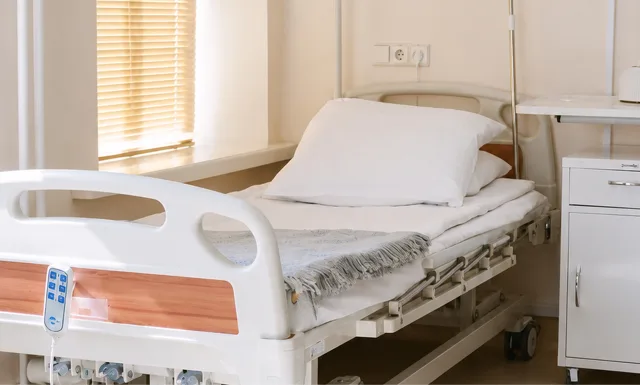
A hospital ward at the clinic5

Inpatient stay

After surgery the patient stays for 1–3 days in a comfortable hospital ward with meals, under medical supervision.
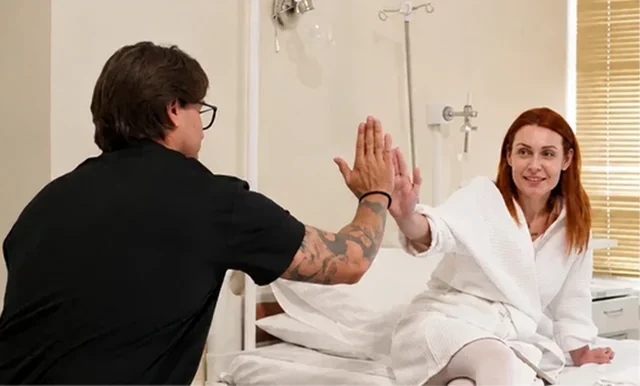
A surgeon and a patient in the ward during recovery6

Recovery

After surgery you get a recovery programme. Check-ups at 7 days, 3 and 6 months help track your recovery.
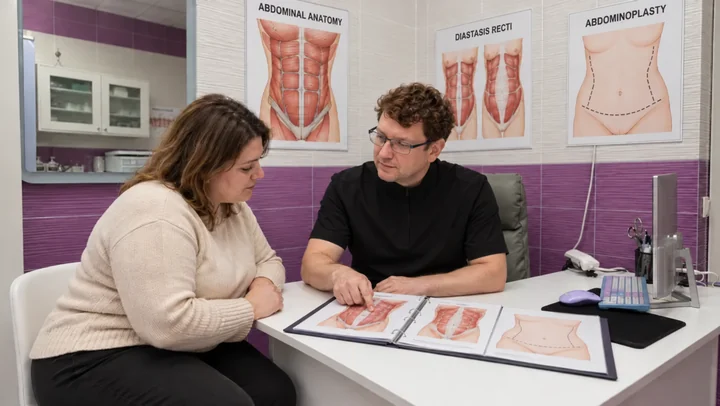
Book a free consultation — the surgeon will plan every step with you.

A doctor discusses the tummy tuck plan with a patient
Book a consultation
A doctor discusses the tummy tuck plan with a patient

How it really happens

Recovering after a tummy tuck

Right after the operation, 1–3 days in hospital under medical supervision. Drains usually come out after two days and stitches after 7 days. The compression binder stays on for 1.5–2 months, supporting the abdominal wall and shaping a smooth contour. Most swelling passes within 30 days, and you can go back to office work after 2–3 weeks. Sport, sauna and heavy lifting are ruled out for 2–3 months; it's advised to sleep on your back with knees bent early on. After 12 months the scar is fully mature — faded and barely noticeable.

Post-op check-ups

After 7 days, at 3 months and at 6 months. Until the end of the year, get a post-surgery consultation with your surgeon to review results and get more information, at the clinic's expense

Advantages

Why patients pick City Medical Centre
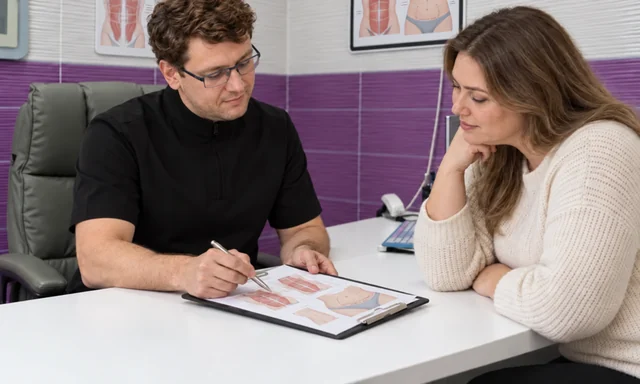
A surgeon discusses the tummy tuck plan with a patient at the consultation

Just find out — you lose nothing

At the consultation we discuss your wishes and assess your abdominal skin and muscles. The surgeon explains what changes are possible, chooses the correction technique and answers your questions.
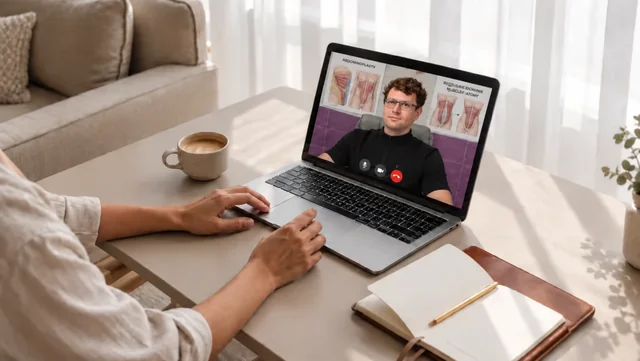
A surgeon on a video call with a patient after surgery

We stay with you after surgery

The surgeon follows your recovery and the changing abdominal contour at check-ups after 7 days, 3 and 6 months. Check-ups, dressings and aftercare advice are already included in the price of surgery.
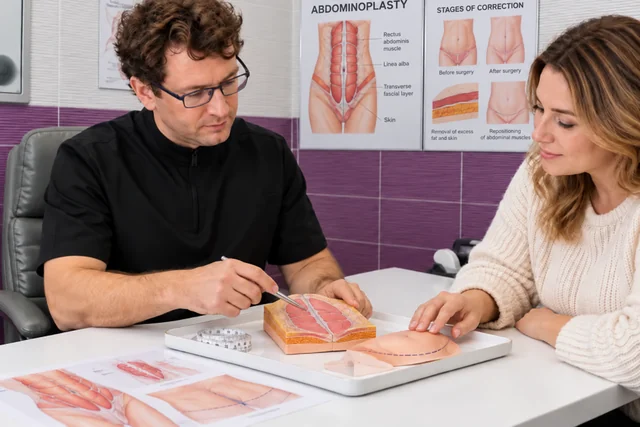
A surgeon shows a patient a model and tummy tuck diagrams

A beautiful contour that fits your figure

We choose the correction technique based on your skin, muscles and figure. Our aim is a harmonious abdominal contour that keeps the natural proportions of your body.

A patient writes down a convenient visit time in her planner

Your schedule is our priority

We respect your time: we work 24/7, with easy booking and a personal approach — we adapt to your pace.
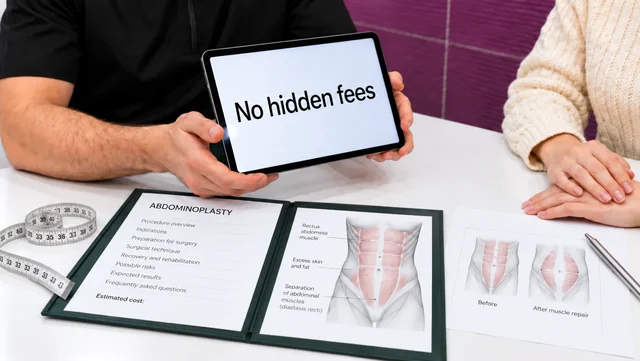
A surgeon shows a patient the fixed price of surgery with no extra charges

Fixed prices

After the consultation the surgeon defines the extent of correction, and you get a clear price for the surgery — no surprises on the way to the result you want.
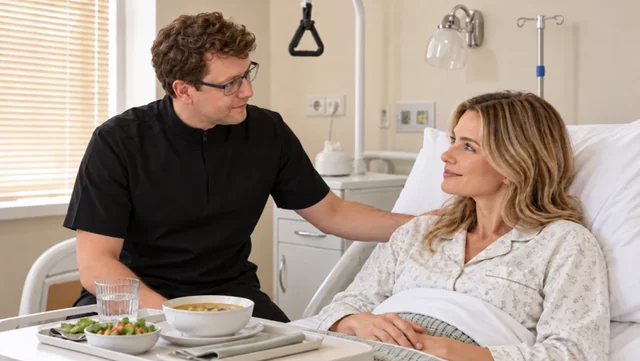
A surgeon visits a patient in the hospital ward after surgery

Round-the-clock care after surgery

Recovery starts in a comfortable hospital ward under round-the-clock nursing care. The stay and meals are already included in the price.

FAQ

We answer what
people ask before booking

Abdominoplasty in Palma: a short guide

Diastasis is not always part of the picture. Repair is done only when the rectus abdominis muscles are actually separated: the surgeon sees it at the examination and, if in doubt, it is confirmed by ultrasound. When needed, the muscles are brought together during the tummy tuck itself, with no separate procedure. Patients from Palma learn at the consultation whether their case requires it.

After surgery you stay in hospital under medical supervision for 1–3 days; after a mini tummy tuck one day is usually enough. Drains are typically removed after two days and stitches after seven. A compression binder is worn for 1.5–2 months to support the abdominal wall and shape a smooth contour. Recovery continues at home, and patients in Palma are monitored at scheduled check-ups.

There is no single price for abdominoplasty, since a mini tummy tuck and a classic operation with diastasis repair differ in scope. What stays constant is the approach: the surgeon names the cost after an in-person examination, and it is fixed in the contract without surprises. Palma residents can apply before the end of the year and get the consultation at the clinic's expense.

Stories of well-known people

Well-known people who spoke openly about this operation, in their own words.

All stories about this operation →

The first three weeks at home: bending, lifting and moving around

A tummy tuck changes how the abdominal wall behaves for a few weeks, and a person who lives in Palma will notice this in ordinary routines before anything else. The service plan starts with 1–3 days in a hospital ward under medical supervision. After that, recovery continues at home. Drains are usually removed after two days and stitches after 7 days. By then the question is no longer about the operation itself. It is about the kitchen, the bathroom, the bed and the stairs of your own home. The operation takes 2–4 hours under general anaesthesia, but the practical test of the plan begins on the day you are discharged.

The most useful preparation is to walk through your home in your mind and mark everything that requires bending or reaching. Low cupboards, the washing machine door, the laundry basket, a low sofa, a bath that you step into: each of these asks the abdominal wall to work. The recovery notes say that physical exertion, heavy lifting and sudden movements are not allowed during the first 2–3 weeks. Sleeping on your back with the knees bent is advised at first. So the plan is to bring daily objects up to waist height before the operation. Put the things you use every day on shelves between hip and shoulder level. Put a firm cushion where you will lie down, so the knees-bent position is comfortable without effort. Keep a chair with arms in the bedroom, because pushing up with your arms is easier than using your abdomen.

Palma is a compact, flat city. The municipality covers 208.63 km2 at an altitude of 13 m, so the ground outside is not an obstacle in itself. For a patient who lives on an upper floor without a lift, the stairs are a more relevant question than the city's relief. Slow, upright walking is part of normal recovery, but sudden effort is not, so think about how you will bring in shopping and carry bags. Online food and household deliveries, or help from an adult relative on the first two weeks, remove the temptation to "just carry it up quickly". These are practical arrangements you make before the date, not medical instructions, and the doctor will give you the exact limits for your case at the consultation.

Returning to work is the other milestone people plan around. The plan states that office work resumes after 2–3 weeks. This is a useful figure, but it describes desk work, and it does not describe jobs that involve standing for long hours, lifting boxes or caring for people physically. If your work includes any of these, say so during the free online consultation, because the doctor can only adapt the advice if the coordinator and the doctor know what a normal working day involves. Sport, sauna and heavy lifting stay off-limits for 2–3 months, which is a much longer horizon than the return to a desk.

A compression binder is worn for 1.5–2 months. It supports the abdominal wall and helps shape a smooth contour. It is fitted on the day of surgery and is included in the price structure of the programme. Think of it as part of your clothing for that period, and choose loose outer garments that do not press on it or hide it uncomfortably. Most swelling goes within 30 days, but the abdomen can feel tight for longer, and this is part of the expected course. The check-ups at 7 days, 3 months and 6 months are the moments where the doctor evaluates the swelling, the scar and the contour. Between them, your personal coordinator is available round the clock on WhatsApp and Telegram, and you can send photos for remote progress monitoring.

Family life while the binder stays on

People who consider a tummy tuck very often have a family, and in many cases the abdominal change is linked to pregnancy. The service plan names rectus abdominis diastasis, stretched skin after pregnancy and skin folds after weight loss among the indications. Family planning therefore belongs in the first conversation, not in the last. The plan is clear on the order of events: childbirth should come first and then surgery. A pregnancy after a tummy tuck is possible, but it stretches the repaired muscles again, so the operation is planned once the family is complete. If you are still thinking about another child, it is reasonable to say so openly during the consultation. The doctor can tell you whether it makes sense to wait.

The next family question is physical contact with small children during the first weeks. Lifting a toddler, bending to a pram, carrying a child on one hip: all of these are heavy lifting or sudden movement in the language of the recovery rules, which exclude them in the first 2–3 weeks. The sensible approach is to prepare the child as well as the home. Explain in simple words that for some weeks you will sit down for cuddles rather than pick them up. Arrange who takes the child to and from school or nursery, and who carries the bag. If you have no other adult at home, plan help before the date rather than at the moment of need. A grandparent, a spouse taking leave, or a friend scheduled in advance is more reliable than a promise to manage alone.

The hospital stay of 1–3 days also needs a plan at home. Someone has to look after the children during that time, and someone has to be available for the return home, when you will not be at your most agile. Palma is the capital of the Balearic Islands and its municipality has 438,234 inhabitants according to the 2024 figure, the eighth largest in Spain. A city of that size has plenty of school and childcare infrastructure, but you still need to confirm your own arrangements for the dates. This is an organisational point, not a medical one, and it is better settled when you book the date of the operation.

Younger adults sometimes ask about timing around studies. The Universitat de les Illes Balears, founded in 1978, had 15,789 students in the 2022–23 academic year, with its main campus in Palma. Patients must be 18 or older and have no contraindications, so a university student who is an adult can consider the operation in principle. For a student the practical points are the same as for a worker: office-type activity resumes after 2–3 weeks, and sport and heavy lifting have to wait 2–3 months. A student who does physical training, or who takes part in sports as a part of the course, should plan the operation around the calendar, and mention this to the doctor.

The emotional side of family life matters as well. A tummy tuck is not a way to lose weight, and it should not be presented to a family as a weight-loss solution. Its goal is to remove excess stretched skin and the fat apron and to restore the abdominal muscle wall. Surgery is done at a stable weight; if your weight is still changing, the plan recommends seeing a dietitian or endocrinologist first. Tell the people at home what to expect: a tight abdomen, a binder worn for weeks, a scar across the lower abdomen from hip to hip, and a final result assessed at 6–12 months. Realistic expectations in the household reduce pressure during the weeks when swelling still hides the contour. The first changes appear about 2 weeks after surgery, the interim result at 1.5–2 months and the final contours at 6–12 months.

Scar, sun and sea water: reading the Mallorca calendar

The scar is the part of a tummy tuck that interacts most with the sun. A classic tummy tuck leaves an incision across the lower abdomen from hip to hip, below the underwear or swimsuit line, and a mini tummy tuck leaves a much shorter one. The service plan says the scar is fully mature by 12 months, when it fades and is barely noticeable. The word "mature" matters here: until then, the scar is still changing, and the way you treat the area in the first year influences how it looks. The plan gives only one clear rule on this subject, which is to avoid sauna, steam bath, pool, tanning beds, alcohol and smoking for at least a month. Beyond that, the doctor sets the personal advice at the check-ups, and the questions of sun exposure should be asked directly rather than guessed.

Palma is a sunny place. According to the 1991–2020 data, the city has 2,858 hours of sunshine a year, with July at 353 hours and December at 152 hours. The climate is classified as warm semi-arid. This means that, for much of the year, a scar covered by a swimsuit is in a setting where sun is a daily fact. Clothing is the first level of protection, and the doctor will tell you whether and when to add anything else. We do not give a product list or a number of weeks for sun protection because the plan does not specify one, and a number from a general source would not be reliable for your skin. What we can say is that the choice of month for the operation changes how many weeks of strong sun fall inside your first year.

The sea is the other seasonal factor. The bathing season at Platja de Palma (El Arenal), the urban beach mentioned in the city description, lasts about 6–7 months, from late April to early November. Sea temperature averages 19.5 °C over the year, with a minimum of 13.9 °C in February and a maximum of 26.0 °C in August. June averages 22.5 °C and September 25.0 °C. For a patient with a fresh scar and a binder, these numbers have a plain meaning. In the first weeks, a pool and similar water are excluded for at least a month, and the doctor decides when sea bathing is appropriate. If you have an operation in the autumn or winter, the sea is cold and the swimming season is ending or over anyway, so the temptation is lower. If you have an operation in spring, the first warm weeks of the season arrive when the scar is still young.

An honest point about the seaside: a beach day is not only about water. It is about lying on the sand, bending to pick up a towel, carrying a bag, walking on soft ground and being in the sun for hours. All of these ask something from the abdominal wall and the skin. During the 2–3 months when sport, sauna and heavy lifting are off-limits, a beach day built around gentle walking at the water's edge is a different activity from a day of swimming and carrying equipment. We prefer to say that the decision belongs to the doctor at the check-up, and to ask you to send photos so that the scar can be assessed before you make plans.

Clothing for the warm months is a practical point as well. The compression binder is worn for 1.5–2 months. Under the warm conditions typical of Palma in summer, with August maxima of 30.2 °C and minima of 23.0 °C, a binder worn for weeks is less comfortable than in January, when maxima are 15.7 °C. Average relative humidity is 72 %. These are climate facts and not medical claims, but they help you imagine the weeks: layers of light, loose clothing, lightweight fabrics and time spent in shade or air-conditioned rooms. If you have a choice, you might prefer the cooler months for the period when the binder is a daily companion.

Choosing the month: temperatures, rain and the recovery timeline

The question of the season is one of the most common in the planning stage, and for Palma the numbers are relatively mild. The annual mean temperature is 18.5 °C. The coldest months are January and February with maxima of 15.7 °C and minima of 8.5 and 8.4 °C. The warmest are July and August with maxima of 29.7 and 30.2 °C. April averages 19.7/12.2 °C, and October 24.0/16.8 °C. A season is therefore not a barrier in itself, and the choice depends on what you want to avoid during the first 2–3 months, when exertion is restricted and the binder is in use.

Consider three simple approaches. The first is to schedule the operation in the cooler season, from about November to March. The binder, which is worn for 1.5–2 months, is more comfortable at lower temperatures, and the strongest sun comes later, when the main phase of swelling has passed. The sea is at its coldest, with 13.9 °C in February, so you are not tempted to swim in the weeks when the pool and similar water are excluded. The disadvantage is that the scar will be in its first months while spring begins, and the swimsuit season will arrive before the scar reaches the maturity mark at 12 months. The second approach is spring. April has mild temperatures of 19.7/12.2 °C, and the bathing season opens in late April. This leaves little time between recovery and the first beach days. The third is autumn: October reaches 24.0/16.8 °C, and the sea is still warm, which makes the early weeks of recovery pleasant for gentle walking, but the sun continues for a while.

Rain is another variable. Annual precipitation is 470.1 mm over 53.6 days. October is the wettest month with 72.6 mm, November has 67.8 mm and September 60.5 mm. July is the driest at 5.1 mm. For a person who has just left hospital, wet days matter less for health than for logistics: slippery pavements, a need to carry an umbrella with an arm that you should not stretch suddenly, and a desire to avoid crowded or unstable ground. A careful patient might think of this when scheduling the check-ups at 7 days, 3 months and 6 months, which are done with the doctor and supported by photos in between. We do not suggest that rain has any effect on the wound. It is simply a fact of the calendar that autumn brings more rainy days.

The most useful way to choose the month is to count backwards from the events you care about. Start with the date of any major occasion: a wedding, a holiday, an important work period or a family event. Then add 2–3 weeks to the date of the operation for the return to office work, 30 days for most swelling to subside, 1.5–2 months for the binder, and 2–3 months before sport, sauna and heavy lifting. If you want the contour to be visible, remember that the interim result appears at 1.5–2 months and the final contours at 6–12 months. For an event that requires a swimsuit, the sensible approach is not to schedule the operation immediately before it, because the scar is still maturing and the abdomen is still adapting.

Tests also have a calendar of their own. The pre-surgery check-up includes blood and urine tests, coagulation panel, biochemistry, infection tests, ECG, chest X-ray, leg vein ultrasound and a GP's report, and the tests are usually valid for 10–14 days. This means that you should not do them months in advance, and you should not leave them to the day before. Smoking, alcohol and medicines affecting blood clotting are stopped 7–10 days before the tummy tuck. The date should therefore be set with a margin, so that a minor cold or a delayed result does not force you to rush. The coordinator can help you plan these steps around your calendar, and the whole process, from photos to date, can be handled online.

Finally, an honest remark about winter in Palma. The coldest months are not harsh, but the 8.5 °C minima of January call for warm indoor clothing, and a compression binder under it is no problem. The advantage is practical rather than dramatic. For the same reason, we do not promise that one month is better than another. We suggest that you discuss your preferences during the free consultation, send photos, and let the doctor tell you whether your case, and for example the choice between a full operation, a mini tummy tuck or a lipoabdominoplasty, suggests any particular timing.

Waiting figures, exclusions and the planning gap

Many people in Palma ask whether the national health system can perform a tummy tuck. The legal framework gives a clear answer: the common portfolio of services of the SNS, defined in Royal Decree 1030/2006, does not finance techniques whose purpose is merely aesthetic or cosmetic improvement. Procedures with an aesthetic purpose that are not related to an accident, illness or congenital malformation are excluded from specialist care. In practice, cosmetic surgery lies outside the public system. The same decree contains related provisions about breast implants and skin expanders, which are included as reconstructive items but not when used in cosmetic surgery without such a link. The logic is the same for the abdomen. This is not a judgement on anyone's reasons for wanting the operation. It is a description of how the portfolio is defined, and it explains why a private, planned path is the realistic one for this procedure.

The waiting statistics show why timing matters even for those who might wonder about public options. At 31 December 2025, the SNS had 853,509 patients on surgical waiting lists, with an average wait of 121 days, and 21.6 % had been waiting more than six months. Plastic Surgery is the specialty with the longest average waiting time: 269 days. For comparison, Neurosurgery was at 172 days. In the Balearic Islands on the same date there were 17,075 patients in structural surgical waiting, which is 13.62 per 1,000 inhabitants, with an average of 105 days. Traumatology in the islands counted 3,874 patients and an average of 138 days. For joint replacements nationally, hip prosthesis averaged 98 days, with 13.7 % exceeding the 180-day maximum, and knee prosthesis 105 days, with 15.9 % over. These are figures for the public system and they do not describe our programme. They are useful because they show that waiting is a normal part of that system, whereas a private plan lets you fix a date after the consultation.

Our process is different in structure. The first consultation is free and online, through WhatsApp or Telegram. You send photos, the doctor assesses them, and you receive a price and plan. The price is fixed in the contract before surgery, and it includes the scheduled dressings, the check-ups, the compression garments fitted on the day of surgery, the stay in a hospital ward with meals, individual recommendations for recovery, and remote monitoring by photos. You then confirm the plan and the date before anything is booked. A deposit can be paid by card or online bank transfer, and the terms are set out in a contract for medical services. We do not quote amounts here because they depend on the individual plan.

Some patients come to a tummy tuck after significant weight loss, and Spanish statistics show why this is a common starting point. In the 2020 European Health Survey, 16.0 % of adults aged 18 and over in Spain were obese, 37.6 % were overweight, and 53.6 % were above normal weight. In the same decree, bariatric surgery with an adjustable gastric band is included for adults with a BMI above 40 kg/m2, or above 35 with significant comorbidity, after conservative alternatives have failed. If you have lost weight through any such route, the practical message is the same as in our plan: operate at a stable weight. Skin that has been removed does not regrow, but the abdomen can stretch again with significant weight gain. The tummy tuck belongs after the weight has settled, and the doctor can discuss this during the consultation.

The same survey records that the Balearic Islands had the highest percentage in Spain of people aged 15 and over who rated their health positively in 2020: 82.9 %. We mention this because a good general state of health is one of the things the pre-surgery check-up aims to confirm. It is no promise about any individual. The plan lists contraindications clearly: acute infections, severe heart, kidney or liver disease, problems with blood clotting, decompensated diabetes, cancer, skin inflammation in the surgical area, pregnancy and nursing, and age under 18. If one of them applies, the doctor will say so at the consultation. If your case can be solved without surgery, the doctor will tell you that as well, and you will not spend money for nothing.

Is it better to plan a tummy tuck in Palma for winter or for autumn?

Neither season is a barrier, so the choice depends on what you want to avoid. In Palma January and February have maxima of 15.7 °C and minima of about 8.5 °C, which makes a compression binder worn for 1.5–2 months comfortable, and the sea at 13.9 °C in February removes the temptation to swim while pool and similar water are excluded for at least a month. October is warmer, at 24.0/16.8 °C, but it is also the wettest month with 72.6 mm of rain. Count back from the dates that matter to you and discuss the timing with the doctor during the free online consultation.

How should I think about the summer sun and my scar?

A classic tummy tuck leaves an incision across the lower abdomen from hip to hip, below the swimsuit line, and the scar is fully mature at about 12 months. During that year it is still changing, and Palma has 2,858 hours of sunshine annually, with 353 hours in July. We do not give a fixed protection schedule, because the doctor sets personal advice at the check-ups at 7 days, 3 months and 6 months. Send photos of the scar to your coordinator before planning beach days, and ask the doctor directly about sun exposure.

When can I go into the sea or use the pool after the operation?

The recovery rules say that sauna, steam bath, pool, tanning beds, alcohol and smoking are to be avoided for at least a month, and that sport resumes gradually and only with the approval of the doctor. Sea bathing is not listed separately, so ask the doctor at a check-up rather than assuming. The bathing season at Platja de Palma runs from late April to early November, and the sea averages 22.5 °C in June and 25.0 °C in September. A beach day also includes bending, carrying and long sun exposure, which matter in the first 2–3 months.

Will the Spanish public health system pay for a tummy tuck?

In general, no. Royal Decree 1030/2006 states that the common portfolio does not cover techniques with the purpose of mere aesthetic or cosmetic improvement, and procedures with an aesthetic purpose unrelated to an accident, illness or congenital malformation are excluded from specialist care. In practice, cosmetic surgery is outside the public system. If you have a medical concern, such as a skin inflammation or pain, discuss it with your own GP, and use the free online consultation to find out whether a tummy tuck is suitable in your case.

Does the long wait for plastic surgery in the public system affect my planning?

It is a useful comparison rather than a direct factor. At 31 December 2025, Plastic Surgery had the longest average wait in the SNS, 269 days, and the Balearic Islands overall had an average of 105 days for structural surgical waiting. A private programme works differently: you receive the plan and price after the free consultation, the price is fixed in the contract, and you set the date together with the coordinator. The pre-surgery tests are valid for 10–14 days, so you schedule them close to the date, not months ahead.

I lost weight after treatment for obesity. When is the right time to ask about a tummy tuck?

Ask as soon as you have a plan, but operate only at a stable weight. A tummy tuck removes loose, stretched skin and the fat apron, and it is not a way to lose weight; if your weight is still changing, the plan advises seeing a dietitian or endocrinologist first. In Spain, 16.0 % of adults were obese in 2020, and the national portfolio includes an adjustable gastric band for adults with a BMI above 40 kg/m2, or above 35 with significant comorbidity, after conservative methods fail. Send photos and tell the coordinator about your weight history, and the doctor will advise on timing.

How do I organise the home and family for the first weeks?

Start with the rules: no physical exertion, heavy lifting or sudden movements in the first 2–3 weeks, and sleeping on your back with knees bent at first. Move everyday items to waist and shoulder height, arrange help with children, shopping and laundry, and plan who will be with you during the 1–3 days in hospital and on the day of discharge. Office work resumes after 2–3 weeks, but sport, sauna and heavy lifting wait 2–3 months. If you plan another pregnancy, say so at the consultation, because the operation is planned once the family is complete.