


























 1
Consultation and scan review
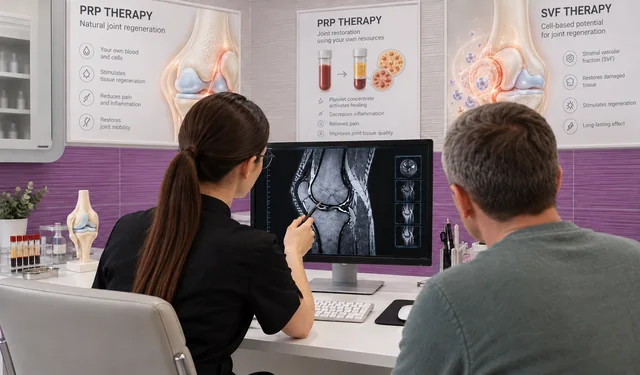
Your joint is examined and your X-rays, MRI or ultrasound are reviewed; then the doctor decides if the procedure suits you. You may send any scans you have before you come.
PRP and SVF cell therapy for the knee, hip and other arthritic joints, plus a free X-ray or MRI review to see which stage you are at
Consultation and review of your scansFree
Message us on WhatsAppFree online consultation · Reply within 15 minutes
Message our coordinator
Free online consultation · Reply within 15 minutes
Message us on TelegramMessage us on WhatsAppBy messaging us, you agree to our Privacy Policy
What it is
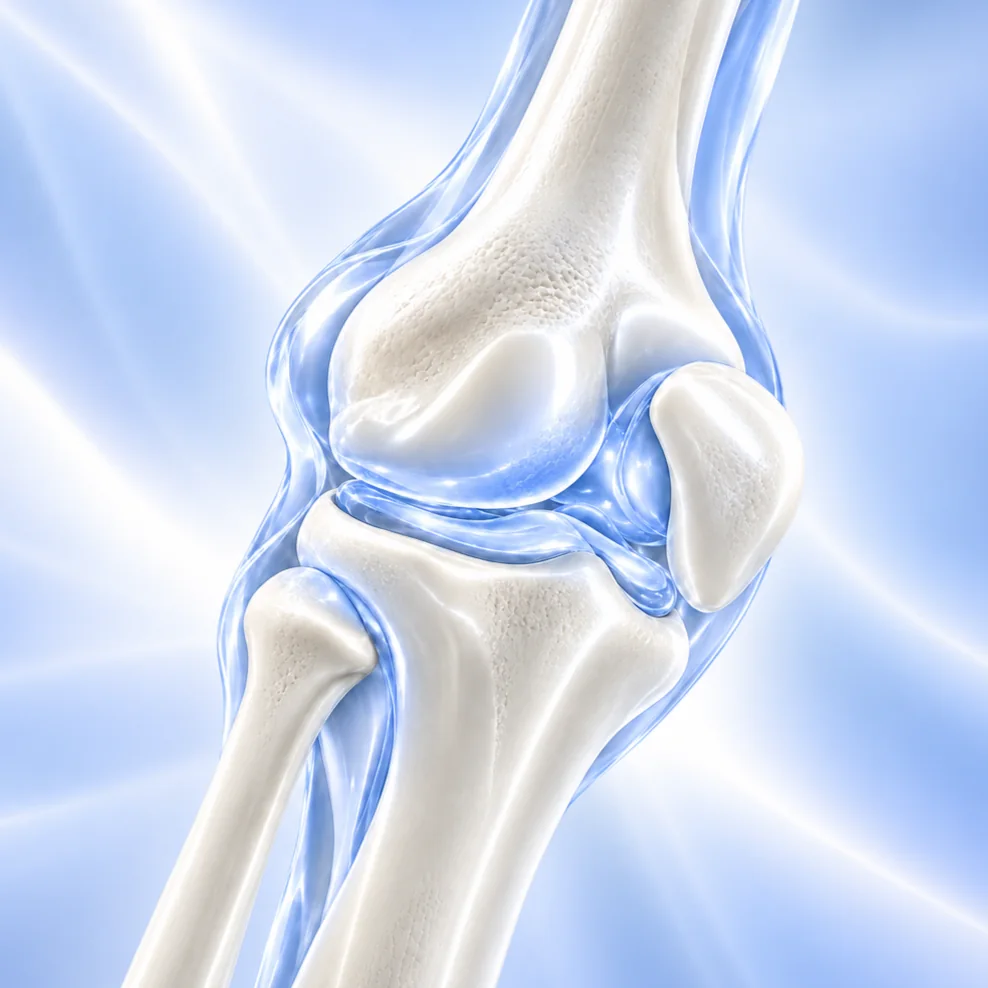
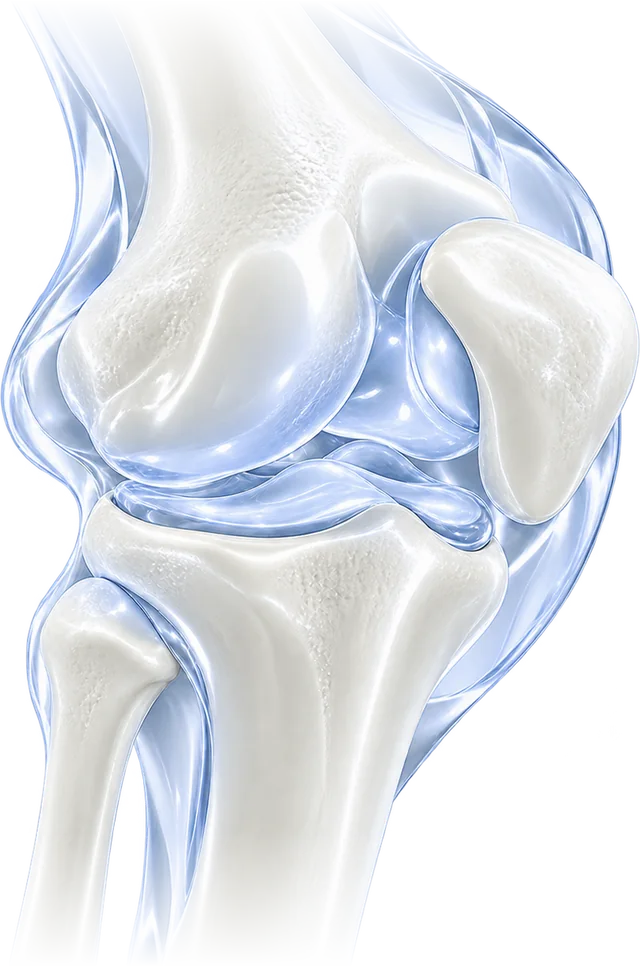
Osteoarthritis, which doctors also call arthrosis, is a chronic process of cartilage thinning and wearing away inside a joint. The cartilage is there to absorb shock, and as it deteriorates the bones rub together, producing pain, stiffness and reduced mobility. It is degenerative rather than inflammatory, although flares with swelling occur.
Most often it hits the most heavily loaded joints — knee (gonarthrosis) and hip (coxarthrosis) — along with the ankle and the small hand joints. Early and moderate stages respond best, before serious damage to the joint surfaces; at an advanced stage the doctor will be honest with you if replacing the joint is the more realistic path.
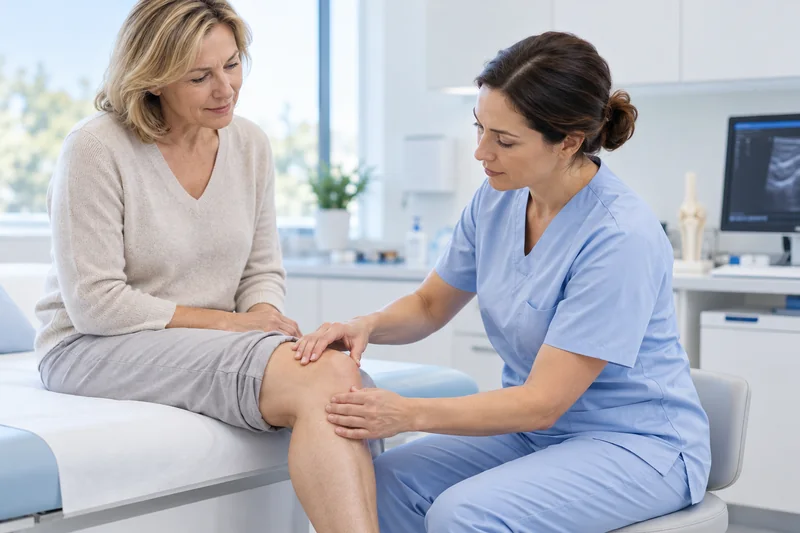
Whether this treatment is right for you is a doctor's decision, made after an examination and a scan review

Not sure the treatment is right for you?
Leave your number — the coordinator will ask for your scans (X-ray, MRI or ultrasound), and the doctor will tell you whether treatment without surgery suits you.
Find out if it suits meWhat we treat
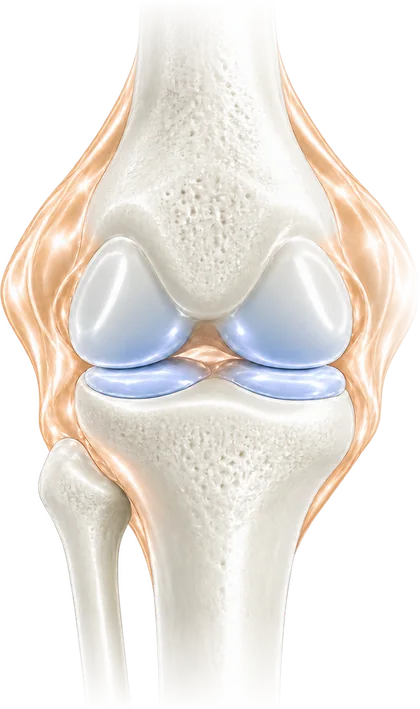 Arthritis
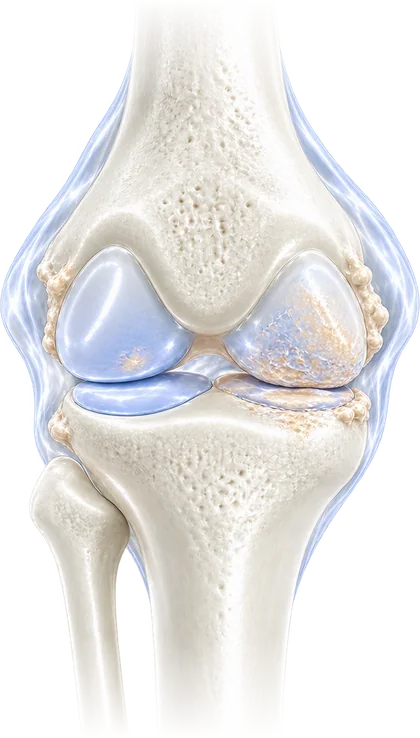 Arthrosis
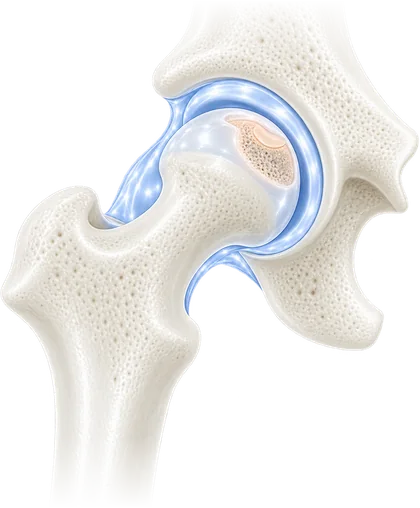 Avascular necrosis
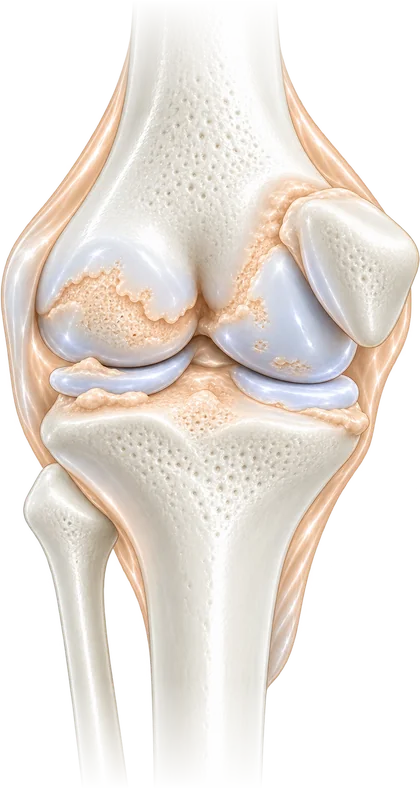 Osteoarthritis
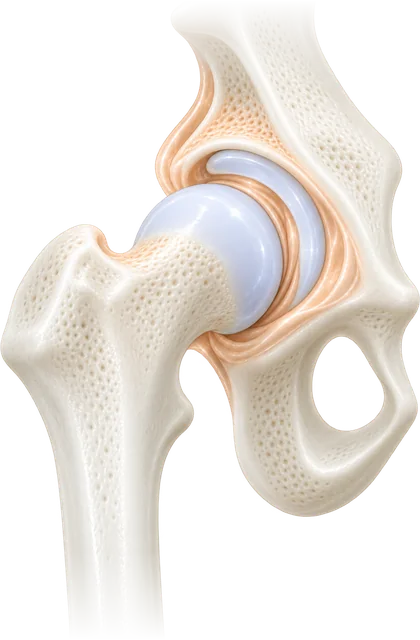 Coxarthrosis (hip osteoarthritis)
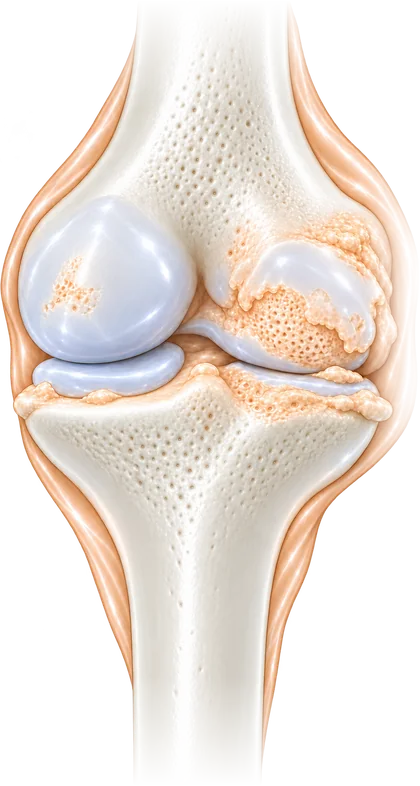 Gonarthrosis (knee osteoarthritis)
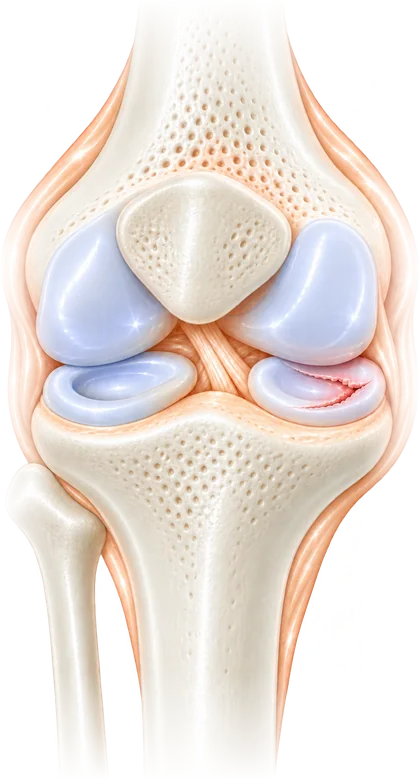 Meniscus pathology and injury
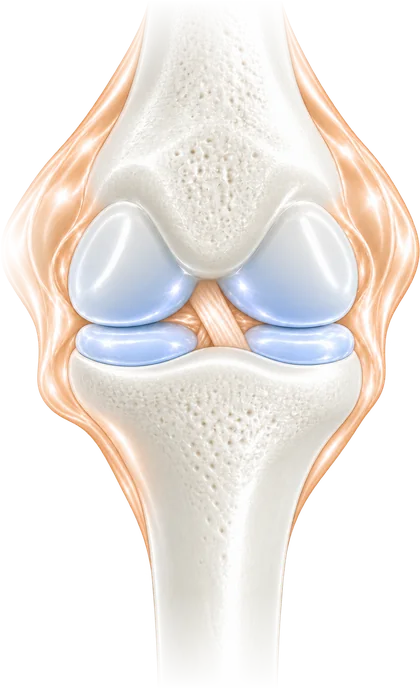 Rehabilitation after injuries and surgery
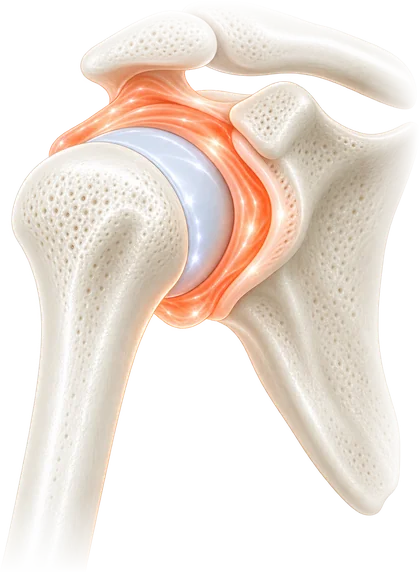 Inflammatory joint conditions
How it works
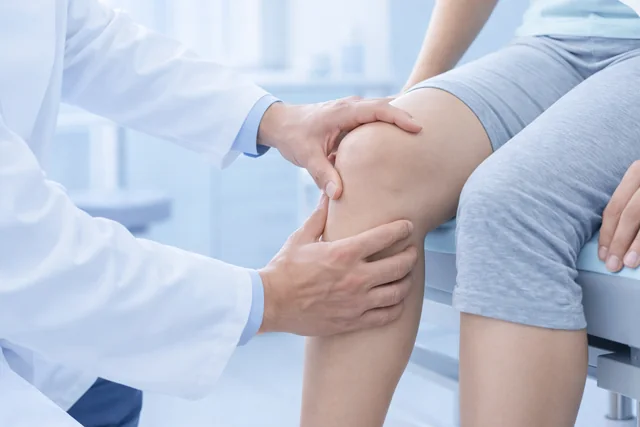
1Your joint is examined and your X-rays, MRI or ultrasound are reviewed; then the doctor decides if the procedure suits you. You may send any scans you have before you come.
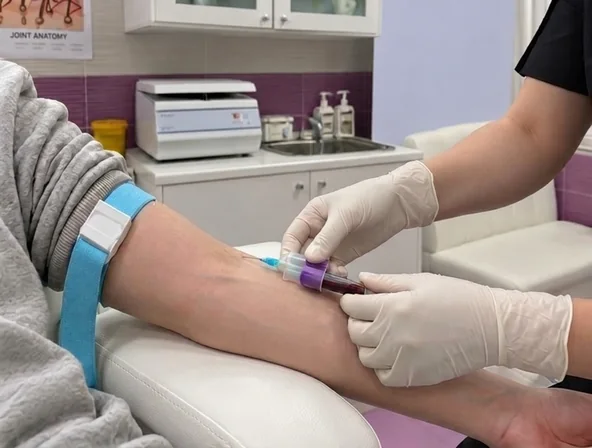 2
From a vein, a small amount of blood is taken — it will later be used to prepare platelet-rich plasma with growth factors.
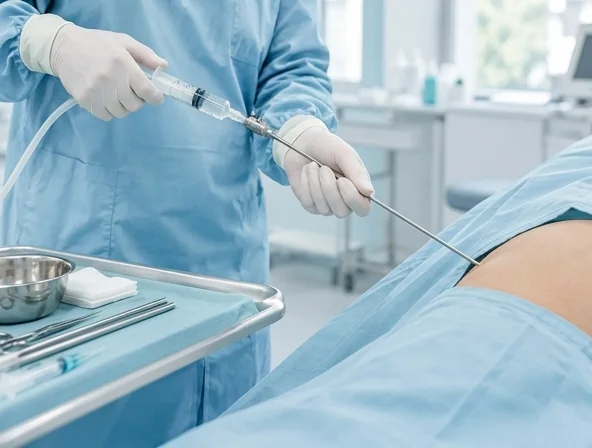 3
With local anaesthetic, a small amount of adipose tissue — around 30 ml — is obtained through a puncture on the abdomen or inner thigh, and no stitches are needed.
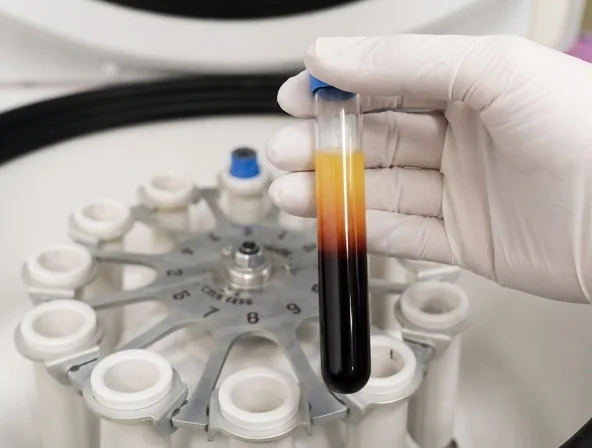 4
The sample is centrifuged so that it splits into layers. The stromal vascular fraction is then isolated and mixed with platelet-rich plasma.
 5
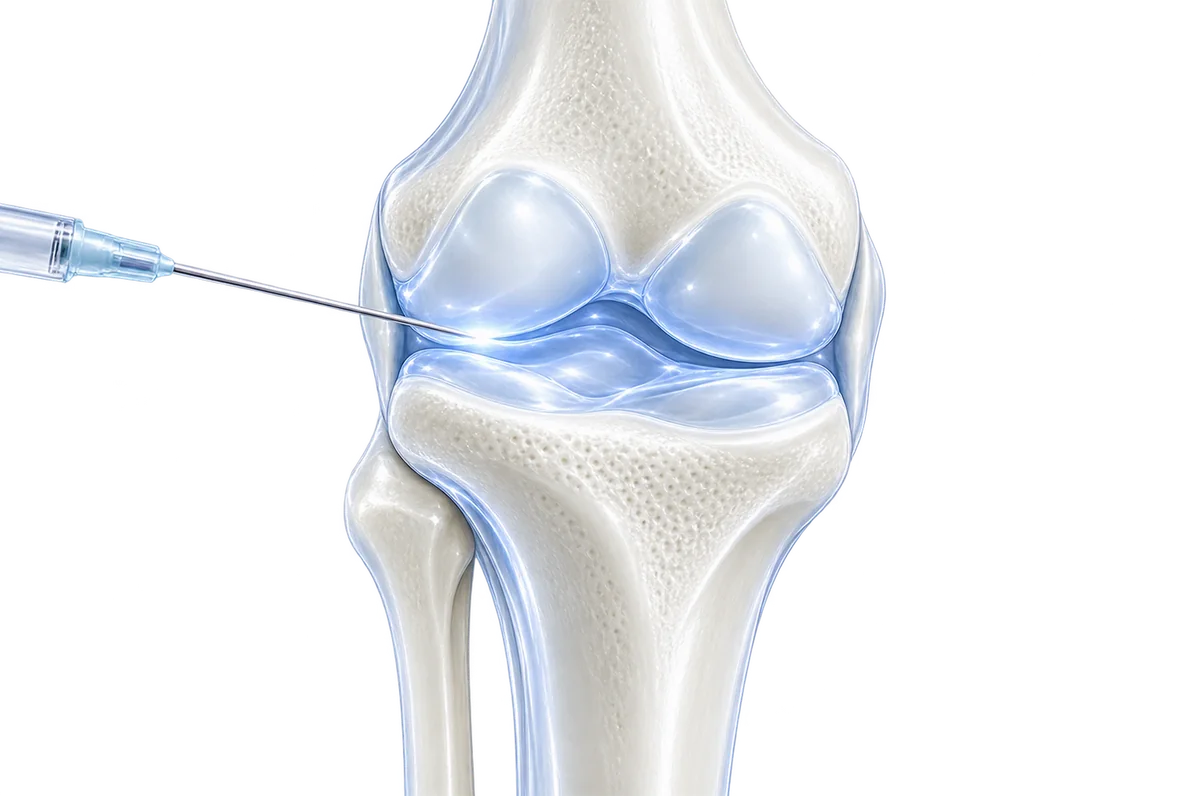
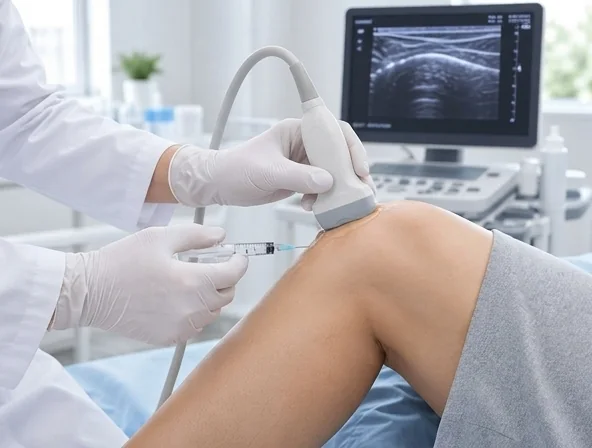
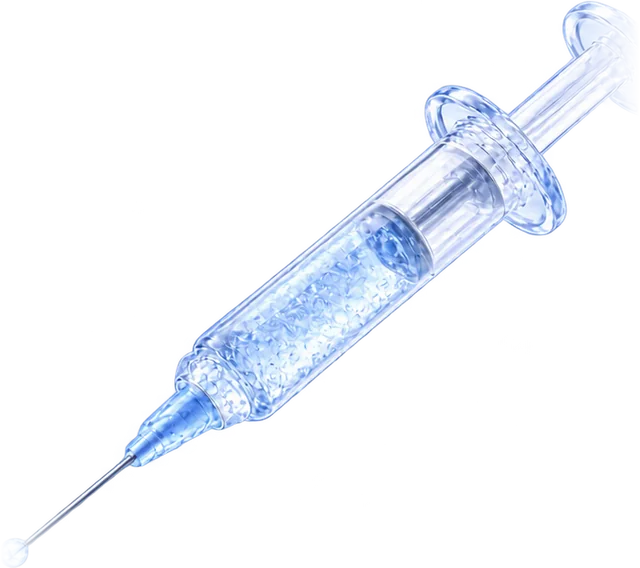
The prepared material goes straight into the affected joint; ultrasound guidance helps position it precisely.
 6
You need neither crutches nor a hospital stay. The doctor stays in contact afterwards and monitors the joint's response.
Call or message us — our coordinator will contact you shortly and book your consultation

Results

The joint may ache a little more — this is an expected reaction.

The pain usually eases.
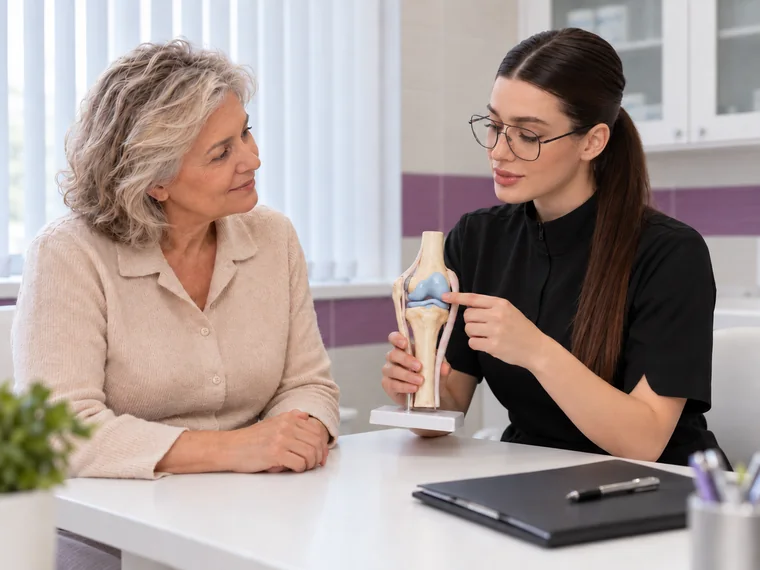
Mobility and activity improve.

The full effect develops.
How long it lasts differs from person to person and depends on the stage of the condition, body weight, activity and other factors — no one can promise a fixed result.
Comparison
We use your own adipose tissue and blood only, with no donor or synthetic material
First a small sample of adipose tissue is processed to isolate the stromal vascular fraction (SVF) — cells involved in tissue repair. This fraction, combined with your plasma, is then injected into the affected joint.
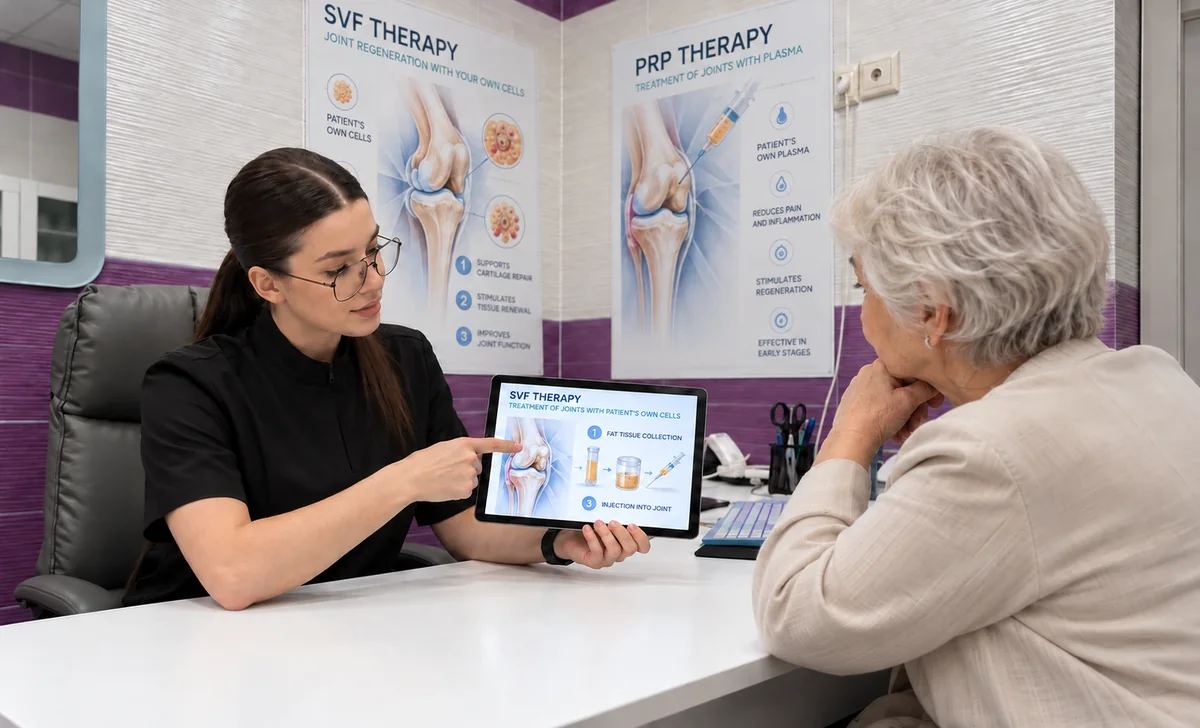
Doctors use it chiefly in early and moderate osteoarthritis, aiming to slow cartilage wear and cut friction between the joint surfaces.
Your own blood, in a small amount, is processed to separate plasma rich in platelets and growth factors, which goes into the joint to calm inflammation and improve conditions for tissue repair.
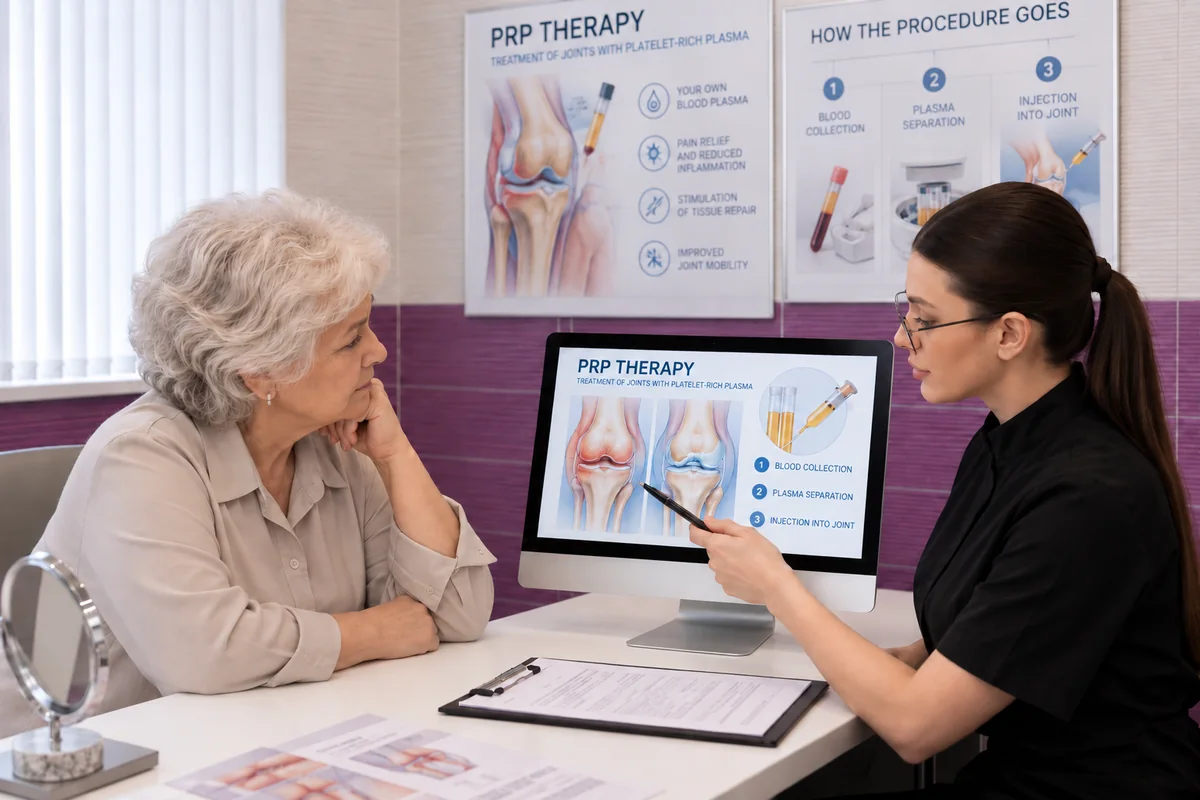
It is a common option in mild osteoarthritis and is combined with SVF where a stronger effect is needed.
The benefits and timings shown are averaged and given for guidance: the plan and recovery depend on your joint and individual features, and the doctor confirms them at the consultation.
At the consultation the doctor will review your scans and suggest a treatment plan
Free consultation
Joints
Small and large joints are treated; the doctor determines the joint, method and number of injections after looking at your scans
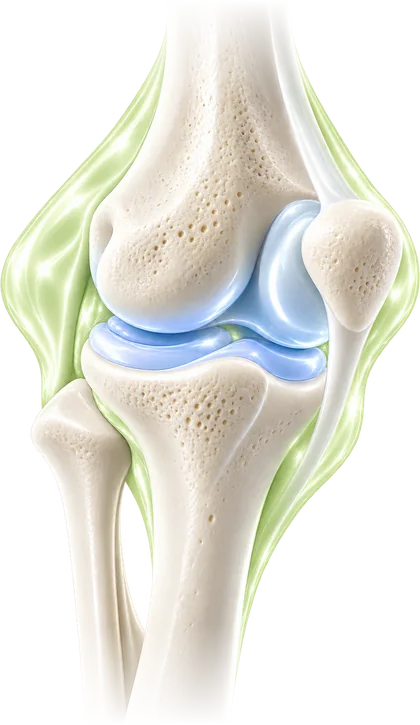 KneeCartilage wear with meniscus trouble and pain on stairs or after walking
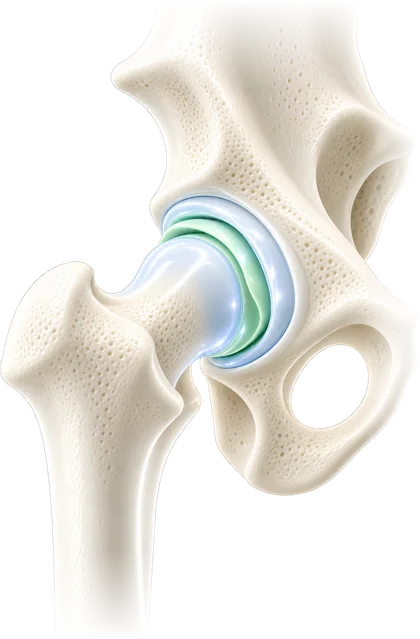 HipEarly hip osteoarthritis, groin pain, limited rotation
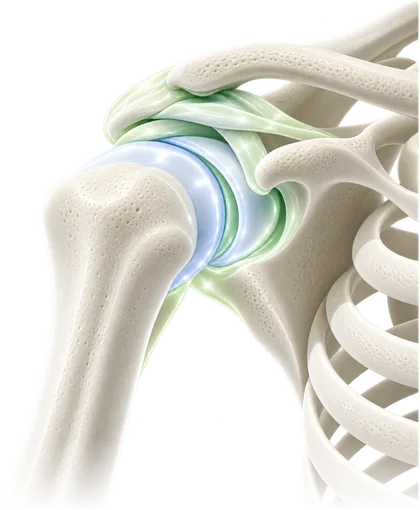 ShoulderPain on raising the arm; wear of the joint and the tendons around it
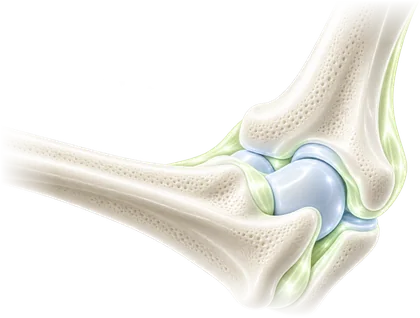 ElbowPain after sports strain or overuse, plus wear of the joint surfaces
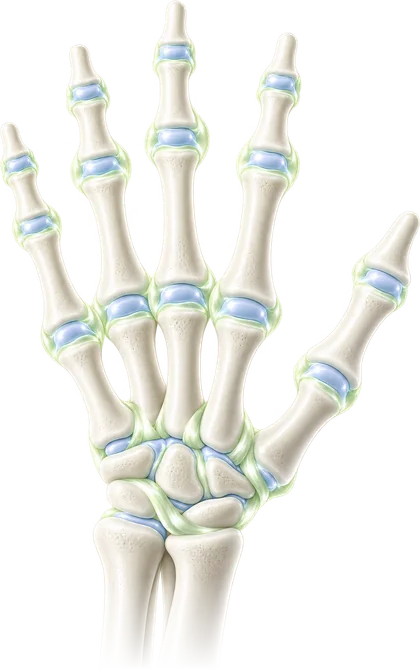 Hand and wrist jointsSmall joints of the fingers and wrist: pain and stiffness
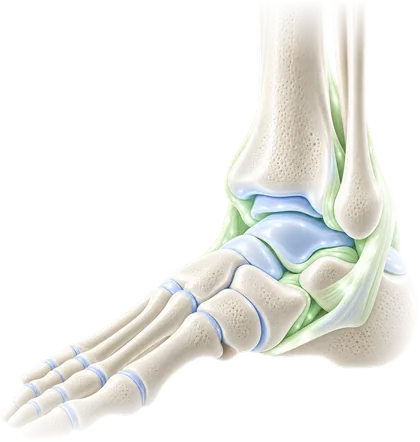 AnklePain and stiffness after sprains and old injuries
Advantages
We aim to preserve your own joint rather than replace it, with treatment that avoids surgery

We use your own adipose tissue and blood only, with no donor or synthetic material
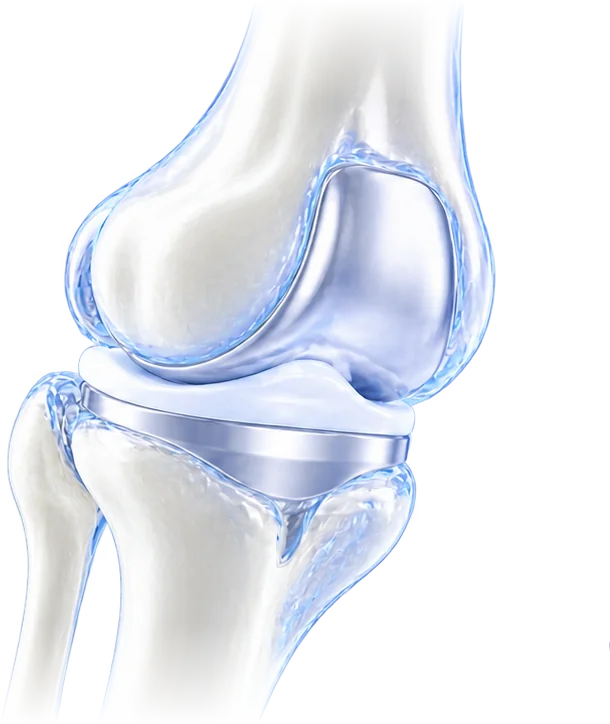
Only punctures, no incisions — under local anaesthetic and without a long rehabilitation
Your X-rays, MRI or reports are assessed independently by a doctor at no charge once you send them
We keep in contact after the procedure and monitor the result, rather than stopping on the day of the injection
About the clinic
Modern equipment, comfortable rooms and care for every patient
We will answer your questions and find a convenient time for a consultation
By messaging us, you agree to our Privacy Policy
Request a free callPrice
Because the cost varies with the joint, the osteoarthritis stage and the method, the doctor names it after the consultation
Free
Book — Consultation and review of your scansPrice at consultation
Book — PRP therapy (platelet-rich plasma)Price at consultation
Book — Cell therapy (SVF + PRP), one jointFAQ
Doctors usually describe four stages, from early thinning of the cartilage to severe wear. Injection treatment is most often considered in the early and middle stages; the doctor decides after reviewing your X-ray or MRI.
Gradual wear of the cartilage covering the ends of the bones is what happens in this condition. Thinning cartilage removes the joint's cushioning, the bones rub together, and pain, stiffness and crunching result. It is degenerative, not inflammatory.
In many cases it can be, provided treatment starts in time. The goal of SVF and PRP injections is to ease pain and support cartilage without an operation; replacing the joint is the last resort once it is destroyed.
Many patients report the first changes 2–3 weeks after the procedure. A stable result develops over about six months and lasts from several months to several years depending on the individual. Because osteoarthritis is chronic, the approach is an ongoing plan rather than a single injection.
At the early and moderate stages. Usually the effect comes faster and lasts longer the milder the stage is, and it may reduce the need for regular hyaluronic acid injections. A lasting effect cannot be expected at the most advanced stage, when the joint space has nearly disappeared.
Load-bearing joints are most at risk: knees, hips, ankles — and also the spine and small hand joints. Regenerative treatment is used across all of these joints.
As a rule it progresses, so pain becomes constant, movement more limited, the joint may deform and walking can be hard. Early diagnosis, weight control, exercise and working with your doctor make a real difference.
Diagnosis relies mainly on an X-ray, which shows the stage. MRI adds a detailed view of the cartilage and soft tissues, ultrasound picks up inflammation and fluid in the joint, and blood tests help exclude inflammatory conditions. Any results you have can be reviewed by the doctor free of charge.
Osteoarthritis is wear of the cartilage: aching pain on movement, crunching, stiffness after rest. Arthritis is inflammation: pain at rest and at night, swelling, redness and warmth over the joint. The approach to treatment differs, so the diagnosis comes first.
Certainly. Send your MRI, X-rays or test results for a free review: a doctor will assess the stage of osteoarthritis and suggest a non-surgical plan if it is appropriate.
Yes, and it helps. Well-chosen activity strengthens the muscles that unload the joint, improves the cartilage's nutrition and keeps you mobile. Swimming, water aerobics, cycling, Nordic walking and yoga work well, while running on hard surfaces, jumping, heavy lifting and sudden movements are best avoided.
About the conditions
Arthritis is an inflammatory disease of the joints. Typical signs are pain at rest and at night, morning stiffness lasting more than 30 minutes, swelling, redness and warmth over the joint. Causes include autoimmune conditions such as rheumatoid arthritis, infections, gout and psoriasis.
At early stages, PRP or SVF injections combined with exercise therapy and physiotherapy can reduce pain and improve movement. If the joint is already badly damaged, replacement may be the more realistic option — the doctor will tell you honestly after seeing your scans.
At early stages (1–2), SVF therapy may be considered to support blood supply to the femoral head and delay the need for joint replacement. At later stages surgery is usually required.
Without treatment, osteoarthritis usually progresses: pain becomes constant, movement becomes limited and the joint may deform. Early diagnosis, weight control, exercise and working with a doctor make a real difference for every patient in Bristol.
The right activity strengthens the muscles that unload the joint and helps cartilage nutrition. Patients from Bristol are advised swimming, cycling, Nordic walking or yoga, and to avoid running on hard surfaces, jumping and heavy lifting.
Patients from Bristol can start with a free review of their scans: the doctor assesses the stage of osteoarthritis and tells you whether non-surgical treatment makes sense. The price is named at the consultation.
Osteoarthritis is the gradual wear of the cartilage that lines the ends of the bones in a joint. When the cartilage thins, the joint is no longer cushioned, the bones rub, and pain, stiffness and crunching appear. It is a degenerative condition, not an inflammatory one, which is the key difference from other forms of arthritis. The NHS describes it as the most common type of arthritis, usually starting in the late 40s and often affecting weight-bearing joints such as the knees and feet. The typical picture is aching pain on movement and stiffness after rest.
The NHS is clear that there is no cure for osteoarthritis, but treatments can relieve symptoms, and it adds that the condition does not necessarily get worse over time. Exercise comes first in its advice: it calls exercise one of the most important treatments for people with osteoarthritis, whatever your age or level of fitness, and recommends a plan that combines muscle strengthening with general fitness, which your GP or a physiotherapist can help you set up. Doing too much, too fast, or the wrong type of exercise can damage joints, so it is worth following a plan rather than improvising.
Weight matters as well. The NHS notes that being overweight often makes osteoarthritis worse, because it places extra strain on joints that bear your weight, and that losing weight through a more active routine and a healthier diet can help. These are not our treatment but the foundation on which any treatment sits, and we say so openly in the first conversation. If your GP or physiotherapist has already given you a plan, bring it to the consultation.
Suitable activity builds the muscles that unload the joint, feeds the cartilage better and keeps you moving. Swimming, water aerobics, cycling, Nordic walking and yoga are the choices we usually suggest. Running on hard surfaces, jumping, heavy lifting and sudden movements are the activities to avoid. That advice matches the NHS view that exercise should be regular but sensible. If you do not exercise at present, begin with ten minutes a day and build up by small steps, listening to the joint.
In a city built on seven hills, with a short coastline on the Bristol Channel, the Avon running through it and wooded slopes along the gorge, there are many places to walk, but the surfaces and gradients are not all equal for a painful knee or hip. Choose flat, even paths at first and leave the steep descents until your thighs are stronger. A walking stick, a firm trainer and a day's rest after a longer outing are not signs of weakness; they are tools that let you keep going.
Strength work deserves a plan of its own. The muscles at the front and back of the thigh protect the knee, and the muscles of the buttocks protect the hip. A physiotherapist can show you exercises that are safe for your joint, and in many areas you can refer yourself to NHS community musculoskeletal services for physiotherapy without a GP referral. Our doctors will happily adjust the timing of an injection to your exercise plan, and the plan to the injection.
The NHS lists a ladder of medicines for osteoarthritis. Paracetamol is suggested for short-term relief, though often not very effective, and creams with anti-inflammatory medicine are often useful for knees and hands. Tablets of the same type are used if creams do not help, usually with a stomach protector and not for everyone. Stronger painkillers are considered for severe pain, usually short-term, and steroid injections can ease pain for weeks or months when other treatments fail. Ask your GP which suits you, since the answer depends on your other conditions and medicines.
The NHS says surgery for osteoarthritis is only needed in a small number of cases where other treatments have not been effective or where daily life is seriously affected. Joint replacement, most often of the hip or knee, is the most common operation, and it may greatly improve symptoms, though it cannot be promised to remove them altogether. Between painkillers and replacement lies a wide middle ground, and that is where regenerative treatment sits.
At City Medical Centre the aim is to keep your own joint. PRP, from your blood, and SVF, from a small sample of your own adipose tissue, are injected into the joint under ultrasound guidance in one day, with no hospital stay and no crutches. Doctors use them chiefly in early and moderate osteoarthritis, aiming to slow cartilage wear and cut friction between the joint surfaces. Where the joint space has almost disappeared at the most advanced stage, a lasting effect cannot be expected, and the doctor will say so honestly. Joint replacement is the last option, for when the joint is already destroyed.
Early changes are noticed by many patients 2 to 3 weeks after the procedure. The result stabilises over about six months and can last several months to several years, depending on the individual. Osteoarthritis is chronic, so it requires an ongoing plan rather than a one-off injection. The milder the stage, the faster and longer-lasting the effect tends to be, which may cut the need for regular hyaluronic acid injections. Early and moderate stages respond best.
On the day itself, the joint may ache a little more, which is an expected reaction. The doctor keeps in touch and follows your result, not just on the day of the injection. Most people return to normal life within a day or two, and the doctor gives you load and exercise recommendations for the first weeks. Do not plan a long hike, a marathon or heavy lifting for that week, and ask when you may return to swimming or cycling.
Keep a simple diary. Write down your pain on a scale of 0 to 10 in the morning and evening, the distance you can walk before it hurts, the stairs you manage and how many painkillers you take. Share it at each follow-up, because trends over weeks are more informative than a single good or bad day. If, after all this, the joint still limits your life, the doctor will tell you when it makes sense to talk to an orthopaedic team about replacement.
According to the Office for National Statistics, Bristol had about 472,400 residents at the 2021 Census, up from about 428,200 in 2011, and the number of people aged 65 and over rose by 8.8 percent over the decade. It is a reminder that joint wear is a common concern, and that adapting your day to a sore knee or hip is an ordinary problem with ordinary solutions. Start with the places where pain strikes: the stairs, the bus step, the supermarket aisle, the kitchen floor.
Small changes help. A raised seat in the bathroom, a second stair rail, shoes with a firm sole and a trolley instead of a heavy bag all reduce load on the joint. Take frequent short rests rather than one long sit. If you work on your feet, ask your employer about a chair, an anti-fatigue mat or shorter shifts for a few days after treatment. Describe your working week to the coordinator, and the doctor can plan around it.
Climate has a place here too, though a small one. Met Office averages for 1991 to 2020 from the Filton station give a mean daily maximum of 8.1 °C in January and 21.7 °C in July, and rain on 135.8 days a year. We do not claim that weather causes osteoarthritis to hurt. We only note that damp pavements and dark evenings are a real reason to take care on steps, and that keeping warm and keeping moving, in sensible amounts, is easier with a plan.
The consultation is online, and the coordinator is available 24/7 on WhatsApp and Telegram. Send your scans, an X-ray, an MRI or an ultrasound, or the written reports, and a doctor will independently assess them free of charge. Describe the stage as you understand it, which joint is affected, which medicines you take and what you have tried so far, including physiotherapy and injections. If you have been told that you need a replacement, say so, and ask for a second opinion on whether that is the only choice.
Ask what stage of osteoarthritis you are at, whether the treatment is likely to help at that stage, how many injections are usually planned, whether PRP alone or combined with SVF is suggested, and what you can do at home to support the result. Ask also about your weight, since it affects both the pain and the outcome, and about exercise, which the NHS places first on its list. The doctor will answer in plain terms and will not promise a result that cannot be promised.
If you have cancer, an acute infection, a blood clotting disorder, a flare-up of a serious chronic illness or are pregnant, the procedure is not done, and the doctor postpones it or offers another option. The 2027 bank holidays in England and Wales fall on 26 March, 29 March, 3 May, 31 May and 30 August; if one of those long weekends suits you for a quiet few days, say so when you propose dates. The clinic confirms which dates are open, and nothing is booked until you agree the plan.
Yes, the NHS offers exercise advice, weight management, medicines, steroid injections and, in a small number of cases, joint replacement. Regenerative PRP and SVF treatment at City Medical Centre is arranged privately, and we make no promises about what a health service might fund.
In osteoarthritis the cartilage wears, causing aching pain on movement, crunching and stiffness after rest. In arthritis the joint is inflamed, with pain at rest and at night, swelling, redness and warmth. The treatment approach differs, so diagnosis comes first.
The knees, hips and ankles, which bear the most load, as well as the spine and the small joints of the hand.
Swimming, water aerobics, cycling, Nordic walking and yoga. Avoid running on hard surfaces, jumping, heavy lifting and sudden movements.
Early changes are noticed by many patients 2 to 3 weeks after the procedure, and the result stabilises over about six months.
Early and moderate stages respond best. At the most advanced stage, when the joint space has almost disappeared, a lasting effect cannot be expected.
Usually it gets worse: pain turns constant, movement is increasingly limited, the joint can deform and walking may become difficult. Early diagnosis, weight control and exercise make a real difference.
In many cases, yes, if treatment is not delayed. SVF and PRP injections aim to ease pain and support the cartilage without an operation. Replacement is the last option.
Not usually. Tell the coordinator about your routine, and the doctor will advise what to do on the day and in the first weeks.