


























Joint treatment6 min read
PRP vs hyaluronic acid for knee osteoarthritis: how the two injections compare
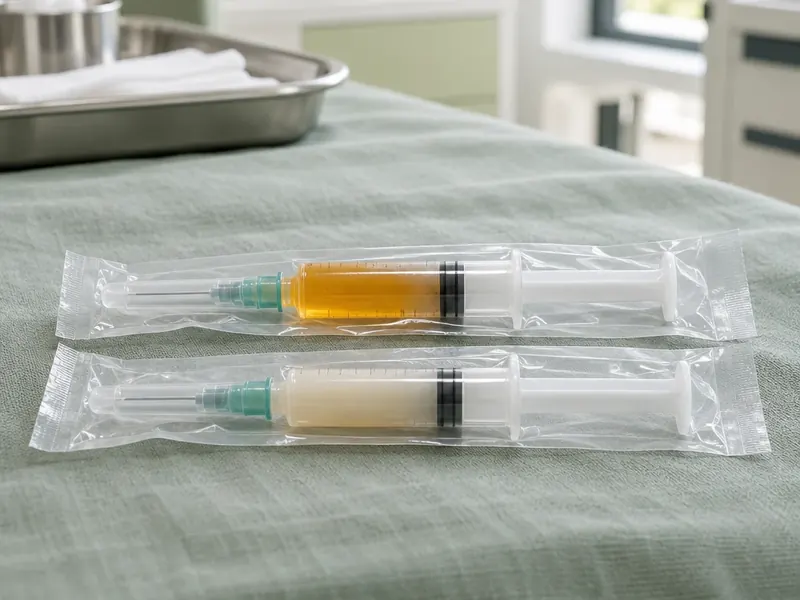
PRP and hyaluronic acid are two of the most discussed injections for knee osteoarthritis, and patients often ask which is better. They work differently, they have different evidence behind them and neither replaces exercise or weight management. This article compares them using published medical sources, so you can ask better questions at a consultation.
By messaging us, you agree to our Privacy Policy
The main points in 30 seconds
- Hyaluronic acid is a lubricant-like gel; PRP is concentrated platelets from your own blood.
- The AAOS reports that recent research has not found hyaluronic acid injections significantly reduce pain.
- A review calls PRP promising, but notes variable preparation and limited long-term data.
- PRP relief generally lasts at least a year; hyaluronic acid relief varies from months.
- Neither replaces exercise and weight management.
Two injections, two different ideas
Hyaluronic acid is a gel-like substance, and the American Academy of Orthopaedic Surgeons (AAOS) explains the idea behind the injection: hyaluronic acid acts as a lubricant and shock absorber in the knee, people with osteoarthritis have lower-than-normal amounts of it, and adding it is thought to improve movement and reduce pain. The treatment is also called viscosupplementation, and the AAOS says the FDA approved it in 1997.
Platelet-rich plasma (PRP) is different. Harvard Health describes it as a concentrate of platelets from your own blood, which are believed to reduce inflammatory cytokines. How it relieves pain is not fully understood, and whether it preserves or regenerates cartilage is still being studied.
Cleveland Clinic lists both among the nonsurgical options, together with pain medication, physical therapy, weight loss, a knee brace, cortisone injections and others. Providers typically try nonsurgical treatments before recommending surgery.
How each procedure is done
For hyaluronic acid, the AAOS says the number of injections is 1 to 5 over several weeks, depending on the product used. If the treatment works, it may be repeated, usually after six months.
For PRP, Harvard Health says blood is drawn, spun in a centrifuge and the platelets are injected, usually with ultrasound guidance. Excess joint fluid is often removed first. It does not state how many injections are needed. Physical therapy before the injection and about two weeks after is part of the protocol it describes.
Source
- Hyaluronic acid
- Gel-like fluid
- PRP
- Your own blood platelets
Idea
- Hyaluronic acid
- Lubricant and shock absorber
- PRP
- Anti-inflammatory effect
Injections
- Hyaluronic acid
- 1 to 5 over several weeks
- PRP
- Set by the doctor
Preparation
- Hyaluronic acid
- Ready-made product
- PRP
- Blood draw and centrifuge
What the evidence says
The picture is not the same for the two. The AAOS says that the most recent research has not found hyaluronic acid injections to significantly reduce pain or improve function, that some patients report relief while others see no improvement, and that the treatment has never been shown to reverse arthritis or regrow cartilage.
For PRP, a comprehensive review in PubMed Central describes it as a promising alternative that reduces pain and improves joint function. It cites a study of 150 patients, 75 on PRP and 75 on hyaluronic acid, in which both groups improved at one month, PRP benefits lasted up to one year and the effect of hyaluronic acid declined over 3, 6, 9 and 12 months. The review states that PRP generally outperformed hyaluronic acid or placebo at all stages of knee osteoarthritis, but it also calls some results inconclusive.
The review is narrative rather than systematic, and the authors urge caution because of variable preparation methods and limited long-term data. Treat the comparison as encouraging but not final.
How long relief lasts
The AAOS says improvement from hyaluronic acid may take several weeks to appear and its duration varies, with some patients reporting relief for several months. Harvard Health says PRP improvement may take six weeks to three months, and that relief generally lasts at least a year, sometimes longer and usually not less than six months.
The PubMed Central review reports mixed durations among individual studies: in one, most patients improved at six months but the benefit diminished by one year, and in another, a single injection gave positive outcomes at six months. Your own response depends on how advanced the arthritis is, your activity level and your general health.
Side effects and safety
After a hyaluronic acid injection, the AAOS lists pain, warmth and slight swelling that usually resolve quickly and can be eased with ice, and advises avoiding jogging or heavy lifting for 48 hours. A local allergy-like reaction is rare, and infection and bleeding are very rare.
For PRP, the PubMed Central review lists injection-site discomfort, swelling and pain, a potential risk of scar tissue or calcification, and rare infection or allergic reactions mainly when aseptic technique is poor. Harvard Health mentions a small risk of infection and bleeding. The review gives no quantified rates and says most studies suggest PRP is relatively safe. Certain autoimmune diseases and cancers are contraindications.
Who each option may suit
The AAOS says hyaluronic acid is for patients who have tried all other nonsurgical treatments and still have pain that limits their activities, and that it may work best in mild to moderate arthritis, though more research is needed. Harvard Health says PRP is recommended for mild-to-moderate knee osteoarthritis that persists despite standard care, and that people with severe arthritis or a misaligned joint should consider knee replacement.
Neither replaces exercise. The NHS calls exercise one of the most important treatments for osteoarthritis, and notes that being overweight often makes it worse. Cleveland Clinic adds that losing 10% of body weight can significantly reduce the risk of knee osteoarthritis. The decision between the two is made by a doctor after examining the knee, looking at imaging and discussing your goals. See our joint treatment page for the approaches used.
Choosing with a doctor at City Medical Centre
City Medical Centre works with international patients. The first consultation is free and can be held online, where the doctor reviews your history and imaging and explains which options may suit your knee, and which do not. The price is given after the free consultation and fixed in the contract.
A personal coordinator stays with you from your first message to the end of recovery, and photos and questions can be sent by Telegram. To start, open the joint treatment page and request your consultation.
Sources
- Harvard Health - PRP injection for knee osteoarthritis: does it work?
- PubMed Central - Addressing knee osteoarthritis pathology through platelet-rich plasma treatment: a comprehensive review
- AAOS OrthoInfo - Viscosupplementation treatment for knee arthritis
- Cleveland Clinic - Knee osteoarthritis
- PubMed / NCBI — Core Recommendations for Osteoarthritis Care: Systematic Review of Clinical Practice Guidelines (2023)
Medical disclaimer. This article is for general information only and is not medical advice. It does not replace a consultation with a doctor. Every procedure has contraindications and risks. Read more · How we prepare and review medical content
Frequently asked questions
Is PRP better than hyaluronic acid?
A review describes PRP as generally outperforming hyaluronic acid in several studies, but it also calls some results inconclusive and notes limited long-term data. The AAOS says research has not found hyaluronic acid to significantly reduce pain. Your doctor should advise based on your knee.
How many injections does each treatment need?
The AAOS says hyaluronic acid involves 1 to 5 injections over several weeks, depending on the product. Harvard Health does not state a number for PRP, and a review lists the best frequency as unknown. The doctor will set the plan after examining you.
Which lasts longer?
Harvard Health says PRP relief generally lasts at least a year, sometimes longer. The AAOS says relief from hyaluronic acid varies, with some patients reporting several months. Individual responses differ, and the effect depends on the stage of arthritis.
Can either injection regrow cartilage?
No such claim is supported. The AAOS says hyaluronic acid has never been shown to reverse arthritis or regrow cartilage, and Harvard Health says whether PRP preserves or regenerates cartilage is still being studied. Treat both as ways to manage symptoms.
Who should avoid these injections?
Severe arthritis or a misaligned joint may call for other treatment, such as knee replacement, according to Harvard Health. A review lists certain autoimmune diseases and cancers as contraindications for PRP. Tell the doctor about your full medical history before any injection.
Have a question about your case? Get a free consultation
Message a coordinator on Telegram: we reply right in the chat, and you can send photos and questions there too.
- The first consultation is free, online consultations are available
- The doctor names the cost after the assessment, and it is fixed in the contract
- A personal coordinator guides you from the first message to recovery
Message our coordinator
We reply right in the chat — you can send photos
Message us on TelegramMessage us on WhatsAppBy messaging us, you agree to our Privacy Policy
Read also
 Joint treatment
Rehabilitation after joint injury or surgery: how regenerative therapy fits in
How joints recover after injury or surgery, the stages of rehabilitation, and where PRP and SVF injections may fit in alongside exercise and physiotherapy.
 Joint treatment
X-ray, MRI or ultrasound: which joint scans a doctor needs before treatment
Which joint scans a doctor needs before PRP or SVF: what X-ray, MRI and ultrasound each show, which suits your joint, and how to send your scans from abroad.
 Osteoarthritis treatment
PRP or SVF therapy for knee osteoarthritis: how the two methods compare
PRP or SVF cell therapy for knee osteoarthritis: how each is prepared, which stage it suits, what to expect and when, contraindications and recovery.