Crown hair transplant: how thinning at the top of the head is treated
A thinning crown is often the first sign of pattern hair loss that men notice, usually in a photo taken from above. A transplant can restore coverage there, but the crown behaves differently from the hairline. This article explains why the crown thins, how the stages progress, when surgery is worth considering, how grafts are planned and how long it takes to see new growth.
Can a transplant restore hair on the crown?
In most men with pattern hair loss, yes. The follicles on the back and sides of the head are usually resistant to the hormone that miniaturises hair on top. When they are moved to the crown, they tend to keep that resistance and continue to grow.
The honest limit is supply. Each person has a finite donor area, and the crown is a wide, round zone. A good plan aims for natural coverage that looks full from normal viewing angles, not for the density of a teenager. Whether a transplant suits you is decided by the doctor after looking at your scalp and donor area.
Why the crown thins: main causes
By far the most common reason is androgenetic alopecia, also called male pattern baldness. Hair follicles on the top of the head are sensitive to dihydrotestosterone (DHT), a hormone derived from testosterone. Under its influence they gradually shrink, the hairs become thinner and shorter, and eventually some follicles stop producing visible hair. Family history plays a large part.
Other factors can speed up shedding or make it look worse:
- long periods of stress, illness or high fever, which can trigger temporary diffuse shedding;
- low iron, thyroid problems and other medical conditions;
- very restrictive diets and sudden weight loss;
- smoking and poor sleep, which affect overall scalp health.
These conditions usually cause shedding all over the head rather than a clearly defined bald spot. That is why a check-up matters: if shedding has a treatable cause, surgery is not the first step.
Early signs and stages of crown baldness
Crown loss tends to start quietly. The first clues are often:
- the scalp showing through the swirl (whorl) at the top of the head under bright light;
- a widening parting of the hair around the whorl;
- finer, softer hairs in that area compared with the back of the head;
- more hair left on the pillow or in the shower over several months.
Doctors often describe progression with the Norwood scale. In the early stages there is only a thinning circle at the vertex. Later it becomes a clear bald spot, which can grow and eventually merge with a receding hairline, leaving a wide bald area across the top. The earlier the process is assessed, the more options there are.
When treatment is enough and when a transplant makes sense
In the early stage, when hairs are thinning but still present, a doctor may suggest non-surgical treatment to slow the process and check how your hair responds. Medical treatment is chosen individually after an examination, and you should not start any medicine on your own.
A transplant is usually considered when:
- there is a visible area where follicles no longer produce normal hair;
- hair loss has become relatively stable rather than rapid;
- the donor area at the back of the head is dense enough;
- the cause is androgenetic alopecia, not an illness, hormonal imbalance or patchy alopecia.
Surgery does not stop the underlying process. Native hair around the transplanted zone can continue to thin, so many doctors combine the operation with ongoing care. More about who is and is not a candidate is on our hair transplant page.
Why the crown needs careful graft planning
The crown is often called a graft-hungry area. Hair there grows out in a spiral from a central point, so light passes between hairs pointing in different directions. To look covered, the crown usually needs more grafts per square centimetre than you might expect.
Planning therefore follows a few principles:
- The front comes first. The hairline frames the face, so if donor supply is limited, doctors often prioritise the front and treat the crown in a later session.
- Future loss is taken into account. Placing grafts in a small circle that later becomes an island of hair is a classic mistake. The design should still look natural if the surrounding hair thins further.
- The whorl is recreated. Each graft is placed at the angle and direction of a natural swirl, so the result does not look combed in one direction.
FUE or DHI for the crown: what to expect on the day
With FUE, individual follicular units are removed from the donor area and placed into tiny channels made in the crown. It is used for androgenetic alopecia and suits larger bald areas well.
A combined approach uses FUE extraction and DHI implantation with a special pen, which places the graft without opening channels in advance. This is helpful for androgenetic alopecia and for thickening areas where native hair still grows, because the doctor can work between existing hairs.
| FUE | FUE extraction + DHI implantation | |
|---|---|---|
| Main use | Androgenetic alopecia, larger bald areas | Androgenetic alopecia and densification |
| Implantation | Into pre-made channels with forceps | With a DHI pen, no channels in advance |
| Working among existing hair | Possible | Especially convenient |
| Anaesthesia | Local | Local |
The procedure is done under local anaesthesia and usually takes most of a day. You can rest, watch something or talk during the operation, and most people go home or back to their hotel the same evening.
Recovery and when crown growth becomes visible
In the first days the doctor will usually ask you to avoid pressure on the recipient area. This matters more for the crown than for the hairline, because the back of the head touches the pillow, so a travel pillow or sleeping semi-upright is often advised. Small crusts usually fall off within about ten days.
A typical timeline looks like this:
- Weeks 2–6: most transplanted hairs shed. This is expected; the follicles stay in the skin.
- Months 3–4: new thin hairs start to appear.
- Months 6–8: the crown looks noticeably fuller.
- Months 12–18: the final result, since the crown often matures a little more slowly than the front.
Possible side effects include swelling, redness, itching, temporary numbness and, rarely, infection. Following the aftercare plan lowers these risks.
Getting a personal plan at City Medical Centre
City Medical Centre works with international patients. The first consultation is free and can be held online: send photos of the crown from above, the hairline and the back of the head, and tell us how long the thinning has been going on. The doctor assesses the area and your donor supply, estimates the number of grafts, suggests a method and names the cost, which is then fixed in the contract. A personal coordinator stays with you from your first message to the end of recovery, and photos and questions can be sent by WhatsApp. Find out more on the hair transplant page.
Sources
Results of our patients
Real before and after photos of City Medical Centre patients. Results are individual.
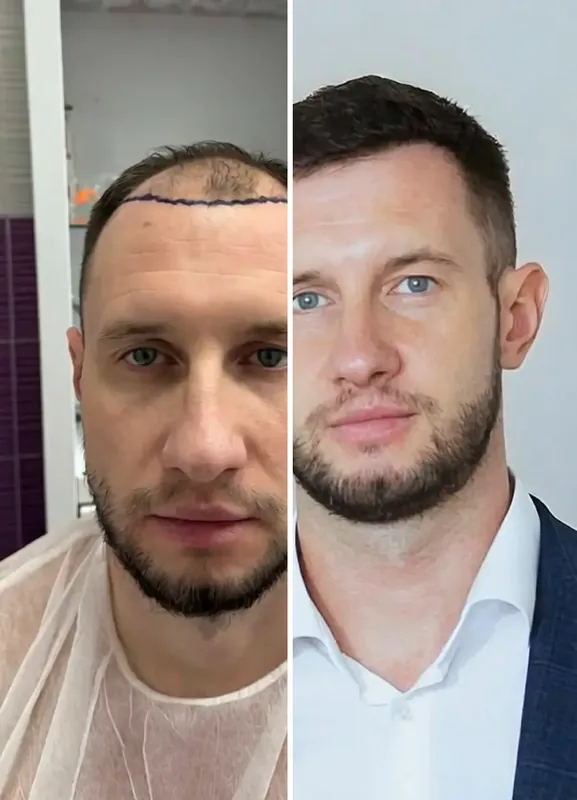 BeforeAfter
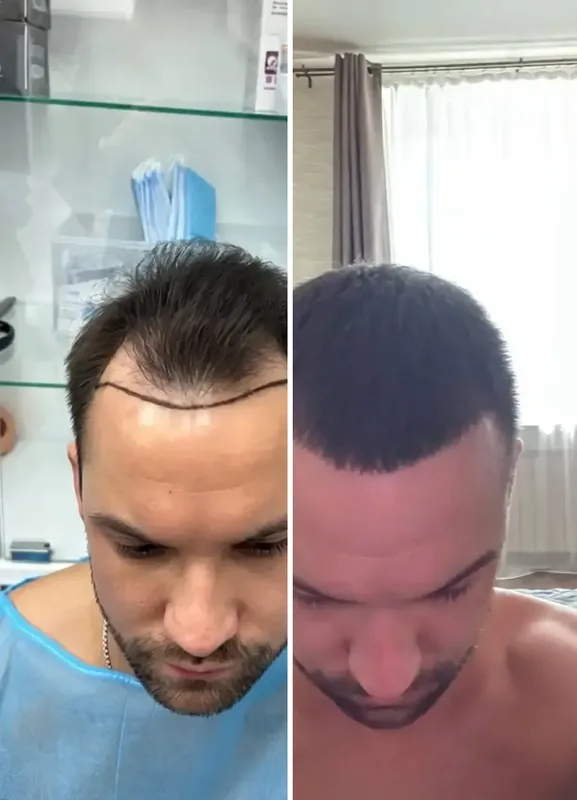 BeforeAfter
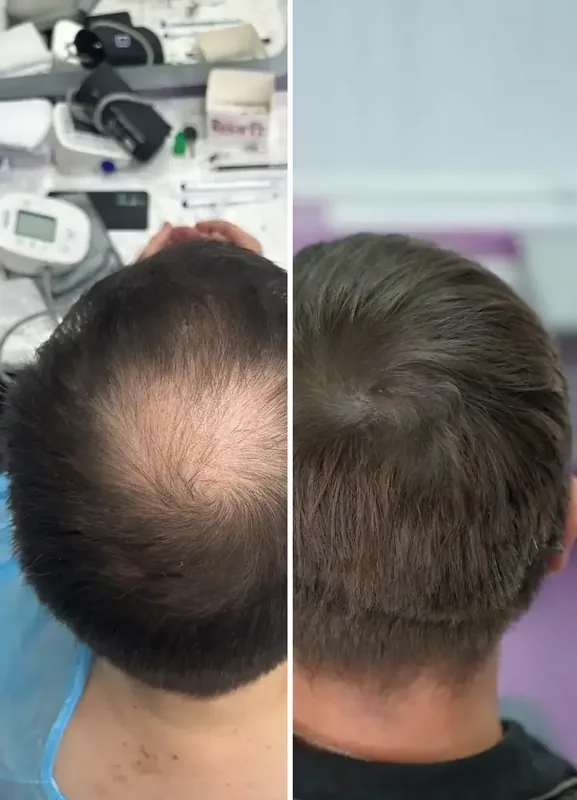 BeforeAfter
Frequently asked questions
How many grafts are needed for a crown hair transplant?
It depends on the size of the bald area, how much native hair remains, hair thickness and your donor supply. A small thinning spot needs far fewer grafts than a wide bald vertex. The doctor calculates the number from photos or at an examination and tells you before any decision is made.
Is a crown transplant harder than a hairline transplant?
It is different rather than harder. The crown is a large round area with a spiral growth pattern, so it needs careful angles and often more grafts to look covered. Planning must also leave room for future hair loss so the result stays natural over the years.
When will I see results after a crown transplant?
Transplanted hairs usually shed in the first weeks, new growth starts around months three to four, and the crown looks clearly fuller by months six to eight. The final result is usually judged at twelve to eighteen months, because the crown often matures more slowly than the hairline.
Can the crown keep thinning after a transplant?
Transplanted follicles from the donor area usually keep growing, but your own hair around them can continue to thin because the transplant does not cure androgenetic alopecia. That is why the doctor plans for future loss and may recommend ongoing care after the operation.
What affects the cost of a crown hair transplant?
The cost mainly depends on the number of grafts, the chosen method and the complexity of the case. At City Medical Centre the doctor names the price after assessing your photos or examining you, and it is fixed in the contract. The first consultation is free.
Have a question about your case? Get a free consultation
Send your name and phone number, and a coordinator will call you back. You can also send photos and questions on WhatsApp.
- The first consultation is free, online consultations are available
- The doctor names the cost after the assessment, and it is fixed in the contract
- A personal coordinator guides you from the first message to recovery
Read also
- Hair transplant
Does a hair transplant hurt? Sensations during and after the procedure
Does a hair transplant hurt? What you feel during local anaesthesia, the procedure and the first days after, and how discomfort is usually managed.
- Hair transplant
Donor area after a hair transplant: how to care for it and what to expect
How the donor area heals after a hair transplant: what is normal, how to wash and protect it, what scarring FUE and FUT leave and when to call your doctor.
- Hair transplant
Hair loss and health: which conditions can cause it and who can help
Pattern baldness, hormonal changes, scalp conditions, medicines and recent illness: an overview of what can cause hair loss and which doctors can help.