





















Hair transplant6 min read
DHI Hair Transplant Explained: the Choi Implanter Technique Step by Step
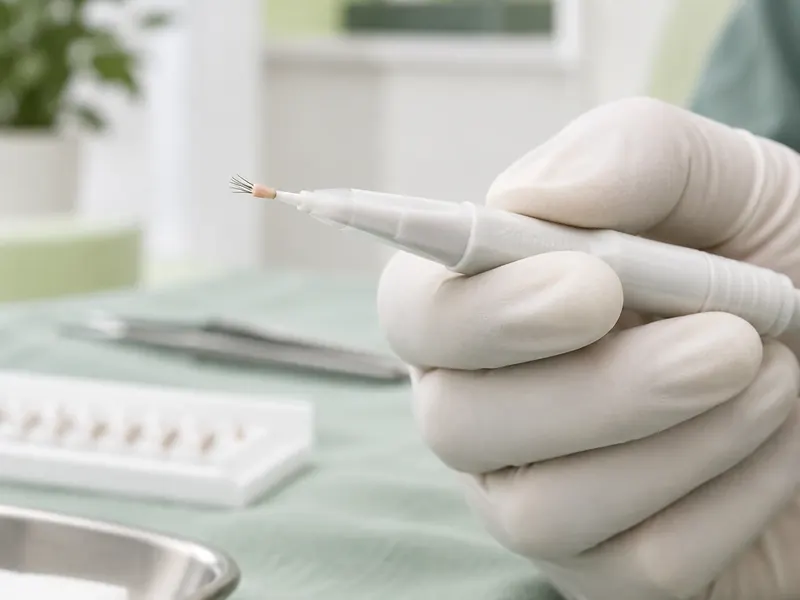
DHI, or direct hair implantation, is a follicular unit technique in which grafts are placed into the scalp with a pen-like tool called a Choi implanter, without first cutting recipient channels. It is often chosen to add density between existing hair and to shape a precise hairline. This article explains what DHI is, how the implanter works, what happens on the day, how DHI compares with FUE and FUT, its pros and cons, who it suits and what the recovery timeline looks like.
The main points in 30 seconds
- DHI places grafts with a Choi implanter pen without pre-made channels.
- Grafts are taken from the donor area the same way as in FUE, one by one.
- It helps add density between existing hair and control angle and direction precisely.
- A session is usually longer and covers fewer grafts per day than classic FUE.
- New hair starts to grow at about 3–4 months; the final result is judged at 12–18 months.
Key facts about the procedure
- Stay in clinicSame day
- Final result12–18 months
- AnaesthesiaLocal
- Price
$2,700from $2,200
What DHI hair transplant is
DHI stands for direct hair implantation. Like FUE, it moves individual follicular units, small groups of one to four hairs, from the donor area at the back and sides of the head to thinning areas. The difference lies in the implantation stage: instead of first making tiny incisions and then placing grafts into them with forceps, the surgeon loads each graft into a hollow needle of an implanter pen and inserts it directly into the scalp in one movement.
DHI is not a different type of hair or a different donor source. It is a way of placing grafts that gives the surgeon close control over the angle, direction and depth of each hair. More about the techniques available at our clinic is on our hair transplant page.
How the Choi implanter works
The Choi implanter is a thin pen with a hollow needle at the tip and a plunger inside. An assistant loads a single graft into the needle. The surgeon holds the pen at the chosen angle, inserts the needle into the skin to the right depth and presses the plunger, which pushes the graft into place as the needle is withdrawn.
Several implanters with different needle diameters are used during one procedure, matched to the size of the grafts. Because the channel is created and filled in the same moment, the graft spends less time handled outside the body, and the surgeon can place hairs very close together, including between existing hairs.

The procedure step by step: extraction to implantation
- Planning. The doctor assesses the type of hair loss and the donor reserve, counts the grafts needed and draws the future hairline.
- Preparation. The donor area is trimmed; the recipient area may be left longer, which is one reason DHI is chosen when shaving is undesirable.
- Local anaesthesia. The donor and recipient areas are numbed, so the procedure is performed with the patient awake and comfortable.
- Extraction. Grafts are removed one by one with a micro-punch about 1 mm wide, as in FUE, leaving tiny dot scars that heal without stitches.
- Loading and implantation. Grafts are sorted by size, loaded into implanters and placed directly into the thinning area.
- Aftercare instructions. The patient goes home the same day with instructions on washing, sleeping and protecting the grafts.
DHI vs FUE and FUT: key differences
DHI
- Harvesting
- Individual grafts with a micro-punch
- Implantation
- Implanter pen, no pre-made channels
- Donor scar
- Tiny dot scars
- Typical use
- Density, hairline detail, work between existing hair
Classic FUE
- Harvesting
- Individual grafts with a micro-punch
- Implantation
- Channels are made first, grafts placed with forceps
- Donor scar
- Tiny dot scars
- Typical use
- Larger areas of androgenetic hair loss
FUT (strip)
- Harvesting
- A strip of scalp is cut out and divided
- Implantation
- Channels are made first, grafts placed with forceps
- Donor scar
- A linear scar at the back of the head
- Typical use
- Large numbers of grafts in one session
In practice, the techniques are often combined: grafts are harvested by FUE and implanted with DHI pens, or FUE and DHI are used in different zones of the same scalp.
Pros and cons of DHI
- Pros: precise control of angle and direction; hair can be added between existing hair; the recipient area often does not need full shaving; less handling of grafts.
- Cons: the procedure is slower and demands an experienced team; fewer grafts are usually placed per day than with classic FUE; it may cost more because of the time and tools involved; it is less practical for very large bald areas.
DHI does not change the basic limits of any transplant: the number of grafts depends on the donor reserve, and transplanted hair does not stop further loss of the original hair.
Who DHI suits and contraindications
DHI is usually considered for people with a stable pattern of hair loss who want to restore a hairline, add density to thinning areas or correct small zones such as temples, eyebrows or scars. It is also used when the patient prefers not to shave the whole head.
A transplant is not recommended, or is postponed, in cases such as:
- hair loss caused by a hormonal imbalance or other condition that must be treated first;
- active inflammatory or autoimmune scalp conditions, or an active phase of patchy hair loss;
- an insufficient donor reserve;
- intolerance to local anaesthetics, uncontrolled diabetes, bleeding disorders or other serious illness.
Recovery and results timeline
- First 1–2 weeks
- Small crusts form and come off; swelling of the forehead settles
- 2–4 weeks
- Transplanted hairs shed; the follicles stay in place
- 3–4 months
- New hairs start to grow
- 6–9 months
- Visible density and contour
- 12–18 months
- Final density and a natural hairline
Most people return to office work within a few days. Heavy exercise, swimming, saunas and tight hats are avoided for the period the doctor advises. Follow-up visits help check healing and growth over the first year.

Getting a personal plan at City Medical Centre
City Medical Centre works with international patients. Our clinic performs three techniques: classic FUE, which is used for androgenetic alopecia; DHI with an implanter pen, used to add density; and a combined FUE extraction with DHI implantation, used for androgenetic alopecia and for density. The FUT strip method is described in this article as general information and is not offered at our clinic; the technique that suits you is chosen at the consultation.
The first consultation is free and can be held online. Send photos of your hairline, crown and donor area by Telegram, and the doctor will assess your type of hair loss and donor reserve and suggest a plan. The cost is named after the assessment and fixed in the contract. A personal coordinator stays with you from your first message to the end of recovery. More details are on our hair transplant page.
How recovery usually goes
- 0-10 daysHealing: the crusts come off, the swelling goes down, the area gradually recovers
- 2-4 weeksShedding of the transplanted hairs: a normal stage, only the hairs fall out, the follicles stay in place
- 3-4 monthsGrowth begins: new hairs gradually appear, the result starts to show
- 6-9 monthsVisible density: the hair becomes thicker, the main volume and contour are visible
- 12-18 monthsFinal result: the final density and a natural hairline take shape
Sources
Frequently asked questions
Is DHI better than FUE?
Not in every case. DHI gives precise control of angle and direction and suits density work and the hairline, while classic FUE is often more practical for larger areas. Both use the same donor grafts. Many plans combine them, and the doctor chooses the approach after assessing your hair loss and donor area.
Do I need to shave my head for DHI?
The donor area is usually trimmed so that grafts can be extracted. The recipient area often does not need full shaving, because the implanter can place grafts between existing hairs. How much shaving is needed depends on the number of grafts and the zones treated, and it is discussed at the consultation.
How many grafts can be implanted with DHI in one day?
It depends on the team, the donor reserve and the size of the grafts. Because each graft is loaded and placed individually, DHI usually covers fewer grafts per day than classic FUE. For larger areas, the procedure may be combined with FUE or planned over more than one session.
Is DHI more expensive than FUE?
DHI often costs more, because the procedure takes longer, requires several implanters and a larger trained team. The final cost depends mainly on the number of grafts and the chosen technique. At City Medical Centre the cost is named after the assessment and fixed in the contract.
When will I see results after DHI?
Transplanted hairs usually shed in the first weeks, which is normal. New hair starts to grow at about three to four months, noticeable density appears at six to nine months, and the final result is assessed at twelve to eighteen months after the procedure.
Have a question about your case? Get a free consultation
Message a coordinator on Telegram: we reply right in the chat, and you can send photos and questions there too.
- The first consultation is free, online consultations are available
- The doctor names the cost after the assessment, and it is fixed in the contract
- A personal coordinator guides you from the first message to recovery
Message our coordinator on Telegram
We reply right in the chat — you can send photos
Message us on TelegramBy sending a message, you agree to the privacy policy
Read also
 Hair transplant
Hair loss and health: which conditions can cause it and who can help
Pattern baldness, hormonal changes, scalp conditions, medicines and recent illness: an overview of what can cause hair loss and which doctors can help.
 Hair transplant
Does a hair transplant hurt? Sensations during and after the procedure
Does a hair transplant hurt? What you feel during local anaesthesia, the procedure and the first days after, and how discomfort is usually managed.
 Tummy tuck
Diastasis recti: how to check for it, what exercise can do and when surgery is the answer
Diastasis recti is a gap between the abdominal muscles. Learn how to check for it, what exercise can and cannot do, and when surgical repair is considered.