




pre-op
12 months later on
2,800 grafts
FUE method
City Medical Centre
Free quote
Free consultation and cost estimate.
Real person
pre-op
12 months later on
No scalpel, no sutures — the FUE method. Graft count and forecast counted up, you pay nothing — before you decide.
It costs nothing, no surgery booking required
Message our coordinator
Free online consultation · Reply within 15 minutes
Message us on TelegramMessage us on WhatsAppBy messaging us, you agree to our Privacy Policy
results
All cases here are real CMC patients.
pre-op
12 months later on
2,800 grafts
FUE method

pre-op
12 months later on
3,500 grafts
FUE method

pre-op
12 months later on
2,600 grafts
FUE method

pre-op
12 months later on
3,000 grafts
FUE method

pre-op
12 months later on
2,700 grafts
FUE method

pre-op
12 months later on
3,300 grafts
FUE method

pre-op
12 months later on
2,900 grafts
FUE method

pre-op
12 months later on
2,500 grafts
FUE method

pre-op
12 months later on
3,400 grafts
FUE method

pre-op
12 months later on
2,500 grafts
FUE method

pre-op
12 months later on
3,100 grafts
FUE method

pre-op
12 months later on
3,600 grafts
FUE method

pre-op
12 months later on
4,000 grafts
FUE method

pre-op
12 months later on
3,200 grafts
FUE method

pre-op
12 months later on
3,000 grafts
FUE method

pre-op
12 months later on
3,700 grafts
FUE method

pre-op
12 months later on
2,700 grafts
FUE method

pre-op
12 months later on
3,800 grafts
FUE method

pre-op
12 months later on
3,300 grafts
FUE method

pre-op
12 months later on
2,800 grafts
FUE method

pre-op
12 months later on
2,500 grafts
FUE method

pre-op
12 months later on
3,900 grafts
FUE method

pre-op
12 months later on
3,500 grafts
FUE method

pre-op
12 months later on
3,800 grafts
FUE method

pre-op
12 months later on
2,900 grafts
FUE method

pre-op
12 months later on
3,600 grafts
FUE method

pre-op
12 months later on
2,600 grafts
FUE method

pre-op
12 months later on
2,700 grafts
FUE method

pre-op
12 months later on
3,700 grafts
FUE method

pre-op
12 months later on
3,200 grafts
FUE method

pre-op
12 months later on
3,000 grafts
FUE method

pre-op
12 months later on
2,800 grafts
FUE method

pre-op
12 months later on
4,000 grafts
FUE method

pre-op
12 months later on
3,400 grafts
FUE method

pre-op
12 months later on
2,900 grafts
FUE method

pre-op
12 months later on
3,100 grafts
FUE method

pre-op
12 months later on
2,600 grafts
FUE method

pre-op
12 months later on
3,300 grafts
FUE method

pre-op
12 months later on
3,900 grafts
FUE method

pre-op
12 months later on
3,500 grafts
FUE method

pre-op
12 months later on
2,700 grafts
FUE method

pre-op
12 months later on
3,800 grafts
FUE method

pre-op
12 months later on
3,200 grafts
FUE method

pre-op
12 months later on
3,000 grafts
FUE method

pre-op
12 months later on
2,800 grafts
FUE method

pre-op
12 months later on
3,100 grafts
FUE method

pre-op
12 months later on
3,600 grafts
FUE method
Comparison
Classic FUE, suture-free DHI and a combined protocol: three graft transfer technologies we work with. Compare implantation technique, tissue trauma and graft survival, and choose your method knowingly.
Classic technique without incisions or stitches

On request
Graft implantation technique
ForcepsGraft trauma
MinimalNatural hair growth angle
NaturalGraft survival
98–100%Suitable for
Androgenetic alopeciaSuture-free implantation with a Choi pen

On request
Graft implantation technique
DHI pen (Choi implanter)Graft trauma
MinimalNatural hair growth angle
NaturalGraft survival
98–100%Suitable for
DensificationFUE extraction, DHI pen implantation

On request
Graft implantation technique
FUE extraction + DHI implantationGraft trauma
MinimalNatural hair growth angle
NaturalGraft survival
98–100%Suitable for
Androgenetic alopecia and densificationSurvival and trauma figures come as method averages, as a reference point: the exact numbers depend on the transplant area and the patient's individual features, and the doctor clarifies them at consultation.
Start with advice


















about the clinic
The rooms are comfortable, the equipment current, the care attentive

Ask us anything, we will reply.
Message us on Telegram Message us on WhatsApp Send your detailsIf your case can be solved without surgery, the doctor will say so right at the consultation — and you will not waste your money. Below are the conditions in which a transplant really works.
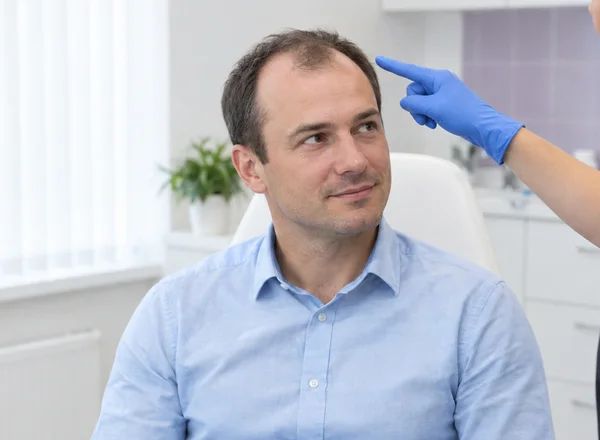

Write to us in WhatsApp or Telegram. The coordinator requests messenger pictures of the thinning zone, a doctor looks them over and answers whether a transplant would help. Free, and nothing is booked.

services
The graft count comes first, at no charge, and the resulting price is set down in the contract.
| Opening appointment | Free |
|---|---|
| Eyebrow transplant, FUE | On request |
| Beard transplant, FUE | On request |
| Hair trichopigmentation | On request |
| PRP therapy / session | On request |
all included
From pre-op preparation to 12 months of follow-up.
No surprise extra charges on the day of surgery.
two added zones
The same donor zone at the back of the head and the same FUE method serve areas beyond the scalp.
FUE method, no incisions or stitches

Grafts are taken from the donor area at the back of the head and moved through micro-punctures of roughly 1 mm — no scars are left. You and the doctor discuss the shape before the operation, taking your facial features into account. Transplanted hair grows for life: the beard can be trimmed and styled as usual.
On request
Nail down the priceFUE method, no incisions or stitches

The initial consultation is where the surgeon draws the eyebrow shape: you look through references together and the design takes your facial features into account. The hairs are implanted at the right angle, so the eyebrows look natural. It also helps where plucking stopped hairs growing.
On request
a day procedure done under local anaesthetic
Nail down the priceThe doctor assesses your donor area, counts the grafts and shows the result achievable in your case; the cost is quoted at the consultation and fixed in the contract.

Message our coordinator
Free online consultation · Reply within 15 minutes
Message us on TelegramMessage us on WhatsAppBy messaging us, you agree to our Privacy Policy
Process
From consultation to going home — all in one day

A consultation opens the process: the doctor describes FUE, describes DHI, answers each question in turn, and evaluates the donor zone.

This step reserves your surgery date through a deposit, paid by card at the clinic or online, with terms captured in a medical services contract.

There is a round of analyses to complete first, and the clinic supplies both the list and the guidance for it.

With local anaesthesia in place, the operation is painless throughout its duration.

This stage extracts grafts from the back of the head or the temples using a technique that requires no stitches.

The grafts taken from the donor zone are implanted where hair is missing.
For a swift recovery, the clinic supplies what is needed and explains every instruction clearly.

Scabs clear off, the swelling settles, the skin returns to normal

A normal step. Only the hairs fall out, the follicles stay in place

Young hairs push through, the change becomes noticeable

Hair becomes thicker and the main volume and contour show up

You see the full volume and a convincingly natural edge

Free, before the operation, with no obligations.
Start with advicedoctors

Hair transplant doctor, trichologist, surgeon
10 years of experience

Dermatovenereologist, trichologist, surgeon
11 years of experience

Plastic surgeon
9 years of experience

Plastic surgeon
9 years of experience

Assistant
9 years of experience
The doctor will assess your donor area, count the grafts and say what you can achieve.
Start with advicecoordinators
You always know who to ask: one coordinator, from the first message until recovery ends.

Patient support officer
Is on hand through preparation and healing
Picks up all your forms and your bookings

Patient support officer
Is on hand through preparation and healing
Picks up all your forms and your bookings

Patient support officer
Is on hand through preparation and healing
Picks up all your forms and your bookings
Patient support officer
Is on hand through preparation and healing
Picks up all your forms and your bookings













Common questions

Certainly. The clinic takes on patients from different cities and different countries, and a doctor can advise you online beforehand.
The exact figure is confirmed for free after a graft count and written into the contract.
Patients need a single day, nothing more, before heading home.
No — the numbing is local and lasts through the whole operation.
FUE is cut-free graft extraction by tweezer. DHI is direct implantation with a Choi pen, skipping channel-making. The combined technique takes grafts by FUE and places them using the DHI method.
The answer depends on donor hair. The doctor provides the exact count at a consultation that is free.
Healing occupies 0–10 days. The 2–4 week shedding of transplanted hair is normal and temporary. Regrowth starts from 3–4 months, real volume appears at 6–9 months, then the result matures at 12–18 months.
Hair growth is covered by a lifetime guarantee, fixed in the signed contract.
The clinic works under a medical licence, care is given to the standards and clinical guidelines
of the Ministry of Health.
A hair transplant for patients from Larache means one day of surgery, not a long course of treatment: FUE and DHI without cuts or stitches, under local anaesthesia.
Nothing has to be arranged in advance to start in Larache. The online consultation is free: the doctor studies photos of the thinning area and counts the grafts needed. The clinic is in touch 24/7, so you write when it suits you.
Healing is done with in 0-10 days. At 2-4 weeks the transplanted hairs shed - normal, predicted and harmless. Growth starts at 3-4 months, and anything you see before that tells you very little.
The cost is calculated individually after a free online consultation. Write to us on WhatsApp or Telegram.
By messaging us, you agree to our Privacy Policy
Larache is a city in northwestern Morocco, on the Atlantic coast, where the Loukkos River meets the ocean. It is one of the most important cities of the Tanger-Tetouan-Al Hoceima region. In the 2024 Moroccan census the commune of Larache recorded a population of 133,731 inhabitants. For a city of this size, people tend to know one another, and a decision about hair is rarely made in secret: friends, colleagues and relatives notice the change sooner or later. That is a good reason to plan the whole process calmly.
This text is written for people in Larache who are considering FUE or DHI and want to understand how the procedure fits into the local rhythm of life: the ocean wind, the wet winters, the sunny summers, the cafes around the central square and the family calendar. The operation itself is performed at the clinic in Rabat, Morocco. The first conversation takes place online and is free, from your own home in Larache.
Nothing here replaces a medical examination. It is a practical guide to the questions that patients from Larache usually ask, and to the points worth discussing with the surgeon before you decide.
You do not need to leave the city for the first step. You write to the coordinators on Telegram or WhatsApp, send clear photos of the front, the top, the crown and the back of the head, and describe your history: how long the hair has been thinning, whether baldness runs in the family, which medicines you take and which illnesses you have. The coordinators are available around the clock, 24/7, so you can write in the evening after work or early in the morning before classes.
The doctor then reviews the material and discusses with you the shape of the hair line, taking your facial features into account. You hear whether you are a suitable candidate, how many grafts the donor area can realistically provide, and which method, FUE or DHI, suits your case. Every question is welcome at this stage, and there is no obligation to continue.
If you decide to go ahead, the team stays with you from pre-op planning to 12 months later. A coordinator will be on the phone 24/7, which matters when you are at home in Larache and a question comes up in the middle of the night.
Grafts are taken from the back of the head, the donor area, and moved through micro-punctures of about 1 mm, so nothing scars over. The doctor discusses the shape with you before the operation, taking your facial features into account. In both FUE and DHI the principle is the same: your own hair is relocated to the thinning zone, and the difference lies in how the grafts are placed. The surgeon explains which approach is more suitable for your density and your goals.
The same technique is used for the beard and moustache. Transplanted hair grows for life: trim and style the beard as usual. For many men in Larache, where a well-kept beard is common, this is a useful point to raise during the consultation.
Ask the surgeon to show how the planned hair line will look from the front and from the side, and how it will age with you over the years. A natural result is built on a modest, age-appropriate design rather than on the lowest possible line.
Larache has a hot-summer Mediterranean climate with heavy rainfall. Summers are moderately hot and sunny, winters are wet and cool, and the record high of 46.4 °C was registered on July 10, 2021. Local climate data also describe annual rainfall of 700 to 800 millimetres. The ocean brings wind and humidity all year round.
In the first weeks the scalp needs protection from strong sun, dust and sweat. In summer this means avoiding long hours in direct light, choosing shade and following the surgeon's advice about headwear: it should be loose, clean and not rub the treated area. In winter the main concern is different: rain, wet hats and crowded indoor spaces. Ask which kind of cover is acceptable and when you may stop using it.
The ocean is one of the pleasures of life in Larache, but sea water, sand and pools are not for the first period of healing. Your coordinator will tell you when swimming and sport can be reintroduced, and you should follow that schedule rather than the weather forecast.
There is no single correct month, only the one that suits your life. Many people in Larache prefer the cooler, wetter months, because sun exposure is lower and a cap or hood looks natural. The disadvantage is damp weather, so you will need to keep the scalp dry and clean as instructed.
Summer in Larache is sunny and lively, with people on the coast and the pine forest paths along the ocean. If you choose this season, plan the first days around the shade and avoid beach days, dusty places and crowded events. Think also about the date when the shedding phase will fall, because it can coincide with holidays or family celebrations.
The best approach is to count backwards from the occasion that matters to you. Remember that the final result takes time: 12–18 months after surgery. A wedding or an important event that is only a few weeks away is not a good target date.
Healing takes 0–10 days, and this is the period when you would normally stay at home in Larache and limit your contact with other people. After that, 2–4 weeks is the time when the transplanted hairs let go, as expected. This normal shedding surprises many patients, and it is worth knowing about in advance so that you do not worry.
At 3–4 months the hair comes back, and at 6–9 months it looks visibly thicker. The settled look arrives at 12–18 months. In total: 0–10 days for healing, 2–4 weeks for normal shedding of transplanted hair, 3–4 months for new growth to start, 6–9 months for real density, and 12–18 months for the final result.
One patient described it this way: the result truly makes me very happy. From about the 4th month active, even growth began. The transplanted hair took very well, the beard now looks as natural as possible, no bald patches are left. The beard became much thicker and denser, with the shape he had thought about for a long time. Each person is different, but this progression matches the timeline above.
Follow-up is organised too: check-ups at months 1, 3, 6, 9 and 12, held by message and photo, so you can follow your progress from Larache.
Larache has a strong school tradition, with Arabic, French and Spanish education systems, and many young people balance study with their first jobs. If you are a student, plan the procedure for a quieter period and tell the coordinator about your exam and class schedule. The visible healing phase is easier to manage when you are not in front of a large group every day.
If you work in an office, a shop, the port or the fishing sector, ask the surgeon when you can resume your normal tasks. Jobs with dust, heavy sweating or strong sun need a more careful plan than desk work. Be honest about your working conditions, because the advice depends on them.
Sport, including football and swimming in the ocean, should be restarted only on the schedule your surgeon gives. Family events are another issue: Moroccan weddings, religious holidays and gatherings are important, and the first visible weeks may not suit them. Choose a date that leaves a comfortable gap, and keep festive meals and crowded rooms in mind during the early phase.
In general terms, a good candidate has stable hair loss, a healthy donor area at the back of the head and realistic expectations. Younger patients with fast-progressing loss may need a longer-term plan, because the hair line you design today must still look right in later years.
Caution is needed with uncontrolled chronic illness, active scalp disease, problems with healing or bleeding, and with medicines that affect them. Tell the doctor everything during the online consultation. If a transplant is not suitable at the moment, an honest doctor will say so and suggest alternatives or a later date.
Smoking, heavy alcohol use and a very poor diet can also slow recovery. Raise these points openly rather than hoping they will go unnoticed.
A good consultation starts with good pictures. In Larache the light changes quickly between the bright Atlantic mornings and grey, rainy afternoons, so take your photos in the same place, in even daylight near a window, without a flash and without a cap. Send the front, both sides, the top, the crown and the back of the head. Wet or freshly styled hair hides the real density, so use dry, clean hair.
Add a short written history: when the thinning began, whether relatives have the same pattern, which medicines or supplements you use, and whether you have had any earlier treatment. If you want a beard or moustache transplant, send clear photos of the face from the front and both sides. The more complete the file, the more precise the doctor's answer will be during the free online consultation.
Keep the chat history on Telegram or WhatsApp. Later, when you compare progress at the check-ups, it is useful to have the first photos in the same conversation, taken from the same angles as the later ones.
Life in Larache often happens outdoors: a coffee on the terrace around the central square, a walk along the ocean front, a stroll through the old medina and the pine woods near the coast. None of this is forbidden in principle, but during the early healing days the scalp should not be exposed to wind-blown dust, strong sun or crowds where someone may touch your head. Ask the surgeon which outings are acceptable and from which day.
Think about small, practical things in advance: a clean pillowcase, a way of sleeping with the head slightly raised if the surgeon recommends it, loose collars instead of shirts you pull over the head, and a gentle routine for washing exactly as instructed. Hairdressers and barbers are part of daily life in the city, so tell your usual barber to wait until the doctor allows any cutting or styling.
Meals matter too. Festive tables and grilled fish are an important part of local food culture, and there is no need to change them drastically. Still, ask whether anything in your diet or any supplement should be paused, and avoid heavy alcohol and smoking during recovery.
The hardest period for many patients is not the first week but the weeks that follow. At 2–4 weeks the transplanted hairs let go, as expected, and the area can look thinner than you hoped. In a city where acquaintances meet often, it is tempting to explain or apologise. You do not need to: this is a planned stage, and new growth starts at 3–4 months.
Avoid judging the result by the mirror every day. Take one photo a month in the same light and at the same angles, and send it at the scheduled check-ups at months 1, 3, 6, 9 and 12. Comparing images is far more reliable than memory, especially at 6–9 months, when the hair becomes visibly thicker.
If something worries you, such as redness, itching or a feeling of tightness, write to the coordinators at once. They are available around the clock, and the doctor can tell you whether it is part of normal healing.
Prepare a list before the call. Useful questions: which method, FUE or DHI, is better for me and why; how many grafts can the donor area give; how will the hair line look in profile; what will I be able to do in the first days; when can I swim and exercise; and how will the shedding phase look.
Ask also how the care continues after the operation. The team stays with you from pre-op planning to 12 months later, with check-ups at months 1, 3, 6, 9 and 12. Ask what to send at each check-up and how quickly the coordinators reply.
Finally, ask about the practical side of being in Rabat for the operation, and what you will need to bring and to arrange at home in Larache afterwards. The clinic in Rabat is in the same country, which makes planning simpler.
Yes. The first online consultation is free. You write on Telegram or WhatsApp from Larache, send photos and receive the doctor's opinion without any obligation.
The procedure is done at the clinic in Rabat, Morocco. The consultation and the follow-up checks are held online, so you can handle them from your own home in Larache.
Yes. The coordinators are available around the clock, 24/7, and a coordinator will be on the phone 24/7 after the operation.
Grafts are taken from the back of the head, the donor area, and moved through micro-punctures of about 1 mm, so nothing scars over. The surgeon will explain what you can expect in your own case.
At 2–4 weeks the transplanted hairs let go, as expected. This is a normal stage, and new hair comes back later.
At 3–4 months the hair comes back, at 6–9 months it is visibly thicker, and the settled look comes at 12–18 months.
Summers are moderately hot and sunny, so the scalp needs protection in the early period. Use shade and follow the surgeon's advice about headwear, and avoid dusty places.
Not in the first period of healing. The coordinator will tell you when swimming and sport may be resumed.
Yes, the technique is used for the beard as well. Transplanted hair grows for life: trim and style the beard as usual.
The team stays with you from pre-op planning to 12 months later, with check-ups at months 1, 3, 6, 9 and 12.
Send clear daylight photos of the front, sides, top, crown and back of the head, with dry hair and no cap, plus a short history of your hair loss and medicines. For a beard transplant, add photos of the face from three angles.
Yes. Ask the barber to wait until the surgeon allows cutting or styling, and do not let anyone touch the treated area before that.
Yes. At 2–4 weeks the transplanted hairs let go, as expected, and the new hair comes back at 3–4 months. The settled look arrives at 12–18 months.

 Forceps
 Minimal








