




original
at 12 months
2,800 grafts
FUE method
City Medical Centre
Free quote
Free consultation and cost estimate.
True case
original
at 12 months
FUE method, no scalpel and no sutures. Graft count and forecast reckoned up without paying — before you decide.
No charge, ever, no surgery booking required
Message our coordinator
Free online consultation · Reply within 15 minutes
Message us on TelegramMessage us on WhatsAppBy messaging us, you agree to our Privacy Policy
results
Actual patients of City Medical Centre, all of them.
original
at 12 months
2,800 grafts
FUE method

original
at 12 months
3,500 grafts
FUE method

original
at 12 months
2,600 grafts
FUE method

original
at 12 months
3,000 grafts
FUE method

original
at 12 months
2,700 grafts
FUE method

original
at 12 months
3,300 grafts
FUE method

original
at 12 months
2,900 grafts
FUE method

original
at 12 months
2,500 grafts
FUE method

original
at 12 months
3,400 grafts
FUE method

original
at 12 months
2,500 grafts
FUE method

original
at 12 months
3,100 grafts
FUE method

original
at 12 months
3,600 grafts
FUE method

original
at 12 months
4,000 grafts
FUE method

original
at 12 months
3,200 grafts
FUE method

original
at 12 months
3,000 grafts
FUE method

original
at 12 months
3,700 grafts
FUE method

original
at 12 months
2,700 grafts
FUE method

original
at 12 months
3,800 grafts
FUE method

original
at 12 months
3,300 grafts
FUE method

original
at 12 months
2,800 grafts
FUE method

original
at 12 months
2,500 grafts
FUE method

original
at 12 months
3,900 grafts
FUE method

original
at 12 months
3,500 grafts
FUE method

original
at 12 months
3,800 grafts
FUE method

original
at 12 months
2,900 grafts
FUE method

original
at 12 months
3,600 grafts
FUE method

original
at 12 months
2,600 grafts
FUE method

original
at 12 months
2,700 grafts
FUE method

original
at 12 months
3,700 grafts
FUE method

original
at 12 months
3,200 grafts
FUE method

original
at 12 months
3,000 grafts
FUE method

original
at 12 months
2,800 grafts
FUE method

original
at 12 months
4,000 grafts
FUE method

original
at 12 months
3,400 grafts
FUE method

original
at 12 months
2,900 grafts
FUE method

original
at 12 months
3,100 grafts
FUE method

original
at 12 months
2,600 grafts
FUE method

original
at 12 months
3,300 grafts
FUE method

original
at 12 months
3,900 grafts
FUE method

original
at 12 months
3,500 grafts
FUE method

original
at 12 months
2,700 grafts
FUE method

original
at 12 months
3,800 grafts
FUE method

original
at 12 months
3,200 grafts
FUE method

original
at 12 months
3,000 grafts
FUE method

original
at 12 months
2,800 grafts
FUE method

original
at 12 months
3,100 grafts
FUE method

original
at 12 months
3,600 grafts
FUE method
Comparison
We transfer grafts by three technologies: classic FUE, suture-free DHI and a combined protocol. Compare them by implantation technique, tissue trauma and graft survival, and pick your method knowingly.
Classic technique without incisions or stitches

On request
Graft implantation technique
ForcepsGraft trauma
MinimalNatural hair growth angle
NaturalGraft survival
98–100%Suitable for
Androgenetic alopeciaSuture-free implantation with a Choi pen

On request
Graft implantation technique
DHI pen (Choi implanter)Graft trauma
MinimalNatural hair growth angle
NaturalGraft survival
98–100%Suitable for
DensificationFUE extraction, DHI pen implantation

On request
Graft implantation technique
FUE extraction + DHI implantationGraft trauma
MinimalNatural hair growth angle
NaturalGraft survival
98–100%Suitable for
Androgenetic alopecia and densificationFigures for survival and trauma are method averages and serve as a guide: the exact numbers rest on the transplant area and the patient's individual features, and the doctor explains them at the consultation.
Meet a specialist


















about the clinic
Care for every patient, modern equipment, comfortable rooms

Ask us anything, we will reply.
Message us on Telegram Message us on WhatsApp Write to usThe doctor will name a non-surgical route at the consultation whenever one exists, and your budget stays untouched. Below you will find the situations where a transplant genuinely helps.
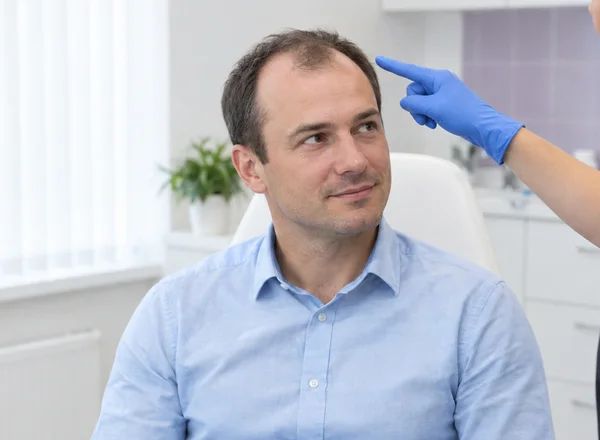

Write to us in WhatsApp or Telegram to start. A coordinator asks for photos of the thinning area in a messenger, a doctor reviews them and says whether a transplant would help. Free, no obligation to book.

services
At the free consultation the grafts are counted, the cost is quoted and fixed in the contract.
| The opening review | Free |
|---|---|
| Eyebrow transplant, FUE | On request |
| Beard transplant, FUE | On request |
| Hair trichopigmentation | On request |
| PRP therapy / session | On request |
all included
From surgery preparation through 12-month follow-up.
Surgery day holds no financial surprises.
two other areas
Whatever zone is treated, the grafts come from the back of the head and the method stays FUE.
FUE method, no incisions or stitches

We take grafts from the donor area at the back of the head and move them through micro-punctures of about 1 mm — no scars remain. Before the operation the doctor agrees the shape with you, taking your facial features into account. Transplanted hair grows for life: the beard is trimmed and styled as usual.
On request
Freeze your quoteFUE method, no incisions or stitches

The initial consultation is where the surgeon draws the eyebrow shape: you look through references together and the design takes your facial features into account. The hairs are implanted at the right angle, so the eyebrows look natural. It also helps where plucking stopped hairs growing.
On request
a procedure you go home from, numbed locally
Freeze your quoteThe doctor assesses what the donor zone holds, counts the grafts and explains the outcome you can expect. You are told the cost at the consultation and it goes into the contract.

Message our coordinator
Free online consultation · Reply within 15 minutes
Message us on TelegramMessage us on WhatsAppBy messaging us, you agree to our Privacy Policy
Process
From consultation to going home — all in one day

The process opens with a free consultation where the FUE and DHI methods are explained, your questions are answered, and an individual operation plan is created.

A deposit reserves the day. Bring a card to the clinic if you prefer paying on site, or complete the payment online.

Tests must be in hand before the operation. The clinic hands you the whole list and walks you through what to do.

The operation is painless thanks to the local anaesthesia administered at this stage.

The surgeon takes grafts from the donor area, either the back of the head or the temples, leaving no stitches behind.

The implantation stage places the grafts into the area of hair loss, handled by the surgeons.
For patients in Khouribga, everything required for healing is provided, with instructions explaining its use.

The crusts fall away, swelling calms down, the skin heals steadily

Expected, not a setback: the hair shafts go, the roots remain

The new hairs appear gradually and the result shows

Growth fills out; the hair gains body and its shape can be seen

The head of hair completes, the edge looking natural

Free, before surgery and leaving you free to decide.
Meet a specialistdoctors

Hair transplant doctor, trichologist, surgeon
10 years of experience

Dermatovenereologist, trichologist, surgeon
11 years of experience

Plastic surgeon
9 years of experience

Plastic surgeon
9 years of experience

Assistant
9 years of experience
The doctor looks over the donor zone, arrives at the number of grafts and explains what is achievable.
Meet a specialistcoordinators
A coordinator takes on your case early and stays with it until recovery ends.

Your personal manager
Is in touch on the day and long after
Runs the paperwork and keeps your diary

Your personal manager
Is in touch on the day and long after
Runs the paperwork and keeps your diary

Your personal manager
Is in touch on the day and long after
Runs the paperwork and keeps your diary
Your personal manager
Is in touch on the day and long after
Runs the paperwork and keeps your diary













Standard questions

Yes. The clinic works with patients from other cities and countries, and an online consultation is available first.
A free consultation and graft count gives you the final, contract-fixed price with no hidden extras.
The surgery takes a single day, and you go home the same day.
No. Local anaesthesia is administered and the session is painless.
With FUE, grafts are taken by tweezer with no incisions. With DHI, grafts are implanted directly using a Choi pen, without pre-made channels. The combined method mixes FUE harvesting with DHI implantation.
Nobody can guess it in advance; the doctor counts them at a free appointment based on your donor reserve.
A healing stage of 0–10 days comes first, then a normal 2–4 week shed. Growth follows at 3–4 months, real thickness across 6–9 months, and the finished result at 12–18 months.
A contract-backed, lifetime guarantee of hair growth comes with every procedure.
A medical licence, and care provided to the standards and clinical guidelines
of the Ministry of Health.
There is no cutting and no stitching in FUE or DHI, and local anaesthesia is all a patient in Khouribga receives. The operation fills one day and ends there, without a second appointment for the surgery itself.
Photos first, decisions later. A patient in Khouribga pays nothing for the online consultation, and the doctor looks at the thinning area and says whether a transplant will help. The clinic is reachable 24/7.
Recovery is short: 0-10 days. The transplanted hairs shed at 2-4 weeks, a normal step, growth begins at 3-4 months, density fills by 6-9 and the final result stands at 12-18. Check-ups at 1, 3, 6, 9 and 12 months, photo tracking with a personal coordinator, growth guaranteed for life.
The cost is calculated individually after a free online consultation. Write to us on WhatsApp or Telegram.
By messaging us, you agree to our Privacy Policy
Khouribga is the capital and largest city of Khouribga Province in the Béni Mellal-Khénifra region, a city that grew up around the nearby phosphate deposits. It was founded in 1923, and its population is 195,931 according to the 2024 census. People came here from many parts of Morocco to work and settle, and that mix shows in how residents talk about appearance, family and work: practical, direct and focused on what is realistic.
Hair loss is a subject many men in the city raise quietly, often first with a barber, a brother or a colleague. A hair transplant by the FUE or DHI method is a medical operation with a long recovery curve, so it helps to plan it the way you would plan any serious step: with facts, a calendar and a clear conversation with the surgeon. This text is written for residents of Khouribga who are considering that step.
The first contact happens from your own city. You write to the coordinators on Telegram or WhatsApp, send photos of the front, top, crown and sides of your head, and describe how long the loss has been going on and what you have already tried. The consultation is online and free, and a coordinator will be on the phone 24/7, so a night-shift worker or someone who finishes late can write at any hour.
The doctor looks at the donor area, the hair line and your facial features, and discusses the shape with you before the operation. You can ask about the number of sessions, the density that is realistic for your hair type and what the plan looks like. The procedure itself is carried out at the clinic in Rabat, Morocco, which is 154 km from Khouribga, so it is a matter within your own country and easy to organise around your work.
Grafts are taken from the back of the head, the donor area, and moved through micro-punctures of about 1 mm, so nothing scars over. In FUE the grafts are extracted individually and then placed; in DHI they are implanted with a special pen. Which one suits you depends on the area to be covered, the length of your hair and the surgeon's assessment, and you should ask for the reasoning rather than a label.
Transplanted hair grows for life, and that is why the result looks natural when the line is drawn well. For men who also want to restore a beard, the same principle applies: trim and style the beard as usual once it has grown in.
Khouribga lies about 820 metres above sea level on the Ouardigha plateau and has a hot-summer Mediterranean climate. The average annual temperature is 17.2 °C and about 432 mm of precipitation falls in a year, with more rain in winter than in summer. For a person recovering after a transplant, this means two different seasons to plan for.
In the hot months the main concerns are sun, sweat and dust on the scalp. Strong direct sun on the treated area should be avoided, headwear should be loose and clean, and you should follow the surgeon's instructions on when a cap is allowed. In winter the air is cooler and gentler on the scalp, but rain and wind call for clean, breathable headwear and careful washing according to the clinic's instructions. Heavy dust from work outdoors or near industrial zones is worth discussing with the surgeon in advance.
Many residents prefer the cooler part of the year, because the first days of healing are easier without strong sun and heat. Autumn and winter also leave time for the hair to pass through the shedding phase before the next summer. That said, the right date is the one that fits your work, your family calendar and the surgeon's availability.
Think about events in your life: a wedding in the family, a holiday gathering, a season of heavy work. The first days after surgery are the most visible, so plan the operation so that you are not obliged to attend large events while the scalp is healing. The coordinators can help you match the date to your plans during the online consultation.
Khouribga is a city shaped by the phosphate industry, with a large share of residents in industrial, technical and administrative jobs. Anyone whose work involves dust, heat or physical effort should ask the surgeon exactly when it is safe to go back to the workplace and what protection is needed. Office and school or university routines are generally easier to resume, but still should be discussed with the doctor.
The city has an active sporting life, with football, tennis, swimming, rugby, athletics and more. If you play on a team or train regularly, ask about the right moment to return to sport, to swimming pools and to contact games. The medical timeline gives a general frame: 0–10 days for healing, 2–4 weeks for normal shedding of transplanted hair, 3–4 months for new growth to start, 6–9 months for real density, and 12–18 months for the final result. Specific permission for sport and pool must come from your surgeon.
Family meals and shared tables are central in Moroccan life, and recovery does not require isolation, but it does call for common sense. During the first days, avoid crowded, hot and smoky places, and do not touch or rub the treated area. Ask the surgeon about sleeping position, washing and what to do if the scalp itches or swells.
Swelling and redness are part of the first days, and it helps to tell your family in advance what to expect so that nobody is alarmed by the shedding that follows. Between 2 and 4 weeks the transplanted hairs let go, as expected, and this is a normal stage rather than a failure. New hair comes back at 3–4 months, becomes visibly thicker at 6–9 months, and the look settles at 12–18 months.
A good candidate has enough healthy hair in the donor area, realistic expectations and stable general health. Men with early or moderate loss often do well, but the decision is individual. Chronic illnesses, skin conditions of the scalp, unstable hair loss that is still progressing quickly, or the use of certain medicines may require a delay or a different plan.
Be honest in the online consultation about your medical history, any medicines you take, smoking and previous procedures. The doctor may ask for additional information or recommend treatment before surgery. Telling the full story is the best way to protect the result.
Many households in Khouribga live by the rhythm of the phosphate industry, and the city grew because workers and technical staff settled here from different regions of Morocco. For a man who works shifts, the practical question is not only which technique to choose but how to fit the first days of healing into a rota. Ask your employer in advance how much time you may need, and keep the surgeon's guidance on return to work in front of you when you talk to a supervisor.
Because the coordinators are available on Telegram and WhatsApp around the clock, you can send photos after a night shift and have the questions ready before the online consultation. Write down your working hours, the kind of protective headwear you wear and how much dust or heat you meet on an ordinary day. The doctor can then plan the recovery around your real routine rather than an average one.
Khouribga stands about 820 metres above sea level on the Ouardigha plateau, and the city has a hot-summer Mediterranean climate. In practice this means a strong sun in summer and a cooler winter with more rain. After a transplant the scalp is sensitive, so the same habits matter in both seasons: do not scratch, do not rub the treated area with a towel and keep hands clean.
Wind can carry dust into a healing scalp, and a dry atmosphere may make the skin feel tight. Ask the surgeon which moisturising or washing routine is suitable and for how long. Do not improvise with home remedies or products recommended by friends, however well meant, because the first stage of healing is the one in which the grafts are most delicate.
In a city where families are close and news travels fast, many patients wonder what to say. There is no obligation to explain, but a short and calm answer works well: you are having a medical procedure and will look better in a few months. Tell the people you live with about swelling, redness and the shedding at 2-4 weeks so that they know it is a normal stage.
Teammates and friends from the football or athletics scene often ask about training. Tell them you will return to sport only when the surgeon allows it. The final look settles at 12-18 months, so patience is part of the plan, and support from family makes that period easier.
Khouribga hosts an international festival of African cinema and an international theatre festival, and the city has cultural venues, youth centres and several cinemas. If you like to attend these events or work around them, keep their dates in mind when you choose a week for the operation. The first days after surgery are the most visible, and a crowded hall with warm air is not the best place for a scalp that is still healing.
A practical approach is to write down the next six months: family gatherings, public events, work peaks and sports fixtures. Then share that list with the coordinators in the online consultation. The doctor can suggest a date that leaves the shedding stage, which falls between 2 and 4 weeks, away from the occasions where you would most like to look your best.
Khouribga has a large school network and many vocational training institutions, as well as a faculty and an engineering school, so young adults make up a visible part of city life. Students and trainees often ask whether a transplant fits around exams and classes. The answer depends on your schedule and on the surgeon's advice, but a study timetable usually allows more flexibility than a physical job.
Younger patients should be especially careful about expectations. If hair loss is still progressing quickly, the surgeon may recommend waiting or a different plan, because a transplant fixes the donor hair but does not stop loss in the surrounding areas. Bring your family history and your photos from past years to the online consultation, so that the doctor can judge how the pattern is developing.
The province of Khouribga has regional hospitals, health centres, urban and rural dispensaries, so basic medical care is close to home. This matters for aftercare: if you have a general question about a cold, a fever or a skin problem during recovery, local care is available, and you should mention your recent transplant to any doctor you see.
For questions about the transplant itself, the coordinators remain the main contact. A coordinator will be on the phone 24/7, and the follow-up runs with check-ups at months 1, 3, 6, 9 and 12. Send photos before each check-up in the same light and from the same angles, so that progress at 3-4 months, 6-9 months and 12-18 months can be compared fairly.
A patient wrote after his beard procedure that active, even growth began from about the 4th month, that the transplanted hair took very well and that no bald patches were left. His beard became much thicker and denser, in the shape he had thought about for a long time. Experiences like this are encouraging, but each case differs, and your own result depends on donor hair, care and healing.
Keep your expectations tied to the timeline: 2-4 weeks of shedding, 3-4 months for hair to return, 6-9 months for visible thickness and 12-18 months for a settled look. If you are comparing yourself with a friend or a neighbour in the city, remember that their schedule may be different. Patience is the most useful quality during these months.
Prepare a short list before the call: which technique is proposed and why; how the hair line will be designed for your face; how many grafts the donor area can safely give; what the plan is if a second session is needed; what the aftercare instructions are, and who you can reach if something worries you.
It is also reasonable to ask how the follow-up works. We stay with you from pre-op planning to 12 months later, with check-ups at months 1, 3, 6, 9 and 12. Knowing that this schedule exists makes the long waiting period easier, because you know when the result will be assessed.
Yes. The first consultation is online and free, and you take it from your own city by writing to the coordinators on Telegram or WhatsApp.
At the clinic in Rabat, Morocco. Rabat is 154 km from Khouribga, and all planning before and after the operation can be done remotely.
Transplanted hairs let go after 2-4 weeks, as expected. Hair comes back at 3-4 months, becomes visibly thicker at 6-9 months, and the look settles at 12-18 months.
No. Shedding at 2-4 weeks is expected. It is a normal stage before new growth begins.
Grafts are taken from the back of the head and moved through micro-punctures of about 1 mm, so nothing scars over.
Sun, sweat and dust can irritate the scalp. Avoid direct sun on the treated area, use loose clean headwear if the surgeon allows it and follow the washing instructions.
The general frame is 0-10 days for healing, but the exact date for sport and swimming must be given by your surgeon. Ask about it during the consultation.
Yes, a beard can be restored with the same logic. The doctor discusses the shape with you beforehand, and once it has grown in you trim and style the beard as usual.
We stay with you from pre-op planning to 12 months later, with check-ups at months 1, 3, 6, 9 and 12, and a coordinator will be on the phone 24/7.
Yes. The coordinators are available 24/7 on Telegram and WhatsApp, so you can write when it suits your working hours and receive the plan without taking time off.
That is your choice, but it helps to agree the days of absence in advance. Ask the surgeon what is needed for your type of work, especially if it involves dust, heat or physical effort.
Dust can irritate a healing scalp, so protect the treated area as instructed, keep hands clean and follow the surgeon's advice on washing and headwear.
Yes. Share the dates with the coordinators during the online consultation. The doctor can choose a period so that the first visible days and the shedding at 2-4 weeks do not coincide with important events.
It can be, if the surgeon confirms that your hair loss is stable enough and the donor area is suitable. Send photos and your family history, and ask about the timing around exams.
Say that you recently had a hair transplant and describe your symptoms. Then inform the coordinators, who are available 24/7, so that the surgeon can advise you on the next step.

 Forceps
 Minimal








