


























Osteoarthritis treatment7 min read
Hip osteoarthritis (coxarthrosis): how it is treated without surgery
Hip osteoarthritis often starts quietly: stiffness in the morning, an ache in the groin after a long walk, difficulty putting on socks. Many people assume the only answer is a new joint. In fact, at early and moderate stages the hip can often be kept working for years without an operation. This guide explains why coxarthrosis develops, how it is diagnosed and which non-surgical options exist.
The main points in 30 seconds
- At early and moderate stages hip osteoarthritis can often be managed without an operation.
- Hip pain is often felt in the groin, thigh or even the knee, not only in the hip itself.
- An X-ray shows the stage; MRI and ultrasound add detail about cartilage and soft tissues.
- Exercise and weight control are the base of treatment; injections can support them.
- At City Medical Centre the doctor offers PRP or SVF with PRP after reviewing your scans.
Can hip osteoarthritis be treated without surgery?
Osteoarthritis of the hip, also called coxarthrosis, is gradual wear of the cartilage that covers the head of the thigh bone and the socket of the pelvis. Cartilage cannot fully grow back, so no treatment turns an old joint into a new one. But the aim of treatment is different: less pain, better movement and a slower course of the disease.
For most people with early or moderate changes, this aim can be reached without an operation. Guidelines from national health bodies put exercise, weight management and education first, with medicines and injections as support. Hip replacement is usually considered only when the joint is badly damaged and pain limits daily life despite other treatment.
The key is timing. The earlier the problem is diagnosed, the more options remain and the longer the joint can serve you.
Why coxarthrosis develops
There is rarely a single cause. Usually several factors add up over the years and overload the cartilage:
- Age: cartilage becomes less elastic and repairs itself more slowly.
- Body weight: every extra kilogram increases the load on the hip with each step.
- Shape of the joint: hip dysplasia or other differences in the shape of the ball and socket, often present from childhood.
- Old injuries: fractures or dislocations near the hip.
- Heavy physical work or sport with repeated impact on the joint.
- Family history: osteoarthritis tends to run in families.
- Other conditions: inflammatory arthritis, poor blood supply to the head of the femur (avascular necrosis), metabolic disorders.
Some of these factors cannot be changed, but weight, activity and muscle strength can. This is where non-surgical treatment has its strongest effect.

Stages and symptoms: where hip pain is felt
A typical sign of hip osteoarthritis is that the pain is not always felt in the hip. The nerves that supply the joint also supply the groin and the front of the thigh, so the pain may spread there and even reach the knee. Some people are treated for their knee for months before the real cause is found.
Other common symptoms are morning stiffness that eases after moving around, pain after walking or standing, a limp, difficulty turning the leg inwards, and trouble tying shoes or getting out of a car.
Early
- What is happening in the joint
- First thinning of the cartilage; the joint space on X-ray is almost normal
- How it feels
- Mild ache after long walks, short stiffness in the morning
Moderate
- What is happening in the joint
- The joint space narrows, small bony spurs appear
- How it feels
- Pain after moderate activity, limited rotation, sometimes a limp
Advanced
- What is happening in the joint
- Cartilage is largely lost, the bones rub against each other, the joint changes shape
- How it feels
- Pain at rest and at night, marked limp, the leg may seem shorter
Non-surgical methods work best at the early and moderate stages. At the advanced stage they can still ease symptoms for a while, but the options become narrower.
Diagnosis: scans a doctor needs
The diagnosis starts with a conversation and an examination: the doctor asks where and when it hurts, checks how the hip moves and how you walk. Scans then confirm the cause and show the stage.
- X-ray of the pelvis and hips: the main test. It shows the width of the joint space, bony spurs and the shape of the joint.
- MRI: a detailed view of the cartilage, bone and soft tissues. It helps at an early stage and when avascular necrosis is suspected.
- Ultrasound: shows fluid in the joint and inflamed soft tissues, and is used to guide injections.
- Blood tests: help rule out inflammatory arthritis and other conditions.
Because hip pain can come from the spine or the knee, a good doctor checks these areas too. If you already have scans, keep the images and reports: they can be reviewed before you visit a clinic.
Non-surgical treatment: exercise, lifestyle, PRP and SVF
Treatment is usually a combination of several steps rather than one procedure. A typical plan may include:
- Exercise and physiotherapy: the core of treatment at every stage.
- Weight loss if you are overweight, which reduces the load on the joint.
- Painkillers and anti-inflammatory medicines prescribed by a doctor for flare-ups.
- Walking aids: a stick used on the opposite side can noticeably unload the hip.
- Injections into the joint: steroids, a lubricating gel or treatments made from your own tissue.
Among injection treatments, regenerative methods are becoming more common. PRP (platelet-rich plasma) is prepared from a small amount of your own blood and contains growth factors that may help calm inflammation. SVF (stromal vascular fraction) is a mix of cells taken from a small sample of your own fat tissue, usually combined with PRP. Both aim to ease pain and support the joint at early and moderate stages. The research on them is still developing, results differ between people, and the doctor decides whether they suit you after reviewing your scans. You can read how these procedures are done on our osteoarthritis treatment page.
Therapeutic exercise and daily habits
Movement feeds cartilage: the joint fluid that nourishes it circulates when the joint moves. Strong muscles around the hip also take part of the load off the joint. That is why exercise is recommended even when it hurts a little, as long as the pain settles afterwards.
Helpful types of activity:
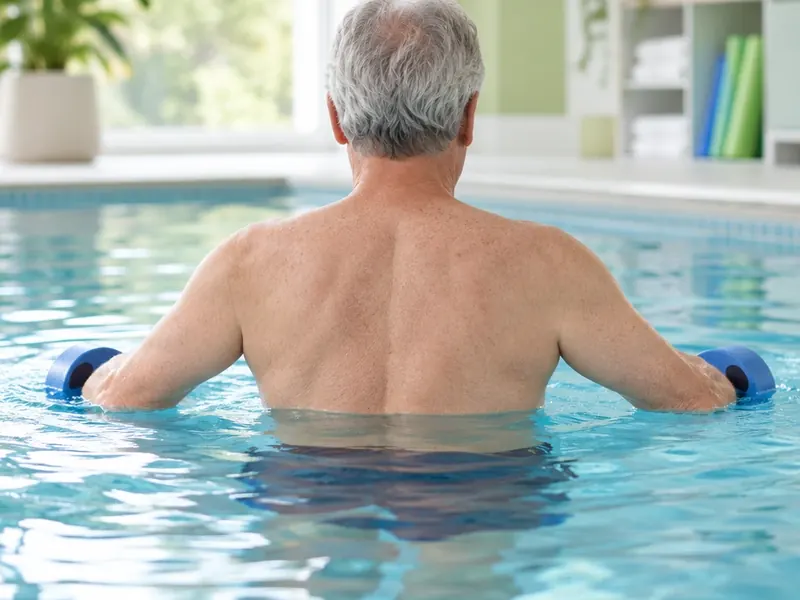
- swimming and water aerobics, where water supports the body;
- cycling or an exercise bike with a comfortable seat height;
- walking on flat ground, Nordic walking;
- exercises to strengthen the buttock and thigh muscles, and gentle stretching.
It is better to avoid running on hard surfaces, jumping, deep squats, carrying heavy loads and sudden twisting movements. In daily life, a higher chair, a raised toilet seat, a long-handled shoe horn and comfortable cushioned shoes all reduce strain. A physiotherapist can choose exercises for your stage and teach you to do them correctly.
When injections are not enough
Non-surgical treatment has limits. It is worth discussing surgery with an orthopaedic surgeon when:
- pain wakes you at night or does not ease at rest;
- you can walk only short distances even with a stick;
- the X-ray shows that the joint space has almost disappeared or the head of the femur has changed shape;
- several months of well-planned conservative treatment have not helped.
In these cases total hip replacement is usually the most reliable way to restore walking and relieve pain. The decision is always made together with the patient, taking into account age, general health and personal goals. An honest assessment of the stage is part of good care: injections should not delay an operation that is really needed.

Getting a personal plan at City Medical Centre
City Medical Centre works with international patients who want to keep their own joint for as long as possible. At our clinic the doctor offers two non-surgical methods for hip osteoarthritis: PRP therapy from your own blood, and cell therapy with SVF from your own fat tissue combined with PRP. Injections are given under ultrasound guidance, and most people go home the same day.
Other options described in this article, such as physiotherapy programmes, other types of injections or joint replacement, are given here as general information; the right approach for you is chosen at the consultation.
The first consultation is free and can be held online. Send your X-rays, MRI or reports, and the doctor will assess the stage and tell you honestly whether treatment without surgery makes sense. The cost is named after the assessment and fixed in the contract. A personal coordinator stays with you from your first message to the end of recovery, and scans and questions can be sent by Telegram. More details are on our osteoarthritis treatment page.
Sources
Frequently asked questions
Can hip arthritis be treated without replacement?
At early and moderate stages it often can. Exercise, weight control, walking aids, medicines prescribed by a doctor and injections can ease pain and keep the hip working for years. Replacement is usually considered when the joint is badly damaged and pain limits daily life despite other treatment.
Do PRP injections work for the hip?
PRP may reduce pain and inflammation in early and moderate hip osteoarthritis, and some people notice improvement over several weeks. Research is still developing and results differ between people. The doctor decides whether PRP suits you after reviewing your scans, and it works best alongside exercise.
What exercises help hip osteoarthritis?
Swimming, water aerobics, cycling, walking on flat ground and exercises that strengthen the buttock and thigh muscles are usually helpful. Gentle stretching keeps the joint mobile. Running on hard surfaces, jumping and deep squats are better avoided. A physiotherapist can adapt the programme to your stage.
Why does hip arthritis cause knee or groin pain?
The nerves that supply the hip joint also supply the groin and the front of the thigh, so the brain can feel hip pain in these areas. Pain can also spread down to the knee. This is why a doctor examines the hip when knee pain has no clear cause.
At what stage of coxarthrosis is surgery needed?
Surgery is usually discussed at the advanced stage, when the joint space has almost disappeared, pain is present at rest or at night, and months of conservative treatment have not helped. The decision depends on your symptoms, scans, age and general health, and is made together with an orthopaedic surgeon.
Have a question about your case? Get a free consultation
Message a coordinator on Telegram: we reply right in the chat, and you can send photos and questions there too.
- The first consultation is free, online consultations are available
- The doctor names the cost after the assessment, and it is fixed in the contract
- A personal coordinator guides you from the first message to recovery
Message our coordinator on Telegram
We reply right in the chat — you can send photos
Message us on TelegramBy sending a message, you agree to the privacy policy
Read also
 Osteoarthritis treatment
Knee osteoarthritis: stages, symptoms and treatment without surgery
Knee osteoarthritis stage by stage: why it develops, typical symptoms, how it is diagnosed and which non-surgical options, including PRP and SVF, suit each stage.
 Osteoarthritis treatment
Living with knee or hip osteoarthritis: exercise, weight and daily habits
How to live well with knee or hip osteoarthritis: safe exercise, weight, footwear and insoles, daily adjustments, and how habits support PRP or SVF treatment.
 Osteoarthritis treatment
Hip replacement or joint injections: how to decide what suits your hip
Hip replacement or injections for hip osteoarthritis? How the stage decides, what PRP and SVF can do, what surgery involves, and how recovery compares.