


























Hair transplant7 min read
Hair transplant for women: diffuse thinning and who can really benefit
Hair loss in women is common and often spread across the scalp rather than limited to one area. A transplant can restore density for some women, but not for all. This article explains why women lose hair, which tests to take first, when medical treatment should come before surgery, who is a good candidate and what recovery really looks like.

The main points in 30 seconds
- Women can have a transplant, but only when thinning has a stable pattern.
- Causes such as low iron or thyroid problems should be treated first.
- A dense, stable donor area is the key condition for a lasting result.
- Transplanted hair sheds first; the final result is judged at around 12 months.
- City Medical Centre offers FUE, DHI, combined FUE and DHI, and PRP therapy.
Key facts about the procedure
- Stay in clinicSame day
- Final result12–18 months
- AnaesthesiaLocal
- Price
$2,700from $2,200
Can women have a hair transplant?
Yes, but fewer women are good candidates than men, and the decision needs more care. Hair loss in women is often spread across the whole scalp rather than limited to a bald patch, and it frequently has causes that a transplant cannot fix, such as iron deficiency or a thyroid problem.
A transplant moves healthy follicles from a stable donor area, usually the back of the head, to thinning zones. It works well when the loss has a clear pattern and the donor area stays dense. It does not work when hair is falling out evenly all over the head, including the donor zone, or when the cause is still active.
So the honest answer is: a transplant can help some women a great deal, but only after the cause of thinning has been found and the donor area has been checked.
Why women lose hair: diffuse thinning and its causes
Diffuse thinning means the hair becomes less dense over a large area, while the hairline often stays in place. A wider parting is usually the first thing women notice. The most common causes are:
- Female pattern hair loss (androgenetic alopecia). It is linked to genes and to how hair follicles respond to hormones. Follicles gradually shrink and produce finer, shorter hair, mostly on the top of the head. It often becomes more visible after menopause.
- Telogen effluvium. Heavy shedding that starts a few months after a trigger: childbirth, a serious illness, surgery, sudden weight loss or severe stress. It is usually temporary.
- Hormonal changes. Thyroid disorders, polycystic ovary syndrome and changes around pregnancy or menopause.
- Nutritional factors. Low iron stores are a common, treatable contributor.
- Traction and styling. Tight hairstyles and harsh treatments can damage follicles along the hairline.
Often more than one factor is involved. That is why a plan should never start with surgery.

Tests to take before deciding on treatment
Before any treatment, a doctor usually wants to rule out causes that can be corrected. Common checks include:
- a complete blood count and iron stores (ferritin);
- thyroid function;
- vitamin D and, where indicated, other vitamins and minerals;
- sex hormones if there are signs of hormonal imbalance, such as irregular periods or acne;
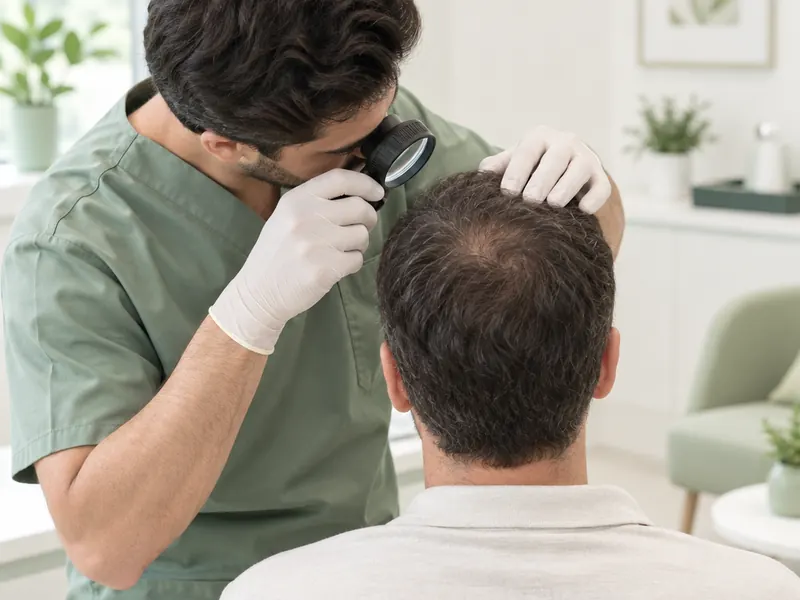
- trichoscopy, a magnified examination of the scalp that shows hair density, thickness and the state of the follicles in both the thinning and donor areas.
The exact list depends on your history. If you already have recent results, bring or send them: they save time and help the doctor judge whether a transplant makes sense.
When conservative treatment comes first
If tests show an active cause, the first step is to treat it. Correcting iron deficiency or a thyroid disorder can stop the shedding, and hair often recovers over several months. Telogen effluvium usually settles on its own once the trigger has passed.
For female pattern hair loss, a doctor may prescribe medical treatment to slow thinning. Platelet-rich plasma (PRP) therapy, made from your own blood, is another option some patients use to support the hair that remains. These treatments work best early and need patience: changes are usually judged after several months.
A transplant is considered when the pattern of loss is stable, conservative care has been tried or is not enough, and the donor area is strong.
Who can benefit from a transplant and who cannot
- Female pattern (androgenetic) thinning with a dense, stable donor area
- Hair falling out evenly all over the scalp, including the donor area
- A thinner parting or crown where density is wanted
- Shedding after an illness or due to an untreated hormonal imbalance
- A receding or uneven hairline or bald patches with a clear pattern
- Patchy (autoimmune) alopecia
- Stable loss after causes have been checked
- Insufficient donor density, hair-pulling disorder, serious untreated illness
The key question is the donor area. If it is thinning too, moving hair from it will not create lasting density. A transplant also does not stop further loss of native hair, so ongoing care may still be advised. The full list of indications and contraindications is on our hair transplant page.
How the procedure works for women
The operation is done under local anaesthetic and usually takes most of a day. Individual follicular units are removed from the donor area and placed into the thinning zones at a natural angle and direction.
- FUE removes grafts one by one without a linear scar and suits androgenetic hair loss.
- DHI places grafts with a special implanter pen and is often chosen to add density between existing hairs.
- A combined FUE and DHI approach uses FUE extraction and DHI implantation and suits both androgenetic loss and densification.
Many women worry about shaving. The donor area usually needs to be trimmed, but with long hair a trimmed section can often be hidden. How much needs to be shaved depends on the method and the number of grafts, and the doctor explains this in advance.
Recovery and realistic results
Most people return to desk work within a few days. Small crusts form and fall off in the first one to two weeks. Between about two and six weeks, the transplanted hairs usually shed. This is expected: the follicles stay in place and start growing new hair.
New growth typically appears from the third or fourth month, and the final result is judged at around 12 months. In women, the aim is usually better density and coverage rather than a completely new hairline. Results vary with hair thickness, colour and the donor supply, and no one can promise a fixed outcome.

Getting a personal plan at City Medical Centre
City Medical Centre works with international patients. For hair restoration the clinic offers FUE, DHI and a combined FUE and DHI method, as well as PRP therapy. Other approaches mentioned in this article are given as general information, and the best option for you is discussed at the consultation.
The first consultation is free and can be held online. Send photos of your parting, crown and donor area together with any recent test results. The doctor assesses whether a transplant will help, suggests a method and names the cost, which is then fixed in the contract. If your case can be managed without surgery, the doctor will say so. A personal coordinator stays with you from your first message to the end of recovery, and photos and questions can be sent by Telegram. More details are on the hair transplant page.
How recovery usually goes
- 0-10 daysHealing: the crusts come off, the swelling goes down, the area gradually recovers
- 2-4 weeksShedding of the transplanted hairs: a normal stage, only the hairs fall out, the follicles stay in place
- 3-4 monthsGrowth begins: new hairs gradually appear, the result starts to show
- 6-9 monthsVisible density: the hair becomes thicker, the main volume and contour are visible
- 12-18 monthsFinal result: the final density and a natural hairline take shape
Sources
Frequently asked questions
Is hair transplant effective for women with thinning hair?
It can be, when thinning follows a stable pattern, such as female pattern hair loss, and the donor area at the back of the head remains dense. If hair is falling out evenly all over the scalp or the cause is still active, a transplant is unlikely to give a lasting result. A doctor decides after examining the scalp and reviewing tests.
Do women need to shave their head for a transplant?
Usually not the whole head. The donor area needs to be trimmed, but with longer hair a trimmed section can often be covered. How much needs trimming depends on the method and the number of grafts. The doctor explains this at the consultation so you can plan around it.
Can hair loss from hormonal imbalance be treated with a transplant?
Not while the imbalance is active. Shedding caused by thyroid problems or other hormonal changes should first be treated by the right specialist, and hair often recovers once the cause is controlled. A transplant may be considered later if a stable pattern of thinning remains and the donor area is strong.
How long until women see results after a transplant?
Transplanted hairs usually shed within the first few weeks, which is normal. New growth typically starts around the third or fourth month and continues to thicken. The final result is usually assessed at about 12 months. The pace varies between people and depends on hair type and the number of grafts.
Which tests should I take before a hair transplant?
Doctors commonly check a complete blood count, iron stores, thyroid function and vitamin D, and sometimes sex hormones if there are signs of imbalance. A trichoscopy of the scalp shows density and follicle health in the thinning and donor areas. The final list depends on your history and is agreed with the doctor.
Have a question about your case? Get a free consultation
Message a coordinator on Telegram: we reply right in the chat, and you can send photos and questions there too.
- The first consultation is free, online consultations are available
- The doctor names the cost after the assessment, and it is fixed in the contract
- A personal coordinator guides you from the first message to recovery
Message our coordinator on Telegram
We reply right in the chat — you can send photos
Message us on TelegramBy sending a message, you agree to the privacy policy
Read also
 Hair transplant
Which instruments are used in a hair transplant?
Which instruments are used in a hair transplant: extraction punches, magnification, anaesthesia, implanter pens and scalp assessment tools explained.
 Hair transplant
Hair transplant methods explained: from outdated techniques to modern FUE and DHI
Hair transplant methods explained: why punch grafts, minigrafts and the strip method were replaced, how motorised and manual FUE differ, and where DHI fits.
 Hair transplant
Hair transplant in Turkey: what to check before you book abroad
Planning a hair transplant in Turkey or elsewhere abroad? What low prices can hide, the hidden costs, who performs the surgery and what the contract should say.