























Breast augmentation7 min read
Compression bra after breast surgery: why, how long and how to choose
After breast augmentation, a lift or a reduction, a compression bra is one of the simplest and most important parts of recovery. It reduces swelling, holds the implants in place and protects the scars. This guide explains why it is needed, which types exist, how to find the right fit, how long to wear it and what to change to afterwards.
The main points in 30 seconds
- A compression bra reduces swelling, holds implants in place and protects scars.
- It is usually worn day and night for four to six weeks after surgery.
- The right fit is firm but never painful; the size is chosen for the swollen breast.
- Stopping too early can lead to seroma, implant shift and wider scars.
- At City Medical Centre the garment is put on right after surgery and worn for 1–1.5 months.
Key facts about the procedure
- Operation time1.5–3 hours
- Back to work7–14 days
- Stay in clinic1 day
- Fixed price$4,700
Why a compression bra is needed after breast surgery
After breast augmentation, a breast lift or a breast reduction, the tissues need support while they heal. A compression bra is a soft, firm garment without underwire that holds the breasts in a stable position and applies even, gentle pressure. It is part of the treatment, not simply underwear. The operations we perform are described on our breast surgery page.
A compression bra helps in several ways:
- Less swelling. Even pressure limits the build-up of fluid in the tissues and helps swelling go down faster.
- Stable implant position. The garment holds the implants in the planned pocket while the body forms the capsule around them.
- Support for stitches and scars. Less movement means less tension on the incisions, which helps them heal neatly.
- More comfort. Most women feel less pain and pulling when the breasts do not move freely.
- Lower risk of fluid collection. Pressure helps prevent seroma, a pocket of fluid under the skin.
Types of compression garments
Not every post-operative bra is the same. Your surgeon will recommend a model based on the operation and your anatomy.
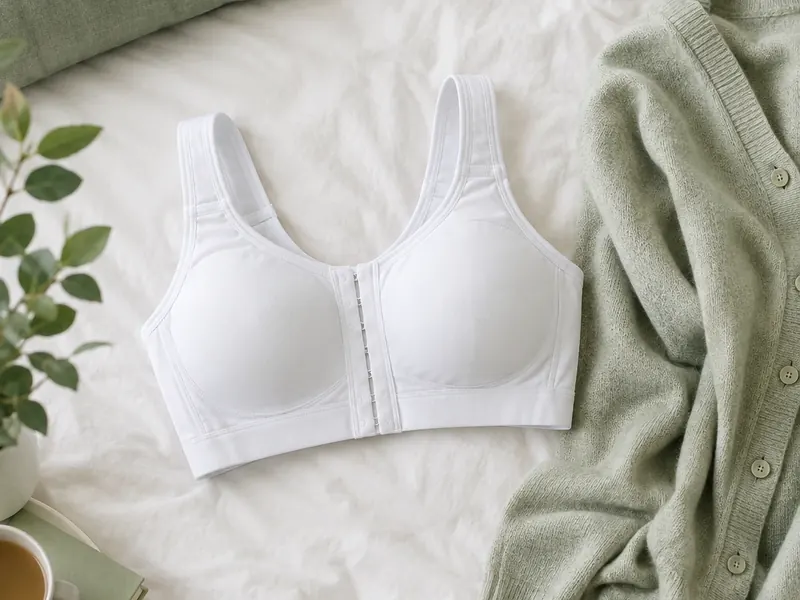
Front-closure surgical bra
- What it is
- Soft cups, wide straps and a zip or hooks at the front
- When it is used
- The first weeks, when raising the arms is difficult
Compression bra with a stabilising band
- What it is
- A bra plus an elastic band (bandeau) over the upper chest
- When it is used
- After augmentation, to keep implants from riding up
Compression vest or top
- What it is
- A garment that covers the chest and part of the upper body
- When it is used
- After combined procedures or when wider compression is needed
Soft sports bra without underwire
- What it is
- A supportive bra with moderate pressure
- When it is used
- Later in recovery, when the surgeon allows a lighter garment
Good compression garments are made of breathable, skin-friendly fabric, have flat seams and have no underwire. The fastening should be easy to use with limited arm movement.

How to choose the right size and fit
The right fit matters as much as the garment itself. A bra that is too loose does not give support, and a bra that is too tight can press on the scars and restrict blood flow.
- The bra should hold the breasts firmly but not cause pain, numbness or deep marks on the skin.
- The band should sit flat under the breasts and not ride up.
- The cups should cover the whole breast without cutting into the tissue at the edges.
- The straps should be wide and adjustable, so the weight does not rest on thin lines on the shoulders.
- Remember that the breasts will be swollen in the first weeks, so the size is usually chosen for the post-operative volume, not the final one.
The first garment is usually fitted in the clinic right after the operation. If it feels too tight, you notice skin irritation or the bra slips, tell your surgeon rather than adjusting it on your own.
How long to wear it
Most surgeons recommend wearing a compression bra for four to six weeks, sometimes a little longer. A typical schedule looks like this:
- First 1–2 weeks
- Day and night, removed only briefly for showering and wound care
- Weeks 3–4
- Still most of the day and at night, as swelling continues to go down
- Weeks 4–6
- Often still worn around the clock; the surgeon may allow a softer model
- After 6 weeks
- Many women switch to a supportive sports bra without underwire
The exact period depends on the type of operation, the size of the implants, how swelling behaves and how the scars heal. Always follow the schedule your surgeon gives you, even if you feel well earlier.
Putting it on, taking it off and washing it
In the first days after surgery, even dressing can feel awkward. A few simple habits make it easier:
- Choose a model that fastens at the front, so you do not have to raise your arms or reach behind your back.
- Put the bra on while sitting, and ask someone to help you in the first days if needed.
- Take the garment off only for as long as necessary: a shower, wound care or changing to a clean bra.
- Check that the fabric is smooth and that there are no folds pressing on the incisions.
- Have at least two garments so that one can be washed while you wear the other.
- Wash by hand or on a gentle cycle in lukewarm water with a mild detergent, and dry the bra flat, away from heaters, so the fabric keeps its elasticity.
Risks of stopping too early
Many women want to stop wearing the compression bra as soon as the pain goes, but the tissues are still healing. Stopping too early can lead to:
- longer-lasting or recurring swelling;
- fluid collecting under the skin (seroma);
- implants shifting from the planned position, often upwards or to the side;
- more tension on the incisions and wider scars;
- more discomfort when moving, especially when walking or climbing stairs.
If the garment is uncomfortable, do not simply remove it. Ask your surgeon whether a different size or model would suit you better.
What to wear after recovery
Once your surgeon allows you to stop wearing compression, you can gradually return to ordinary lingerie. Soft bras and sports bras without underwire usually come first. An underwire bra is usually allowed only when the swelling has gone and the scars under the breast have healed well.
Many surgeons suggest waiting at least six weeks, and sometimes up to three months, especially if the incision is in the fold under the breast.
When choosing new bras, remember that the breasts may still settle for several months. It makes sense to buy only one or two bras at first and to choose the rest once the final shape and size are clear. For sport, a well-fitting supportive sports bra remains a good choice in the long term.

Aftercare guidance at City Medical Centre
City Medical Centre works with international patients and performs breast augmentation with implants, breast lift with or without implants, breast reduction and implant removal. At the end of the operation the nurse helps you put on the compression garment, which holds the breasts in the right position from the first hours. After surgery compression garments are usually worn for one to one and a half months.
For about three weeks you should not raise your arms above your shoulders, heavy lifting is avoided, and saunas and baths are off limits for up to three months. The garment types and schedules described above are general information, and your personal plan is set by the surgeon.
The first consultation is free and can be held online: send photos by Telegram, and the surgeon will explain which procedure suits you and what recovery will involve. The cost is named after the assessment and fixed in the contract. A personal coordinator supports you from your first message to the end of recovery, and follow-up check-ups with the plastic surgeon continue after surgery. Learn more on our breast surgery page.
How recovery usually goes
- 7–14 daysReturn to work without physical exertion
- 3 weeksPost-op swelling disappears; scars form; no lifting over 3 kg, no raising arms above shoulder level
- 1 monthThe swelling subsides and the breasts take on a natural shape and softness
- 4–6 weeksFitness, swimming, pool and sea; compression garments worn for 4–6 weeks
- 3 monthsDiscomfort disappears; inflammatory changes resolve and a pocket forms around the implant; strength training
Sources
Frequently asked questions
How long should I wear a compression bra after breast augmentation?
Most surgeons recommend four to six weeks, sometimes a little longer. In the first weeks the bra is worn day and night and removed only for a shower and wound care. The exact period depends on the operation, the implant size, how swelling goes down and how the scars heal, so follow your surgeon's schedule.
Can I sleep without a compression bra?
Usually not in the first weeks. At night the breasts still need support, and sleeping without the garment can increase swelling and allow the implants to move. Most surgeons ask patients to wear it around the clock for at least the first month and to sleep on their back during this time.
When can I wear an underwire bra again?
Usually only when the swelling has gone and the scars have healed well. Many surgeons suggest waiting at least six weeks, and sometimes up to three months, especially if the incision is in the fold under the breast, where an underwire would press directly on the scar.
How many compression bras do I need?
At least two, so that you can wear one while the other is being washed and dried. Some women buy a third, softer model for the later weeks, when the surgeon allows lighter compression. It is better to wait with ordinary bras until the final breast size is clear.
What happens if I stop wearing it too early?
Swelling may last longer or return, fluid can collect under the skin, and the implants may shift from the planned position. The scars are also under more tension and can become wider. If the garment is uncomfortable, ask your surgeon about a different size or model instead of stopping on your own.
Have a question about your case? Get a free consultation
Message a coordinator on Telegram: we reply right in the chat, and you can send photos and questions there too.
- The first consultation is free, online consultations are available
- The doctor names the cost after the assessment, and it is fixed in the contract
- A personal coordinator guides you from the first message to recovery
Message our coordinator on Telegram
We reply right in the chat — you can send photos
Message us on TelegramBy sending a message, you agree to the privacy policy
Read also
 Breast augmentation
Double bubble after breast augmentation: why it happens and how it is corrected
Double bubble after breast augmentation: what the deformity looks like, why it happens, when it is temporary, how it is corrected and how to lower the risk.
 Breast augmentation
A Short History of Breast Augmentation and Modern Implants
How breast augmentation developed: early experiments, the first silicone implants, safety debates and how modern implants differ in material, shape and surface.
 Tummy tuck
Compression garment after a tummy tuck: why it matters and how long to wear it
Why a compression garment is worn after a tummy tuck, how long to wear it, how it should fit, how to care for it and when to call your surgeon.