



















Breast augmentation7 min read
Breast lift (mastopexy): degrees of sagging, techniques and scars
A breast lift raises the breast and nipple, removes stretched skin and reshapes the breast tissue so that it sits higher on the chest. This guide explains how surgeons grade sagging, what causes it, why creams and exercises cannot replace surgery, how the three main incision patterns differ, when a lift is combined with implants and what to expect from scars and recovery.

The main points in 30 seconds
- Surgeons grade sagging by where the nipple sits relative to the crease under the breast.
- Exercise and creams cannot raise the nipple or remove stretched skin.
- Periareolar, vertical and anchor lifts differ by scar length and degree of correction.
- A lift adds no volume; implants are added when the breast has also become empty.
- Scars fade over months but remain; the final shape settles in three to six months.
Key facts about the procedure
- Operation time1.5–3 hours
- Back to work7–14 days
- Stay in clinic1 day
- Fixed price$4,700
What breast ptosis is and how its degree is measured
Ptosis is the medical term for sagging. The breast moves down on the chest, and the nipple points lower than before. Surgeons do not judge it by eye alone: they look at the position of the nipple in relation to the inframammary fold, the crease where the lower breast meets the chest.
Mild (grade 1)
- Nipple position
- At the level of the fold
- Typical approach
- A small lift around the areola, or implants alone in some cases
Moderate (grade 2)
- Nipple position
- Below the fold, but above the lowest part of the breast
- Typical approach
- Usually a vertical lift
Severe (grade 3)
- Nipple position
- At the lowest point of the breast, pointing downwards
- Typical approach
- Usually an anchor lift
Pseudoptosis
- Nipple position
- Nipple stays above the fold, but the lower breast hangs
- Typical approach
- Depends on tissue; often a lift or reshaping of the lower pole
Surgeons also measure the distance from the collarbone to the nipple, the width of the breast and the stretch of the skin. These numbers help to plan how much the nipple needs to move and how much skin has to be removed.
Why breasts sag
The breast has no muscle of its own. It is held in shape by skin and by thin connective tissue bands. When these structures stretch, the breast descends, and they rarely return to their former tension.
- Pregnancy and breastfeeding: the glands grow and then shrink, leaving loose skin.
- Weight changes: gaining and losing weight stretches the skin repeatedly.
- Age: skin loses collagen and elasticity over the years.
- Heavy or large breasts: more weight puts more strain on the supporting tissue.
- Genetics and smoking: skin quality is partly inherited, and smoking damages elastic fibres.

Can breasts be lifted without surgery?
Many people hope that exercise, creams or special bras will lift the breasts. Unfortunately, none of them can move the nipple higher or remove excess skin. Exercise strengthens the chest muscles that lie behind the breast and may improve posture, but the breast itself does not tighten.
- A well-fitted bra supports the breasts and makes them look higher while it is worn.
- Stable weight and not smoking help to slow further stretching.
- Creams can make the skin feel softer, but they do not change the position of the breast.
For a visible and lasting change in shape and position, surgery is currently the only reliable option.
Mastopexy techniques: periareolar, vertical and anchor
The technique is chosen mainly according to the degree of sagging and the amount of excess skin. The more the breast has dropped, the longer the incisions usually need to be.
Periareolar lift
The incision runs around the edge of the areola. A ring of skin is removed, and the areola can be made smaller. This approach suits mild sagging and leaves a scar only around the areola, but it lifts the breast only a little.
Vertical lift
The incision goes around the areola and straight down to the fold, which is why it is sometimes called the lollipop lift. It allows the surgeon to reshape the breast tissue and narrow the lower breast. It is often used for moderate sagging.
Anchor lift
The incision goes around the areola, down to the fold and along the fold itself, forming an inverted T. It gives the most control over skin removal and shape and is used for severe sagging or very loose skin.
With every technique, the surgeon lifts and redistributes the breast tissue, moves the nipple and areola to a higher position and closes the wound in layers. You can find out how the operation is organised on our breast surgery page.
When a lift is combined with implants
A lift changes the position and shape of the breast, but it does not add volume. If the breasts have also become small or empty, especially in the upper part, a lift can be combined with implants in one operation.
- Lift alone: suitable when the breast has enough volume and the main problem is sagging.
- Lift with implants: restores fullness in the upper breast while raising the nipple and removing loose skin.
- Implants alone: may be enough for mild sagging with clear volume loss, but they do not correct marked ptosis.
A combined operation is more complex, because the surgeon has to balance the implant against the tightened skin. The risks of implants, such as capsular contracture and the need for future surgery, also apply. The surgeon explains which option fits your case after the examination.
Scars, recovery and when you see the result
A breast lift always leaves scars, and their length depends on the technique. At first they are red or pink and slightly raised. Over six to twelve months they usually become paler and flatter, but they do not disappear. Good wound care and avoiding sun on the scars help them to mature.
- Swelling and tightness are strongest in the first weeks and then gradually settle.
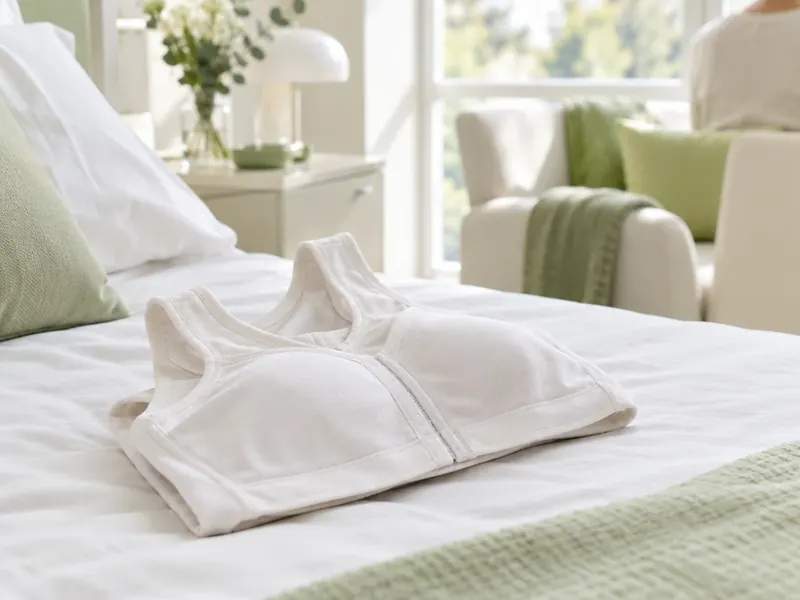
- A compression garment is usually worn for around one to one and a half months.
- Lifting heavy objects and raising the arms above shoulder level are avoided for several weeks.
- Most people return to light daily activities within one to two weeks and to sport after about six weeks, as the surgeon allows.
- The breast takes on its final shape over three to six months.
The result lasts for many years, but it does not stop time. Ageing, weight changes and new pregnancies can make the breasts descend again. Changes in nipple sensation and difficulty with breastfeeding later are possible, and your surgeon should discuss them with you.
Contraindications and preparation
Before the operation the surgeon examines and palpates the breasts. Blood tests, an ECG and a breast ultrasound are usually ordered, and a consultation with other specialists may be needed. The operation is postponed or not advised in some situations.
- Pregnancy, breastfeeding or plans for pregnancy in the near future.
- A lump or change in the breast that has not been investigated.
- Uncontrolled chronic disease, clotting disorders or an active infection.
- Smoking, which increases the risk of poor wound healing; stop well before surgery.
- Unstable weight: it is better to reach a stable weight first.
In the weeks before surgery, your surgeon will tell you which medicines to pause, such as those that affect blood clotting. Plan help at home for the first weeks and arrange time off work.
Breast lift at City Medical Centre
City Medical Centre works with international patients. The clinic performs a breast lift without implants and a breast lift with implants, as well as breast augmentation, breast reduction, implant removal and breast reconstruction. The first consultation is free and can be held online: send photos by Telegram, and the surgeon will assess the degree of sagging and suggest a suitable technique.
The doctor names the cost after the assessment, and it is fixed in the contract. A personal coordinator stays with you from your first message to the end of recovery, and follow-up check-ups with the plastic surgeon continue after the operation. Learn more on the breast surgery page.
How recovery usually goes
- 7–14 daysReturn to work without physical exertion
- 3 weeksPost-op swelling disappears; scars form; no lifting over 3 kg, no raising arms above shoulder level
- 1 monthThe swelling subsides and the breasts take on a natural shape and softness
- 4–6 weeksFitness, swimming, pool and sea; compression garments worn for 4–6 weeks
- 3 monthsDiscomfort disappears; inflammatory changes resolve and a pocket forms around the implant; strength training
Sources
Frequently asked questions
How do I know if I need a breast lift?
A lift is usually considered when the nipple sits at or below the crease under the breast, or when the lower breast hangs and the skin is loose. A simple look in the mirror gives a first idea, but the surgeon confirms the degree of sagging with measurements during the examination.
Which breast lift leaves the smallest scar?
The periareolar lift leaves a scar only around the areola, so it is the shortest. However, it is suitable only for mild sagging. For moderate or severe sagging, a vertical or anchor lift is needed to reshape the breast properly, and the scars are longer.
Can a breast lift be done without implants?
Yes. If the breast has enough volume, the surgeon can lift it using your own tissue, remove excess skin and reposition the nipple. Implants are added only when you also want more fullness, especially in the upper part of the breast.
How long does a breast lift last?
The result usually lasts many years, but the breasts continue to age. Weight changes, pregnancy and loss of skin elasticity can make them descend again over time. Keeping a stable weight, not smoking and wearing a supportive bra help to preserve the result.
When will I see the final result?
The breasts look higher straight after surgery, but they are swollen and firm at first. Most swelling settles within the first weeks, and the final shape usually appears after three to six months. Scars keep fading for up to a year.
Have a question about your case? Get a free consultation
Message a coordinator on Telegram: we reply right in the chat, and you can send photos and questions there too.
- The first consultation is free, online consultations are available
- The doctor names the cost after the assessment, and it is fixed in the contract
- A personal coordinator guides you from the first message to recovery
Message our coordinator on Telegram
We reply right in the chat — you can send photos
Message us on TelegramBy sending a message, you agree to the privacy policy
Read also
 Breast augmentation
Breast lift or implants: which operation do you actually need?
Breast lift or implants? How to tell what you need, what each operation fixes, when to combine them, tests before surgery, recovery and results compared.
 Breast augmentation
Breast reduction recovery: timeline, aftercare and when you see the result
Breast reduction recovery week by week: the first days, restrictions in weeks 1–6, scar care and compression, warning signs and when the final result appears.
 Breast augmentation
Breast Reconstruction After Mastectomy: Options and Timing
When breast reconstruction can be done after mastectomy, immediate versus delayed timing, implant-based methods, nipple restoration, symmetry and recovery.