
























Breast augmentation6 min read
Anchor (inverted-T) breast lift: when this technique is the right choice
When the breasts sag significantly, a small lift through a short incision may not be enough to reshape them. The anchor, or inverted-T, breast lift removes the most skin and gives the surgeon the most control over the new shape, at the cost of a longer scar. This guide explains who usually needs it, how it differs from other techniques, what the scars look like and what recovery involves.
The main points in 30 seconds
- The anchor lift uses incisions around the areola, down the breast and along the fold.
- It is usually needed for significant sagging, large breasts or a lot of excess skin.
- It removes the most skin and gives the most control, but leaves the longest scar.
- Scars usually fade over 6 to 12 months; the T-junction may heal more slowly.
- A lift can be combined with implants when volume is also needed.
Key facts about the procedure
- Operation time1.5–3 hours
- Back to work7–14 days
- Stay in clinic1 day
- Fixed price$4,700
What an anchor breast lift is
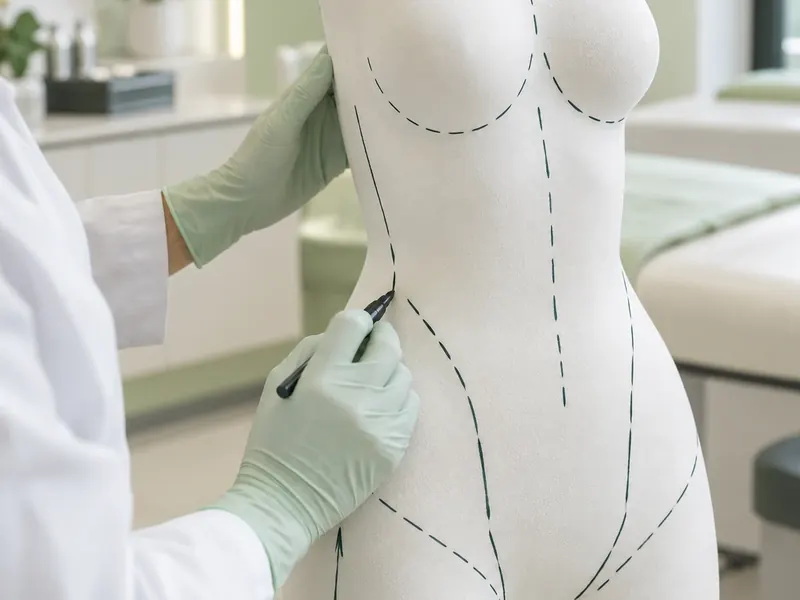
A breast lift (mastopexy) raises and reshapes sagging breasts by removing excess skin, tightening the remaining tissue and moving the nipple and areola higher. The anchor lift is named after the shape of its incisions:
- a circle around the edge of the areola;
- a vertical line from the areola down to the fold under the breast;
- a horizontal line hidden in that fold.
Together they look like an anchor or an upside-down T. This pattern allows the surgeon to remove skin both vertically and horizontally, which is why it suits breasts with a large excess of skin. The nipple usually stays attached to the underlying tissue, which helps preserve its blood supply and, in many cases, sensation.
The operation is performed under general anaesthesia and typically takes one and a half to three hours, longer if it is combined with implants.
Who needs an anchor lift
Surgeons judge sagging mainly by where the nipple sits relative to the fold under the breast and by how much loose skin there is. An anchor lift is usually considered when:
- the nipple sits at or well below the breast fold;
- there is a large amount of stretched, thin skin after pregnancy, breastfeeding or major weight loss;
- the breasts are large and heavy, or the lift is combined with a reduction;
- the lower part of the breast hangs over the fold and the shape cannot be corrected with shorter incisions.
With mild or moderate sagging, a smaller technique is often enough. The decision is always made after an examination and measurements. At a consultation for breast surgery at City Medical Centre, the surgeon assesses the degree of sagging and explains which incision pattern is needed and why.
How it differs from other lift techniques
The main lift techniques differ in how much skin they can remove and how long the scars are.
Crescent
- Scar
- Along the upper edge of the areola
- Usually suited to
- Very slight sagging or a minor nipple adjustment
Periareolar (donut)
- Scar
- Around the areola
- Usually suited to
- Mild sagging with little excess skin
Vertical (lollipop)
- Scar
- Around the areola and down to the fold
- Usually suited to
- Moderate sagging
Anchor (inverted-T)
- Scar
- Around the areola, down to the fold and along the fold
- Usually suited to
- Significant sagging, large breasts, a lot of excess skin
Choosing a shorter scar for breasts that need more correction can backfire: the areola may stretch, the shape may flatten or the sagging may return sooner. That is why the technique is matched to the anatomy rather than to the wish for the smallest scar.

Advantages and drawbacks
Advantages:
- removes the greatest amount of excess skin;
- allows the nipple and areola to be moved a long way up;
- gives precise control over the shape, projection and symmetry of the breast;
- can be combined with a reduction or with implants when volume is also needed.
Drawbacks:
- the longest scars of all lift techniques;
- the point where the vertical and horizontal incisions meet is under the most tension and may heal more slowly;
- a lift does not add volume in the upper breast on its own;
- the result is not permanent: ageing, weight changes and pregnancy affect it over time.
Contraindications
A breast lift is a planned operation, and some situations mean it should be postponed or reconsidered:
- pregnancy and breastfeeding, or a pregnancy planned in the near future;
- an unstable weight or plans to lose a lot of weight;
- chronic illnesses that are not well controlled, such as diabetes or heart disease;
- an active infection or a skin condition in the operated area;
- a breast lump or change that has not yet been investigated;
- blood clotting problems;
- heavy smoking, which greatly increases the risk of poor healing;
- expectations the operation cannot meet.
Before surgery, blood tests, an ECG and a breast ultrasound or mammogram are usually carried out, and other specialists may be consulted if needed.
Possible complications and scar care
Serious complications are uncommon when the operation is well planned and aftercare is followed, but every patient should know the possible risks:
- bleeding (haematoma) or a collection of fluid (seroma);
- infection or slow healing, most often where the incisions meet;
- temporary or, less often, lasting changes in nipple sensation;
- some asymmetry in shape, size or nipple position;
- thick or raised scars;
- rarely, problems with the blood supply to the nipple or skin.
Scars are red at first and usually fade and flatten over 6 to 12 months or longer. To help them mature well, avoid strain on the wound, wear the compression bra as advised, protect the scars from the sun and do not smoke. Your surgeon may recommend silicone gel or sheets once the wounds have closed. Scars that remain thick after the first year can sometimes be improved later.

Is an anchor lift right for you? Ask City Medical Centre
City Medical Centre performs breast lift without implants and breast lift combined with implants, as well as breast augmentation with implants, breast reduction, implant removal and breast reconstruction. The lift technique, including whether an anchor pattern is needed, is chosen by the surgeon after examining you. City Medical Centre does not perform breast surgery with your own fat (fat transfer); other options are discussed at the consultation as general information.
International patients receive a free first consultation, which can be held online, and can send photos and questions via Telegram. A personal coordinator stays with you from the first message to the end of recovery, and the price is set after the assessment and fixed in your contract. Book a consultation about a breast lift to find out which technique suits you.
How recovery usually goes
- 7–14 daysReturn to work without physical exertion
- 3 weeksPost-op swelling disappears; scars form; no lifting over 3 kg, no raising arms above shoulder level
- 1 monthThe swelling subsides and the breasts take on a natural shape and softness
- 4–6 weeksFitness, swimming, pool and sea; compression garments worn for 4–6 weeks
- 3 monthsDiscomfort disappears; inflammatory changes resolve and a pocket forms around the implant; strength training
Sources
Frequently asked questions
When is an anchor breast lift necessary?
It is usually needed when the nipple sits at or below the fold under the breast, when there is a lot of loose skin after pregnancy or weight loss, or when the breasts are large and heavy. With milder sagging, shorter incisions are often enough. The surgeon decides after examining and measuring the breasts.
How visible are anchor lift scars?
The scar goes around the areola, down the lower breast and along the fold underneath. It is red at first and usually fades and flattens over 6 to 12 months or longer. The horizontal part sits in the fold and is covered by a bra or swimsuit, while the vertical part is more noticeable when undressed.
Can an anchor lift be combined with implants?
Yes. If the breasts have lost volume, especially in the upper part, a lift can be combined with implants in one operation. The lift corrects sagging and excess skin, while the implant restores fullness. The surgeon explains whether a single-stage or staged approach is safer for your tissues.
How long is recovery after an anchor lift?
Most people stay one night in hospital and return to desk work after 7 to 14 days. A compression bra is usually worn for four to six weeks, arms are kept below shoulder level for about three weeks and heavy lifting is avoided for longer. The shape continues to settle over several months.
Does an anchor lift affect breastfeeding?
It can. The nipple usually stays attached to the underlying tissue, which helps, but some milk ducts or nerves may be affected, so the ability to breastfeed cannot be guaranteed. If you plan to have children, discuss this with your surgeon; many advise waiting until after pregnancy and breastfeeding.
Have a question about your case? Get a free consultation
Message a coordinator on Telegram: we reply right in the chat, and you can send photos and questions there too.
- The first consultation is free, online consultations are available
- The doctor names the cost after the assessment, and it is fixed in the contract
- A personal coordinator guides you from the first message to recovery
Message our coordinator on Telegram
We reply right in the chat — you can send photos
Message us on TelegramBy sending a message, you agree to the privacy policy
Read also
 Breast augmentation
Breast lift (mastopexy): degrees of sagging, techniques and scars
Breast lift explained: how the degree of sagging is measured, why breasts sag, periareolar, vertical and anchor techniques, scars, recovery and implants.
 Breast augmentation
Breast lift or implants: which operation do you actually need?
Breast lift or implants? How to tell what you need, what each operation fixes, when to combine them, tests before surgery, recovery and results compared.
 Hair transplant
Male pattern baldness: treatment options and when to consider a transplant
What causes male pattern baldness, how Norwood stages work, which treatments slow it down, when a hair transplant makes sense and how to care for the result.