


























Hair transplant7 min read
Male pattern baldness: treatment options and when to consider a transplant
Male pattern baldness, or androgenetic alopecia, is the most common reason men lose hair. It starts with a receding hairline or thinning at the crown and usually progresses slowly over years. This article explains what causes it, how to tell which stage you are at, what treatment can and cannot do, and when a hair transplant becomes the logical step.
The main points in 30 seconds
- Androgenetic alopecia is hereditary: follicles sensitive to DHT gradually shrink.
- The back of the head is resistant to DHT and serves as the donor area.
- Treatment slows loss and keeps existing hair, but only while it continues.
- A transplant makes sense once the diagnosis is confirmed and bald areas are visible.
- CMC performs FUE, DHI and combined transplants under local anaesthesia.
Key facts about the procedure
- Stay in clinicSame day
- Final result12–18 months
- AnaesthesiaLocal
- Price
$2,700from $2,200
What causes androgenetic alopecia
Androgenetic alopecia is a hereditary condition. Hair follicles in certain areas of the scalp are genetically sensitive to dihydrotestosterone (DHT), a hormone formed from testosterone. Under its influence these follicles gradually shrink: each new hair cycle produces a thinner, shorter and lighter hair, until the follicle stops producing visible hair at all.
The process affects the temples, the front hairline and the crown. The hair at the back and sides of the head is usually resistant to DHT and stays for life. This is why that area is used as the donor zone in a transplant: hair moved from there keeps its resistance in its new place.
Genes from both parents play a role, and the condition can begin as early as the late teens or twenties. Stress, illness or poor diet do not cause androgenetic alopecia, although they can cause temporary shedding that makes it look worse for a while.
Norwood stages and how to identify yours
Doctors often describe male pattern baldness with the Norwood scale. It helps to track progression and to plan treatment, including the number of grafts a transplant would need.
1–2
- What it looks like
- Slight recession at the temples, hairline almost intact
- Usual approach
- Observation and treatment to slow loss
3
- What it looks like
- Deep recession at the temples, or thinning at the crown (3 vertex)
- Usual approach
- Treatment; a transplant can restore the hairline
4–5
- What it looks like
- Bald areas at the front and crown, separated by a band of thinning hair
- Usual approach
- Transplant plus treatment of the remaining hair
6–7
- What it looks like
- Front and crown merge into one large bald area
- Usual approach
- Transplant limited by the donor reserve; priority to the front
To judge your stage, look at the hairline and crown in good light, take photos from the front, the top and both sides, and compare them every few months. A doctor can confirm the stage at a consultation, including from photos.

Diagnosis before choosing treatment
Not every case of thinning hair is androgenetic alopecia. Before treatment is chosen, the doctor needs to rule out other causes, because they are treated differently:
- patchy (alopecia areata), in which round bald patches appear and which is treated by a dermatologist;
- shedding after illness, surgery, childbirth or severe stress;
- shedding caused by hormonal imbalance, such as thyroid disorders;
- iron deficiency and other nutritional deficits;
- scarring conditions, skin diseases of the scalp and hair pulling (trichotillomania).
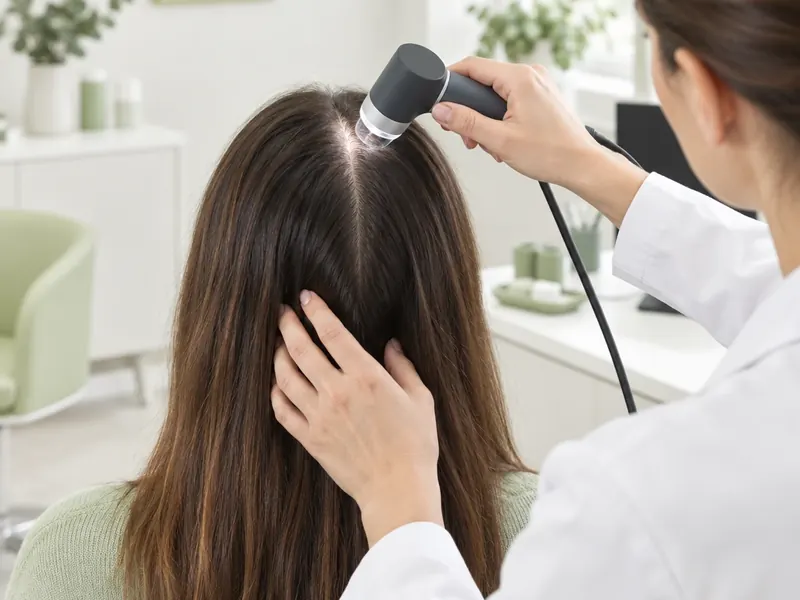
The assessment usually includes an examination of the scalp, trichoscopy (magnified examination of the hair and skin) and, if needed, blood tests. The typical pattern of androgenetic alopecia is thinning hairs of different thickness in the affected area, while the back of the head stays dense.
Medical and in-clinic treatments
Treatment of androgenetic alopecia aims to slow further loss and keep the hair you still have. It works best at early stages, while follicles are still active.
- Medicines that slow hair loss. Topical solutions that stimulate follicles and tablets that reduce the effect of DHT are used. They are prescribed by a dermatologist after an assessment, and the effect lasts only while they are taken.
- PRP therapy. Injections of the patient’s own platelet-rich plasma into the scalp may support weakened follicles and healing after a transplant.
- Other in-clinic methods. Laser therapy and microneedling are used in some clinics; the evidence for them is more modest.
- Trichopigmentation. A cosmetic technique that imitates short hair with pigment and reduces the contrast between the scalp and the hair.
Treatment cannot bring back hair where the follicles are gone and the skin is smooth. It also needs to be continued: when it stops, the process usually resumes.
When a transplant is the right step
A hair transplant moves follicles from the donor area to thinning or bald areas. It does not create new hair, it redistributes the hair you have. It is usually worth discussing when:
- the diagnosis of androgenetic alopecia is confirmed;
- there are clearly visible bald or thin areas, such as a receding hairline or crown;
- hair loss has slowed or is controlled with treatment;
- the donor area at the back of the head is dense enough;
- you are over 18 and have realistic expectations about density.
A transplant is not recommended in patchy alopecia, in shedding after illness or hormonal imbalance, in trichotillomania and body dysmorphic disorder, or when donor hair is insufficient. Serious heart disease, diabetes, epilepsy, a pacemaker, cancer and some infections such as HIV and hepatitis B or C are also contraindications. The number of grafts depends on the stage and the donor reserve; in real cases shown on the City Medical Centre page, patients received from about 2,500 to 4,000 grafts.
Long-term care after a transplant
Transplanted hair keeps the resistance of the donor area, but the native hair around it can continue to thin. That is why long-term care matters:
- in the first 10 days the crusts come off and the swelling goes down;
- after 2–4 weeks the transplanted hairs shed — this is normal, the follicles stay in place;
- new hair starts to grow after 3–4 months;
- visible density appears after 6–9 months, and the final result forms after 12–18 months.
A dermatologist decides whether to continue treatment for the native hair. PRP sessions may be recommended after surgery. Follow the washing and sleeping instructions, protect the scalp from the sun and avoid sport until the doctor allows it. Follow-up visits track how the new hair is growing.

Getting a personal plan at City Medical Centre
City Medical Centre works with international patients and performs hair transplants using FUE, DHI and a combined FUE and DHI method. FUE is used for androgenetic alopecia, and the combined FUE and DHI method for androgenetic alopecia and for densification. The operation is done under local anaesthesia in one day, with grafts taken from the back or sides of the head without stitches. The clinic also offers PRP therapy and trichopigmentation.
Long-term medical treatment of hair loss is prescribed by a dermatologist, and City Medical Centre does not offer laser therapy or microneedling courses; they are mentioned here as general information. Transplants are not performed in patchy alopecia, which is treated by a dermatologist first.
The first consultation is free and can be held online. Send photos of your hairline, crown and the back of your head, and the doctor will estimate your stage, the donor reserve and the number of grafts. The cost is named after assessment and fixed in the contract. Follow-up appointments are planned at 1, 3, 6, 9 and 12 months, and a personal coordinator stays with you throughout. Photos and questions can be sent by Telegram. Read more on the hair transplant page.
How recovery usually goes
- 0-10 daysHealing: the crusts come off, the swelling goes down, the area gradually recovers
- 2-4 weeksShedding of the transplanted hairs: a normal stage, only the hairs fall out, the follicles stay in place
- 3-4 monthsGrowth begins: new hairs gradually appear, the result starts to show
- 6-9 monthsVisible density: the hair becomes thicker, the main volume and contour are visible
- 12-18 monthsFinal result: the final density and a natural hairline take shape
Sources
Frequently asked questions
Can male pattern baldness be stopped?
It cannot be cured, but it can be slowed. Medicines prescribed by a dermatologist and PRP therapy help keep existing hair, especially at early stages. When treatment stops, hair loss usually resumes, so the plan is long-term.
At what Norwood stage should I get a transplant?
Most often from stage 3, when the hairline or crown has clearly receded. At stages 1–2 treatment usually comes first. At stages 6–7 a transplant is possible, but it is limited by the donor reserve, so the front is usually restored first.
Do vitamins help androgenetic alopecia?
Vitamins help only if there is a real deficiency, such as low iron. They do not stop the hereditary process caused by sensitivity to DHT. Blood tests show whether a deficiency exists, and the doctor decides whether to correct it.
Will transplanted hair fall out again?
The transplanted hairs shed 2–4 weeks after surgery, but the follicles stay and start growing again after 3–4 months. Follicles from the donor area are resistant to DHT, so the transplanted hair usually keeps growing. The native hair around it can still thin.
How many grafts do I need for my stage?
It depends on the size of the area, the desired density and the donor reserve. A receding hairline needs fewer grafts than a front and crown together. In real City Medical Centre cases, patients received from about 2,500 to 4,000 grafts; the doctor counts your number at the consultation.
Have a question about your case? Get a free consultation
Message a coordinator on Telegram: we reply right in the chat, and you can send photos and questions there too.
- The first consultation is free, online consultations are available
- The doctor names the cost after the assessment, and it is fixed in the contract
- A personal coordinator guides you from the first message to recovery
Message our coordinator on Telegram
We reply right in the chat — you can send photos
Message us on TelegramBy sending a message, you agree to the privacy policy
Read also
 Hair transplant
Hair loss treatments vs hair transplant: what works and when
Treatment or transplant? How medication, supplements and PRP work, what they cannot do, when a transplant becomes the logical step and why the two are often combined.
 Hair transplant
Stages of hair loss step by step: the Norwood and Ludwig scales explained
The stages of hair loss explained: the Norwood scale for men, the Ludwig scale for women, common causes and how the stage affects the choice of treatment.
 Arthritis treatment
Arthritis treatment without surgery: options, who they suit and when an operation is discussed
Treating arthritis without surgery: exercise, supports, physiotherapy, PRP and SVF injections, when to see a rheumatologist and when surgery is discussed.