




earlier
12 months by now
2,800 grafts
FUE method
City Medical Centre
Free quote
Free consultation and cost estimate.
Actual case
earlier
12 months by now
The FUE method, no incisions or stitches. Grafts and forecast tallied without a penny — before you decide.
With no fee, no surgery booking required
Message our coordinator
Free online consultation · Reply within 15 minutes
Message us on TelegramMessage us on WhatsAppBy messaging us, you agree to our Privacy Policy
results
Every result here comes from a genuine patient.
earlier
12 months by now
2,800 grafts
FUE method

earlier
12 months by now
3,500 grafts
FUE method

earlier
12 months by now
2,600 grafts
FUE method

earlier
12 months by now
3,000 grafts
FUE method

earlier
12 months by now
2,700 grafts
FUE method

earlier
12 months by now
3,300 grafts
FUE method

earlier
12 months by now
2,900 grafts
FUE method

earlier
12 months by now
2,500 grafts
FUE method

earlier
12 months by now
3,400 grafts
FUE method

earlier
12 months by now
2,500 grafts
FUE method

earlier
12 months by now
3,100 grafts
FUE method

earlier
12 months by now
3,600 grafts
FUE method

earlier
12 months by now
4,000 grafts
FUE method

earlier
12 months by now
3,200 grafts
FUE method

earlier
12 months by now
3,000 grafts
FUE method

earlier
12 months by now
3,700 grafts
FUE method

earlier
12 months by now
2,700 grafts
FUE method

earlier
12 months by now
3,800 grafts
FUE method

earlier
12 months by now
3,300 grafts
FUE method

earlier
12 months by now
2,800 grafts
FUE method

earlier
12 months by now
2,500 grafts
FUE method

earlier
12 months by now
3,900 grafts
FUE method

earlier
12 months by now
3,500 grafts
FUE method

earlier
12 months by now
3,800 grafts
FUE method

earlier
12 months by now
2,900 grafts
FUE method

earlier
12 months by now
3,600 grafts
FUE method

earlier
12 months by now
2,600 grafts
FUE method

earlier
12 months by now
2,700 grafts
FUE method

earlier
12 months by now
3,700 grafts
FUE method

earlier
12 months by now
3,200 grafts
FUE method

earlier
12 months by now
3,000 grafts
FUE method

earlier
12 months by now
2,800 grafts
FUE method

earlier
12 months by now
4,000 grafts
FUE method

earlier
12 months by now
3,400 grafts
FUE method

earlier
12 months by now
2,900 grafts
FUE method

earlier
12 months by now
3,100 grafts
FUE method

earlier
12 months by now
2,600 grafts
FUE method

earlier
12 months by now
3,300 grafts
FUE method

earlier
12 months by now
3,900 grafts
FUE method

earlier
12 months by now
3,500 grafts
FUE method

earlier
12 months by now
2,700 grafts
FUE method

earlier
12 months by now
3,800 grafts
FUE method

earlier
12 months by now
3,200 grafts
FUE method

earlier
12 months by now
3,000 grafts
FUE method

earlier
12 months by now
2,800 grafts
FUE method

earlier
12 months by now
3,100 grafts
FUE method

earlier
12 months by now
3,600 grafts
FUE method
Comparison
The clinic works with three graft transfer technologies: classic FUE, suture-free DHI and a combined protocol. Implantation technique, tissue trauma and graft survival differ, so compare before choosing.
Classic technique without incisions or stitches

On request
Graft implantation technique
ForcepsGraft trauma
MinimalNatural hair growth angle
NaturalGraft survival
98–100%Suitable for
Androgenetic alopeciaSuture-free implantation with a Choi pen

On request
Graft implantation technique
DHI pen (Choi implanter)Graft trauma
MinimalNatural hair growth angle
NaturalGraft survival
98–100%Suitable for
DensificationFUE extraction, DHI pen implantation

On request
Graft implantation technique
FUE extraction + DHI implantationGraft trauma
MinimalNatural hair growth angle
NaturalGraft survival
98–100%Suitable for
Androgenetic alopecia and densificationThe numbers for survival and trauma are averaged for each method and given as a guide: exact values depend on the transplant area and the patient's individual features and are clarified by the doctor at consultation.
Arrange a consultation


















about the clinic
Clean, well-equipped rooms and staff who notice you

Ask us anything, we will reply.
Message us on Telegram Message us on WhatsApp Send your detailsIf your case does not call for surgery, you will be told so at the consultation, sparing you a pointless expense. Listed below are the situations where a transplant is genuinely effective.
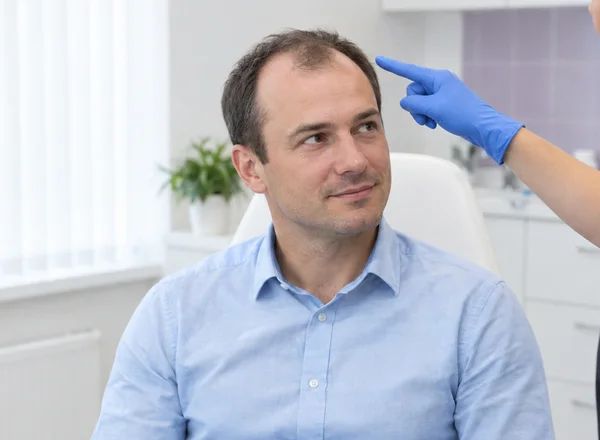

Write to us in WhatsApp or Telegram. The coordinator collects close-up pictures through a messenger, a doctor reviews them and says whether a transplant would help. No fee, and no operation is booked.

services
The grafts are counted at the free consultation, the cost is quoted and fixed in the contract.
| The first sit-down | Free |
|---|---|
| Eyebrow transplant, FUE | On request |
| Beard transplant, FUE | On request |
| Hair trichopigmentation | On request |
| PRP therapy / session | On request |
all included
From preparation for surgery to follow-up at 12 months.
No surprise costs on the day of the surgery.
two more patches
Beyond the scalp too: the same grafts from the back of the head, the same FUE method — only the area changes.
FUE method, no incisions or stitches

Grafts are taken from the donor area at the back of the head and go in through micro-punctures of about 1 mm — no scars are left. The doctor discusses the shape with you ahead of the operation, taking your facial features into account. Transplanted hair grows for life: trim and style the beard as usual.
On request
Nail down the priceFUE method, no incisions or stitches

The brow design is settled at the first consultation, with the surgeon drawing the line, reference images reviewed jointly and your face's proportions guiding every curve. Implanted at the angle of natural growth, the hairs keep the result believable. This is also the answer when long plucking has put an end to growth.
On request
an op you leave the same day, local anaesthesia
Nail down the priceAn inspection of the donor zone, a graft number and a clear view of what the outcome will be. Nothing about the cost changes once the contract has been signed.

Message our coordinator
Free online consultation · Reply within 15 minutes
Message us on TelegramMessage us on WhatsAppBy messaging us, you agree to our Privacy Policy
Process
From consultation to going home — all in one day

Before anything else the doctor explains the workings of the DHI and FUE methods, responds to whatever you ask, and inspects the donor area.

A deposit is all it takes to lock the day in. Card payment happens at the clinic, or the payment can be made online.

The tests required beforehand are spelled out by the clinic, which also explains how each of them should be taken.

This stage applies local anaesthesia, which keeps the entire operation painless.

Follicular units are gathered behind the head or at the temples, with no suturing at any point.

The surgeons work through the balding area, implanting the grafts one by one.
The clinic makes recovery straightforward, offering everything necessary and complete instructions for fast healing.

The crusts are gone, the swelling goes down, the area recovers

A normal stage. Only the hairs leave, the follicles stay in place

Young hairs push through, the change becomes noticeable

The hair gains body, and the volume and hairline can be seen

Your final density and natural hairline take shape

Free, before the operation and asking nothing in return.
Arrange a consultationdoctors

Hair transplant doctor, trichologist, surgeon
10 years of experience

Dermatovenereologist, trichologist, surgeon
11 years of experience

Plastic surgeon
9 years of experience

Plastic surgeon
9 years of experience

Assistant
9 years of experience
You get an examination of the donor zone, a graft figure and a straight answer on the outcome.
Arrange a consultationcoordinators
Every patient is assigned a personal coordinator, from the first enquiry to recovery.

Your care coordinator
Stays in touch from the first step to recovery
Runs the paperwork and keeps your diary
Your care coordinator
Stays in touch from the first step to recovery
Runs the paperwork and keeps your diary

Your care coordinator
Stays in touch from the first step to recovery
Runs the paperwork and keeps your diary
Your care coordinator
Stays in touch from the first step to recovery
Runs the paperwork and keeps your diary













What gets asked

Yes — City Medical Centre regularly treats patients from other cities and countries, starting with an online consultation.
The exact figure is confirmed for free after a graft count and written into the contract.
The whole operation is completed in one day, with no overnight stay needed.
No — a local anesthetic removes sensation for the whole operation.
FUE means tweezer-based, incision-free graft harvesting. DHI means channel-free implantation with a Choi pen. Combined DHI+FUE uses FUE for harvesting and the DHI pen for implanting.
The total is individual and is named by the doctor, without charge, after the donor area is examined.
After surgery, 0–10 days are enough for healing. A 2–4 week shed is normal. Hair starts again at 3–4 months, thickens visibly through 6–9 months, and the finished look lands at 12–18 months.
A contract-backed, lifetime guarantee of hair growth comes with every procedure.
A medical licence, and care provided to the standards and clinical guidelines
of the Ministry of Health.
There is no cutting and no stitching in FUE or DHI, and local anaesthesia is all a patient in Inezgane receives. The operation fills one day and ends there, without a second appointment for the surgery itself.
Before deciding anything, a patient in Inezgane gets a free online consultation: pictures of the thinning area go to the doctor, and the doctor states whether a transplant is worth doing. The clinic answers 24/7.
Skin settles over 0-10 days. Then come 2-4 weeks, when the transplanted hairs drop out - normal, expected, and no reason to worry. Growth resumes at 3-4 months, slowly at first and then in earnest.
The cost is calculated individually after a free online consultation. Write to us on WhatsApp or Telegram.
By messaging us, you agree to our Privacy Policy
Inezgane is the capital of the Inezgane-Aït Melloul Prefecture, on the north bank of the Sous River, about 11.5 km south of Agadir on the Atlantic coast of Morocco. It is in some ways a suburb of larger Agadir, yet it keeps the identity of a typical Moroccan city rather than a tourism-centred one. People here work in trade, transport, crafts and services, and many of them spend long days outdoors and in front of customers.
For men in Inezgane, thinning at the temples, a receding frontal hair line, a bare crown or a patchy beard are everyday concerns. They come up at the barber, in the family and at work. This text explains how hair transplantation by the FUE or DHI method fits into the rhythm of Inezgane and how to plan it calmly.
The operation is performed at the clinic in Rabat, Morocco. Your first contact, however, takes place from Inezgane: a free online consultation, with coordinators available around the clock (24/7) on Telegram and WhatsApp.
Grafts are taken from the back of the head, the donor area, and moved through micro-punctures of about 1 mm, so nothing scars over. FUE and DHI differ in the way the grafts are placed, and the doctor will explain which approach suits your case after seeing your photos and hearing your goals.
The doctor discusses the shape with you before the operation, taking your facial features into account. For a man in Inezgane this matters in practice: a hair line that looks natural in a close family setting, at a wedding or at the weekly market must not look drawn on or too low.
Transplanted hair grows for life: trim and style the beard as usual. The same applies to scalp hair, which you can cut and style at your usual barber once the healing period is over.
Inezgane lies in the Souss valley close to the Atlantic coast, and the area can be very hot. Local records even mention extreme temperatures, although the highest figure is disputed. For a fresh transplant this means that sun, heat and sweat are the main things to manage in the first days.
During the first stage, 0–10 days for healing, avoid direct sun on the treated area, avoid dusty places and do not cover the area with tight headwear unless the surgeon allows it. Dust from busy roads and construction is a real factor in a transport hub, so plan your first days at home, in a cool and clean room.
Sea and pool are part of life in the Agadir area. Do not go into salt water or a pool until the surgeon tells you the skin is ready. Ask for written instructions on washing, sleeping position and sun protection, and keep them on your phone.
Many patients from Inezgane choose the cooler months, when it is easier to stay indoors and avoid strong sun. Summer is possible, but it requires more discipline: shade, light loose clothing, a clean cap only if the surgeon approves it, and no long hours outdoors.
Think also about your calendar. Weddings, family gatherings, Eid and the summer holiday season all bring photos and close contact. Remember the timeline: 2–4 weeks is the period when transplanted hairs let go, as expected. Do not schedule the operation right before an event where you want to look your best.
Discuss the date with your coordinator. Because the first consultation is online, you can compare several options for the season without leaving Inezgane.
Inezgane is known for its souks, silver jewellery and the vegetable, fruit and spice market. Tuesday is the main market day, when people arrive from nearby villages to sell goods and buy provisions for the week. If you work at a stall, in transport or in a shop, you spend many hours in sun, crowds and dust.
Plan the operation so that the first days of healing do not fall on your busiest trading period. Tell the surgeon honestly what your job involves: standing in the open air, helmets, uniforms, caps, heavy physical effort. The advice on returning to work depends on this.
If your work is in an office or you study, the practical question is mainly visible redness and the shedding phase. Many people choose a quiet period at work or in the academic calendar. Ask your coordinator what to expect in each phase so that you can tell your employer or family only what you wish.
Food culture in the Souss region is built around vegetables, fruit, spices and shared meals. Family gatherings are central, and a transplant is easier to manage if the household knows the plan. Ask your spouse, parents or a close friend to help with washing and sleeping position in the first days.
Avoid crowded kitchens, smoke from grills and dusty courtyards during the early healing. Ask the surgeon about alcohol, smoking and any medication you take, and follow the answer exactly.
The region has a strong cultural life, with Amazigh traditions and local festivals. If you plan to take part in a dance, a festival or a family celebration, count the days honestly and leave margin before the event.
Football on a local pitch, running along the river or the coast and gym training are common in the Agadir area. After the operation, heavy sport, sweating and contact are limited for a period set by the surgeon. Do not rely on a friend's experience; ask for your own schedule.
Swimming in the sea or pool is the same: wait for the surgeon's permission. Sun after sport is a second risk, so shade and clean light headwear approved by the doctor are your allies.
If you play in a team, tell your teammates when you will be absent and explain that it is a medical break, not a lack of interest.
A good candidate has enough healthy hair in the donor area, realistic expectations and stable general health. The surgeon looks at the pattern of loss, age, the density of the back of the head and your family history of hair loss.
Some conditions call for caution or postponement: unstable chronic illness, active scalp disease, problems with wound healing, or unrealistic goals. Tell the surgeon about all medication and past operations. Hair loss may also have a medical cause, and a good consultation checks this first.
Send clear photos from several angles during the online consultation from Inezgane. This lets the team give a first opinion before any decision.
Patience is the main skill. In summary: 0–10 days for healing, 2–4 weeks for normal shedding of transplanted hair, 3–4 months for new growth to start, 6–9 months for real density, and 12–18 months for the final result.
One patient described it this way: now the result truly makes him very happy. From about the 4th month active, even growth began, the transplanted hair took very well, the beard looks as natural as possible and no bald patches are left. It became much thicker and denser, with the shape he had thought about for a long time.
We stay with you from pre-op planning to 12 months later, with check-ups at months 1, 3, 6, 9 and 12. A coordinator will be on the phone 24/7, so a worry at night in Inezgane does not have to wait.
Men in Inezgane often start with a practical list: how natural the hair line will look, whether the donor area will be visible after a short haircut, and how long they must stay out of the sun. These are sensible questions, and it helps to write them down before the chat with the coordinator, so nothing is forgotten once the conversation begins.
A second group of questions concerns family and work. Will colleagues notice? What do I tell relatives? How do I explain a few weeks of caution to a team at the shop, the stall or the workshop? Many patients decide to say simply that they are having a medical procedure and to share details only with people they trust.
Ask the surgeon what the plan is if the first result is thinner than hoped, how the density is planned across the frontal zone and the crown, and which areas are treated first. Honest answers at this stage prevent disappointment at month 6 or month 12.
Inezgane is a regional hub where the N1, N8 and N10 highways meet, and the Souss-Massa region is busy with trade, farming and tourism around Agadir. Life here runs fast, so the healing days should be written into the calendar as protected time, like any other important commitment.
Before the operation, arrange deliveries, shopping and family errands for the first days, so that you are not tempted to go out into traffic, dust and bright sun too early. Keep a light clean pillow cover, the written care instructions and the coordinator's chat on your phone within reach.
Agriculture and citrus growing are important in the wider Souss-Massa region, and many families have ties to farm work. If you work in the fields or in packing, discuss dust, sun and bending with the surgeon, because the advice on returning to this kind of work is more careful than for desk work.
Some men in Inezgane come for the scalp, others for a patchy beard, and some for both. The doctor plans each area on its own, because density, direction of growth and the number of grafts needed are different on the head and on the face.
A beard looks natural only when the angle of the hairs follows the real growth pattern of the face. Ask to see how the plan treats the cheeks, the chin line and the area around the mouth, and discuss which beard length you wear in daily life.
For the scalp, ask how the temples, the frontal hair line and the crown are balanced, so that the result still looks right in ten or twenty years as the rest of the hair changes.
You write to the coordinators on Telegram or WhatsApp, send photos of the head or beard, and describe your goals and health history. The online consultation is free and takes place from your own city.
The doctor then proposes a plan: method, shape, area and timing. The operation itself is performed at the clinic in Rabat, Morocco. Inezgane sits where the N1, N8 and N10 highways meet and is an important transport hub of the Souss-Massa region, so many people here are used to organising their time around the roads; still, agree every practical detail with your coordinator in advance.
After the operation you stay in contact for the whole recovery, including the check-ups at months 1, 3, 6, 9 and 12.
Yes. The first consultation is online and free. Write to the coordinators on Telegram or WhatsApp, send photos and describe your goals.
At the clinic in Rabat, Morocco. Planning and follow-up are handled remotely from your own city.
Both use grafts taken from the donor area at the back of the head. They differ in how the grafts are placed. The doctor recommends the approach after reviewing your case.
Grafts are moved through micro-punctures of about 1 mm, so nothing scars over. The doctor discusses the shape with you before the operation.
Transplanted hairs let go after 2–4 weeks, as expected. Hair comes back at 3–4 months, becomes visibly thicker at 6–9 months, and the settled look comes at 12–18 months.
Heat, sun, dust and sweat need care during the first days, which are the 0–10 days of healing. Stay in shade, keep the area clean and follow the surgeon's written instructions.
Not until the surgeon confirms the skin is ready. Ask for a clear date for your own case.
It depends on your work. Tell the surgeon about sun, dust and physical effort so that the advice on return to work fits your situation.
Yes. Transplanted hair grows for life: trim and style the beard as usual.
We stay with you from pre-op planning to 12 months later, with check-ups at months 1, 3, 6, 9 and 12. A coordinator will be on the phone 24/7.
Yes. Write down your goals, your work conditions, your health history and any medication, and send clear photos. This lets the coordinator and the doctor give a more useful first opinion.
In the first days some redness and small crusts are normal, and from 2–4 weeks the transplanted hairs let go, as expected. Many patients plan this phase around a quieter period at work and in the family.
You can discuss both in the same online consultation. The doctor plans each area separately, taking your facial features into account, and explains the order and timing.

 Forceps
 Minimal








