


























Joint treatment6 min read
Shoulder joint pain: treatment without surgery and the signs that an operation is needed
Shoulder pain is one of the most common reasons people see a joint specialist, and in most cases it can be managed without an operation. This article explains what usually causes the pain, how the stage of joint damage is judged, which scans are worth doing, what non-surgical treatment includes and which situations really call for a surgeon.

The main points in 30 seconds
- Most shoulder pain is treated first without surgery: load changes, exercise and injections.
- Common causes are rotator cuff problems, arthrosis, frozen shoulder and instability.
- X-ray shows bone and joint space; ultrasound and MRI show tendons and cartilage.
- PRP and SVF work best in early and moderate stages and do not replace a rheumatologist.
- Large fresh tears, repeated dislocations and end-stage arthrosis are cases for a surgeon.
Can shoulder pain be treated without surgery?
Usually, yes. Most shoulder problems, including tendon irritation, early wear of the joint and many partial tendon tears, are treated first with activity changes, exercises and injections. Surgery is kept for specific cases: a large fresh tear, a joint that keeps dislocating, or advanced joint damage that no longer responds to other treatment.
The key is to find the exact cause. The shoulder is the most mobile joint in the body, and pain in the same spot can come from the joint surfaces, the tendons around them or even the neck. A treatment that helps one of these problems can be useless for another.
Common causes: arthrosis, tendons, rotator cuff, instability
- Rotator cuff problems. Four muscles and their tendons hold the head of the arm bone in the socket. With age and repeated overhead work they can become irritated or torn. Pain is typical when lifting the arm to the side and when lying on that shoulder.
- Arthrosis (osteoarthritis). The cartilage of the joint thins out, often after an old injury or with age. The shoulder becomes stiff, may click or grind, and aches after load.
- Frozen shoulder. The joint capsule thickens and tightens, so movement becomes painful and then very limited. It often improves on its own, but slowly, over one to two years or more.
- Instability. After a dislocation the joint may keep slipping out of place, especially in younger and active people.
- Inflammatory arthritis. Rheumatoid arthritis and similar conditions can affect the shoulder together with other joints. These need a rheumatologist.
Pain can also spread to the shoulder from the neck. If it runs down the arm with numbness or tingling, the doctor will check the spine as well.
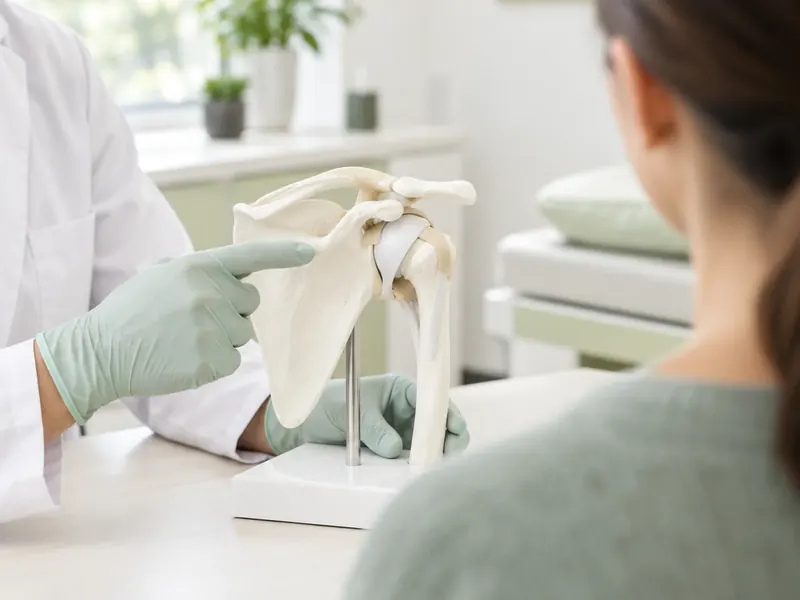
Symptoms and stages of shoulder joint damage
Joint wear develops gradually. Doctors describe it in stages based on symptoms and X-ray findings:
Early
- What you usually feel
- Ache after load, mild morning stiffness
- What scans show
- Small changes or a normal X-ray; MRI may show cartilage thinning
Moderate
- What you usually feel
- Pain with daily tasks, clicking, reduced range of movement
- What scans show
- Narrowed joint space, bony spurs
Advanced
- What you usually feel
- Pain at rest and at night, hard to lift the arm or reach behind the back
- What scans show
- Little joint space left, deformed joint surfaces
Non-surgical treatment works best in the early and moderate stages. The more cartilage is left, the more there is to protect.
Diagnosis: which scans show the problem
A diagnosis starts with a conversation and an examination: the doctor checks which movements hurt, how strong the arm is and how far it can be lifted. Then scans are chosen to answer a specific question:
- X-ray shows the bones, the joint space and bony spurs. It is the basic test for arthrosis.
- Ultrasound shows tendons, fluid and inflammation, and allows the doctor to watch the tendons while you move.
- MRI gives the most detailed picture of cartilage, tendons, the labrum and bone. It is useful when a tear is suspected or before planning treatment.
- Blood tests are added when an inflammatory type of arthritis is suspected.
If you already have recent scans, they are often enough for a first assessment, including an online one.
Non-surgical treatment: physiotherapy, PRP and SVF
A good plan usually combines several steps rather than relying on one injection.
Load management and exercise
Short-term changes to overhead work and sport give irritated tissues time to calm down. A physiotherapist then builds a programme to restore movement and strengthen the rotator cuff and shoulder blade muscles. For many tendon problems, exercise is the main treatment, and results usually take several weeks to appear.
Medication and other injections
Painkillers and anti-inflammatory medicines, chosen by a doctor, can ease a flare-up. Steroid injections may calm severe inflammation for a while, but they are generally not repeated often. These are general options; which of them suits you is decided at a consultation.
PRP and SVF
PRP is platelet-rich plasma prepared from a small amount of your own blood. SVF is the stromal vascular fraction, a mix of cells isolated from a small sample of your own adipose tissue. Both are injected into the joint under ultrasound guidance to reduce pain and inflammation and support the tissues. PRP can be given as a course; SVF combined with plasma is usually chosen when changes are more pronounced. Neither method replaces a rheumatologist when arthritis is inflammatory. Details are on our joint treatment page.
When surgery is needed
Surgery is worth discussing with an orthopaedic surgeon when:
- a large rotator cuff tear happened after an injury and the arm has suddenly become weak;
- the shoulder dislocates again and again;
- pain at night and at rest persists despite several months of proper non-surgical treatment;
- the joint surfaces are badly destroyed and daily life is seriously limited.
Typical operations include arthroscopy (keyhole surgery to repair tendons or the labrum or to release a stiff capsule) and, for end-stage arthrosis, shoulder replacement. These are general facts: the choice of operation is made by the surgeon after examination.
See a doctor urgently if the shoulder is hot, red and swollen with a fever, if it looks deformed after a fall, or if shoulder or arm pain comes with chest pain or shortness of breath.

Getting a personal plan at City Medical Centre
City Medical Centre works with international patients and treats the shoulder without surgery: with PRP from your own blood and SVF cell therapy from your own adipose tissue, injected under ultrasound guidance. The clinic does not perform arthroscopy, shoulder replacement or steroid injections; if your scans show that one of these is the better option, the doctor will tell you so openly.
The first consultation is free and can be held online: send your X-rays, MRI or ultrasound results with a short description of your symptoms. If PRP or SVF suits your case, the doctor explains the plan and names the cost, which is then fixed in the contract. A personal coordinator stays with you from the first message to the follow-up visits, and scans and questions can be sent by Telegram. Read more on the joint treatment page.
Sources
Frequently asked questions
Do injections help shoulder arthritis?
They can reduce pain and inflammation, especially in the early and moderate stages. PRP and SVF use material from your own body and are given under ultrasound guidance. Injections work best together with exercise and sensible load, and a doctor decides after reviewing your scans whether they suit you.
Can a rotator cuff injury heal without surgery?
Many partial tears and tendon irritation improve with rest from overhead activity, physiotherapy and injections. A large fresh tear after an injury, especially in a younger active person with sudden weakness, is more often repaired surgically. The decision depends on the size of the tear, your age and how much the arm is used.
Which doctor should I see for shoulder pain?
Start with an orthopaedic or joint specialist, who examines the shoulder and orders scans. If pain affects several joints and comes with morning stiffness, a rheumatologist is also needed. A physiotherapist usually joins the treatment once the cause is clear.
Can shoulder arthrosis be cured completely?
Worn cartilage does not return to its original state, so the aim is to reduce pain, keep movement and slow further damage. Many people live actively for years with the right exercise, load and injections. How long an effect lasts differs from person to person.
When does shoulder pain need surgery?
When there is a large fresh tendon tear with weakness, repeated dislocations, or advanced joint destruction with pain at rest that has not improved after several months of proper non-surgical treatment. An orthopaedic surgeon makes this decision after an examination and scans.
Have a question about your case? Get a free consultation
Message a coordinator on Telegram: we reply right in the chat, and you can send photos and questions there too.
- The first consultation is free, online consultations are available
- The doctor names the cost after the assessment, and it is fixed in the contract
- A personal coordinator guides you from the first message to recovery
Message our coordinator on Telegram
We reply right in the chat — you can send photos
Message us on TelegramBy sending a message, you agree to the privacy policy
Read also
 Joint treatment
SVF cell therapy for joints: how it works and who it suits
SVF cell therapy for joints explained: where the cells come from, which joints it helps, the procedure, recovery, SVF vs PRP and contraindications.
 Joint treatment
Avascular necrosis of the hip: what can be done in the early stages
Avascular necrosis of the hip is easiest to treat early. Learn the causes, first signs, why MRI matters, the stages and where SVF and PRP fit before surgery.
 Facelift
Skin care after a facelift: a practical guide to the first weeks and months
How to care for your skin after a facelift: incisions, swelling, food and medicines, sun protection, when to return to skincare and make-up, and warning signs.