























Facelift6 min read
Platysmaplasty: how neck bands and a loose neck are corrected
The neck often shows age earlier than the face: vertical cords appear under the chin, the angle between chin and neck softens and the skin becomes loose. Creams and exercises rarely change this, because the cause lies in a thin muscle just under the skin. This guide explains what platysmaplasty is, why neck bands form, how the operation is done, how it fits with a facelift, what recovery looks like and what influences the cost.

The main points in 30 seconds
- Neck bands form when the edges of the thin platysma muscle separate and sag.
- Platysmaplasty tightens this muscle through a small incision under the chin.
- It is often combined with a neck and lower face lift or a facelift.
- Many people return to office work after about 10–14 days.
- The cost depends on the scope of surgery and is fixed in the contract.
Key facts about the procedure
- Main healing2 months
- Final result3–6 months
- AnaesthesiaGeneral
- Pricefrom $2,400
What platysmaplasty is
Platysmaplasty is an operation on the platysma, a thin, flat muscle that covers the front and sides of the neck like a sheet. With age its inner edges separate and sag, and the neck loses its clean contour. During platysmaplasty the surgeon tightens and repositions this muscle, and often removes excess fat and skin at the same time.
The procedure is sometimes performed on its own, but more often it is part of a neck lift or a facelift. Its goal is a defined angle between the chin and the neck, a smoother front of the neck and a jawline that no longer merges into the throat.
Why neck bands appear
Vertical bands in the neck, called platysmal bands, become visible when the edges of the platysma separate and hang down. They are most obvious when you tense the neck, speak or grimace, and in time may be seen at rest.
Several factors contribute:
- natural loosening of the muscle and its attachments with age;
- loss of skin elasticity, so the skin no longer hides the muscle edges;
- fat under the chin that blurs the neck angle;
- large weight changes;
- genetics and a naturally thin neck, where bands show earlier.
Neck bands often appear together with jowls and a double chin, which is why the neck is usually assessed together with the lower face.
How the procedure is performed
Platysmaplasty is carried out under general anaesthesia. The exact technique depends on the neck, but in broad terms:
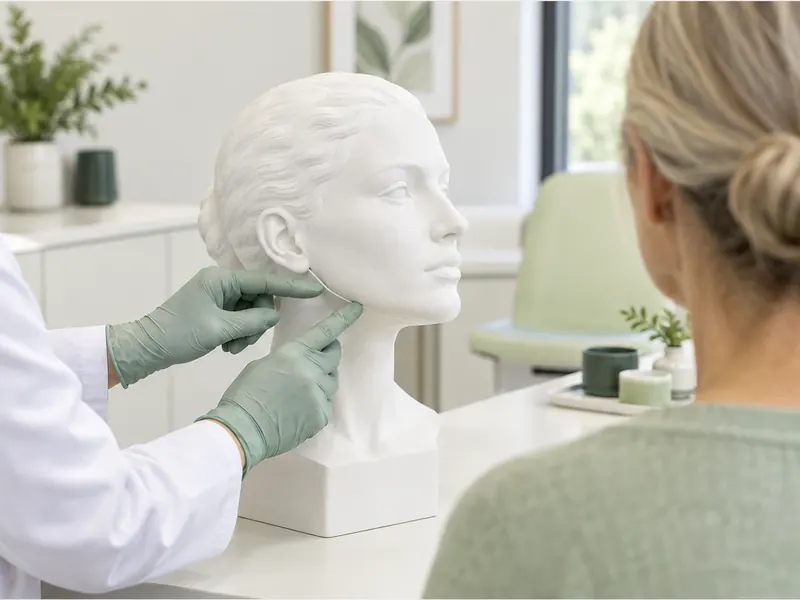
- the surgeon makes a small incision in the natural crease under the chin;
- if needed, excess fat under the chin is removed through this access;
- the separated inner edges of the platysma are brought together and stitched, creating an internal support like a sling;
- when the sides of the neck are also loose, the muscle is lifted and secured towards the back through incisions behind the ears;
- excess skin is redraped and removed, and the incisions are closed with fine stitches.
The scars lie under the chin and behind the ears, where they are usually hard to notice once healed.
- Vertical bands in the front of the neck
- Tightens and joins the inner edges of the platysma
- Double chin
- Removes excess fat under the chin during the same operation
- Loose skin on the neck
- Redrapes and removes excess skin behind the ears
- Jowls and a blurred jawline
- Combines the neck work with a lower face or SMAS lift
Combining it with a facelift
The neck and lower face are closely linked: the platysma continues upwards into the deep facial layer, the SMAS. That is why tightening the neck alone may not be enough if the jowls are pronounced, and lifting the face without treating the neck can leave the result looking unfinished.
For this reason platysma work is often part of a neck and lower face lift, an SMAS facelift or a full (circular) facelift. Treating these areas together gives a smooth transition from the cheeks to the jawline and the neck. The surgeon decides on the combination after examining you at rest and in motion.
Recovery and results
After surgery a supportive bandage is applied to the chin and neck. The first days are spent resting with the head raised; the neck feels tight, and turning the head may be uncomfortable. Swelling and bruising usually fade over two to three weeks, and many people return to office work after about 10 to 14 days.
Advice during recovery usually includes:
- wearing the bandage as instructed, first continuously, then mainly at night;
- avoiding sharp bending of the neck and heavy exercise for the period your surgeon advises;
- not smoking, as it slows healing;
- attending follow-up visits so that healing can be checked.
Possible complications include a collection of blood under the skin, infection, temporary numbness, irregularities of the skin surface and, rarely, temporary weakness of the lower lip. The final contour appears as swelling settles, usually over several months. Results last many years, although the neck continues to age naturally.

What affects the cost
The price of neck correction is always individual. It depends on:
- the scope of surgery: work on the neck only, or combined with a lower face or full facelift;
- whether fat under the chin and excess skin need to be removed;
- the length of the operation and anaesthesia;
- the stay in the clinic and aftercare included.
A reliable figure can only be named after the surgeon has examined you or reviewed your photos. At a good clinic the cost is fixed in the contract before surgery.
Neck correction at City Medical Centre
City Medical Centre performs surgical facelifts only: the SMAS facelift, the full (circular) facelift, the neck and lower face lift and the endoscopic brow and temple lift. A loose neck, a double chin and jowls are treated with the neck and lower face lift, or as part of an SMAS or full facelift; the surgeon decides at the consultation how the neck muscle should be addressed.
City Medical Centre does not offer muscle-relaxing injections, fillers or other non-surgical neck treatments. Read more on the facelift page.
International patients can start with a free online consultation by sending photos of the face and neck from the front and side. The cost is named after the assessment and fixed in the contract. After surgery you stay in the clinic’s inpatient unit under monitoring, your surgeon follows you up for a year, and a personal coordinator supports you from the first message to the end of recovery, including by Telegram.
Sources
Frequently asked questions
What are platysmal bands?
They are vertical cords in the front of the neck formed by the inner edges of the platysma, a thin muscle under the skin. With age these edges separate and sag, so the bands become visible, first when the neck is tensed and later at rest.
Can injections replace platysmaplasty?
As general information, muscle-relaxing injections can soften neck bands for a few months in some people, but they do not remove loose skin or fat and need repeating. They are not a substitute for surgery when the neck is clearly loose. City Medical Centre does not offer these injections.
Is platysmaplasty done with a facelift?
Often, yes. Because the neck muscle continues into the deep layer of the face, neck bands are frequently treated together with a neck and lower face lift or a facelift. This gives a smooth contour from the cheeks to the neck. The surgeon decides on the combination after an examination.
How long is recovery?
Most people need about 10 to 14 days before returning to office work. Swelling and bruising fade over two to three weeks, the bandage is worn for the period the surgeon advises, and the final neck contour settles over several months.
Are results permanent?
The result usually lasts many years, because the muscle is tightened and secured rather than only the skin being pulled. However, the neck continues to age naturally, and a stable weight, sun protection and not smoking help keep the contour for longer.
Have a question about your case? Get a free consultation
Message a coordinator on Telegram: we reply right in the chat, and you can send photos and questions there too.
- The first consultation is free, online consultations are available
- The doctor names the cost after the assessment, and it is fixed in the contract
- A personal coordinator guides you from the first message to recovery
Message our coordinator on Telegram
We reply right in the chat — you can send photos
Message us on TelegramBy sending a message, you agree to the privacy policy
Read also
 Liposuction
Double chin liposuction: how chin and neck fat removal works
How chin and neck liposuction removes a double chin: who it suits, how it is done, recovery with a chin strap, results, and when a neck lift is the better choice.
 Facelift
Full (circular) facelift: what it corrects, who it suits and what recovery involves
What a full circular facelift corrects, who it suits and who it does not, how the operation and the first weeks with a face bandage go, and how long results last.
 Osteoarthritis treatment
Post-Traumatic Osteoarthritis After a Fracture or Injury
How an old fracture, ligament or meniscus injury can lead to osteoarthritis, the symptoms that appear years later, diagnosis and non-surgical treatment options.