
















Facelift6 min read
Neck and lower face lift: how it fixes jowls, a double chin and loose neck skin
For many people the first signs of ageing that really bother them are below the cheekbones: jowls along the jaw, a soft chin line and loose skin on the neck. A neck and lower face lift is designed for exactly this area. This article explains what the operation corrects, who it suits, where the incisions go, whether it helps a double chin, what recovery looks like and when it is not advised.
The main points in 30 seconds
- The lift targets jowls, a double chin and loose neck skin.
- Incisions lie around the ear and, if needed, under the chin.
- A double chin from loose tissue or fat usually improves; a small chin bone does not change.
- Most bruising settles in two to three weeks; the final contour forms over months.
- City Medical Centre offers this as one of four surgical facelift options.
Key facts about the procedure
- Main healing2 months
- Final result3–6 months
- AnaesthesiaGeneral
- Pricefrom $2,400
What a neck and lower face lift corrects
A neck and lower face lift is a focused operation on the part of the face below the cheekbones and on the neck. It is designed for changes that appear when the deep supporting layer of the lower face, the SMAS, and the thin neck muscle beneath the skin (the platysma) lose their tone.
The operation typically addresses:
- jowls that break the line of the jaw;
- a blurred angle between the jaw and the neck;
- a double chin caused by loose tissues;
- loose, folded skin on the front of the neck;
- vertical bands on the neck that appear with age.
It does not treat the forehead, the brows or the upper cheeks. If those areas have also changed, a SMAS facelift or a full facelift may suit better.
Who it suits
This lift usually suits people whose main concern is the lower third of the face and the neck, while the mid-face and eyes still look relatively fresh. That is often the case in the 40s and 50s, and for people who have lost weight and noticed loose skin under the jaw.
Good candidates generally:
- have visible sagging along the jaw or under the chin;
- have reasonably elastic skin;
- have a stable weight;
- are in good general health and do not smoke, or are ready to stop before and after surgery;
- expect a natural, rested look rather than a different face.

Incisions and scars
The incisions are planned so that they are hidden in natural lines. Most often they run in the crease in front of the ear or just inside it, around the earlobe and behind the ear into the hairline. When the neck needs tightening at the front, a short incision is added in the natural fold under the chin.
In front of and around the ear
- Purpose
- Lifting the SMAS of the lower face and redraping the skin
- Where the scar lies
- In the natural ear crease
Behind the ear into the hairline
- Purpose
- Tightening the side of the neck and removing excess skin
- Where the scar lies
- Behind the ear and in the hair
Under the chin (if needed)
- Purpose
- Tightening the platysma at the front of the neck
- Where the scar lies
- In the fold under the chin
Scars are permanent, but in most people they fade to thin, pale lines over several months and are hard to see. The surgeon plans their position individually, taking into account the hairline and how you wear your hair.
Will it fix a double chin?
It depends on what is causing it. A double chin has three common causes, and a lift works on each in a different way:
- Loose skin and weak neck muscles. This is exactly what the lift corrects: the surgeon tightens the platysma and removes the excess skin.
- Excess fat under the chin. During the operation the surgeon can also reduce fat in this area to refine the contour.
- A small or set-back chin bone. A lift improves the neck, but it does not change the bone; this is assessed at the consultation.
That is why the result is always planned after examining the neck in profile. You can read more about the types of lift on our facelift page.
Recovery: going home and the first weeks
The operation is done under anaesthesia and usually involves a short stay in the clinic under observation. Recovery typically follows this pattern:
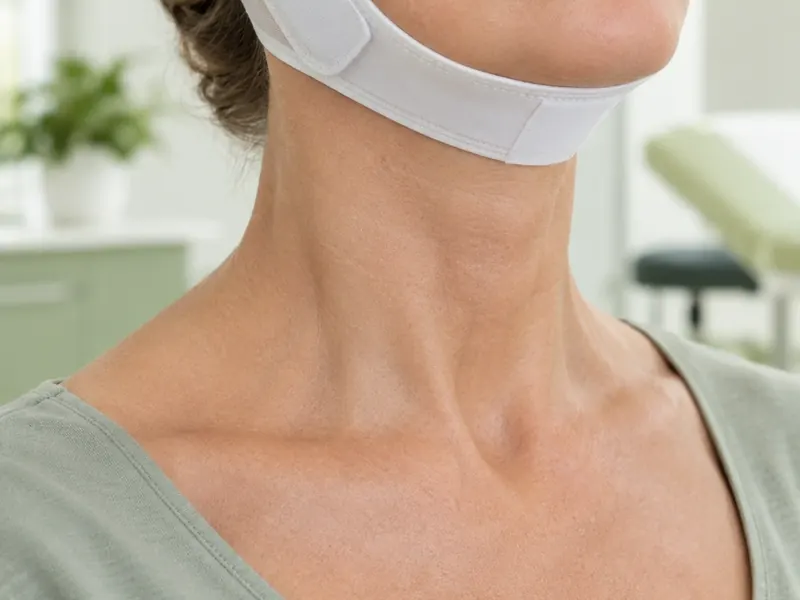
- First days. A supportive bandage or garment around the face and neck, tightness and swelling. Sleeping with the head raised helps.
- First week. Swelling and bruising peak and start to settle; stitches are checked and removed on the surgeon’s schedule.
- Two to three weeks. Most visible bruising has gone and many people return to desk work and social life.
- One to three months. Residual swelling and numbness around the ears gradually fade.
- Around six months. The final contour of the jaw and neck is usually assessed.
Heavy exercise, saunas and bending forward are usually avoided for several weeks. Your surgeon gives you a personal plan.

Contraindications
A neck and lower face lift is generally not performed before 30. Conditions that make surgery unsafe or require treatment first include:
- acute inflammation of the skin of the face or neck;
- pregnancy and breastfeeding;
- severe cardiovascular disease;
- blood clotting disorders;
- cancer;
- decompensated diabetes.
If you have a chronic condition, tell the doctor at the consultation. The final decision is always made after an examination.
Lower face and neck lift at City Medical Centre
City Medical Centre performs a neck and lower face lift as one of its four surgical facelift options, together with a standard SMAS facelift, a full (circular) facelift and an endoscopic brow and temple lift. The clinic performs surgical facelifts only. If your changes also involve the mid-face, the surgeon will explain whether a wider lift would suit you better, and the variant is chosen at the consultation.
The clinic works with patients from abroad. The first consultation is free and can take place online: send front and side photos of your face and neck, including a profile view with the head level, and describe what bothers you. The doctor assesses your case and names the price, which is then fixed in the contract. A personal coordinator supports you from your first message to the end of recovery, and you can send photos and questions via Telegram. Learn more on our facelift page.
Sources
Frequently asked questions
Does a lower face lift remove jowls?
Yes, correcting jowls is one of its main aims. The surgeon lifts the deep SMAS layer of the lower face, which carries the sagging tissue back up towards the ear, and then removes excess skin. This restores a cleaner line along the jaw rather than simply stretching the skin.
Where are the incisions for a neck lift?
Usually in the crease in front of the ear or just inside it, around the earlobe and behind the ear into the hairline. If the front of the neck needs tightening, a short incision is added in the natural fold under the chin. The scars are permanent but usually become thin and pale.
How long does a neck lift last?
The result usually lasts for many years, because the deep layers are repositioned rather than only the skin. Ageing continues, so the neck will change gradually over time, but from a better starting point. A stable weight and sun protection help maintain the result.
Can a neck lift remove a double chin?
Often, yes, when the double chin is caused by loose skin, weak neck muscles or excess fat under the chin; the surgeon can address all three during the operation. If the chin bone itself is small or set back, a lift alone may not fully correct the profile.
How long is recovery?
Most visible bruising and swelling settle within two to three weeks, when many people return to desk work. Residual swelling and numbness around the ears fade over one to three months. The final result of the jaw and neck contour is usually assessed at around six months.
Have a question about your case? Get a free consultation
Message a coordinator on Telegram: we reply right in the chat, and you can send photos and questions there too.
- The first consultation is free, online consultations are available
- The doctor names the cost after the assessment, and it is fixed in the contract
- A personal coordinator guides you from the first message to recovery
Message our coordinator on Telegram
We reply right in the chat — you can send photos
Message us on TelegramBy sending a message, you agree to the privacy policy
Read also
 Facelift
Platysmaplasty: how neck bands and a loose neck are corrected
What platysmaplasty is, why vertical neck bands and a loose neck appear, how the neck muscle is tightened, recovery, results and what shapes the cost.
 Facelift
Sagging face after weight loss: how to restore facial contours
Why the face sags after fast weight loss, how to protect your skin, options for mild, moderate and marked sagging and when to plan a facelift after weight loss.
 Liposuction
Non-surgical fat reduction vs liposuction: what each can really do
Fat freezing, energy devices or liposuction? Compare how each works, realistic results, number of sessions, side effects and who each option suits.