























Facelift6 min read
Sagging face after weight loss: how to restore facial contours
Losing a lot of weight is good news for health, but the face does not always keep up. When fat disappears quickly, especially after the age of 35–40, the skin may not shrink back, and the cheeks, jawline and neck can look hollow and loose. This article explains why the face sags after weight loss, how to protect the skin while you are still losing weight, what can help at each degree of sagging and when it makes sense to plan a facelift.

The main points in 30 seconds
- Fast weight loss removes facial fat faster than the skin can shrink back, especially after 35–40.
- Gradual weight loss, sun protection and not smoking help the skin adapt.
- Non-surgical treatments suit only mild changes and do not remove excess skin.
- Plan a facelift once your weight has been stable for several months.
- City Medical Centre performs surgical lifts only and advises on timing at the consultation.
Key facts about the procedure
- Main healing2 months
- Final result3–6 months
- AnaesthesiaGeneral
- Pricefrom $2,400
Why the face sags after fast weight loss
Facial fat does more than fill the face; it supports the skin from beneath. When that volume disappears, the skin that was stretched over it is left with less support. How well it adapts depends on several factors:
- speed of weight loss — rapid loss, whether through diet, medication or bariatric surgery, gives the skin little time to adjust;
- age — after about 35–40 the skin has less collagen and elasticity and shrinks back less well;
- how much weight was lost — the larger the loss, the more excess skin is left;
- skin quality — sun damage and smoking reduce its ability to recover.
The typical result is hollow cheeks, deeper folds from nose to mouth, jowls and loose skin under the chin and on the neck. Some people describe it as looking older or more tired than before, even though they feel healthier.
How to protect your skin while losing weight
You cannot fully prevent sagging, but you can give the skin a better chance to adapt:
- lose weight gradually where possible, as your doctor advises;
- eat enough protein and a varied diet to support tissue repair;
- drink enough water and avoid smoking;
- protect your face from the sun every day to preserve collagen;
- keep a consistent skincare routine.
These steps help the skin stay in better condition, but they cannot tighten skin that has already stretched a great deal. If you are taking weight-loss medication or preparing for bariatric surgery, discuss the pace of weight loss with the doctor who is managing it.
Mild sagging: non-surgical options
When the changes are small and the skin still has good quality, general practice offers several non-surgical treatments:
- radiofrequency and focused ultrasound devices, which heat the deeper skin and can give mild tightening over a few months;
- threads, which give a light, temporary lift;
- skincare and professional skin treatments, which improve texture rather than lift.
Their effect is modest and temporary. They can help mild laxity but do not remove excess skin.
Moderate sagging: injectable treatments
After weight loss, part of the problem is lost volume. In general practice, injectable volume is sometimes used to fill hollow cheeks and temples, and this can make the face look fuller for a period of time. However, injections do not remove loose skin or lift tissue that has slid down, and they need repeating.
When the main issue is sagging skin rather than volume loss, adding volume alone can make the face look heavier instead of lifted.
Marked sagging: when a facelift is needed
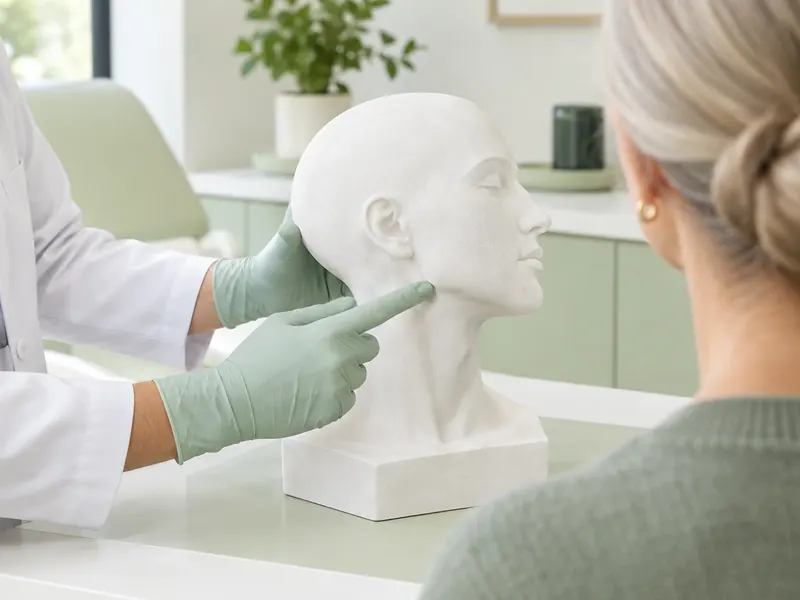
When there is clear excess skin on the lower face and neck, a surgical lift is the method that removes it and repositions the deeper tissues:
- Loose skin mainly on the jaw, chin and neck
- Neck and lower face lift
- Jowls combined with sagging cheeks and deep folds
- SMAS facelift
- Sagging in several areas, including forehead and temples
- Full (circular) facelift
- Heavy brows and temples after volume loss
- Endoscopic brow and temple lift
A facelift lifts the deep layer of the face, the SMAS, and removes excess skin, which is why it gives the clearest and longest-lasting change. You can read about the types of lift on our facelift page.
When to plan surgery after weight loss
Timing matters as much as technique. A facelift gives the best and most lasting result when your weight is stable:
- wait until you have reached your target weight and it has stayed stable for several months — often around six months or more; the surgeon will advise in your case;
- if you plan to lose more weight, it is usually better to do so first, because further loss can loosen the skin again;
- your general health should be good, and conditions such as diabetes should be well controlled.
A facelift is generally not performed before the age of 30. Acute skin inflammation, pregnancy or breastfeeding, severe cardiovascular disease, clotting disorders, cancer or decompensated diabetes are reasons not to operate or to treat the condition first.

Restoring facial contours at City Medical Centre
City Medical Centre performs surgical facelifts only: the standard SMAS facelift, the full (circular) facelift, the neck and lower face lift, and the endoscopic brow and temple lift. After weight loss, these operations remove excess skin and lift the deep tissues of the face and neck. Devices, threads and injectable volume are described here as general information; the clinic does not offer them.
The surgeon chooses the variant that suits your face at the consultation and will advise whether your weight is stable enough for surgery. Results typically last seven to ten years, and the price includes a year of post-operative follow-up by the plastic surgeon.
The clinic works with patients from abroad. The first consultation is free and can take place online: send front, side and three-quarter photos of your face, tell us how much weight you have lost and over what period, and describe what bothers you most. The doctor assesses your case and names the price, which is then fixed in the contract. A personal coordinator stays with you from the first message to the end of recovery, and photos and questions can be sent via Telegram. Learn more on our facelift page.
Sources
Frequently asked questions
Can a sagging face be fixed without surgery after weight loss?
Mild changes may improve with good skincare and, in general practice, non-surgical treatments that tighten the skin slightly or restore some volume. These effects are modest and temporary. When there is clear excess skin on the jaw and neck, surgery is the method that removes it.
How long after weight loss should I wait for a facelift?
It is best to wait until you have reached your target weight and it has been stable for several months, often around six months or more. This gives the skin time to settle and makes the result more predictable. The surgeon will advise on timing in your case.
Does weight-loss medication cause face sagging?
The medication itself does not damage the skin, but it can lead to fast weight loss, and rapid loss of facial fat is what causes the sagging. The effect is similar to fast weight loss from any other cause and is more noticeable after about 35–40.
Will a facelift last if I lose more weight?
A significant further weight loss can loosen the skin again and shorten the result. That is why surgeons usually recommend reaching a stable weight first. With a stable weight, a facelift usually lasts many years, often seven to ten.
Can home remedies fix jowls?
No. Skincare, sun protection and a healthy lifestyle keep the skin in better condition, and facial exercises may slightly improve muscle tone, but none of them can remove excess skin or lift jowls that have formed after weight loss.
Have a question about your case? Get a free consultation
Message a coordinator on Telegram: we reply right in the chat, and you can send photos and questions there too.
- The first consultation is free, online consultations are available
- The doctor names the cost after the assessment, and it is fixed in the contract
- A personal coordinator guides you from the first message to recovery
Message our coordinator on Telegram
We reply right in the chat — you can send photos
Message us on TelegramBy sending a message, you agree to the privacy policy
Read also
 Facelift
Skin care after a facelift: a practical guide to the first weeks and months
How to care for your skin after a facelift: incisions, swelling, food and medicines, sun protection, when to return to skincare and make-up, and warning signs.
 Facelift
SMAS facelift: what it is, how it works and what to realistically expect
What the SMAS layer is, how a surgical SMAS facelift lifts the face and neck, how it differs from ultrasound lifting, who it suits, recovery and results.
 Hair transplant
Scalp hair vs eyebrow hair: differences in structure, growth and function
Scalp hair and eyebrow hair differ in length, thickness, growth cycle, texture and purpose. Here is how, and why it matters when hair is transplanted.