























Facelift6 min read
How long a facelift lasts, and when it can be repeated
A facelift does not stop time, but it resets the clock. Most people look younger than they would have without surgery for many years afterwards. How long the effect lasts depends on the technique, your skin, your lifestyle and how your face continues to age. This article explains what to expect over time, the signs that a second procedure may be worth discussing, how often a lift can be repeated and what helps the result last.

The main points in 30 seconds
- A SMAS facelift usually lasts around seven to ten years.
- The face keeps ageing after surgery, but from a better starting point.
- A facelift can be repeated; timing depends on how the face has changed.
- Sun protection, not smoking and a stable weight help the result last.
- City Medical Centre includes a year of follow-up with your surgeon.
Key facts about the procedure
- Main healing2 months
- Final result3–6 months
- AnaesthesiaGeneral
- Pricefrom $2,400
How long facelift results last
When the deep supporting layer of the face, the SMAS, is lifted and secured, the result usually lasts many years. For a SMAS facelift a period of around seven to ten years is commonly quoted before the changes become noticeable enough for people to consider further surgery. A full (circular) facelift, which treats several areas at once, is expected to last for a similar or slightly longer time.
These figures are general guidance, not a guarantee. Two people who have the same operation can see different durations, because the result depends on:
- the technique and how deep the lift is;
- skin thickness and elasticity;
- age at the time of surgery;
- genetics, sun exposure and smoking;
- weight stability after surgery.
- Skin-only lift (without SMAS)
- Shorter; the skin stretches again relatively soon
- SMAS facelift
- Often around seven to ten years
- Full (circular) facelift
- Often up to about ten years
- Neck and lower face lift
- Many years, depending on skin quality
Why the face keeps ageing after surgery
A facelift repositions tissues that have already descended, but it does not change the biological processes behind ageing. After surgery the skin continues to lose collagen, the ligaments gradually weaken again, facial fat slowly redistributes and the bones of the face change shape over the decades.
That is why the right way to think about a facelift is not "how long until it wears off" but "how many years younger I look compared with not having it". Ten years after surgery you will be older than on the day after the operation, but usually still younger-looking than you would be without it.
Signs it may be time for another procedure
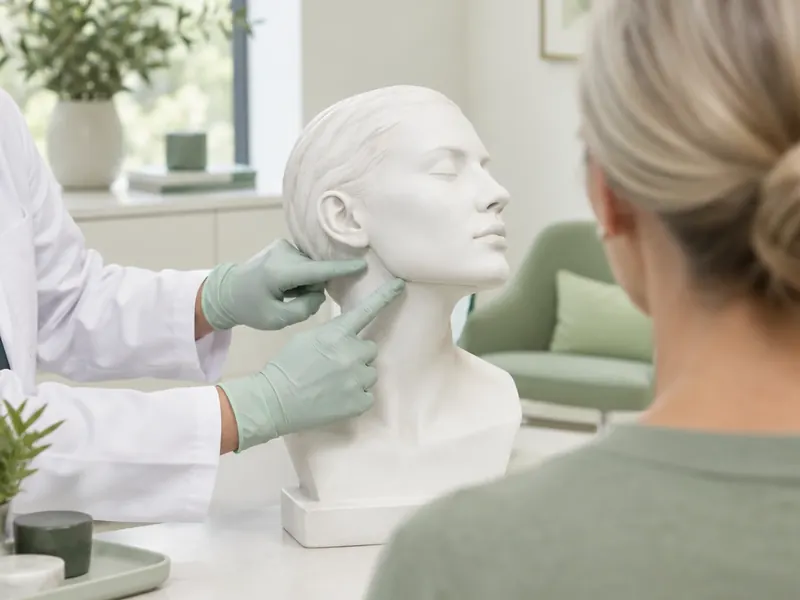
There is no fixed date for a second operation. People usually start thinking about it when they notice:
- that the jawline is becoming less defined again;
- new, small jowls along the jaw;
- loose skin returning under the chin or on the neck;
- the cheeks descending and the nasolabial folds deepening;
- heaviness in the brows or upper face, which the first operation did not treat.
Sometimes the change is limited to one area, and a smaller procedure, such as a neck and lower face lift or a brow lift, is enough rather than a full repeat.
How often a facelift can be repeated
A facelift can be repeated, and secondary facelifts are a well-established part of plastic surgery. Many surgeons prefer an interval of several years and usually decide based on how the face has changed rather than on the calendar. A second operation is often less extensive than the first, because the tissues were already repositioned once.
Secondary surgery requires careful planning: the surgeon takes into account previous scars, the position of the hairline, how much skin can safely be removed and the blood supply to the tissues. That is why it is important to tell the surgeon about any previous facial surgery or procedures and, if possible, bring the operation notes. More about the types of lift is on our facelift page.
Surgical vs device lifting: longevity compared
People often compare a facelift with non-surgical lifting when thinking about how long the effect will last. The difference is large:
- RF and ultrasound devices tighten the skin slightly; the effect usually lasts months to about a year and needs maintenance sessions.
- Thread lifts give a mild lift that often lasts around one to two years.
- A surgical facelift repositions the deep tissues and removes excess skin; the effect usually lasts many years.
Over a decade, repeated non-surgical sessions give a smaller change than one operation, but without surgery and with little downtime. Which approach is right depends on the degree of sagging and your priorities.
Habits that extend your result
You cannot stop ageing, but you can slow it down and help the result last:
- Protect your skin from the sun every day. Ultraviolet light is one of the main causes of collagen loss.
- Do not smoke. Smoking damages the small blood vessels and speeds up skin ageing.
- Keep your weight stable. Large gains and losses stretch the skin again.
- Follow a consistent skincare routine chosen with a dermatologist.
- Sleep well and limit alcohol, which both affect skin quality.
- Attend follow-up visits, so that the surgeon can assess the result and advise you in time.

Long-term follow-up at City Medical Centre
City Medical Centre performs surgical facelifts only: a standard SMAS facelift, a full (circular) facelift, a neck and lower face lift, and an endoscopic brow and temple lift. Device lifting and threads are described here as general information; the clinic does not offer them. The surgery package includes a year of post-operative follow-up with your plastic surgeon until the final result, so the surgeon monitors how your face settles and answers your questions along the way.
If you have already had a facelift elsewhere, the surgeon assesses whether a secondary procedure makes sense, and the variant is chosen at the consultation.
The clinic works with patients from abroad. The first consultation is free and can take place online: send front and side photos of your face and neck, tell us about any previous surgery and describe what bothers you. The doctor assesses your case and names the price, which is then fixed in the contract. A personal coordinator supports you from your first message to the end of recovery, and you can send photos and questions via Telegram. Learn more on our facelift page.
Sources
Frequently asked questions
How many years does a facelift last?
A SMAS facelift usually keeps its effect for around seven to ten years before changes become noticeable enough to consider further surgery. A full facelift may last a similar or slightly longer time. The exact duration depends on skin quality, age, genetics, sun exposure, smoking and weight stability.
Can a facelift be repeated?
Yes. Secondary facelifts are a well-established procedure. Surgeons usually decide on timing based on how the face has changed, often after several years. A repeat operation may be less extensive than the first, and the surgeon plans it carefully around previous scars and the hairline.
Does a SMAS facelift last longer than a skin lift?
Generally, yes. A skin-only lift pulls the skin, which gradually stretches again. A SMAS facelift lifts and secures the deeper muscle and fascia layer that carries the sagging tissues, so the correction is supported from underneath and usually lasts longer and looks more natural.
What shortens facelift results?
The main factors are sun exposure without protection, smoking, large weight changes, poor sleep and heavy alcohol use. Thin, sun-damaged skin also tends to age faster. Protecting your skin, keeping a stable weight and not smoking help the result last.
Will I look older than before when it wears off?
No. A facelift does not speed up ageing. As the years pass, your face continues to age from the improved starting point, so you usually still look younger than you would have without surgery. The effect gradually becomes less noticeable, but it does not reverse.
Have a question about your case? Get a free consultation
Message a coordinator on Telegram: we reply right in the chat, and you can send photos and questions there too.
- The first consultation is free, online consultations are available
- The doctor names the cost after the assessment, and it is fixed in the contract
- A personal coordinator guides you from the first message to recovery
Message our coordinator on Telegram
We reply right in the chat — you can send photos
Message us on TelegramBy sending a message, you agree to the privacy policy
Read also
 Facelift
How to get rid of jowls: what works without surgery and when a facelift is the answer
Why jowls form, what creams, exercises and non-surgical treatments can realistically do, and when a SMAS or lower face and neck lift is the reliable fix.
 Facelift
How to tighten a sagging jawline: from home care to surgery
Why the jawline loses definition, what home care and cosmetic treatments can do, surgical options for a defined jawline and how to choose the right method.
 Rhinoplasty
How rhinoplasty is performed: from consultation to cast removal
The full path of rhinoplasty: consultation and 3D forecast, tests and preparation, types of surgery, the day of the operation, hospital stay and cast removal.