















Hair transplant7 min read
FUT (strip) vs FUE hair transplant: scars, grafts and recovery compared
Both FUT and FUE move hair follicles from the back of the head to thinning areas, and both can give natural results in skilled hands. The real difference lies in how the grafts are taken from the donor area. That one step shapes the scar, the recovery, how short you can wear your hair and how the donor area can be used in the future.
The main points in 30 seconds
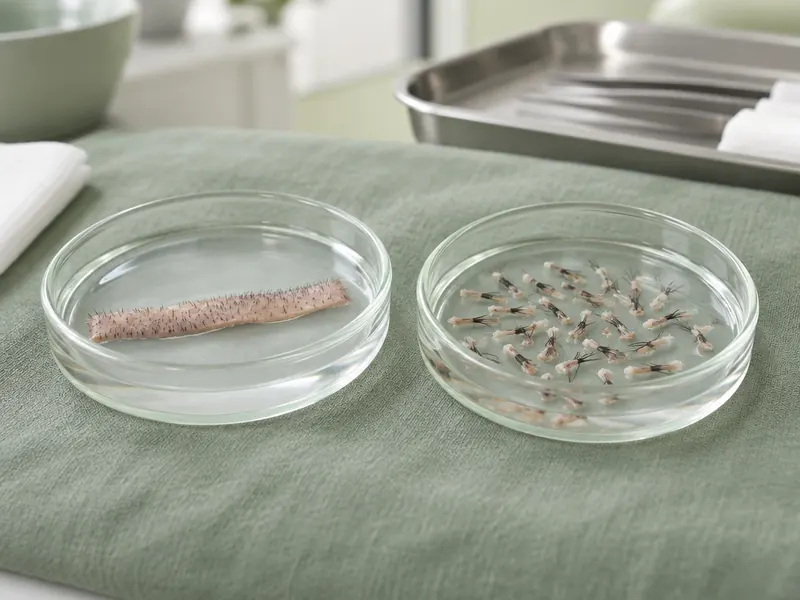
- FUT removes a strip of scalp; FUE takes follicles one by one through tiny punches.
- FUT leaves a thin linear scar; FUE leaves small dot scars spread over the donor area.
- Recovery of the donor area after FUE is usually quicker and less painful.
- The right method depends on hair loss, donor density, hairstyle and scalp features.
- City Medical Centre performs FUE, DHI and combined FUE+DHI, not the strip method.
Key facts about the procedure
- Stay in clinicSame day
- Final result12–18 months
- AnaesthesiaLocal
- Price
$2,700from $2,200
FUT vs FUE: the main difference
In any hair transplant, the surgeon moves follicular units, small natural groups of one to four hairs, from the donor area to the area of thinning. The donor area is usually the back and sides of the head, where hair is more resistant to the hormone that causes male pattern baldness.
The two methods differ in how these units are harvested:
- FUT (follicular unit transplantation, also called the strip method) removes a narrow strip of scalp, which is then divided into grafts under a microscope.
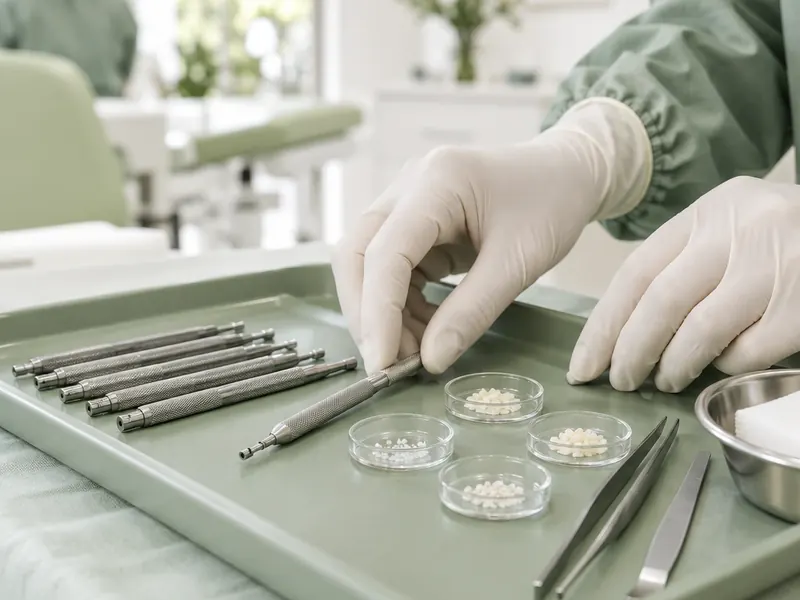
- FUE (follicular unit extraction) takes each unit separately with a tiny round punch, usually under one millimetre across.
The way grafts are placed into the recipient area is similar for both. What changes is the donor area: the type of scar, the healing and the options you keep for later.
How the FUT strip method works
The operation is done under local anaesthetic. The surgeon removes a thin strip of skin with hair from the back of the head, then closes the wound with stitches or staples. Neighbouring hair covers the line once it grows over it.
While the wound is being closed, a team of technicians cuts the strip into individual follicular units under magnification. The surgeon then makes small openings in the thinning area and places the grafts one by one.
Stitches are usually removed after one to two weeks. The back of the head may feel tight and numb for several weeks, and some people find sleeping on their back uncomfortable at first. The final result is a single linear scar, whose width depends on skin tension, healing and the surgeon's technique.
How FUE extracts individual grafts
In FUE, the donor area is usually trimmed short so that the surgeon can see the direction of each hair. Under local anaesthetic, follicular units are taken out one at a time with a micro-punch, spreading the extractions evenly so that the remaining hair still looks full.
The tiny openings are not stitched: they close on their own within days. The grafts are then placed into the recipient area. They can be implanted with fine forceps into pre-made openings (classic FUE) or with a special implanter pen that makes the opening and places the graft in one move (DHI). A combined approach uses FUE extraction with DHI implantation.
Because every graft is taken by hand, FUE sessions can be long, and a large number of grafts may need a full day of work.
Scars, graft numbers and recovery compared
How grafts are taken
- FUT (strip)
- A strip of scalp is removed and divided
- FUE
- Follicles are extracted one by one
Stitches
- FUT (strip)
- Yes, removed after one to two weeks
- FUE
- No
Scar
- FUT (strip)
- One thin line at the back of the head
- FUE
- Many tiny dots, usually hard to see
Wearing hair very short
- FUT (strip)
- The line may show with a close crop
- FUE
- Usually possible once healed
Donor area healing
- FUT (strip)
- Tightness and discomfort for several weeks
- FUE
- Small crusts that usually settle within a week or two
Return to desk work
- FUT (strip)
- Often after about a week or more
- FUE
- Often within several days
The number of grafts depends more on your donor area than on the method. Donor hair is limited, and a responsible surgeon plans how much to take so that the back of the head still looks natural and some reserve remains for the future. In the recipient area, healing is similar for both: small crusts form and fall off within about ten days, the transplanted hairs often shed after a few weeks, and new growth usually becomes visible from about three to four months, with the full result after about a year.

Who each method suits
There is no universal winner. The choice depends on your hair loss and your priorities.
FUT is still used by some surgeons, for example for people who need a large number of grafts in one session, who want to avoid shaving the donor area, or who always wear their hair long enough to cover a line.
FUE is usually preferred when:
- you like to wear your hair short at the back and sides;
- you want a quicker recovery of the donor area without stitches;
- the scalp is tight, which can make a strip scar wider;
- you have androgenetic alopecia, the most common type of pattern hair loss.
A transplant is not suitable for everyone. It helps with androgenetic and some types of diffuse hair loss when there is enough donor hair. It is not suitable when there is no healthy donor hair, for example in total hair loss, and it does not stop further thinning of your own hair. A doctor first checks the cause of hair loss and the density of the donor area.
Why modern clinics favour FUE and DHI
Over the past years many clinics have moved from the strip method to FUE and its variations. The main reasons are practical: no linear scar, no stitches, a shorter recovery and the freedom to wear short hairstyles. Improved micro-punches and implanter tools have also made it easier to handle grafts gently.
DHI adds control over the angle, direction and depth of each implanted hair, which helps create a natural hairline and add density between existing hairs. Combining FUE extraction with DHI implantation lets the surgeon use the strengths of both. This does not make the strip method wrong, but it explains why FUE-based methods are now the most common choice. You can compare the techniques we use on our hair transplant page.
Getting a personal plan at City Medical Centre
City Medical Centre works with international patients. Our clinic performs three techniques: classic FUE, which is used for androgenetic alopecia; DHI with an implanter pen, used to add density; and a combined FUE extraction with DHI implantation, used for androgenetic alopecia and for density. The FUT strip method is described in this article as general information and is not offered at our clinic; the technique that suits you is chosen at the consultation.
The first consultation is free and can be held online. Send photos of your hairline, crown and donor area by Telegram, and the doctor will assess your type of hair loss and donor reserve and suggest a plan. The cost is named after the assessment and fixed in the contract. A personal coordinator stays with you from your first message to the end of recovery. More details are on our hair transplant page.
How recovery usually goes
- 0-10 daysHealing: the crusts come off, the swelling goes down, the area gradually recovers
- 2-4 weeksShedding of the transplanted hairs: a normal stage, only the hairs fall out, the follicles stay in place
- 3-4 monthsGrowth begins: new hairs gradually appear, the result starts to show
- 6-9 monthsVisible density: the hair becomes thicker, the main volume and contour are visible
- 12-18 monthsFinal result: the final density and a natural hairline take shape
Sources
Frequently asked questions
Which leaves less scarring, FUT or FUE?
FUE usually leaves less visible scarring. It creates many tiny dot scars spread over the donor area, which are usually hard to see even with fairly short hair. FUT leaves one linear scar at the back of the head, which is hidden by longer hair but may show with a very close crop.
Can FUT give more grafts than FUE?
FUT can provide many grafts in one session, which is why some surgeons use it for extensive hair loss. With FUE, a large number of grafts is also possible but may take longer. In both cases the real limit is your donor area, and a surgeon plans the number of grafts to keep it looking natural.
Is FUE recovery faster than FUT?
The donor area usually heals faster after FUE: there are no stitches, and small crusts settle within a week or two. After FUT, the back of the head may feel tight and sore for several weeks. Healing of the transplanted area and the timeline of new hair growth are similar for both methods.
Is FUT cheaper than FUE?
Costs depend on the clinic, the country, the number of grafts and the technique, so there is no single rule. FUE is more time-consuming for the team, which can affect the price. At City Medical Centre the doctor names the cost after assessing your photos, and it is fixed in the contract.
Do I need to shave my head for FUE?
For classic FUE the donor area is usually trimmed short so the surgeon can see the direction of each hair. In some cases only part of the donor area needs to be shaved and can be hidden under longer hair. Your doctor explains what is needed for your case at the consultation.
Have a question about your case? Get a free consultation
Message a coordinator on Telegram: we reply right in the chat, and you can send photos and questions there too.
- The first consultation is free, online consultations are available
- The doctor names the cost after the assessment, and it is fixed in the contract
- A personal coordinator guides you from the first message to recovery
Message our coordinator on Telegram
We reply right in the chat — you can send photos
Message us on TelegramBy sending a message, you agree to the privacy policy
Read also
 Hair transplant
Hair care with age: how to keep ageing hair healthy
How hair changes with age and how to care for it: gentle washing, nutrition, careful brushing, less heat and when thinning needs a doctor.
 Hair transplant
Hair growth stages after a transplant: why transplanted hair falls out and grows back
How the hair growth cycle works after a transplant: why transplanted hair falls out first, how follicles restart growth and what affects the final result.
 Bariatric surgery
Gastric band vs sleeve and bypass: why banding is used much less today
Gastric band compared with sleeve gastrectomy and gastric bypass: how the band works, its complications, typical results and why it is used less today.