
























Facelift6 min read
Facelift consultation: the questions to ask your surgeon
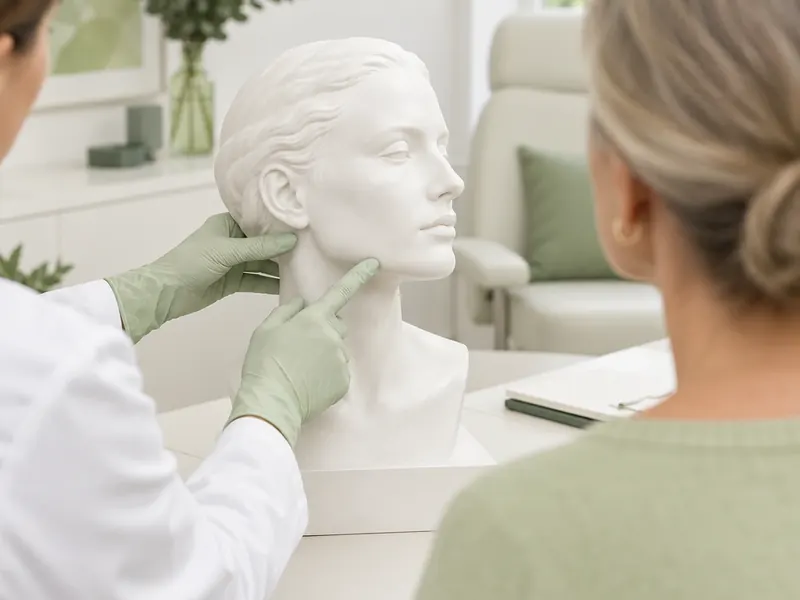
A facelift is planned at the consultation, not in the operating theatre. This is where the surgeon assesses your face, explains which technique suits it and sets out what the result and recovery will look like. The more precise your questions, the clearer the picture you leave with. This article groups the questions worth asking by topic — suitability, incisions, recovery, results, price and follow-up — and explains what a good answer usually sounds like.

The main points in 30 seconds
- The consultation is where the facelift is actually planned for your face.
- Ask which lift suits you, where the scars will be and how long recovery takes.
- Ask what the price includes and whether it is fixed in writing.
- Seeing the surgeon's own before-and-after photos is the best check of experience.
- At City Medical Centre the first consultation is free and can be held online.
Key facts about the procedure
- Main healing2 months
- Final result3–6 months
- AnaesthesiaGeneral
- Pricefrom $2,400
Why the consultation matters
Two people of the same age can need quite different operations. One has mainly jowls and a loose neck; another has sagging cheeks and heavy brows as well. The consultation is where these differences are identified and turned into a plan. It is also your chance to judge whether you trust the surgeon and understand what is proposed.
Before the consultation it helps to:
- write down the three things that bother you most about your face;
- list your medical conditions, previous operations and anything you take regularly;
- think about how much time off you can realistically take;
- bring or send clear photos from the front, side and three-quarter view.
A good consultation is a conversation, not a sales pitch. You should leave knowing what will be done, why, and what the limits are.
Questions about suitability and technique
Start with the basic question: is a facelift the right step for me now? Then move on to the details:
- Which areas of my face would the operation address, and which would it not?
- Which type of lift do you recommend, and why that one?
- Will you lift the deep layer (SMAS) or only the skin?
- Should the neck, brows or temples be treated at the same time?
- Is there anything in my health that makes surgery unsuitable or needs attention first?
Two common questions deserve a clear answer. A double chin caused by loose skin and muscle bands usually improves with a neck and lower face lift, while a chin that is mostly fat may need additional work. Drooping mouth corners improve only partly with a facelift, because they also depend on muscle action. You can read about the types of lift on our facelift page.
Questions about incisions and scars
Every facelift leaves scars, so ask exactly where they will be and how they are expected to look over time:
- Where will the incisions run — in front of the ear, behind it, in the hairline, under the chin?
- Will my hairline or sideburns shift, and how is that avoided?
- How long do the scars stay pink, and when do they usually fade?
- What can I do to help them heal well?
- Where are the incisions?
- A clear drawing or description of each line for your type of lift
- How will they look in a year?
- A realistic picture of fading, not a promise of no scars
- What affects healing?
- Smoking, sun exposure and wound care, explained in plain terms
- What if a scar heals poorly?
- How the clinic monitors scars and what can be done
Questions about recovery and time off
Recovery is where plans most often clash with real life, so ask for a concrete timeline:
- How long will I stay in the clinic after the operation?
- When are the stitches removed, and when is the first check-up?
- How long will swelling and bruising be visible?
- When can I return to office work, social life, driving and sport?
- When can I fly home, if I am travelling for the operation?
As a general guide, most bruising fades within two to three weeks and many people return to office work after two to three weeks, while the final result settles over a few months. Many patients go home the next day, but the exact stay depends on the extent of surgery and the anaesthesia, so ask your surgeon for your own plan.

Questions about results and longevity
Ask what you can realistically expect, not what the best case looks like:
- What will change in my face, and what will stay the same?
- When will I see the final result?
- How long does the result usually last with this technique?
- Can I see before-and-after photos of your own patients with a similar face?
- What are the possible complications, and how often do they occur?
A surgical facelift that lifts the deep layer usually lasts many years, often seven to ten, though ageing continues. Asking how many facelifts the surgeon performs and seeing their own results is the most practical way to judge experience.
Questions about price and follow-up
Money and aftercare should be clear before you agree to anything:
- What exactly is included in the price — the operation, anaesthesia, stay, garments, check-ups?
- Is the price fixed in writing, or can it change?
- How long does follow-up with the surgeon last after the operation?
- Who do I contact if I have a question or worry during recovery, including after I go home?
A clear written agreement protects both sides and means there are no surprises later.
Your consultation at City Medical Centre
City Medical Centre performs surgical facelifts only: the standard SMAS facelift, the full (circular) facelift, the neck and lower face lift, and the endoscopic brow and temple lift. At the consultation the surgeon assesses your face, explains which variant suits you and answers the questions above, including honest advice if surgery is not the right step yet. Results typically last seven to ten years, and the price includes a year of post-operative follow-up by the plastic surgeon.
The clinic works with patients from abroad. The first consultation is free and can take place online: send front, side and three-quarter photos of your face and describe what bothers you most. The doctor assesses your case and names the price, which is then fixed in the contract. A personal coordinator stays with you from the first message to the end of recovery, and photos and questions can be sent via Telegram. Learn more on our facelift page.
Sources
Frequently asked questions
What should I ask at a facelift consultation?
Ask which type of lift suits your face and why, where the incisions will be, how long recovery takes and when you can return to work, how long the result usually lasts, and what exactly the price includes. Ask to see the surgeon's own before-and-after photos as well.
Will the facelift fix my double chin?
It depends on the cause. When the double chin comes from loose skin and neck muscle bands, a neck and lower face lift usually improves it well. When it is mainly fat, additional work may be needed. The surgeon assesses this at the consultation.
Can a facelift lift the corners of the mouth?
Only partly. A facelift lifts the cheeks and jowls, which can soften the lines around the mouth, but drooping mouth corners also depend on muscle action. The surgeon will explain what can realistically change in your case.
How many days after surgery can I go home?
Many patients go home the day after surgery, but the exact stay depends on the extent of the operation and the anaesthesia. If you are travelling for surgery, plan extra days before flying home so the surgeon can check the healing.
How do I know the surgeon is experienced?
Ask how many facelifts they perform, which techniques they use and ask to see before-and-after photos of their own patients with faces similar to yours. A surgeon who explains limits and risks openly is usually a better sign than one who only promises results.
Have a question about your case? Get a free consultation
Message a coordinator on Telegram: we reply right in the chat, and you can send photos and questions there too.
- The first consultation is free, online consultations are available
- The doctor names the cost after the assessment, and it is fixed in the contract
- A personal coordinator guides you from the first message to recovery
Message our coordinator on Telegram
We reply right in the chat — you can send photos
Message us on TelegramBy sending a message, you agree to the privacy policy
Read also
 Facelift
Facelift risks and complications: what can happen and how to lower the chances
Facelift risks explained: normal swelling and numbness, rarer haematoma, nerve injury and scarring, who is at higher risk and how surgeons reduce complications.
 Facelift
Facelift or thread lift: how long each lasts and who each one suits
A thread lift gives a short-lived lift with little downtime; a surgical facelift works on deeper tissues for longer. Compare results, risks and who each suits.
 Facelift
Facelift recovery timeline: what to expect from the first day to six months
Facelift recovery week by week: the first days, swelling and bruising, stitches, sleep, return to work and sport, flying home and when the result shows.