





















Breast augmentation6 min read
Breast implants vs fat transfer: what each method can and cannot do
Fat transfer sounds like the most natural way to enlarge the breasts: no foreign device, and a slimmer waist or thighs as a bonus. Implants, on the other hand, give a predictable size in one operation. This guide compares the two honestly, including how much volume each can add, why part of the transferred fat disappears and who is a realistic candidate for each option.
The main points in 30 seconds
- Implants give a planned size in one operation; fat transfer usually adds about one cup or less.
- Part of the transferred fat is absorbed, so results are judged after three to six months.
- Fat transfer needs spare fat; very slim patients are usually better suited to implants.
- Neither method lifts sagging breasts on its own; a lift may be needed.
- City Medical Centre performs augmentation with implants, lifts, reduction and implant removal.
Key facts about the procedure
- Operation time1.5–3 hours
- Back to work7–14 days
- Stay in clinic1 day
- Fixed price$4,700
Implants vs fat transfer: the key differences
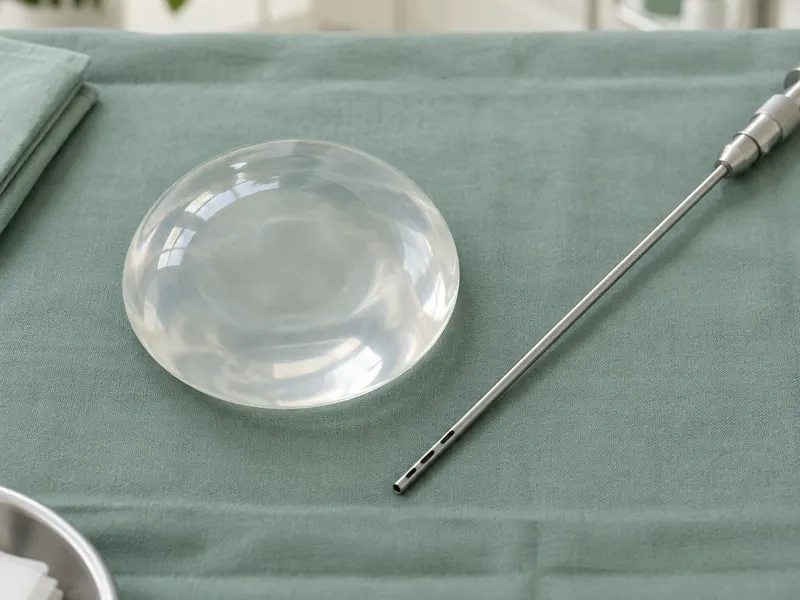
Both methods aim to make the breasts fuller, but they work in very different ways. An implant is a silicone or saline device placed behind the breast tissue or the chest muscle. Fat transfer, also called fat grafting or lipofilling, moves your own fat from one area of the body to the breast through a series of small injections.
The practical difference is control. With an implant the surgeon knows the exact volume before surgery. With fat, the final result depends on how much of the grafted tissue survives in its new place, and that varies from person to person.
Size increase
- Breast implants
- From modest to significant, chosen in advance
- Fat transfer
- Usually modest, often about one cup size or less
Predictability
- Breast implants
- High: the volume is known before surgery
- Fat transfer
- Lower: part of the fat is absorbed
Number of operations
- Breast implants
- Usually one
- Fat transfer
- One or more sessions may be needed
Scars
- Breast implants
- A short incision, usually under the breast fold
- Fat transfer
- Tiny punctures on the breast and the donor area
Long-term upkeep
- Breast implants
- Implants are not lifetime devices and may need replacing
- Fat transfer
- No device, but the breast changes with body weight
Requirement
- Breast implants
- Enough skin and tissue to cover the implant
- Fat transfer
- Enough spare fat elsewhere on the body
How fat transfer works and its limits
Fat transfer is a two-stage procedure performed in one operation. First, fat is removed by gentle liposuction, most often from the abdomen, flanks or thighs. Then it is purified and injected in very small portions into different layers of the breast so that each portion can connect to a blood supply.
The method has clear limits:
- Only a limited amount of fat can be placed at once, because too much tissue in one area cannot survive.
- It adds volume but does not lift the breast. Sagging needs a separate lift.
- It gives softness and fullness rather than strong projection or a rounded upper pole.
- Results depend heavily on the surgeon's technique and on the quality of your tissue.
Some surgeons also use small amounts of fat to refine the edges of an implant or to smooth minor contour irregularities. Whether this is useful in your case is a decision for the surgeon after an examination.

Advantages and drawbacks of implants
Implants remain the most widely used method of breast augmentation because the result is predictable. You and your surgeon choose the shape, profile and volume together, and the change is visible immediately after the swelling settles.
Advantages
- A planned, measurable increase in size in a single operation.
- Suitable for slim patients who have little spare fat.
- Can be combined with a breast lift in the same operation when the breast has also dropped.
Drawbacks
- A foreign device that may need to be replaced or removed at some point in life.
- Possible complications such as capsular contracture, rupture or rippling.
- A rare type of lymphoma, BIA-ALCL, has been linked mainly to textured implants, so regular check-ups matter.
You can see how the clinic approaches implant surgery, from consultation to follow-up, on the breast surgery page.
How much size each method can add
This is where the two methods differ most. An implant can add a small, moderate or large increase, limited mainly by chest width, skin elasticity and how much tissue you have to cover the device.
Fat transfer usually gives a more modest change. Many patients gain around one cup size or less after one session, and some choose a second session several months later to add more. The amount also depends on how much fat you can spare and how much the breast skin can stretch to accept it.
If your main goal is a clear, noticeable increase, implants are usually the more realistic choice. If you want a subtle change and have fat to spare, fat transfer can be discussed.
Fat absorption, lumps and repeat sessions
Not all transferred fat survives. A proportion of it is naturally absorbed by the body over the first few months, and the amount varies widely between patients. The result is usually judged only after about three to six months, when the volume has stabilised.
Fat cells that do not receive enough blood supply can die and form firm areas. These may appear as:
- oil cysts, small fluid-filled lumps;
- areas of fat necrosis that feel firm under the skin;
- small calcifications that can be seen on breast imaging.
These changes are usually harmless, but any new lump in the breast needs to be checked by a doctor, and breast imaging may need to be interpreted by a radiologist who knows about the previous surgery. Because of absorption, repeat sessions are common with fat transfer, while with implants a further operation is usually related to the device itself later in life.
Who suits each option
The choice depends on your body, your goals and your attitude to future surgery. A general picture looks like this:
- Implants often suit people who want a noticeable increase, have little spare fat, or want an augmentation combined with a lift.
- Fat transfer may be considered for people who want a small, soft change, have enough fat in other areas and accept that more than one session may be needed.
- Neither is advised during pregnancy or breastfeeding, with untreated breast disease, or when general health does not allow elective surgery.
Smoking, large weight changes and unrealistic expectations make results less reliable with both methods. An honest discussion of what you want to achieve is the most useful first step.

Why City Medical Centre uses implants for augmentation
City Medical Centre performs breast augmentation with implants, breast lift with or without implants, breast reduction, implant removal and breast reconstruction. City Medical Centre does not perform fat transfer to the breast. Fat transfer is described here as general information; which approach fits you is decided by the surgeon at the consultation.
The clinic works with international patients. The first consultation is free and can take place online: you can send photos and questions on Telegram, and the surgeon will assess your anatomy and explain the options. The price is given after this assessment and is fixed in the contract. A personal coordinator stays with you from the first message to the end of recovery. Learn more on the breast augmentation page.
How recovery usually goes
- 7–14 daysReturn to work without physical exertion
- 3 weeksPost-op swelling disappears; scars form; no lifting over 3 kg, no raising arms above shoulder level
- 1 monthThe swelling subsides and the breasts take on a natural shape and softness
- 4–6 weeksFitness, swimming, pool and sea; compression garments worn for 4–6 weeks
- 3 monthsDiscomfort disappears; inflammatory changes resolve and a pocket forms around the implant; strength training
Sources
Frequently asked questions
Does fat transfer to the breast last?
The fat that survives the first few months usually behaves like normal body fat and stays long term. However, part of the transferred fat is absorbed, so the final volume is judged after about three to six months. Weight loss or gain later will also change the size of the breast.
How many cup sizes can fat transfer add?
Fat transfer usually gives a modest increase, often about one cup size or less per session. The result depends on how much fat you can spare, how well it survives and how much the skin can stretch. A larger change often requires more than one session.
Is fat transfer safer than implants?
Neither method is free of risk. Fat transfer avoids a foreign device but may cause oil cysts, firm areas and repeat procedures. Implants carry risks such as capsular contracture, rupture and a future operation. The surgeon weighs these risks against your health and goals.
Can thin women have fat transfer?
Very slim people often do not have enough spare fat to make a visible difference to the breasts. In that case implants are usually the more realistic way to increase size. The surgeon checks the possible donor areas during the examination before suggesting any method.
Which looks more natural?
Fat gives a very soft, natural feel but only a limited change in size. A well-chosen implant, matched to the chest width and placed with enough tissue cover, can also look natural. The more natural result is usually the one that respects your own proportions.
Have a question about your case? Get a free consultation
Message a coordinator on Telegram: we reply right in the chat, and you can send photos and questions there too.
- The first consultation is free, online consultations are available
- The doctor names the cost after the assessment, and it is fixed in the contract
- A personal coordinator guides you from the first message to recovery
Message our coordinator on Telegram
We reply right in the chat — you can send photos
Message us on TelegramBy sending a message, you agree to the privacy policy
Read also
 Breast augmentation
Breast lift or implants: which operation do you actually need?
Breast lift or implants? How to tell what you need, what each operation fixes, when to combine them, tests before surgery, recovery and results compared.
 Breast augmentation
Breast Reconstruction After Mastectomy: Options and Timing
When breast reconstruction can be done after mastectomy, immediate versus delayed timing, implant-based methods, nipple restoration, symmetry and recovery.
 Breast augmentation
Breast lift (mastopexy): degrees of sagging, techniques and scars
Breast lift explained: how the degree of sagging is measured, why breasts sag, periareolar, vertical and anchor techniques, scars, recovery and implants.