

















Facelift6 min read
The best age for a facelift: signs you are ready, and when surgery is not advised
People often ask surgeons for a number: at what age should I have a facelift? The honest answer is that there is no universal age. What matters is how much the deep tissues of the face have descended, the quality of your skin and your general health. This article explains the signs that you may be ready, what surgery can achieve at different ages, how recovery changes with age and who should not have a facelift.
The main points in 30 seconds
- There is no universal best age; the degree of sagging and health decide.
- Most facelifts are done between the mid-40s and late 60s.
- Jowls, a blurred jawline and loose neck skin are typical signs of readiness.
- A facelift is generally not done before 30; there is no strict upper limit.
- City Medical Centre performs surgical facelifts only.
Key facts about the procedure
- Main healing2 months
- Final result3–6 months
- AnaesthesiaGeneral
- Pricefrom $2,400
Is there a best age for a facelift?
Most people who have a facelift are somewhere between their mid-40s and their late 60s. That is simply when the typical changes it corrects, such as jowls, loose neck skin and deep folds, tend to appear. It does not mean these ages are a rule.
Some people show marked sagging in their early 40s because of genetics, sun exposure, smoking or weight changes. Others reach 60 with firm skin and only mild changes. For that reason surgeons look at the face, not the birth certificate. A good candidate is someone whose sagging is real, whose health allows surgery and whose expectations are realistic.
Why age alone does not decide
Two people of the same age can need completely different things. The factors that usually matter more than age are:
- The degree of sagging. A facelift repositions the deep muscle and fascia layer (SMAS). If that layer has not descended, there is nothing for surgery to lift.
- Skin quality. Thicker, more elastic skin tends to settle well; very thin, sun-damaged skin may show fine lines even after surgery.
- Bone structure. A well-defined jaw and cheekbones support the result.
- Weight stability. Large weight changes after surgery can undo part of the effect.
- General health and smoking. They affect both the safety of surgery and healing.

Signs you may be ready
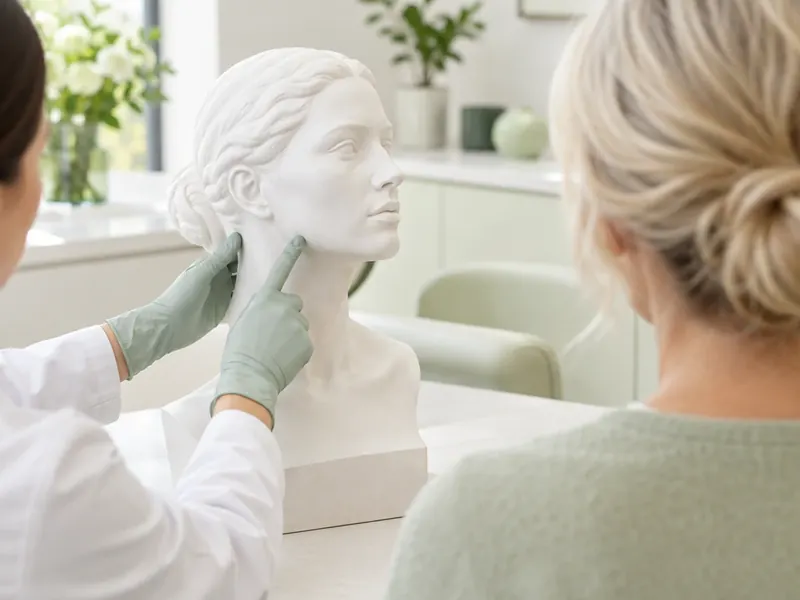
A useful test is to look at your face in a mirror and gently lift the skin in front of your ears upwards and backwards with your fingertips. If this simple movement makes you look noticeably more like yourself a few years ago, the deep tissues have probably descended.
Common signs that point towards surgery:
- jowls that break the line of the jaw;
- a jawline that has lost its definition;
- loose skin or a double chin under the jaw;
- deep nasolabial folds and marionette lines;
- heavy brows and a tired look that do not improve with rest;
- non-surgical treatments that give less and less effect.
If your concerns are mainly fine lines, pigmentation or skin texture, a facelift is usually not the answer: it changes the position of tissues, not the surface of the skin.
What a facelift achieves at different ages
40s
- Typical changes
- Early jowls, softer jawline
- What surgery usually does
- A targeted lower face and neck lift or SMAS lift gives a subtle, natural refresh
50s
- Typical changes
- Jowls, neck laxity, deep folds
- What surgery usually does
- A SMAS or full facelift gives a clear improvement in contour
60s and older
- Typical changes
- Marked sagging in several areas, thinner skin
- What surgery usually does
- A full facelift, often combined with a brow lift, gives the most visible change
In younger patients the change is often more subtle and friends notice that you look rested rather than different. In older patients the change is larger because there is more to correct. In both cases the aim is a natural face, not a tight one. More about the types of lift is on our facelift page.
Recovery by age
The main stages of healing are similar at any age: swelling and bruising are most visible in the first one to two weeks and usually settle within two to three weeks, while the final result forms over several months.
Age influences the details. Younger tissue with a good blood supply often heals a little faster. Older patients may need a few more days before they feel ready for social life, and numbness around the ears may take longer to fade. What matters more than age is following the aftercare plan: sleeping with the head raised, avoiding heavy exertion and not smoking.

Minimum age and contraindications
A facelift is generally not performed before 30. Under that age the deep tissues are rarely lax enough to benefit, and the risks of surgery are not justified by the expected change.
There is no strict upper age limit, but there are health conditions that make a facelift unsafe or require them to be treated first. Typical contraindications include:
- acute inflammation of the skin of the face;
- pregnancy and breastfeeding;
- severe cardiovascular disease;
- blood clotting disorders;
- cancer;
- decompensated diabetes.
If you have any chronic condition, tell the doctor at the consultation. Some conditions only need to be stabilised before surgery; the final decision is always made after an examination.
Timing your facelift with City Medical Centre
City Medical Centre performs surgical facelifts only: a standard SMAS facelift, a full (circular) facelift, a neck and lower face lift, and an endoscopic brow and temple lift. The clinic does not offer non-surgical lifting. If your changes are early and surgery is not yet justified, the surgeon will tell you honestly, and the variant that fits your face and age is chosen at the consultation.
The clinic works with patients from abroad. The first consultation is free and can take place online: send front and side photos of your face and neck, tell us your age, health conditions and what bothers you. The doctor assesses your case and names the price, which is then fixed in the contract. A personal coordinator supports you from your first message to the end of recovery, and you can send photos and questions via Telegram. Learn more on our facelift page.
Sources
Frequently asked questions
What is the youngest age for a facelift?
A facelift is generally not performed before 30. In the 30s it is rarely needed because the deep tissues are usually still well supported. Exceptions, for example after major weight loss, are decided individually by the surgeon after an examination.
Is 60 too old for a facelift?
No. Many people have a facelift in their 60s and 70s. What matters is general health, not age: the surgeon checks your heart, blood clotting, blood sugar and other conditions. In this age group the visible change is often larger because there is more sagging to correct.
Does a facelift last longer if done younger?
Ageing continues after any facelift, so the result does not stop the clock. Younger, more elastic tissue often holds the correction well, and a subtle early lift may look natural for many years. But having surgery before the changes are there brings no benefit.
What are the signs I need a facelift?
Typical signs are jowls, a blurred jawline, loose skin under the chin, deep nasolabial folds and a tired look that rest does not fix. If lifting the skin in front of the ears with your fingertips makes you look noticeably fresher, the deep tissues have probably descended.
Why is a facelift not advised under 30?
Under 30 the SMAS layer and ligaments are usually still firm, so there is little sagging for surgery to correct. The risks of anaesthesia, scars and a long recovery would not be balanced by a meaningful change. Skin care and prevention are more appropriate at this age.
Have a question about your case? Get a free consultation
Message a coordinator on Telegram: we reply right in the chat, and you can send photos and questions there too.
- The first consultation is free, online consultations are available
- The doctor names the cost after the assessment, and it is fixed in the contract
- A personal coordinator guides you from the first message to recovery
Message our coordinator on Telegram
We reply right in the chat — you can send photos
Message us on TelegramBy sending a message, you agree to the privacy policy
Read also
 Facelift
Deep plane or SMAS facelift: how the two techniques differ and how surgeons choose
How a deep plane facelift differs from a SMAS facelift: which layers are lifted, what each adds, recovery, how natural the result looks and who each suits.
 Facelift
Endoscopic brow and forehead lift: how it works, what the scars are like and how recovery goes
How an endoscopic brow and temple lift works, who it suits, how it compares with an open brow lift, what the operation and recovery involve and how long it lasts.
 Breast augmentation
Contraindications to breast augmentation: who should not have surgery and who should simply wait
Which health conditions rule out breast augmentation, which only delay it, what breast problems must be checked first and which tests confirm you are fit.