


























Arthritis treatment7 min read
Arthritis vs osteoarthritis: what is the difference and why it matters for treatment
Arthritis and osteoarthritis are often mixed up, yet they are not the same condition. One usually begins with inflammation in the joint, the other with gradual wear of cartilage. This article explains what happens inside the joint in each case, who is at risk, which symptoms and tests help tell them apart and why the treatment plan differs.
The main points in 30 seconds
- Arthritis usually means joint inflammation; osteoarthritis is gradual wear of cartilage.
- Long morning stiffness and pain at rest point towards inflammatory arthritis.
- Blood tests and scans, not symptoms alone, confirm which condition you have.
- Systemic arthritis needs a rheumatologist; PRP and SVF can complement that care.
- City Medical Centre offers PRP and SVF; other treatments are discussed at consultation.
Arthritis vs osteoarthritis: the core difference
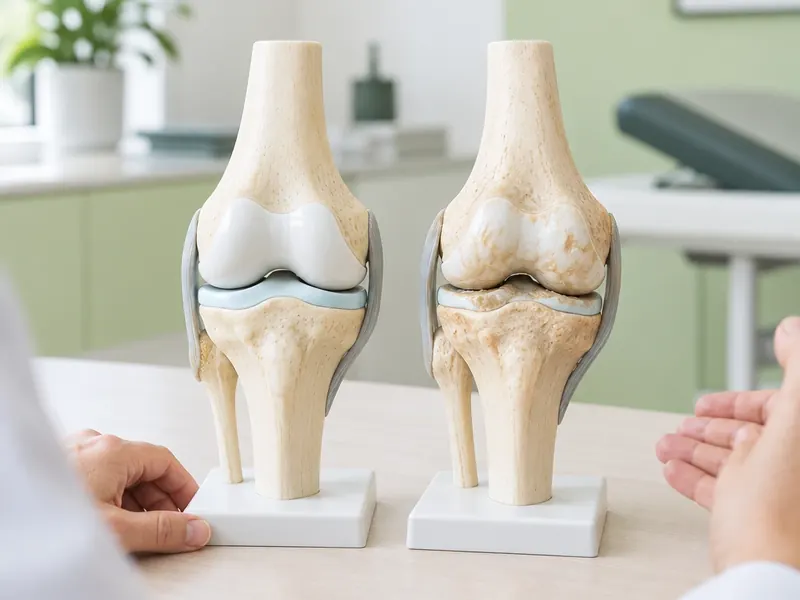
The two words sound almost the same, and many people use them as if they meant one thing. In medicine they do not. Arthritis is a broad term for conditions that cause pain and swelling in joints, and in everyday clinical use it most often means joint inflammation. Osteoarthritis is one specific type: a condition in which the cartilage that covers the ends of the bones gradually thins and the joint changes shape over time.
Put simply, inflammatory arthritis starts with the immune system or another cause of inflammation attacking the joint. Osteoarthritis starts with the joint tissues themselves slowly wearing and failing to repair. The two can overlap, and inflammation also plays a part in osteoarthritis, but the starting point and the course are different.
Why does the difference matter? Because the right tests, the right specialist and the right treatment plan depend on which condition you have. A plan that suits worn cartilage in one knee may be the wrong first step for an autoimmune disease that affects many joints at once.
Inflammation vs wear: what happens inside the joint
A healthy joint has smooth cartilage on the bone ends, a thin lining (the synovium) and a small amount of fluid that helps the surfaces glide.
In inflammatory arthritis
In conditions such as rheumatoid arthritis, the immune system mistakenly targets the joint lining. The synovium becomes thick and inflamed, produces extra fluid and, if left untreated, can damage cartilage and bone. Other types of inflammatory arthritis include psoriatic arthritis, gout, where crystals form in the joint, and reactive or infectious arthritis.
In osteoarthritis
In osteoarthritis the cartilage becomes rough and thinner. The body tries to repair the joint, and bony growths called osteophytes can appear at the edges. The lining may become mildly inflamed, and the joint can lose its smooth movement. These changes usually develop slowly over years.
Who is at risk of each condition
The risk factors partly differ, which is one of the first clues a doctor looks at.
- Osteoarthritis becomes more common with age, usually from the mid-40s onwards. Excess body weight, previous joint injuries or operations, joint overuse at work or in sport and a family history all raise the risk. It is more common in women.
- Rheumatoid arthritis and several other inflammatory types can start at any adult age, often between 30 and 50. Women are affected more often than men. Smoking and family history increase the risk.
- Gout is more common in men and is linked to high levels of uric acid in the blood.
Having a risk factor does not mean you will develop the condition. It only helps the doctor decide which explanation is more likely.

Symptoms that help tell them apart
Both conditions cause joint pain and stiffness, but the pattern is often different. The table below shows typical features; real cases do not always follow the textbook.
Morning stiffness
- Inflammatory arthritis (e.g. rheumatoid)
- Often longer than 30 minutes
- Osteoarthritis
- Usually short, easing within half an hour
When pain is worse
- Inflammatory arthritis (e.g. rheumatoid)
- At rest and at night, eases with gentle movement
- Osteoarthritis
- With activity and at the end of the day
Swelling and warmth
- Inflammatory arthritis (e.g. rheumatoid)
- Common, joint may feel warm and look red
- Osteoarthritis
- Mild swelling possible, bony enlargement
Which joints
- Inflammatory arthritis (e.g. rheumatoid)
- Often small joints of hands and feet, on both sides
- Osteoarthritis
- Knees, hips, spine and base of the thumb, often one side first
General symptoms
- Inflammatory arthritis (e.g. rheumatoid)
- Tiredness, feeling unwell, sometimes mild fever
- Osteoarthritis
- Usually limited to the joint
Onset
- Inflammatory arthritis (e.g. rheumatoid)
- Weeks to months
- Osteoarthritis
- Slowly over years
If a joint is suddenly hot, very swollen and painful, or you feel feverish, seek medical help promptly. This can be a sign of infection or gout that needs urgent care.
How doctors diagnose each: tests and scans
There is no single test that tells the two apart. The diagnosis comes from your history, an examination and a combination of tests.
- Blood tests. Markers of inflammation (such as ESR and CRP) are often raised in inflammatory arthritis. Rheumatoid factor and anti-CCP antibodies help confirm rheumatoid arthritis, and uric acid levels help assess gout. In osteoarthritis blood tests are usually normal and are mainly used to rule out other causes.
- X-rays. In osteoarthritis they may show narrowing of the joint space and osteophytes. In inflammatory arthritis early X-rays can look normal.
- Ultrasound and MRI. These show the joint lining, fluid, cartilage and soft tissues, and help detect inflammation early.
- Joint fluid analysis. Sometimes a small sample of fluid is taken to look for crystals or infection.
If you already have scans and test results, keep them. A doctor reviewing your case remotely can often tell from them which direction to take next.
Why treatment differs and where PRP and SVF fit
Because the causes differ, so do the treatment strategies.
Inflammatory arthritis
Systemic inflammatory diseases such as rheumatoid arthritis are managed by a rheumatologist. Treatment usually includes disease-modifying medicines that calm the immune response, chosen and monitored by that specialist. The aim is to control the disease early and protect the joints from lasting damage. Local joint treatments can support this care but do not replace it.
Osteoarthritis
Osteoarthritis care usually starts with exercise and physiotherapy, weight management, pain relief advised by a doctor and joint support where useful. When a joint is badly damaged and daily life is limited, joint replacement surgery may be discussed. These are general options; the right mix is chosen with your doctor after an assessment.
PRP and SVF
Platelet-rich plasma (PRP) and stromal vascular fraction (SVF) are injection treatments made from your own blood and adipose tissue. They are used to help reduce inflammation and pain and to support the tissues inside the joint. In osteoarthritis they are considered as an option to ease symptoms and delay more invasive steps. In inflammatory arthritis they may be part of the overall plan once an acute flare has settled, alongside the care prescribed by your rheumatologist. They are not done during an active joint infection. Results differ between people, and no treatment can promise a fixed outcome. You can read how the procedure works on our arthritis treatment page.

Getting a personal plan at City Medical Centre
City Medical Centre works with international patients. For joint conditions the clinic offers PRP therapy and SVF cell therapy from your own tissue, with every injection given under ultrasound guidance. Other treatments described in this article, such as rheumatology medicines, physiotherapy programmes or joint replacement, are covered here as general information; the most suitable option for you is discussed at the consultation.
The first consultation is free and can be held online. Send your X-rays, MRI or ultrasound reports and recent blood tests, and describe your symptoms. The doctor reviews them, confirms whether PRP or SVF suits your type of arthritis and names the cost, which is then fixed in the contract. A personal coordinator stays with you from your first message to the end of follow-up, and photos, scans and questions can be sent by Telegram. More details are on the arthritis treatment page.
Sources
Frequently asked questions
Is arthritis the same as osteoarthritis?
No. Arthritis is a broad term for conditions that cause joint pain and swelling, and it often refers to joint inflammation. Osteoarthritis is one specific type, in which cartilage gradually thins and the joint changes over years. The causes, the course and the treatment approach are different.
How can I tell arthritis from osteoarthritis?
The pattern of symptoms gives clues. Inflammatory arthritis often causes long morning stiffness, pain at rest, warm swollen joints and tiredness, often in small joints on both sides. Osteoarthritis pain usually worsens with activity and eases with rest. Only a doctor can confirm the diagnosis with an examination, blood tests and scans.
Which blood tests show arthritis?
Doctors usually check markers of inflammation such as ESR and CRP. Rheumatoid factor and anti-CCP antibodies help confirm rheumatoid arthritis, and uric acid is measured when gout is suspected. In osteoarthritis blood tests are usually normal and mainly help rule out other causes of joint pain.
Can PRP help both arthritis and osteoarthritis?
PRP may help ease pain and inflammation in both, but its role differs. In osteoarthritis it is used as one option to relieve symptoms. In inflammatory arthritis it can be part of the plan once a flare has settled and does not replace care from a rheumatologist. Whether it suits you is decided after a doctor reviews your case.
Is arthritis more common in women?
Yes, several types are. Rheumatoid arthritis affects women more often than men, and osteoarthritis is also more common in women, especially after menopause. Gout, on the other hand, is more common in men. Age, weight, injuries and family history also play an important part.
Have a question about your case? Get a free consultation
Message a coordinator on Telegram: we reply right in the chat, and you can send photos and questions there too.
- The first consultation is free, online consultations are available
- The doctor names the cost after the assessment, and it is fixed in the contract
- A personal coordinator guides you from the first message to recovery
Message our coordinator on Telegram
We reply right in the chat — you can send photos
Message us on TelegramBy sending a message, you agree to the privacy policy
Read also
 Arthritis treatment
Arthritis of the fingers and hands: symptoms, diagnosis and treatment
Arthritis of the fingers and hands: the main types, early signs, who is at risk, how it is diagnosed, treatment options and where PRP injections may fit.
 Arthritis treatment
Knee arthritis: causes, types and the treatment options available today
Why knee arthritis develops, the main types, how doctors diagnose it, treatment from exercise to PRP and SVF injections, and when to seek urgent care.
 Joint treatment
Avascular necrosis of the hip: what can be done in the early stages
Avascular necrosis of the hip is easiest to treat early. Learn the causes, first signs, why MRI matters, the stages and where SVF and PRP fit before surgery.