











Rhinoplasty6 min read
Revision rhinoplasty: signs the first surgery went wrong and when to redo it
Not every nose surgery turns out as planned. Some patients are unhappy with the shape, others struggle to breathe. Before deciding on a second operation, it is important to separate normal healing from a real problem and to wait long enough. This article explains the warning signs, the usual timing and what revision surgery involves.
The main points in 30 seconds
- Swelling and a blocked nose in the first months are usually part of normal healing.
- Most surgeons advise waiting at least a year before a revision.
- Common reasons: a remaining hump, a dropped tip, asymmetry or poor breathing.
- Revision is more complex than the first surgery and may need cartilage grafts.
- City Medical Centre performs revision rhinoplasty and reconstructive rhinoseptoplasty.
Key facts about the procedure
- Operation time1.5–3 hours
- Main healing4 months
- Stay in clinic1 day
- Price
$6,000from $4,200
When revision rhinoplasty is needed
Revision rhinoplasty is a repeat operation to correct the result of an earlier nose surgery. People consider it for two broad reasons: the nose does not look as planned, or it does not work as it should, most often because breathing has become harder.
Most patients are satisfied after their first rhinoplasty, but a share of them ask for a second correction. Sometimes the problem is obvious, such as a visible step on the bridge. Sometimes it is subtle, and the question is whether it is a real problem at all or simply a stage of healing.
The first rule is not to rush. The nose changes for many months after surgery, and a decision made too early can lead to an unnecessary operation.
Normal healing vs a true problem
Many things that worry patients in the first weeks are a normal part of recovery. The table below shows what is usually expected and what deserves a closer look.
- Swelling, especially of the tip, for several months
- A clear asymmetry that persists after swelling has settled
- Bruising around the eyes in the first two weeks
- A new hump or step on the bridge months later
- A blocked nose while the inside heals
- Breathing that is worse than before surgery after several months
- Numbness or stiffness of the tip
- A tip that droops, pinches or looks over-rotated once healed
- A nose that looks slightly wider at first
- Collapse of the side walls when breathing in
Most swelling settles within the first months, but the tip, especially with thicker skin, may keep refining for a year or longer. That is why the final shape is judged late.
Some signs need prompt medical attention at any time: fever, increasing pain, redness spreading over the nose, heavy bleeding or a sudden painful swelling inside the nose.

Signs the first surgery went wrong
After healing is complete, these are common reasons patients seek a revision:
- A remaining or new hump. Too little tissue may have been removed, or a callus of bone or scar tissue has formed.
- Over-resection. Too much cartilage or bone was removed, leading to a scooped or saddle-shaped bridge.
- Tip problems. A drooping tip, a pinched or asymmetric tip, or a tip that looks too upturned. A tip can drop over time if its supporting cartilage was weakened.
- Asymmetry of the bridge, nostrils or tip that is clearly visible.
- Irregularities such as small bumps or edges that can be seen or felt through thin skin.
- A result that does not match the face, for example a nose that looks too small or artificial.
Not every imperfection needs another operation. A good surgeon will also tell you when the gain from a revision is too small to justify the risks.
Breathing problems after rhinoplasty
A blocked nose for the first weeks is normal. Persistent breathing difficulty months later is not. Common causes include:
- a septum that is still or newly deviated;
- narrowing or collapse of the nasal valve, the narrowest part of the airway, often after too much cartilage was removed;
- scar tissue inside the nose;
- enlarged turbinates or chronic inflammation of the lining;
- a hole in the septum (septal perforation), which can cause whistling, crusting or nosebleeds.
Some of these problems can be managed without surgery, others need a functional correction. An examination of the inside of the nose, sometimes with an endoscope or CT scan, helps find the exact cause before any decision is made.
How long to wait before a second operation
In most cases surgeons advise waiting at least a year after the first rhinoplasty. By then swelling has largely settled, tissues have softened and the true result is visible. Operating on scarred, still-swollen tissue makes the outcome harder to predict.
There are exceptions. A clear functional problem or a complication may need earlier attention, and small corrections are sometimes discussed sooner. The timing is always decided by the surgeon after an examination. Our rhinoplasty page lists revision surgery as done no earlier than a year after the first operation.
What revision surgery involves and why it is more complex
A second operation is usually more demanding than the first:
- Scar tissue changes the anatomy and makes dissection slower and less predictable.
- Missing cartilage. If too much was removed, the surgeon may need grafts to rebuild support. They are usually taken from the septum, the ear or, when little septal cartilage remains, a rib.
- Thinner or thicker skin after the first operation can hide or reveal small details differently.
- Approach. Revisions are often done with an open approach, which gives the surgeon a better view and control.
The operation is done under general anaesthesia. Recovery follows the same stages as after the first surgery, but swelling may last longer. Because the work is more complex, revision surgery usually costs more than a primary rhinoplasty, and the exact price depends on how much needs to be corrected.
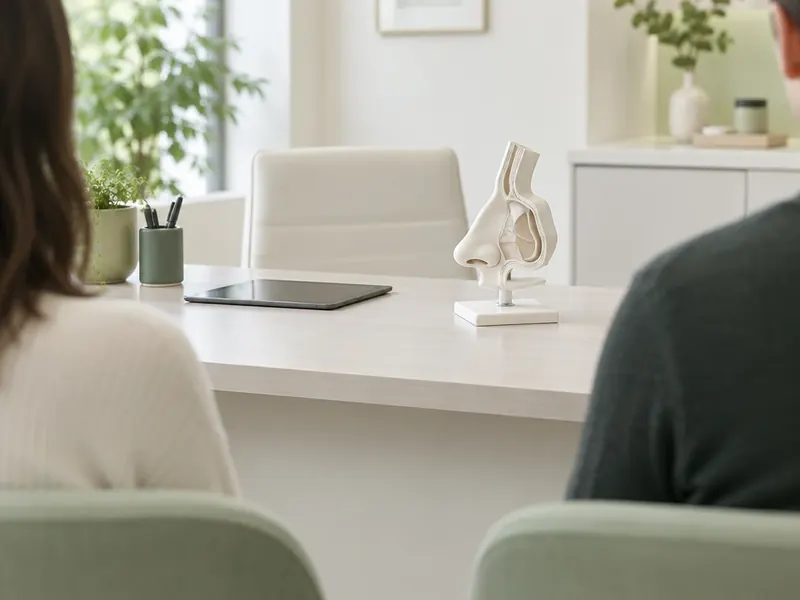
Getting a personal plan at City Medical Centre
City Medical Centre works with international patients. The clinic performs closed and open rhinoplasty, septorhinoplasty, revision rhinoplasty and reconstructive rhinoseptoplasty, including with a rib cartilage graft. Other treatments mentioned in this article, such as specific procedures for breathing problems, are described as general information, and the right option for you is discussed at the consultation.
The first consultation is free and can be held online. Send photos of your nose from the front, side and below, the date of your first surgery and, if you have them, the operation report and scans. The surgeon assesses whether a revision is needed and when, prepares a personal plan with a 3D forecast and names the cost, which is then fixed in the contract. A personal coordinator stays with you from your first message to the end of recovery, and photos and questions can be sent by Telegram. More details are on the rhinoplasty page.
Sources
Frequently asked questions
How soon after rhinoplasty can I have a revision?
Most surgeons advise waiting at least a year. By then swelling has largely settled and the real result can be judged, and scar tissue is softer and easier to work with. A clear functional problem or a complication may be assessed earlier, but the timing is always decided by the surgeon after an examination.
Is a remaining hump after rhinoplasty a reason for revision?
It can be, but only once healing is complete. In the first months, swelling can make the bridge look uneven. If a hump is still visible after about a year, it may be due to tissue left in place or a callus that formed during healing, and a surgeon can assess whether a correction is worthwhile.
Why did my nose tip drop after rhinoplasty?
A tip can drop when the cartilage that supports it was weakened or not reinforced enough, or as tissues settle over time. Early after surgery, swelling can also change how the tip looks. A surgeon examines the tip support and decides whether grafts or other techniques could restore its position.
Is revision rhinoplasty riskier than the first surgery?
It is usually more complex. Scar tissue and missing cartilage make the operation longer and the result harder to predict, and grafts may be needed. The main risks are similar to those of any rhinoplasty. Choosing a surgeon with experience in revision work and planning carefully helps reduce them.
How much does revision rhinoplasty cost?
It usually costs more than a primary rhinoplasty because the work is more complex and may need cartilage grafts. The exact price depends on what needs to be corrected. At City Medical Centre the surgeon names the cost after a free consultation, and it is then fixed in the contract.
Have a question about your case? Get a free consultation
Message a coordinator on Telegram: we reply right in the chat, and you can send photos and questions there too.
- The first consultation is free, online consultations are available
- The doctor names the cost after the assessment, and it is fixed in the contract
- A personal coordinator guides you from the first message to recovery
Message our coordinator on Telegram
We reply right in the chat — you can send photos
Message us on TelegramBy sending a message, you agree to the privacy policy
Read also
 Rhinoplasty
How old do you need to be for rhinoplasty? Age limits explained
The minimum age for rhinoplasty, why surgeons wait for the nose to stop growing, medical exceptions, and what changes when you have nose surgery after 40 or 50.
 Rhinoplasty
Rhinoplasty cost: what affects the price and what it should include
What rhinoplasty cost depends on: type of surgery, complexity, what the price includes, travel costs from abroad and why the cheapest quote can cost more.
 Arthritis treatment
Rheumatoid arthritis: where PRP and cell therapy fit into treatment
Rheumatoid arthritis and joint injections: how the disease damages joints, key tests, why rheumatology care comes first and when PRP or SVF may help.