Hair transplant for a receding hairline: how a natural hairline is designed and what results to expect
A receding hairline is one of the most common reasons people consider a hair transplant, and also one of the most demanding areas to restore, because the hairline frames the whole face. This article explains when a transplant can help, which causes of recession must be ruled out first, how a surgeon designs a natural hairline, which methods are used and how the result develops over the following year.
Can a transplant fix a receding hairline?
In many cases, yes. When the hairline recedes because of pattern hair loss (androgenetic alopecia), hair from the back and sides of the head usually keeps growing for life. Moving follicles from this donor area to the front can rebuild the hairline, and the transplanted hair keeps the donor area's resistance to further loss.
A transplant has limits, though. It redistributes your own hair rather than creating new hair, so the result depends on the size and density of the donor area. It does not stop the loss of the original hair around the transplanted zone, and it is not suitable for every cause of recession. That is why the first step is always a diagnosis, not a graft count.
Why the hairline recedes: pattern loss vs other causes
In men, pattern hair loss typically starts at the temples, forming an M-shaped hairline, and may later progress to the crown. In women, the front hairline is often preserved while hair thins along the parting, although some women also notice recession at the temples. Genes and sensitivity of the follicles to male hormones play the main role.
Other causes can look similar at first glance:
- Traction alopecia from tight ponytails, braids or extensions pulling on the front hairline for years;
- Telogen effluvium, a temporary diffuse shedding after illness, stress, surgery or childbirth;
- Hormonal or thyroid problems and some nutritional deficiencies;
- Scarring (cicatricial) alopecias, in which inflammation destroys the follicles.
Some of these respond to treating the cause and need no surgery at all. Others need a stable, inactive condition before a transplant can even be discussed.
Ruling out scarring types of hair loss first
One condition deserves special attention: frontal fibrosing alopecia. It causes a slowly receding band along the front hairline, often with loss of eyebrows, and is more common in women after menopause, although it also occurs in men. Because inflammation destroys follicles, transplanted grafts can be lost too while the disease is active.
Warning signs worth mentioning to the doctor include redness or scaling around the hair follicles at the hairline, itching or burning, smooth pale skin where hair used to be, and thinning eyebrows. A doctor examines the scalp with a dermatoscope and, if needed, recommends a biopsy. With scarring alopecia, a transplant is usually considered only after the condition has been inactive for a long time, and sometimes not at all.
Designing a natural hairline for your face and age
A good hairline is judged not by how low it sits, but by how natural it looks now and in twenty years. When planning it, the surgeon considers:
- Position. An adult hairline usually sits a little higher than the teenage one. Placing it too low can look unnatural and uses up grafts that may be needed later if loss progresses.
- Shape. Natural hairlines are not straight lines. They have soft irregularities, small peaks and a gentle recession at the temples that suits a mature face.
- Transition zone. The very front row is made of single-hair grafts, with thicker two- and three-hair grafts placed behind them, so the edge looks soft rather than dense like a wall.
- Angle and direction. At the front, hairs grow forward at a low angle; each graft is placed to match that direction.
- Your future. The design must still look right if hair behind the new line thins over time.
The hairline is drawn on your skin before the procedure and discussed with you in front of a mirror. Taking time over this step is worth it, because it defines the whole result.
FUE, DHI or combined: how the hairline is rebuilt
In all modern methods, grafts are taken one by one from the donor area with a fine punch (FUE extraction), leaving tiny dot-like marks rather than a linear scar. The methods differ in how the grafts are implanted:
| Method | How grafts are implanted | Typically used for |
|---|---|---|
| FUE | Tiny channels are opened first, then grafts are placed with forceps | Androgenetic hair loss, including the hairline and temples |
| DHI | Each graft is inserted with an implanter pen that creates the channel and places the graft in one step | Densifying areas where some hair remains |
| Combined FUE + DHI | FUE extraction, implantation with the pen, sometimes combined with channels | Androgenetic hair loss together with densification behind the hairline |
All three methods can create a natural hairline in skilled hands. The choice depends on the extent of loss, how much hair remains in the zone and the donor supply, and the surgeon explains it at the consultation. The procedure is usually done under local anaesthetic in one day. More about the methods is on our hair transplant page.
Recovery and timeline of results
Most people return to office work within a few days, though small crusts and redness in the recipient area are visible for about one to two weeks. The results develop slowly and in a predictable order:
- First two weeks: crusts form and fall away; the scalp is washed gently as instructed.
- Weeks two to eight: most transplanted hairs shed. This is normal: the follicles stay in the skin and enter a resting phase.
- Months three to four: new thin hairs begin to appear.
- Around six months: the change is clearly visible, though the hair is still maturing.
- Twelve months: the result is usually assessed; in some people the hair keeps thickening a little longer.
Because the original hair behind the new hairline may continue to thin, a doctor may also recommend treatment to slow further loss. How dense the final hairline looks depends on the donor area, hair thickness and colour, and the number of grafts, so the result is individual.
Getting a personal plan at City Medical Centre
City Medical Centre works with international patients. The first consultation is free and can be held online: send photos of your hairline from the front, both sides and the top, plus a photo of the back of your head, and tell the doctor when the recession started and whether it is progressing. Photos and questions can be sent by WhatsApp.
The doctor assesses the cause of the loss and your donor area, estimates the number of grafts, suggests the method and names the cost, which is then fixed in the contract. A personal coordinator stays with you from your first message to the end of recovery, and follow-up visits track how the new hairline grows. Find out more on the hair transplant page.
Sources
- American Academy of Dermatology — Hair loss: hair transplants
- American Academy of Dermatology — Frontal fibrosing alopecia
- NHS — Cosmetic procedures: hair transplant
Results of our patients
Real before and after photos of City Medical Centre patients. Results are individual.
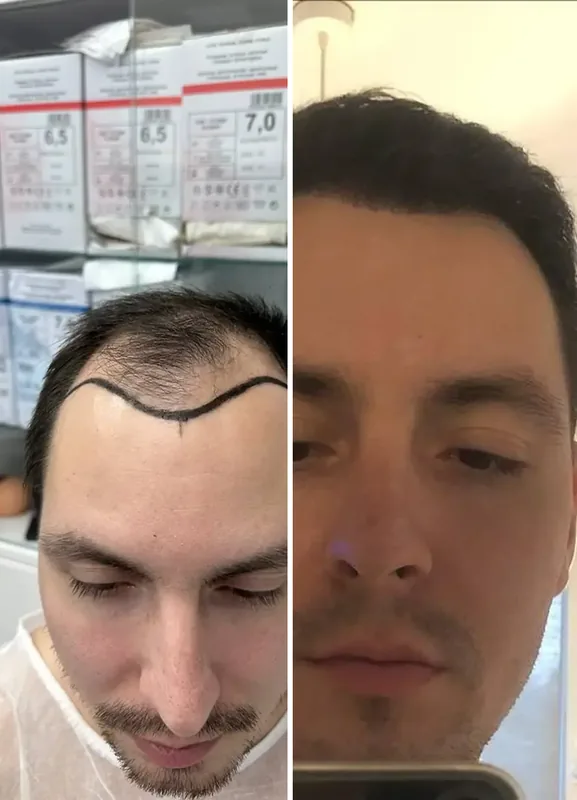 BeforeAfter
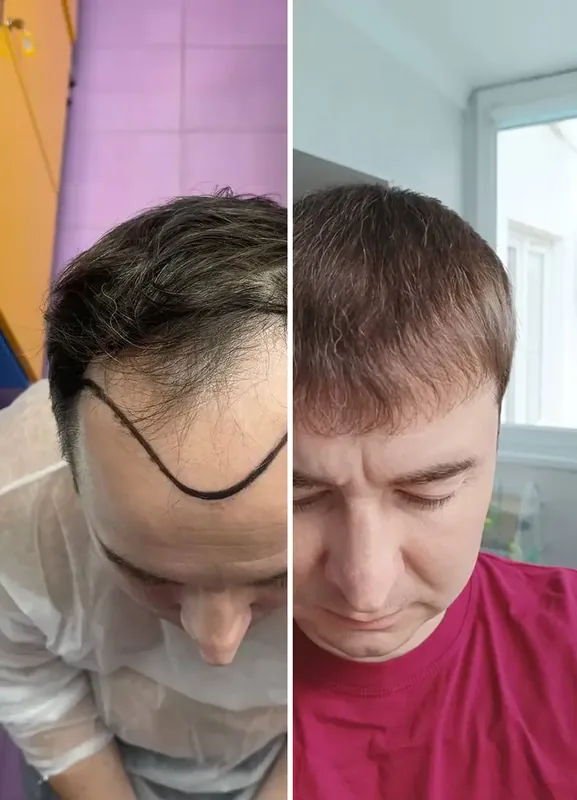 BeforeAfter
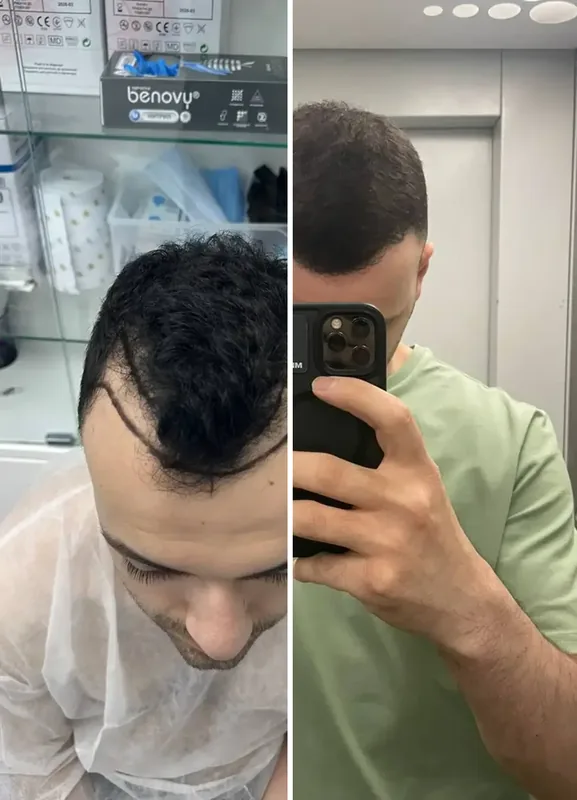 BeforeAfter
Frequently asked questions
How many grafts do I need for a receding hairline?
It depends on how far the hairline has receded, the width of the area, your hair thickness and the density you want. Restoring the temples and front edge often takes somewhere between about one and two and a half thousand grafts, but the exact number is set only after the doctor has examined your scalp and donor area.
Will a transplanted hairline look natural?
It usually does when it is designed well. A natural hairline has soft irregularities, single-hair grafts at the very front and hairs placed at a low forward angle. The surgeon also sets a position that suits a mature face, so the result still looks right years later.
Can I get a hairline transplant if my hair loss is still progressing?
Often yes, but the plan must allow for it. The surgeon avoids placing the hairline too low and keeps donor grafts in reserve, and a doctor may recommend treatment to slow further loss. In very young patients with rapid loss, surgeons usually advise waiting until the pattern becomes clearer.
Which is better for the hairline, FUE or DHI?
Neither is better in every case. Both use the same one-by-one extraction and can give a natural hairline. Classic FUE is commonly used for androgenetic loss, DHI for densifying areas with remaining hair, and a combined approach for both. The surgeon chooses after assessing your hair loss and donor area.
When will I see the final hairline result?
New hairs usually start to appear three to four months after the procedure, and the change is clearly visible at around six months. The result is usually assessed at about twelve months, and in some people the hair keeps thickening slightly for a few more months.
Have a question about your case? Get a free consultation
Send your name and phone number, and a coordinator will call you back. You can also send photos and questions on WhatsApp.
- The first consultation is free, online consultations are available
- The doctor names the cost after the assessment, and it is fixed in the contract
- A personal coordinator guides you from the first message to recovery
Read also
- Hair transplant
Scalp hair vs eyebrow hair: differences in structure, growth and function
Scalp hair and eyebrow hair differ in length, thickness, growth cycle, texture and purpose. Here is how, and why it matters when hair is transplanted.
- Hair transplant
Benefits of scalp micropigmentation and how to prepare for the procedure
What scalp micropigmentation can and cannot do: visual density, natural look, how long it lasts, how to prepare and how it compares with a hair transplant.
- Rhinoplasty
Rhinoplasty cost: what affects the price and what it should include
What rhinoplasty cost depends on: type of surgery, complexity, what the price includes, travel costs from abroad and why the cheapest quote can cost more.