



at first
12 months later
2,800 grafts
FUE method
City Medical Centre
0% instalments
from $367/mo
First talk and pricing — $0.
Real client
at first
12 months later
FUE method, no incisions or stitches. Grafts and outcome forecast measured up and never billed — before you decide.
Nothing to pay, no surgery booking required
Message our coordinator
Free online consultation · Reply within 15 minutes
Message us on TelegramMessage us on WhatsAppBy messaging us, you agree to our Privacy Policy
results
All cases are real patients of our clinic.
at first
12 months later
2,800 grafts
FUE method

at first
12 months later
3,500 grafts
FUE method

at first
12 months later
2,600 grafts
FUE method

at first
12 months later
3,000 grafts
FUE method

at first
12 months later
2,700 grafts
FUE method

at first
12 months later
3,300 grafts
FUE method

at first
12 months later
2,900 grafts
FUE method

at first
12 months later
2,500 grafts
FUE method

at first
12 months later
3,400 grafts
FUE method

at first
12 months later
2,500 grafts
FUE method

at first
12 months later
3,100 grafts
FUE method

at first
12 months later
3,600 grafts
FUE method

at first
12 months later
4,000 grafts
FUE method

at first
12 months later
3,200 grafts
FUE method

at first
12 months later
3,000 grafts
FUE method

at first
12 months later
3,700 grafts
FUE method

at first
12 months later
2,700 grafts
FUE method

at first
12 months later
3,800 grafts
FUE method

at first
12 months later
3,300 grafts
FUE method

at first
12 months later
2,800 grafts
FUE method

at first
12 months later
2,500 grafts
FUE method

at first
12 months later
3,900 grafts
FUE method

at first
12 months later
3,500 grafts
FUE method

at first
12 months later
3,800 grafts
FUE method

at first
12 months later
2,900 grafts
FUE method

at first
12 months later
3,600 grafts
FUE method

at first
12 months later
2,600 grafts
FUE method

at first
12 months later
2,700 grafts
FUE method

at first
12 months later
3,700 grafts
FUE method

at first
12 months later
3,200 grafts
FUE method

at first
12 months later
3,000 grafts
FUE method

at first
12 months later
2,800 grafts
FUE method

at first
12 months later
4,000 grafts
FUE method

at first
12 months later
3,400 grafts
FUE method

at first
12 months later
2,900 grafts
FUE method

at first
12 months later
3,100 grafts
FUE method

at first
12 months later
2,600 grafts
FUE method

at first
12 months later
3,300 grafts
FUE method

at first
12 months later
3,900 grafts
FUE method

at first
12 months later
3,500 grafts
FUE method

at first
12 months later
2,700 grafts
FUE method

at first
12 months later
3,800 grafts
FUE method

at first
12 months later
3,200 grafts
FUE method

at first
12 months later
3,000 grafts
FUE method

at first
12 months later
2,800 grafts
FUE method

at first
12 months later
3,100 grafts
FUE method

at first
12 months later
3,600 grafts
FUE method
Comparison
We transfer grafts by three technologies: classic FUE, suture-free DHI and a combined protocol. Compare them by implantation technique, tissue trauma and graft survival, and pick your method knowingly.
Classic technique without incisions or stitches

$2,200
$2,700
Graft implantation technique
ForcepsGraft trauma
MinimalA natural angle for hair
NaturalGraft survival
98–100%Suitable for
Androgenetic alopeciaImplantation with a Choi pen, no sutures

$2,500
$2,900
Graft implantation technique
DHI, a Choi implanterGraft trauma
MinimalA natural angle for hair
NaturalGraft survival
98–100%Suitable for
DensificationFUE extraction, DHI pen implantation

$2,700
$2,900
Graft implantation technique
Extraction by FUE, DHI implantGraft trauma
MinimalA natural angle for hair
NaturalGraft survival
98–100%Suitable for
Androgenetic alopecia and densificationThe survival and trauma figures for each method are averages, given as a guide; exact numbers depend on the transplant area and the patient's individual traits and are clarified by the doctor at the consultation.
Discuss your options


















about the clinic
A well-equipped operating room, pleasant rooms, attentive care

Our team explains the details and books the consultation at a convenient time
Message us on WhatsApp Send detailsWhen a non-surgical route exists for you, the doctor names it during the consultation and your budget is untouched. Set out below are the situations where a transplant is genuinely effective.
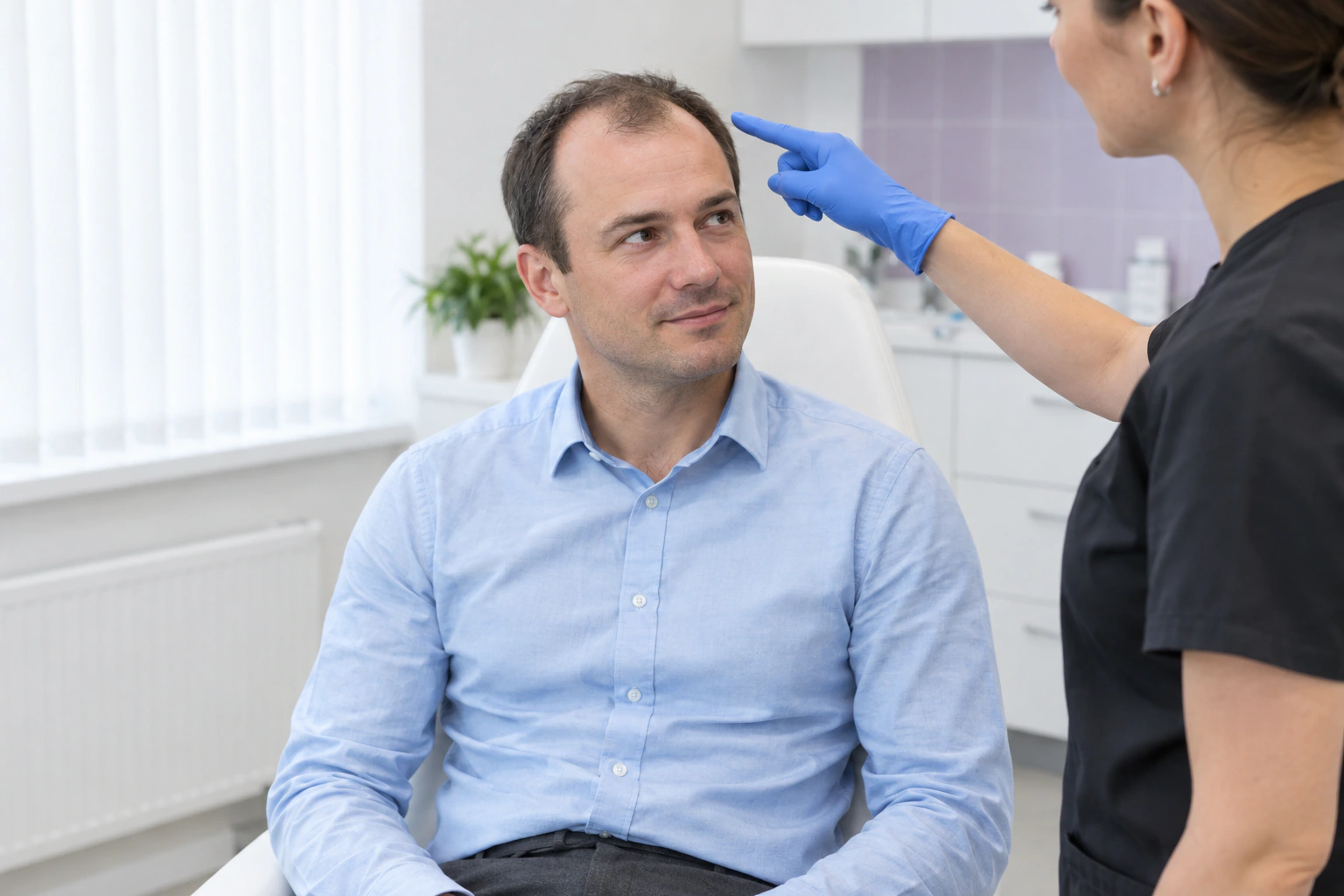

Give a number for contact. Pictures of the thinning zone are requested by a coordinator in a messenger, then a doctor looks and answers whether a transplant would help you. No payment, no obligation.

services
The cost is named at the free consultation, after the graft count, and written into the contract.
suture-free graft extraction

$2,200$2,700
or $367/mo — 0% instalments for 6 months
Pin your priceimplantation without channels

$2,500$2,900
or $417/mo — 0% instalments for 6 months
Pin your pricecombined technique

$2,700$2,900
or $450/mo — 0% instalments for 6 months
Pin your price| Talking to a doctor | Free |
|---|---|
| Eyebrow transplant, FUE | |
| Beard transplant, FUEinstalments $467/mo | |
| Hair trichopigmentation | |
| PRP therapy / session | $200 |
all included
Guidance before the operation and across 12 months after.
No extra charges appear on the day of surgery.
two extra areas
The same grafts from the back of the head, the same FUE method — only the area changes: it is not only about the scalp.
FUE method, free of cuts or stitches

The donor area at the back of the head supplies the grafts, moved through micro-punctures of about 1 mm — no scars are left. The doctor goes over the shape with you before the operation, taking your facial features into account. Transplanted hair grows for life and the beard is styled as usual.
$2,800$3,000
or $467/mo — 0% instalments for 6 months
Pin your priceFUE method, free of cuts or stitches

At your first meeting the surgeon settles the brow shape: references are turned over together and the proportions of your face underpin the design. Angled correctly, the implanted hairs give brows that read as natural. Growth stopped by long years of plucking is covered as well.
$1,600$1,700
an op you walk out of, under local anaesthesia
Pin your priceThe donor zone is looked at, the grafts are added up and a realistic result is spelled out. At that consultation you also learn the cost, which the contract then fixes.

Message our coordinator
Free online consultation · Reply within 15 minutes
Message us on TelegramMessage us on WhatsAppBy messaging us, you agree to our Privacy Policy
Process
From consultation to going home — all in one day

At this first meeting, the doctor walks you through both the FUE and DHI methods, addresses any questions you have, and designs a surgical plan built around your case — at no cost.

Booking involves reserving the surgery date with a deposit — card payment at the clinic or an online transfer — under a medical services contract.

Preparing for the procedure means taking the tests on the clinic's list, following the instructions provided along the way.

Nothing sharp is felt: the operation proceeds under local anaesthetic.

Grafts are extracted from behind the head or from the temple area, and no thread touches the skin.

This is where the grafts are implanted into the affected, balding area.
You are sent home with the required items and a complete explanation of how to heal quickly.

Crusts thin out and vanish, swelling flattens, the skin repairs

Losing the shafts is normal, and the roots are not lost

First sprouts come through, the difference starts showing

The hair becomes thicker, the main volume and contour show

The picture completes: full volume, a natural front line

Free, well before surgery and with no obligation.
Discuss your optionsdoctors

Hair transplant doctor, trichologist, surgeon
10 years of experience

Dermatovenereologist, trichologist, surgeon
11 years in practice

Plastic surgeon
9 years of experience

Plastic surgeon
9 years of experience

Assistant
9 years of experience
A careful look at the donor zone, a graft calculation and a clear statement of the outcome.
Discuss your optionscoordinators
You are handed to a coordinator who stays with your case until recovery is complete.

Your care coordinator
In touch until you have healed
Takes care of the forms and of scheduling

Your care coordinator
In touch until you have healed
Takes care of the forms and of scheduling
Your care coordinator
In touch until you have healed
Takes care of the forms and of scheduling
Your care coordinator
In touch until you have healed
Takes care of the forms and of scheduling













Our team explains the details and books the consultation at a convenient time
Message us on WhatsApp Send detailsStandard questions

Yes — this happens often. Treatment is given to people from all sorts of cities and countries, and a doctor's opinion is given online to begin with.
The base prices are $2,200 (≈ RWF 3,300,000) (FUE), $2,500 (≈ RWF 3,700,000) (DHI) and $2,700 (≈ RWF 4,000,000) (combined). The precise cost is determined at a free consultation and graft count, then fixed in your contract.
A day-long operation, after which everyone returns home.
Patients feel nothing: the scalp is numbed with an anesthetic given locally.
FUE is cut-free graft extraction by tweezer. DHI is direct implantation with a Choi pen, skipping channel-making. The combined technique takes grafts by FUE and places them using the DHI method.
The answer depends on donor hair. The doctor provides the exact count at a consultation that is free.
The skin closes over 0–10 days. One shed at 2–4 weeks follows, and it is normal. Growth sets in at 3–4 months, the head looks noticeably denser at 6–9 months, and by 12–18 months the result is settled.
Your procedure includes a lifetime hair-growth guarantee under contract.
The clinic works under a medical licence, and care meets the standards and clinical guidelines
of the Ministry of Health.

Diplomas and certificates of the doctors who will operate
Study the documentsAKC POMOSHCH LLC
the clinic's legal entity
1057746096924
OGRN
7728536872
INN
Both FUE and DHI are open to a patient in Kigali: neither leaves a surgical cut, neither requires stitches, both are carried out under local anaesthesia, and both wrap up in one day instead of dragging on.
The beginning is remote and free for a patient in Kigali: photographs of the area, a look from the doctor, and a clear word on whether a transplant will help. The clinic responds 24/7.
The first 0-10 days go on healing. Between 2-4 weeks the transplanted hairs fall out, which sounds alarming and is in fact entirely normal. Growth begins at 3-4 months and keeps going quietly from there.
Prices are in US dollars; the amount in brackets is an approximate conversion to RWF at the rate of 02.10.2026. The final price is fixed in your contract.
By messaging us, you agree to our Privacy Policy
What patients write after this operation. Reviews are translated from the original language.
Andrey M.
I had the operation a month ago. Before and after surgery they were always in touch and helped with questions about my tests. The operation itself went wonderfully, the staff are polite and masters of their craft, you feel you are in safe hands. I am recovering now, and they answer all my questions. I am happy and I recommend them!
DHI hair transplant
Pavel Sinitsyn
The best clinic of all the ones I was choosing from. No regrets at all! The result is simply amazing, I am thrilled. I recommend it to everyone: these people do great work and make people happy. Once again, a huge thank you to everyone. Roman, the head of the clinic, is the best: he was personally in touch with me and looked after my recovery. Thank you for making my dream come true.
FUE hair transplant
Maria Akopyan
I thought about an eyebrow transplant for a long time and finally went for it. At first I was afraid the result would look unnatural, but when I saw my new eyebrows I was delighted! They came out full and in harmony with my face. I can hardly believe that now I just wash my face and go, I have never felt so free. For anyone tired of constant make-up, a transplant is a real lifesaver!
Eyebrow transplant (FUE)
Alexander M.
I really wanted a thick beard, but I had problems with it. I tried every home remedy and minoxidil, and nothing helped. After a long search for the best clinic I settled on this one. Thank you so much for the service, I liked everything and now I am happy! I had the beard transplant 10 months ago and I am very pleased with the result. By the way, the music in the clinic was great, as far as I remember. A friend of mine has already come to you for a transplant on my advice and was also happy with the result. I wish you every success!
Beard transplant (FUE)
Vladimir Z.
I went to the clinic to see a trichologist and had a hair transplant. I really liked the doctor's approach, and all the recommendations helped. I want to point out that nobody tries to sell you extra services: they tell you things as they are, and if some treatment is not needed, they do not push it. Cosy and clean.
DHI hair transplant
Artem Popov
This may sound obvious, but a head of hair really changes everything in your life. You feel much more confident and go through life like a winner. And it is all thanks to the doctor at this clinic and to the staff who take care of their patients. Many thanks to the clinic for a happy life with new hair, for the comfortable conditions and for the professionalism during the hair transplant.
FUE hair transplant
Page medically reviewed by Anastasia A. Kolesnik, hair transplant doctor. Review date: .
Kigali is the capital, the largest city and a province-level administrative unit of Rwanda. It sits near the geographic centre of the country, in a landscape of rolling hills with valleys and ridges joined by steep slopes. As of the 2022 Rwandan census the population of Kigali was 1,745,555, and the city is young: 73 per cent of residents were under 30 at the time of the 2012 census, and 94 per cent were under 50.
That age profile explains a lot about the questions people from Kigali bring to a hair transplant consultation. Many are in their twenties and thirties, studying or building a career in services, information technology or business, and noticing a receding frontal hair line or thinning at the crown earlier than they expected. Others want to fill out a patchy beard or sharpen a moustache line.
The procedure is FUE or DHI. Grafts are taken from the back of the head, the donor area, and moved through micro-punctures of about 1 mm, so nothing scars over. The doctor discusses the shape with you before the operation, taking your facial features into account. What follows is about fitting that plan into everyday life in Kigali, from the weather to the working week.
Under the Köppen classification Kigali has a tropical savanna climate, but its altitude keeps temperatures cooler than is typical for equatorial countries. The average daily range is between 15 and 27 °C, with little variation through the year. For recovery this is good news: extreme heat is rare, which means less sweating on the scalp during the first days of healing.
Even so, the sun at altitude is strong. Newly treated skin should be protected from direct sunlight, and the surgeon will tell you what kind of loose headwear is acceptable and when. Avoid tight caps that rub the grafted area, and ask which fabrics are safe to use.
Walking is part of life in a hilly city, and steep slopes mean more exertion than you might expect on an ordinary errand. During the early healing period, plan your errands so that you are not straining, bending sharply or sweating heavily. Ask your coordinator how to adapt your usual routine to the 0–10 days allowed for healing.
Kigali has two rainy seasons, from February to June and from September to December. They are separated by a major dry season from June to September, when there is often no rain at all, and a shorter, less severe dry season from December to February. April is the wettest month and July the driest.
Dry months bring more dust on unpaved side streets and more bright sun, while rainy months bring torrential downpours that can make hillside roads slippery and traffic slow. Neither is a barrier to surgery. The question is which inconveniences you would rather manage while the scalp is healing: dust and glare, or wet weather and the need to keep the head dry and clean.
Because the climate changes little through the year, many people in Kigali choose the date by their own calendar: a quieter period at work or university, a gap between exams, or a time without family events. Remember the timeline that follows the procedure: 0–10 days for healing, 2–4 weeks for normal shedding of transplanted hair, 3–4 months for new growth to start, 6–9 months for real density, and 12–18 months for the final result. Count forward from your chosen date and see which important occasions fall into the awkward shedding phase.
Kigali is the economic and financial hub of Rwanda and its largest business centre. The service sector is the largest contributor to the city's economy, covering retail, information technology, transport, hotels and real estate. Many people work in client-facing jobs where appearance matters and where long absences are not easy.
The city is also a centre of learning, with institutions such as the Kigali Health Institute, the Kigali Institute of Science and Technology and the Kigali Institute of Education, as well as private universities. Students and young professionals often ask how soon they can be seen in public after the operation.
The honest answer is to separate the phases. The first days of healing are the most visible. After that, many people with desk work or study return to their routine, following the surgeon's instructions on washing, headwear and activity. The shedding phase, 2–4 weeks, is when transplanted hairs let go, as expected. This is normal and not a sign of failure, but it is worth planning around if you have presentations, interviews or graduation photos. Ask the surgeon what you can do at work and what to avoid.
Food in Kigali is built around bananas, plantains known as ibitoke, pulses, sweet potatoes, beans and cassava. These staples are served in restaurants across the city, often in a mélange buffet with meat, chips or fish, and brochettes are the most popular evening dish. Popular drinks include ikivuguto, a fermented milk, and urwagwa banana beer.
A balanced diet supports healing in general. Ask the surgeon whether any dietary restrictions apply, and in particular about alcohol: a social evening with friends over brochettes is a normal part of city life, but alcohol and a fresh procedure are a question to settle with the doctor beforehand, not afterwards.
Family gatherings, weddings and community events matter a great deal, and crowded, warm rooms are not ideal for a fresh scalp. If you have a major event on the calendar, plan the operation so that it falls well before it, beyond the early healing and shedding period, or after it. Tell your coordinator about such dates in the first conversation.
Kigali is a city where people walk, climb hills and exercise outdoors. After hair transplantation, the guidance on sport and pool use comes from your surgeon, and you should follow it exactly rather than rely on what a friend did. Ask specifically about running, football, gym training, swimming pools and contact sports, and when each can resume.
As a general principle, anything that makes the scalp sweat heavily, risks a knock to the head or exposes it to chlorinated water should wait until the doctor allows it. Teammates and training colleagues should be told to avoid contact with the head during the early period.
Plan a gradual return. Many people prefer to restart with light walking, then move to regular training once the wound has healed. Your check-ups, at months 1, 3, 6, 9 and 12, are good moments to ask what is now allowed.
Typical questions concern the natural look of the frontal hair line, the density that can realistically be achieved, how long the shedding lasts, and whether a beard transplant looks natural. One patient wrote: «But now the result truly makes me very happy. From about the 4th month active, even growth began. The transplanted hair took very well, the beard now looks as natural as possible, no bald patches are left. The beard became much thicker and denser, with the shape I had thought about for a long time.» Individual results differ, and this is simply one experience.
Questions worth bringing to the surgeon: how will the shape be designed for my face? How many grafts can the donor area comfortably provide? Which method, FUE or DHI, suits my case? What care do I need in the first days? What should I do if I am worried about something in the weeks after the operation?
Also ask about the long term. Transplanted hair grows for life: trim and style the beard as usual. Ask how existing hair loss may continue around the transplanted area and whether supporting treatment makes sense.
In general terms, a good candidate has a sufficient donor area at the back of the head, realistic expectations and stable general health. Chronic conditions, scalp skin diseases, blood clotting problems or unstable hair loss need to be assessed by the doctor first. Overweight and metabolic health can also matter for any surgery, and the WHO publishes general information on this topic. Be fully honest about medications and past illnesses.
The consultation is free and online, so you take part from Kigali without leaving your home or office. You send photos of the scalp, donor area or beard, describe your history, and discuss the plan with the medical team. Coordinators are available around the clock (24/7) on WhatsApp and Telegram, so you can write at any time, including outside working hours.
We stay with you from pre-op planning to 12 months later, with check-ups at months 1, 3, 6, 9 and 12. After the procedure a coordinator will be on the phone 24/7. Timing of the result is explained in advance: 2-4 weeks, transplanted hairs let go, as expected; 3-4 months, hair comes back; 6-9 months, visibly thicker; 12-18 months, settled look.
Kigali's altitude keeps the average daily temperature between 15 and 27 °C with little change through the year, so extreme heat is rare. The sun is still strong, so protect the treated area as the surgeon advises and avoid tight headwear.
There is no single answer. The major dry season runs from June to September, with rainy seasons from February to June and from September to December. Choose by your work, study and family calendar, and keep the shedding phase away from important events.
0–10 days for healing, 2–4 weeks for normal shedding of transplanted hair, 3–4 months for new growth to start, 6–9 months for real density, and 12–18 months for the final result.
Yes, the transplanted hairs let go at 2-4 weeks, as expected. Hair comes back at 3-4 months and looks visibly thicker at 6-9 months.
Grafts are taken from the back of the head, the donor area, and moved through micro-punctures of about 1 mm, so nothing scars over.
Yes. The consultation is free and online, and coordinators are available 24/7 on WhatsApp and Telegram.
We stay with you from pre-op planning to 12 months later. Check-ups take place at months 1, 3, 6, 9 and 12, and a coordinator will be on the phone 24/7.
Yes, beard restoration is possible. The doctor discusses the shape with you before the operation, taking your facial features into account. Transplanted hair grows for life: trim and style the beard as usual.
Many people with office or study routines return after the early healing days, following the surgeon's instructions. Sport, swimming and contact activities should wait until the doctor allows them.

 Forceps
 Minimal


