



at first
12 months on
2,800 grafts
FUE method
City Medical Centre
0% instalments
from $367/mo
Meeting and a quote — $0.
A real case
at first
12 months on
FUE, without a single cut or stitch. Graft count and forecast done for you, free of fee — before you decide.
Nothing to pay, no surgery booking required
Message our coordinator
Free online consultation · Reply within 15 minutes
Message us on TelegramMessage us on WhatsAppBy messaging us, you agree to our Privacy Policy
results
Each example is drawn from a genuine patient.
at first
12 months on
2,800 grafts
FUE method

at first
12 months on
3,500 grafts
FUE method

at first
12 months on
2,600 grafts
FUE method

at first
12 months on
3,000 grafts
FUE method

at first
12 months on
2,700 grafts
FUE method

at first
12 months on
3,300 grafts
FUE method

at first
12 months on
2,900 grafts
FUE method

at first
12 months on
2,500 grafts
FUE method

at first
12 months on
3,400 grafts
FUE method

at first
12 months on
2,500 grafts
FUE method

at first
12 months on
3,100 grafts
FUE method

at first
12 months on
3,600 grafts
FUE method

at first
12 months on
4,000 grafts
FUE method

at first
12 months on
3,200 grafts
FUE method

at first
12 months on
3,000 grafts
FUE method

at first
12 months on
3,700 grafts
FUE method

at first
12 months on
2,700 grafts
FUE method

at first
12 months on
3,800 grafts
FUE method

at first
12 months on
3,300 grafts
FUE method

at first
12 months on
2,800 grafts
FUE method

at first
12 months on
2,500 grafts
FUE method

at first
12 months on
3,900 grafts
FUE method

at first
12 months on
3,500 grafts
FUE method

at first
12 months on
3,800 grafts
FUE method

at first
12 months on
2,900 grafts
FUE method

at first
12 months on
3,600 grafts
FUE method

at first
12 months on
2,600 grafts
FUE method

at first
12 months on
2,700 grafts
FUE method

at first
12 months on
3,700 grafts
FUE method

at first
12 months on
3,200 grafts
FUE method

at first
12 months on
3,000 grafts
FUE method

at first
12 months on
2,800 grafts
FUE method

at first
12 months on
4,000 grafts
FUE method

at first
12 months on
3,400 grafts
FUE method

at first
12 months on
2,900 grafts
FUE method

at first
12 months on
3,100 grafts
FUE method

at first
12 months on
2,600 grafts
FUE method

at first
12 months on
3,300 grafts
FUE method

at first
12 months on
3,900 grafts
FUE method

at first
12 months on
3,500 grafts
FUE method

at first
12 months on
2,700 grafts
FUE method

at first
12 months on
3,800 grafts
FUE method

at first
12 months on
3,200 grafts
FUE method

at first
12 months on
3,000 grafts
FUE method

at first
12 months on
2,800 grafts
FUE method

at first
12 months on
3,100 grafts
FUE method

at first
12 months on
3,600 grafts
FUE method
Comparison
You have three graft transfer technologies to choose between: classic FUE, suture-free DHI and a combined protocol. They differ in implantation technique, tissue trauma and graft survival.
Classic method requiring no cuts or sutures

$2,200
$2,700
Graft implantation technique
ForcepsGraft trauma
MinimalA natural growth angle
NaturalGraft survival
98–100%Suitable for
Androgenetic alopeciaImplantation with a Choi pen, no sutures

$2,500
$2,900
Graft implantation technique
Choi implanter, DHI penGraft trauma
MinimalA natural growth angle
NaturalGraft survival
98–100%Suitable for
DensificationFUE extraction, DHI pen implantation

$2,700
$2,900
Graft implantation technique
FUE extraction + DHI implantationGraft trauma
MinimalA natural growth angle
NaturalGraft survival
98–100%Suitable for
Densification for androgenetic alopeciaFor every method the survival and trauma figures are averages and serve as a guide: the precise numbers follow from the transplant area and the patient's individual features, clarified by the doctor at consultation.
Speak to a specialist


















about the clinic
Good equipment, pleasant rooms and attention to each patient

We will talk through your questions and book the consultation at a good time
Message us on WhatsApp Get in touchIf nothing needs to be operated on, that verdict comes during the consultation, and you part with nothing. Described below are the situations where a transplant genuinely helps.
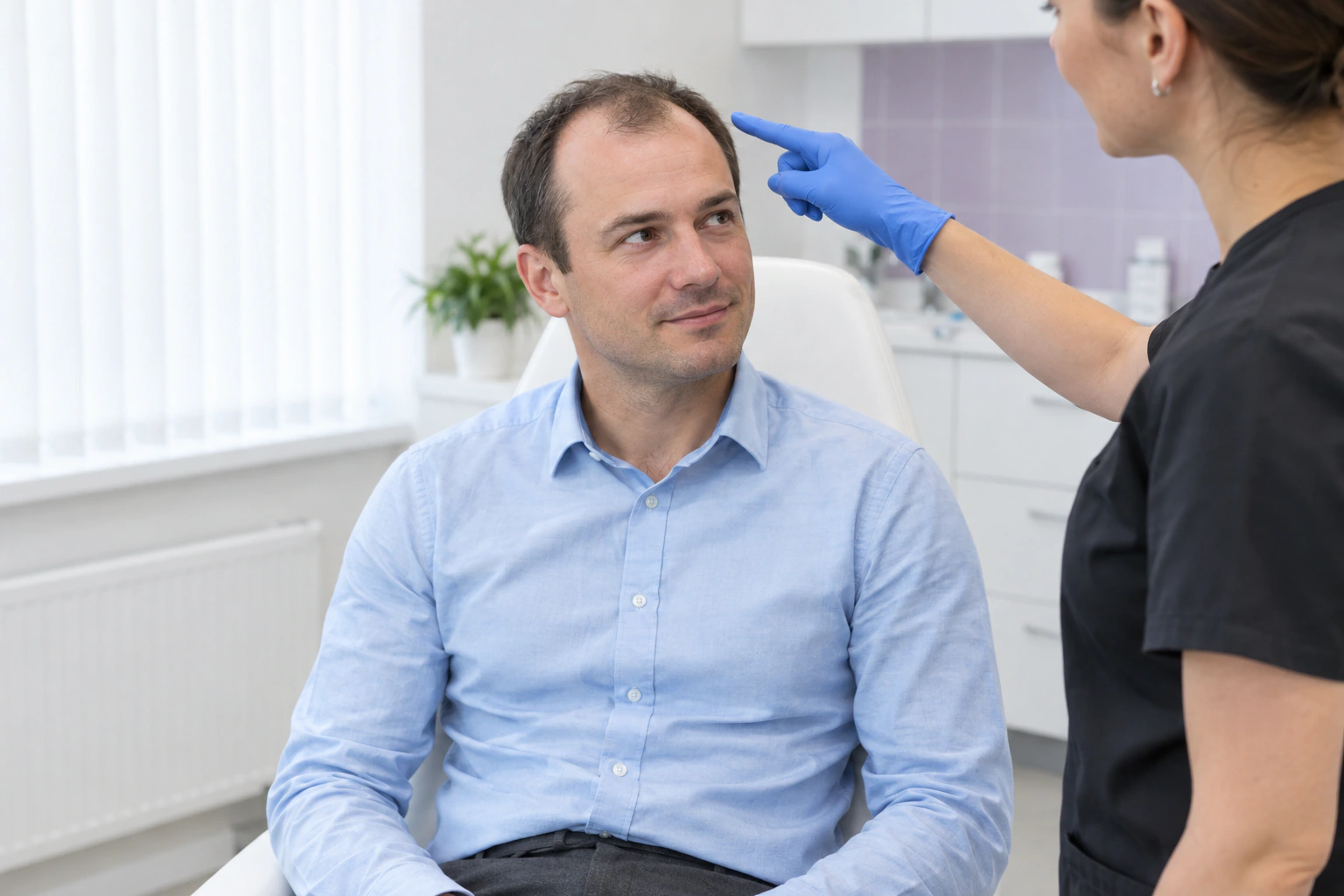

Your number is enough: a coordinator asks for photos, the doctor says if a transplant helps. Free, no booking.

services
No figure is named until the grafts have been counted; this happens at the free consultation and is recorded in the contract.
suture-free graft extraction

$2,200$2,700
or $367/mo — 0% instalments for 6 months
Nail down the priceimplantation without channels

$2,500$2,900
or $417/mo — 0% instalments for 6 months
Nail down the pricecombined technique

$2,700$2,900
or $450/mo — 0% instalments for 6 months
Nail down the price| The opening review | Free |
|---|---|
| Eyebrow transplant, FUE | |
| Beard transplant, FUEinstalments $467/mo | |
| Hair trichopigmentation | |
| PRP therapy / session | $200 |
all included
From preparation for the operation to 12 months after.
No hidden extra charges on the day of surgery.
two other areas
Not the scalp alone. The same grafts from the back of the head, the same FUE method — only the treated area changes.
The FUE method, no incisions used

Grafts are taken from the donor area at the back of the head and moved through micro-punctures of roughly 1 mm — no scars are left. You and the doctor discuss the shape before the operation, taking your facial features into account. Transplanted hair grows for life: the beard can be trimmed and styled as usual.
$2,800$3,000
or $467/mo — 0% instalments for 6 months
Nail down the priceThe FUE method, no incisions used

The surgeon draws out the brow at the opening consultation, example photos are weighed up together, and the design keeps to the proportions of your face. Set at the angle of growth, the hairs give a result nobody reads as artificial. Brows that gave up growth after long years of tweezing benefit as well.
$1,600$1,700
a procedure that needs no stay, numbed locally
Nail down the priceThe doctor assesses what the donor zone holds, counts the grafts and explains the outcome you can expect. You are told the cost at the consultation and it goes into the contract.

Message our coordinator
Free online consultation · Reply within 15 minutes
Message us on TelegramMessage us on WhatsAppBy messaging us, you agree to our Privacy Policy
Process
From consultation to going home — all in one day

At this first meeting, the doctor walks you through both the FUE and DHI methods, addresses any questions you have, and designs a surgical plan built around your case — at no cost.

A deposit paid by card — whether at the clinic or online — secures the surgery date, with the details set out in a medical services contract.

The clinic gives you everything needed to prepare — a list of required tests and instructions — before the transplant takes place.

The operation runs on local anaesthetic, which removes any pain from it.

The donor supply lies behind the head or around the temples, and grafts come from there without any stitching.

Surgeons move the collected grafts across to where hair has been lost.
The final step is recovery, backed by the clinic's supplies and full instructions for fast healing.

The crusts clear away, the puffiness fades, the skin repairs itself

Normal stage. Only the hairs fall out, the follicles remain in place

New hairs gradually appear, the result starts to show

The hair becomes fuller, the main volume and contour are visible

The finished volume shows, with a naturally drawn edge

Free, before surgery and with no obligations.
Speak to a specialistdoctors

Hair transplant doctor, trichologist, surgeon
10 years in practice

Dermatovenereologist, trichologist, surgeon
11 years in practice

Plastic surgeon
9 years of experience

Plastic surgeon
9 years of experience

Assistant
9 years of experience
The doctor looks over the donor zone, arrives at the number of grafts and explains what is achievable.
Speak to a specialistcoordinators
You are assigned a personal coordinator — they guide you from your first enquiry through to recovery.

Patient support lead
Never leaves you alone at any stage
Sorts out all your paperwork and bookings

Patient support lead
Never leaves you alone at any stage
Sorts out all your paperwork and bookings

Patient support lead
Never leaves you alone at any stage
Sorts out all your paperwork and bookings
Patient support lead
Never leaves you alone at any stage
Sorts out all your paperwork and bookings













We will talk through your questions and book the consultation at a good time
Message us on WhatsApp Get in touchWhat people ask

Absolutely. Patients based in other towns and other countries are taken on, and a doctor can look at your photographs online.
The base prices are $2,200 (≈ KES 285,000) (FUE), $2,500 (≈ KES 325,000) (DHI) and $2,700 (≈ KES 350,000) (combined). The precise cost is determined at a free consultation and graft count, then fixed in your contract.
One day sees the whole operation through, and then it is home.
Local anesthesia is standard, and that keeps the work pain-free.
FUE relies on tweezer harvesting with no incisions or stitches. DHI relies on Choi-pen implantation without channels. The combined DHI+FUE approach harvests by FUE and implants by DHI.
There is no fixed answer; the doctor works it out at zero cost from the condition of your donor zone.
Within 0–10 days the skin is healed. The 2–4 week loss of transplanted hairs is normal. Regrowth begins at 3–4 months, becomes obvious around 6–9 months, and reaches completion at 12–18 months.
Hair growth is covered by a lifetime guarantee, fixed in the signed contract.
The clinic works under a medical licence, care is given to the standards and clinical guidelines
of the Ministry of Health.

Diplomas and certificates of the doctors who operate
Look at the documentsAKC POMOSHCH LLC
the clinic's legal entity
1057746096924
OGRN
7728536872
INN
The procedure is built to fit a working life in Thika: FUE and DHI need neither cuts nor stitches, local anaesthesia is enough, and everything fits into one day. Graft survival is 98-100 %, and a price from $2,200 (≈ KES 285,000) is fixed in the contract after a free count.
The start costs nothing in Thika: a free online consultation where the doctor sees photos of the thinning area and gives a graft count. The clinic is on the line 24/7, so you can write during a break rather than at night.
Healing needs 0-10 days of your patience and nothing else. Then at 2-4 weeks the transplanted hairs shed, a normal turn of events. Growth starts at 3-4 months and continues long after that first sign of it.
Prices are in US dollars; the amount in brackets is an approximate conversion to KES at the rate of 02.10.2026. The final price is fixed in your contract.
By messaging us, you agree to our Privacy Policy
What patients write after this operation. Reviews are translated from the original language.
Andrey M.
I had the operation a month ago. Before and after surgery they were always in touch and helped with questions about my tests. The operation itself went wonderfully, the staff are polite and masters of their craft, you feel you are in safe hands. I am recovering now, and they answer all my questions. I am happy and I recommend them!
DHI hair transplant
Pavel Sinitsyn
The best clinic of all the ones I was choosing from. No regrets at all! The result is simply amazing, I am thrilled. I recommend it to everyone: these people do great work and make people happy. Once again, a huge thank you to everyone. Roman, the head of the clinic, is the best: he was personally in touch with me and looked after my recovery. Thank you for making my dream come true.
FUE hair transplant
Maria Akopyan
I thought about an eyebrow transplant for a long time and finally went for it. At first I was afraid the result would look unnatural, but when I saw my new eyebrows I was delighted! They came out full and in harmony with my face. I can hardly believe that now I just wash my face and go, I have never felt so free. For anyone tired of constant make-up, a transplant is a real lifesaver!
Eyebrow transplant (FUE)
Alexander M.
I really wanted a thick beard, but I had problems with it. I tried every home remedy and minoxidil, and nothing helped. After a long search for the best clinic I settled on this one. Thank you so much for the service, I liked everything and now I am happy! I had the beard transplant 10 months ago and I am very pleased with the result. By the way, the music in the clinic was great, as far as I remember. A friend of mine has already come to you for a transplant on my advice and was also happy with the result. I wish you every success!
Beard transplant (FUE)
Vladimir Z.
I went to the clinic to see a trichologist and had a hair transplant. I really liked the doctor's approach, and all the recommendations helped. I want to point out that nobody tries to sell you extra services: they tell you things as they are, and if some treatment is not needed, they do not push it. Cosy and clean.
DHI hair transplant
Artem Popov
This may sound obvious, but a head of hair really changes everything in your life. You feel much more confident and go through life like a winner. And it is all thanks to the doctor at this clinic and to the staff who take care of their patients. Many thanks to the clinic for a happy life with new hair, for the comfortable conditions and for the professionalism during the hair transplant.
FUE hair transplant
Thika is an industrial town and commerce hub in Kiambu County, 42 kilometres northeast of Nairobi, near the confluence of the Thika and Chania Rivers. The town had a population of 279,429 as of the 2019 National Census and is growing rapidly. Thika also has the largest economy in Kiambu County. People here work in offices, shops, workshops and trade, and many meet customers every day, so a thinning hair line or a patchy beard is something they notice in every meeting and every photograph.
Patients from Thika usually come to a hair transplant with practical questions rather than abstract ones. How many days will I be away from work? When will the redness fade before a family event? Can I keep my routine in a busy commercial town? This text deals with those questions in the context of Thika, using only the timelines that the procedure itself allows.
The consultation is free and online, so you can begin from home in Thika. Coordinators are available around the clock, 24/7, on Telegram and Telegram. You can send photos, ask your first questions in the evening after work and receive a considered reply without rearranging your day.
In both methods, grafts are taken from the back of the head, the donor area, and moved through micro-punctures of about 1 mm, so nothing scars over. The difference between FUE and DHI lies mainly in how the grafts are placed, and the surgeon will explain which approach suits your hair type, your density goals and the area to be treated.
The doctor discusses the shape with you before the operation, taking your facial features into account. This matters for a man in Thika who wants a frontal hair line that looks natural in daylight at close range, and equally for someone restoring a beard or eyebrows.
The same method is used for the beard. Transplanted hair grows for life: trim and style the beard as usual. A barber in Thika can work with it as with any other beard once the skin has settled.
Thika has a subtropical highland climate with sunshine most of the year and an average annual temperature of 19.8 °C. The town lies at an elevation of approximately 1,631 metres, so the weather is mild rather than extreme. For a person recovering after a transplant this is helpful, but strong sun is still a factor on clear days.
The hottest period is March and April, leading into the long rains, and the coolest month is July. In the hotter weeks, protect the treated scalp from direct sun with a loose, clean, breathable head covering as your surgeon advises, and avoid sweating heavily during the early healing days. Keep swelling in mind too: sleeping with the head raised and following the care plan are general measures many patients find useful.
During the long rains, from March or April to May or June, and the short rains from October to November or December, the main concerns are mud, dust that dries after the rain, and wet headwear. A clean cap or hood that does not rub the grafts, and clean hands before any contact with the treated area, are sensible habits. The surgeon will give you exact washing instructions for the first days.
Because Thika has sunshine most of the year and a mild average temperature, there is no single season that is closed to a transplant. The choice depends more on your calendar than on the weather. Think about the healing window of 0–10 days and decide when you can stay out of crowded places and intense sun.
The coolest month, July, suits patients who prefer to keep the scalp comfortable without excess heat. The hottest weeks of March and April call for more care with sun cover, while the rainy seasons call for care with dust, mud and damp headwear. None of these is a barrier; each simply changes small details of your routine.
Planning also means working backwards from events. If a wedding, graduation or family gathering in Thika is important to you, remember that transplanted hairs let go at 2–4 weeks, as expected. That shedding is a normal phase, so it is wise to schedule the operation well ahead of the occasion rather than just before it.
Thika is a working town. Many people are tied to schedules in trade, industry, transport or services, and others study or run small businesses. Talk with the surgeon about your type of work: desk-based work, outdoor work and dusty workshop work lead to different advice for the first days.
Be honest with the coordinator about your routine. If you spend much of the day outdoors, or work where dust or sweat is unavoidable, say so during the online consultation. The plan can then be arranged so that the first stage of healing, 0–10 days, falls when you have the most control over your environment.
Many patients return to everyday activity sooner than they expect, but the scalp still needs gentle treatment. Avoid anything that rubs, pulls or presses on the grafts until the surgeon clears it. For students, the weeks around exams or presentations deserve special thought, because the shedding phase can be distracting if it is unexpected.
Thika is surrounded by places that invite outdoor leisure. Chania Falls and Fourteen Falls on the River Athi are nearby, and Ol Donyo Sabuk National Park lies to the southeast. The greater Thika area also has a golf club. People who enjoy walking, picnics or sport in these places should plan their return carefully.
Ask the surgeon exactly when you may resume running, football, gym work, golf and swimming, and follow the dates you are given for pool and sport. Do not improvise based on how you feel. Sweat, sun, river water and contact with other people all affect a healing scalp, and the safe moment is set by the doctor, not by the plans of a weekend outing.
When you do return to outdoor places, wear suitable headwear in strong sun and keep the treated area clean. If visits to the falls or the park are a regular part of your life, mention it during the consultation so the care plan matches your habits.
Family gatherings, shared meals and celebrations are central to life in most Kenyan towns, and Thika is no exception. These events are the moments when people notice appearance, so many patients want to know how they will look at a given date. The honest answer follows the timeline: 0–10 days for healing, 2–4 weeks for normal shedding of transplanted hair, 3–4 months for new growth to start, 6–9 months for real density, and 12–18 months for the final result.
Before the operation, ask the surgeon about nutrition, alcohol and medicines in the days around the procedure, and follow that guidance rather than general advice. Body weight and general health also matter when planning surgery, as the World Health Organization notes in its material on obesity and overweight, so tell the team about your health history and any long-term conditions.
Plan help at home for the first days. Someone who can prepare simple meals and respect your care routine makes the early period easier. Keep a few clean caps and soft pillow covers ready, and arrange your schedule so that crowded events do not fall in the first healing days.
The stages are clear. At 2–4 weeks, transplanted hairs let go, as expected. At 3–4 months, hair comes back. At 6–9 months, the area looks visibly thicker. At 12–18 months, the look has settled. Knowing this in advance helps a Thika patient avoid the worry that often appears in the second month.
One patient who had a beard transplant described it this way: the result made him very happy, active and even growth began from about the 4th month, the transplanted hair took very well, no bald patches were left, and the beard became much thicker and denser, with the shape he had thought about for a long time. Your own course may differ, and the surgeon will set realistic expectations for you.
Follow-up is part of the service. We stay with you from pre-op planning to 12 months later, with check-ups at months 1, 3, 6, 9 and 12, and a coordinator will be on the phone 24/7. You send photos from Thika and the team reviews progress with you at each stage.
Thika grew near the confluence of the Thika and Chania Rivers, and the name itself has two explanations. One links it to the Kikuyu word Guthika, meaning to bury, and the other to the Maasai word Sika, meaning rubbing something off an edge. The area was also inhabited by the Akamba, so it was a border region between three communities. A town with such mixed roots has many barbers and many styles, and a patient planning a hair transplant here often arrives with strong views on how a beard or a hair line should look.
The two rivers cut small valleys on the western and northern edges of the town, and they have many waterfalls. Chania Falls is close, and Fourteen Falls, a set of 14 distinct waterfalls on a broad section of the River Athi, lies off the Thika-Garissa Road. For recovery, this means a simple rule for family outings: leave the river banks, spray and shared water for later, and ask the surgeon for the date when swimming and sport are allowed. Until then, enjoy the view of the falls only after the healing stage of 0–10 days is behind you, with a clean, loose head covering and no rubbing on the grafts.
Thika received town status by government gazette in 1924, became a municipality when Kenya gained independence in 1963, and chose its first mayor in 1968. A pillar monument in the central business district, put up in the early 1900s, marks the founding of the town. Many residents pass it on the way to work, which makes the centre a natural place to think about a planned date: if you want the early shedding phase of 2–4 weeks to pass quietly, choose a stretch with no formal ceremonies or public appearances.
Mugumo Gardens is named for the giant fig tree where the seer Mugo wa Kibiro is said to have prophesied, and the tree fell in two stages in 1963. People who visit such historical places in a group should remember that crowds, close contact and hats borrowed from friends are poor companions for a fresh transplant. Plan the visit for a later month, when the new hair has begun to come back at 3–4 months.
Thika has about 50 major factories and about 100 small-scale industries in and around the town. They cover pineapple and horticulture, coffee, cooking oils, animal feed, textiles, macadamia nuts, tanneries, motor vehicle assembly, bakeries, packaging and industrial chemicals. A person working in a bakery, a tannery or a chemical plant faces heat, fumes, powders or protective helmets, and each of these matters for a healing scalp. Tell the coordinator exactly where you work and whether a helmet, hairnet or cap is required, so the surgeon can set a start date for work that suits the healing stage of 0–10 days.
Office staff at banks and financial institutions, of which Thika has dozens, usually have more control over their environment, but they meet clients daily. For them the question is timing the visible phases: shedding at 2–4 weeks, regrowth at 3–4 months and visible thickness at 6–9 months. Farm and packing workers near the pineapple and coffee areas should discuss dust and sun cover in particular, because outdoor work with a sweating scalp is the most demanding situation in the first days.
Thika is home to or close to three universities, tens of middle-level colleges and hundreds of schools, including Mount Kenya University, Gretsa University and the Thika Institute of Science and Technology. Students often start thinning at the temples or want a fuller beard before graduation or job interviews. Because the result takes 12–18 months to settle, a student who wants a good look at a graduation should start the online consultation well in advance and ask the doctor about a realistic plan.
The town also has a busy nightlife with clubs and bars, and campus goers from Thika and Juja come for weekend fun. For a fresh transplant, crowded dance floors, smoke, sweat and accidental knocks to the head are poor choices in the first days. Ask the surgeon when you can return to such evenings, and do not decide by how you feel. Alcohol in particular is something to discuss with the doctor before the operation.
Thika is connected to the capital by an eight-lane superhighway, and also by a highway to Garissa and another to the central highlands. Internally the town has a well maintained road network. Because the consultation, planning and 12-month follow-up are run remotely, Thika patients do not need to plan their routine around any road, and can send photos from home or the workplace.
Check-ups at months 1, 3, 6, 9 and 12 are done by sharing clear photos with the team, and a coordinator will be on the phone 24/7. A practical habit for Thika patients is to take photos in the same daylight, at the same spot, every time, so that the change from shedding to regrowth can be compared honestly.
In general terms, a good candidate has enough healthy hair in the donor area at the back of the head, realistic expectations and stable general health. Some conditions, such as active skin disease of the scalp, unstable chronic illness or very limited donor hair, may make surgery unsuitable or call for a different plan. Only the doctor can judge this after seeing your photos and history.
To start, contact the coordinators on Telegram or Telegram from Thika, send clear photos of the front, top, crown and donor area, and describe your medical history, medicines and goals. The doctor then reviews the case in a free online consultation and explains the technique, the plan and the expected course.
Good questions to ask the surgeon include: Which method, FUE or DHI, suits me and why? How will the frontal hair line be shaped for my face? How many sessions might I need? What care do I follow in Thika's sun, dust and rain? When can I return to work, sport and swimming? What happens if healing differs from the usual timeline?
Yes. The consultation is free and online. Write to the coordinators on Telegram or Telegram, send photos and your questions, and the team will reply. Coordinators are available 24/7.
Grafts are taken from the back of the head, the donor area, and moved through micro-punctures of about 1 mm, so nothing scars over. The surgeon will explain which method suits you.
Thika has sunshine most of the year, with March and April the hottest period. Protect the scalp from direct sun with suitable headwear as the surgeon advises, and avoid heavy sweating in the early days.
The long rains run from March or April to May or June, and the short rains from October to November or December. Keep the scalp clean, avoid dust and mud, and do not wear damp or tight headwear.
Transplanted hairs let go at 2–4 weeks, as expected. Hair comes back at 3–4 months, looks visibly thicker at 6–9 months, and has a settled look at 12–18 months.
Plan for 0–10 days of healing. Your surgeon will give exact instructions for washing, sleeping and activity.
Yes. We stay with you from pre-op planning to 12 months later, with check-ups at months 1, 3, 6, 9 and 12, and a coordinator will be on the phone 24/7.
Yes. The doctor discusses the shape with you before the operation, taking your facial features into account. Transplanted hair grows for life: trim and style the beard as usual.
Follow the dates for pool and sport that your surgeon gives you. Do not resume running, gym work, golf or swimming in a river or pool earlier, even if you feel well.
People with active scalp disease, unstable chronic illness or too little donor hair may not be suitable. The doctor decides after reviewing your photos and medical history.
The name is explained in two ways, from the Kikuyu word Guthika or the Maasai word Sika. It has no effect on the procedure, but local history is a good topic to enjoy once the healing stage of 0–10 days has passed.
Wait for the dates your surgeon gives for swimming, sport and outdoor activity. Spray, crowds and rubbing against the grafts are best avoided in the early period, and strong sun needs suitable headwear.
It depends on your work. Tell the coordinator whether you wear a helmet or cap and whether dust, heat or fumes are present. The surgeon will set a return date that fits the healing stage.
Remember that transplanted hairs let go at 2–4 weeks, new growth starts at 3–4 months and the final result settles at 12–18 months. Start the free online consultation early and choose a date well ahead of the event.
Page medically reviewed by Anastasia A. Kolesnik, hair transplant doctor. Review date: .

 Forceps
 Minimal


