



Before
12 months after
2,800 grafts
FUE method
City Medical Centre
0% instalments
from $367/mo
A chat and a costing — $0.
Our case
Before
12 months after
FUE — no cuts and no stitches. Graft numbers and result forecast done for you, free of fee — before you decide.
With no fee, no surgery booking required
Message our coordinator
Free online consultation · Reply within 15 minutes
Message us on TelegramMessage us on WhatsAppBy messaging us, you agree to our Privacy Policy
results
Not one image is stock: only genuine patients.
Before
12 months after
2,800 grafts
FUE method

Before
12 months after
3,500 grafts
FUE method

Before
12 months after
2,600 grafts
FUE method

Before
12 months after
3,000 grafts
FUE method

Before
12 months after
2,700 grafts
FUE method

Before
12 months after
3,300 grafts
FUE method

Before
12 months after
2,900 grafts
FUE method

Before
12 months after
2,500 grafts
FUE method

Before
12 months after
3,400 grafts
FUE method

Before
12 months after
2,500 grafts
FUE method

Before
12 months after
3,100 grafts
FUE method

Before
12 months after
3,600 grafts
FUE method

Before
12 months after
4,000 grafts
FUE method

Before
12 months after
3,200 grafts
FUE method

Before
12 months after
3,000 grafts
FUE method

Before
12 months after
3,700 grafts
FUE method

Before
12 months after
2,700 grafts
FUE method

Before
12 months after
3,800 grafts
FUE method

Before
12 months after
3,300 grafts
FUE method

Before
12 months after
2,800 grafts
FUE method

Before
12 months after
2,500 grafts
FUE method

Before
12 months after
3,900 grafts
FUE method

Before
12 months after
3,500 grafts
FUE method

Before
12 months after
3,800 grafts
FUE method

Before
12 months after
2,900 grafts
FUE method

Before
12 months after
3,600 grafts
FUE method

Before
12 months after
2,600 grafts
FUE method

Before
12 months after
2,700 grafts
FUE method

Before
12 months after
3,700 grafts
FUE method

Before
12 months after
3,200 grafts
FUE method

Before
12 months after
3,000 grafts
FUE method

Before
12 months after
2,800 grafts
FUE method

Before
12 months after
4,000 grafts
FUE method

Before
12 months after
3,400 grafts
FUE method

Before
12 months after
2,900 grafts
FUE method

Before
12 months after
3,100 grafts
FUE method

Before
12 months after
2,600 grafts
FUE method

Before
12 months after
3,300 grafts
FUE method

Before
12 months after
3,900 grafts
FUE method

Before
12 months after
3,500 grafts
FUE method

Before
12 months after
2,700 grafts
FUE method

Before
12 months after
3,800 grafts
FUE method

Before
12 months after
3,200 grafts
FUE method

Before
12 months after
3,000 grafts
FUE method

Before
12 months after
2,800 grafts
FUE method

Before
12 months after
3,100 grafts
FUE method

Before
12 months after
3,600 grafts
FUE method
Comparison
We transfer grafts by three technologies: classic FUE, suture-free DHI and a combined protocol. Compare them by implantation technique, tissue trauma and graft survival, and pick your method knowingly.
Classic method requiring no cuts or sutures

$2,200
$2,700
Graft implantation technique
ForcepsGraft trauma
MinimalNatural hair growth angle
NaturalGraft survival
98–100%Suitable for
Androgenetic alopeciaSuture-free placement with a Choi pen

$2,500
$2,900
Graft implantation technique
DHI pen (Choi implanter)Graft trauma
MinimalNatural hair growth angle
NaturalGraft survival
98–100%Suitable for
DensificationFUE for extraction, DHI implant

$2,700
$2,900
Graft implantation technique
FUE extraction plus DHI implantGraft trauma
MinimalNatural hair growth angle
NaturalGraft survival
98–100%Suitable for
Densification for androgenetic alopeciaThe survival and trauma figures for each method are averages, given as a guide; exact numbers depend on the transplant area and the patient's individual traits and are clarified by the doctor at the consultation.
Discuss your options


















about the clinic
Quality equipment, a restful room, attention for every patient

Put your questions to us and we will settle on a suitable consultation slot
Message us on WhatsApp Leave a requestNothing is spent needlessly: the doctor tells you at the consultation if an operation would not help in your case. Below are the situations in which a transplant genuinely helps.
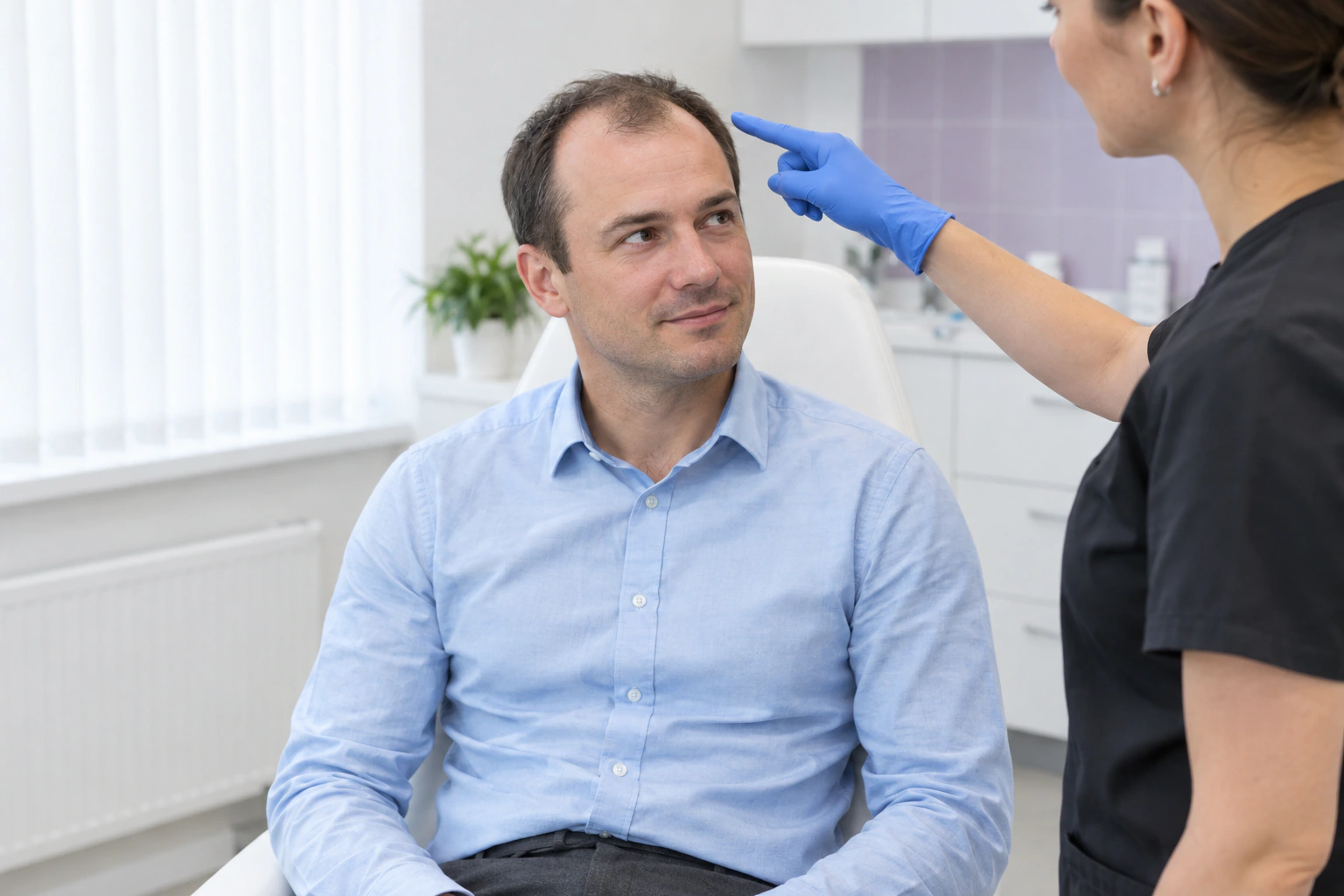

A phone number is all it takes. The coordinator collects close-up pictures through a messenger, a doctor reviews them and says whether a transplant would help. No fee, and no operation is booked.

services
The price is set at the free consultation, after the grafts are counted, and fixed in the contract.
suture-free graft extraction

$2,200$2,700
or $367/mo — 0% instalments for 6 months
Hold the cost nowimplantation without channels

$2,500$2,900
or $417/mo — 0% instalments for 6 months
Hold the cost nowcombined technique

$2,700$2,900
or $450/mo — 0% instalments for 6 months
Hold the cost now| Talking to a doctor | Free |
|---|---|
| Eyebrow transplant, FUE | |
| Beard transplant, FUEinstalments $467/mo | |
| Hair trichopigmentation | |
| PRP therapy / session | $200 |
all included
From the very first steps to the 12-month check.
No surprise extra charges on the day of surgery.
two more patches
A change of zone does not change the surgery: the back of the head supplies the grafts and FUE remains the method.
The FUE method, no incisions used

Grafts are taken from the donor area at the back of the head and moved through micro-punctures of about 1 mm, so no scars are left. The doctor agrees the shape with you before the operation, taking your facial features into account. Transplanted hair grows for life: trim and style the beard as usual.
$2,800$3,000
or $467/mo — 0% instalments for 6 months
Hold the cost nowThe FUE method, no incisions used

The eyebrow shape comes from the surgeon at the initial consultation: you look through references together and the design accounts for your facial features. The hairs are implanted at the right angle, so the eyebrows look natural. It also helps where years of plucking stopped hair growth.
$1,600$1,700
one-day procedure under local anaesthesia
Hold the cost nowExamination of the donor zone, a count of the grafts, and an honest picture of the outcome. The contract then holds the figure you were given at the appointment.

Message our coordinator
Free online consultation · Reply within 15 minutes
Message us on TelegramMessage us on WhatsAppBy messaging us, you agree to our Privacy Policy
Process
From consultation to going home — all in one day

Your first contact with the doctor brings an explanation of FUE as well as DHI, replies to any questions, and a close look at the donor area.

This step fixes your surgery date with a deposit, payable by card on site or online, and the agreement is set out in a medical services contract.

This stage is about completing the pre-operative tests, for which the clinic gives you a clear list and step-by-step instructions.

Under a local anaesthetic, the surgical stage is entirely painless.

Grafts are harvested from the donor area at the back of the head or the temples, without any stitches.

Surgeons move the collected grafts across to where hair has been lost.
Healing is not left to chance: the clinic provides the supplies and explains how they are used.

Crusts come off and swelling goes down while the area recovers

Nothing has gone wrong. The shafts leave, the roots remain seated

Gradually the new hairs appear, the result shows

Growth fills out; the hair gains body and its shape can be seen

The final density and natural hairline take shape

Free, before surgery and without any obligation.
Discuss your optionsdoctors

Hair transplant doctor, trichologist, surgeon
10 years in practice

Dermatovenereologist, trichologist, surgeon
11 years in practice

Plastic surgeon
9 years in practice

Plastic surgeon
9 years in practice

Assistant
9 years in practice
The donor zone gets a proper look, the grafts get a number, and the outcome gets explained.
Discuss your optionscoordinators
The clinic gives every patient one coordinator who covers the whole path to recovery.
Patient liaison officer
With you through to recovery
Covers the paperwork and the scheduling
Patient liaison officer
With you through to recovery
Covers the paperwork and the scheduling
Patient liaison officer
With you through to recovery
Covers the paperwork and the scheduling
Patient liaison officer
With you through to recovery
Covers the paperwork and the scheduling













Put your questions to us and we will settle on a suitable consultation slot
Message us on WhatsApp Leave a requestThe usual queries

Yes, they are accepted. City Medical Centre works with people from places large and small, and the case is discussed online before a decision.
Prices start at $2,200 (≈ TZS 5,900,000) for FUE, $2,500 (≈ TZS 6,700,000) for DHI, and $2,700 (≈ TZS 7,200,000) for the combined method. Your final price is set after a free graft count and locked into the contract.
One day covers the entire operation, and home follows.
Nothing hurts: local anaesthesia is given before the work starts.
FUE is the classic method: grafts are harvested with tweezers, with no cuts or stitches. DHI implants grafts without channels, using a Choi pen. A combined method harvests grafts by FUE and implants them with the DHI pen.
The count depends on your donor supply; a doctor establishes it during a consultation that costs nothing.
Give it 0–10 days for healing. Transplanted hairs fall at 2–4 weeks and that is meant to happen. Growth resumes by 3–4 months, density shows at 6–9 months, while the finished head arrives at 12–18 months.
Your procedure includes a lifetime hair-growth guarantee under contract.
The clinic holds a medical licence, care is provided to the standards and clinical guidelines
of Ministry of Health.

Diplomas and certificates of the operating doctors
Study the documentsAKC POMOSHCH LLC
the clinic's legal name
1057746096924
OGRN
7728536872
INN
FUE and DHI are built around convenience, which is what a patient in Dar es Salaam usually needs: no cuts, no stitches, local anaesthesia on its own, and an operation that finishes the day it starts.
Starting in Dar es Salaam costs neither money nor effort: the online consultation costs nothing at all and the doctor, looking at photos of the area, gives a verdict on whether a transplant makes sense for you. Answers come 24/7.
After the operation: 0-10 days to heal, 2-4 weeks until the transplanted hairs shed, which is a normal phase, 3-4 months to the start of growth, 6-9 to real density and 12-18 to the final result. Check-ups at 1, 3, 6, 9 and 12 months, photos with a personal coordinator, lifetime growth guarantee.
Prices are in US dollars; the amount in brackets is an approximate conversion to TZS at the rate of 02.10.2026. The final price is fixed in your contract.
By messaging us, you agree to our Privacy Policy
What patients write after this operation. Reviews are translated from the original language.
Andrey M.
I had the operation a month ago. Before and after surgery they were always in touch and helped with questions about my tests. The operation itself went wonderfully, the staff are polite and masters of their craft, you feel you are in safe hands. I am recovering now, and they answer all my questions. I am happy and I recommend them!
DHI hair transplant
Pavel Sinitsyn
The best clinic of all the ones I was choosing from. No regrets at all! The result is simply amazing, I am thrilled. I recommend it to everyone: these people do great work and make people happy. Once again, a huge thank you to everyone. Roman, the head of the clinic, is the best: he was personally in touch with me and looked after my recovery. Thank you for making my dream come true.
FUE hair transplant
Maria Akopyan
I thought about an eyebrow transplant for a long time and finally went for it. At first I was afraid the result would look unnatural, but when I saw my new eyebrows I was delighted! They came out full and in harmony with my face. I can hardly believe that now I just wash my face and go, I have never felt so free. For anyone tired of constant make-up, a transplant is a real lifesaver!
Eyebrow transplant (FUE)
Alexander M.
I really wanted a thick beard, but I had problems with it. I tried every home remedy and minoxidil, and nothing helped. After a long search for the best clinic I settled on this one. Thank you so much for the service, I liked everything and now I am happy! I had the beard transplant 10 months ago and I am very pleased with the result. By the way, the music in the clinic was great, as far as I remember. A friend of mine has already come to you for a transplant on my advice and was also happy with the result. I wish you every success!
Beard transplant (FUE)
Vladimir Z.
I went to the clinic to see a trichologist and had a hair transplant. I really liked the doctor's approach, and all the recommendations helped. I want to point out that nobody tries to sell you extra services: they tell you things as they are, and if some treatment is not needed, they do not push it. Cosy and clean.
DHI hair transplant
Artem Popov
This may sound obvious, but a head of hair really changes everything in your life. You feel much more confident and go through life like a winner. And it is all thanks to the doctor at this clinic and to the staff who take care of their patients. Many thanks to the clinic for a happy life with new hair, for the comfortable conditions and for the professionalism during the hair transplant.
FUE hair transplant
Page medically reviewed by Anastasia A. Kolesnik, hair transplant doctor. Review date: .
Dar es Salaam is the largest city and financial hub of Tanzania, set on the Swahili coast around a natural harbour on the Indian Ocean. It is the capital of the Dar es Salaam Region, which has five districts: Kinondoni, Ilala, Ubungo, Temeke and Kigamboni. In 2012 the national census counted 4,364,541 residents, and the city is described as the largest in East Africa by population, with more than seven million people. A city of this size and pace puts real weight on appearance: people meet clients, colleagues and relatives every day, and a receding frontal hair line or thin crown is noticed.
Dar es Salaam is also known as Tanzania's centre for arts, fashion, media, film and television. For people who work in front of a camera, on stage or with the public, hair density is a professional question as well as a personal one. Men often come to the consultation about the frontal hair line and temples. Others ask about the beard, because a full, well-shaped beard matters to many.
This text is written for people in Dar es Salaam who are weighing FUE or DHI and want to plan it around the real rhythm of the city: the heat, the humidity, the traffic and the working week. The aim is to help you arrive at the consultation with clear questions.
In both methods, grafts are taken from the back of the head, the donor area, and moved through micro-punctures of about 1 mm, so nothing scars over. FUE and DHI differ in how the grafts are placed, and the surgeon explains which approach suits your hair type, the size of the area to be covered and your expectations.
The doctor discusses the shape with you before the operation, taking your facial features into account. This is the most important design step. A hair line that looks natural on one face can look wrong on another, so ask to see the proposed shape and talk through its height and the way it blends at the temples.
The same technique is used for the beard. Transplanted hair grows for life: trim and style the beard as usual. For many men in Dar es Salaam, where a neat, shaped beard is part of everyday grooming, this is a practical reason to consider the procedure.
Dar es Salaam has a tropical savanna climate: hot and humid for much of the year, because of its closeness to the equator and the warm Indian Ocean. Annual rainfall is about 1,150 millimetres, with the long rains in April and May and the short rains in November and December.
Heat and humidity matter for the first days after surgery. Sweat, dust from the road and strong sun are all things the treated area should be protected from while it heals. The first healing period is 0–10 days, and during this time you should plan to stay in a cool, clean room, avoid heavy exertion and follow the washing routine the clinic gives you. Ask the surgeon exactly how to protect the scalp when you must go outside, and what kind of loose headwear is acceptable.
During the rainy months the air is damp and the roads are often busy and muddy. That is not a reason to postpone, but it is a reason to plan your first days at home with food, water and everything you need within reach, so that you do not have to go out unnecessarily.
Because Dar es Salaam is warm all year, there is no cold season that would make hats natural. The choice is mainly between the dry periods and the two rainy seasons. In the dry months there is more sun and dust; in April, May, November and December there is more rain and humidity. Both can be managed with good planning.
Think about your calendar rather than the weather alone. Avoid a date close to a wedding, a major family gathering, an important presentation or a shoot. The healing period is 0–10 days, and the normal shedding of transplanted hair comes at 2–4 weeks, so choose a window when you can be calm and keep a low profile for the first stretch.
If you have a beach holiday or a sports tournament planned, put it well after the operation, and ask the surgeon when the sea, pool and sun are acceptable for you personally.
Dar es Salaam is the country's most important city for business and government, and its central business district around Kisutu, Kivukoni, Upanga and Kariakoo is full of offices, traders and banks. Many patients work in jobs with fixed hours and want to know when they can return. Discuss this openly with the surgeon: the answer depends on your job, your commute and whether you can avoid dust and sweat at work.
The city has a heavy transport load. Most people use dala dala minibuses, bodaboda motorcycle taxis or bajaj. In the first days after surgery, crowded vehicles and a motorcycle helmet pressing on the scalp are worth asking about specifically. Ask when a helmet may be worn again, and what to do if you have no alternative to a motorcycle taxi.
Students and young professionals often ask about lectures, exams and photographs. Plan the operation so that the first visible phase, including the shedding at 2–4 weeks, falls in a quieter part of the term or the work year. Occasional power cuts and a warm climate also mean it is worth arranging a fan or other ways to stay cool and keep a clean, calm routine at home.
Dar es Salaam has beaches on the Msasani peninsula and in Kigamboni, and many residents enjoy the sea at weekends. Salt water, sand, sun and shared pools should be avoided until the surgeon confirms that the scalp has healed. Do not decide this by yourself or from what a friend did; ask for your own timeline in writing.
Football, running, the gym and training in the heat all increase sweating and the temperature of the scalp. Ask when each type of activity can restart and how to build back gradually. Contact sports and anything where the head may be hit need a separate, explicit answer.
Muslims make up a large share of the city's residents, and religious holidays, weddings and family meals are central to social life. Large shared meals, close greetings and long days outside are all part of these occasions. Think ahead about which events fall inside the first weeks, and whether you are comfortable attending while healing.
A hair transplant is a slow process, and it helps to know the stages in advance. 0–10 days for healing, 2–4 weeks for normal shedding of transplanted hair, 3–4 months for new growth to start, 6–9 months for real density, and 12–18 months for the final result.
Many patients are alarmed by the shedding. At 2–4 weeks the transplanted hairs let go, as expected. At 3–4 months hair comes back, at 6–9 months it is visibly thicker, and at 12–18 months the look has settled. One patient described it this way: from about the 4th month active, even growth began, the transplanted hair took very well, and the beard now looks as natural as possible, with the shape he had thought about for a long time.
Be patient and avoid judging the result before the stages have passed. Photographs taken at the same angle and in the same light every month make the change much easier to see.
Good candidates are usually people with a stable pattern of hair loss and enough healthy hair in the donor area. Younger patients whose loss is still progressing need an especially careful discussion, because the design must take future loss into account.
Some conditions call for caution or a different plan: active scalp disease, unstable chronic illness, poorly controlled blood conditions, or very limited donor hair. Tell the doctor about all medicines you take, past operations, allergies and tendencies to heal poorly. The final decision belongs to the surgeon after reviewing your photographs and medical history.
Overall health matters for healing. Weight and general fitness influence how well the body recovers from any procedure, and the WHO publishes general information on overweight and obesity that you can read if you wish to look at your own health more broadly before planning.
Before it was Dar es Salaam, the place was Mzizima, a Swahili name meaning healthy town, a fishing village on the edge of Indian Ocean trade. Around 1865 or 1866 Sultan Majid bin Said of Zanzibar began building a new town nearby and called it Dar es Salaam, the abode of peace. Many patients like this meaning when they think about the operation: it is a calm, planned decision, not a rushed one.
The city's growth followed its harbour. It became the administrative and commercial centre of German East Africa, then of British Tanganyika and later of Tanzania. Its population was estimated at 20,000 in 1900, 93,000 in 1957 and 273,000 in 1967. A city that has grown this fast is full of people who move between districts every day, so when you plan your first days after FUE or DHI, think about which of those districts you really must visit and which can wait until the 0-10 day healing period has passed.
Kariakoo is the shopping district of the city, with shops, bazaars and merchants selling everything from foodstuffs to hardware, and its market is the major supply point of food for the residents. Anyone who works or trades there knows the crowds, the dust and the heat under crowded roofs. If your daily work is in Kariakoo, Kisutu or Upanga, ask the surgeon how long you should stay away from dusty, crowded places, and arrange for a relative or colleague to cover the first days.
Kivukoni holds the Bank of Tanzania, the Dar es Salaam Stock Exchange and the Magogoni fish market, while Kisutu has the PSPF Towers and the TPA Tower. Office workers in these towers can usually arrange quieter days more easily than traders, but both groups should agree a return date with the surgeon. Mark the 2-4 weeks of shedding in your calendar too, because that is when transplanted hairs let go, as expected, and you may prefer fewer meetings with clients.
The Bus Rapid Transit line runs between Kimara and Kivukoni and is often crowded at rush hours. If you rely on it, ask whether a quieter hour is safer for the scalp during the first days.
Oyster Bay Beach, also known as Coco Beach, is the white sandy beach on the central coast, and Kigamboni, known as South Beach, and the Msasani peninsula offer more shoreline. Bongoyo Island is reached by boat from the Msasani Slipway. These are the places where Dar es Salaam relaxes at weekends, and they are exactly the places to postpone until the surgeon allows sun, sand and salt water on the scalp.
Kigamboni is reached mainly by the ferry, with the Kigamboni Bridge as an alternative. If you live there, plan how you will cross the harbour during the first days, because queues and open decks mean sun and wind on a healing scalp. Ask what headwear is acceptable and for how long.
Dar es Salaam is the sports centre of Tanzania. The National Stadium, in Chang'ombe, holds up to 60,000 people and hosts the clubs Young Africans and Simba. Match days mean dense crowds, sun, shouting and shared seats. If you are a supporter, plan the operation so that you miss no important fixture during the first stretch, and ask when a big crowd in the heat is acceptable.
Players and runners in the city also use the Gymkhana golf courses with their tennis and squash courts, and boxing is a popular sport in the country. Contact sports need a separate answer from your surgeon, since the head must not be hit while the grafts settle. Build your return to training together with the 6-9 months stage in mind, when the hair is visibly thicker.
The first consultation is free and online. You do not need to arrange anything in advance beyond a few clear photographs of the front, top, crown, sides and back of your head, in daylight. Coordinators are available around the clock, 24/7, on WhatsApp and Telegram, so you can write at a time that suits your work and family schedule.
We stay with you from pre-op planning to 12 months later. A coordinator will be on the phone 24/7, and check-ups take place at months 1, 3, 6, 9 and 12. This continuity is useful in a large city where you may be busy and want one clear point of contact for questions about shedding, washing, sun and sport.
Before the consultation, write down your goals, your work and sport schedule, your medical history and the dates you want to avoid. Then you can go through the plan calmly and compare it with your expectations.
Yes. The online consultation is free, and coordinators are available around the clock on WhatsApp and Telegram.
Send clear daylight photographs of the front, top, crown, both sides and the back of the head. If you are asking about a beard, add photographs of the face from the front and both sides.
The doctor discusses the shape with you before the operation, taking your facial features into account. Grafts are taken from the back of the head and moved through micro-punctures of about 1 mm, so nothing scars over.
At 2–4 weeks the transplanted hairs let go, as expected. This is a normal stage, and new growth begins at 3–4 months.
Hair comes back at 3–4 months, becomes visibly thicker at 6–9 months, and the look settles at 12–18 months after surgery.
The healing period is 0–10 days. Heat, sweat, dust and strong sun should be avoided as much as possible during this time. Ask the surgeon for exact instructions on washing and headwear.
Ask the surgeon about this directly. Pressure and friction on the treated area, together with sweat and dust, are the concern, so get a clear answer for your situation.
Not until the surgeon confirms that the scalp has healed. Ask for your personal timeline before planning any sea or pool visit.
For a beard transplant, transplanted hair grows for life: trim and style the beard as usual.
We stay with you from pre-op planning to 12 months later, with check-ups at months 1, 3, 6, 9 and 12, and a coordinator will be on the phone 24/7.
Kariakoo is crowded, dusty and hot. Ask the surgeon how long to avoid such places during the 0-10 day healing period and arrange cover at work.
Not until the surgeon confirms that the scalp has healed. Ask for your personal timeline before planning any visit to the sea.
Large crowds, sun and sweat are best avoided at first. Ask the surgeon for a date that suits your own healing.
Both dry and rainy months can work with planning. Choose a window when you can stay calm, keep a low profile through the 2-4 weeks of shedding and keep to your check-ups at months 1, 3, 6, 9 and 12.

 Forceps
 Minimal


