



start
12 months out
2,800 grafts
FUE method
City Medical Centre
0% instalments
from $367/mo
Consultation and quote — $0.
Our case
start
12 months out
The FUE method: no incisions, no stitches. Graft count and forecast counted without any fee — before you decide.
Costs nothing, no surgery booking required
Message our coordinator
Free online consultation · Reply within 15 minutes
Message us on TelegramMessage us on WhatsAppBy messaging us, you agree to our Privacy Policy
results
All cases are real City Medical Centre patients.
start
12 months out
2,800 grafts
FUE method

start
12 months out
3,500 grafts
FUE method

start
12 months out
2,600 grafts
FUE method

start
12 months out
3,000 grafts
FUE method

start
12 months out
2,700 grafts
FUE method

start
12 months out
3,300 grafts
FUE method

start
12 months out
2,900 grafts
FUE method

start
12 months out
2,500 grafts
FUE method

start
12 months out
3,400 grafts
FUE method

start
12 months out
2,500 grafts
FUE method

start
12 months out
3,100 grafts
FUE method

start
12 months out
3,600 grafts
FUE method

start
12 months out
4,000 grafts
FUE method

start
12 months out
3,200 grafts
FUE method

start
12 months out
3,000 grafts
FUE method

start
12 months out
3,700 grafts
FUE method

start
12 months out
2,700 grafts
FUE method

start
12 months out
3,800 grafts
FUE method

start
12 months out
3,300 grafts
FUE method

start
12 months out
2,800 grafts
FUE method

start
12 months out
2,500 grafts
FUE method

start
12 months out
3,900 grafts
FUE method

start
12 months out
3,500 grafts
FUE method

start
12 months out
3,800 grafts
FUE method

start
12 months out
2,900 grafts
FUE method

start
12 months out
3,600 grafts
FUE method

start
12 months out
2,600 grafts
FUE method

start
12 months out
2,700 grafts
FUE method

start
12 months out
3,700 grafts
FUE method

start
12 months out
3,200 grafts
FUE method

start
12 months out
3,000 grafts
FUE method

start
12 months out
2,800 grafts
FUE method

start
12 months out
4,000 grafts
FUE method

start
12 months out
3,400 grafts
FUE method

start
12 months out
2,900 grafts
FUE method

start
12 months out
3,100 grafts
FUE method

start
12 months out
2,600 grafts
FUE method

start
12 months out
3,300 grafts
FUE method

start
12 months out
3,900 grafts
FUE method

start
12 months out
3,500 grafts
FUE method

start
12 months out
2,700 grafts
FUE method

start
12 months out
3,800 grafts
FUE method

start
12 months out
3,200 grafts
FUE method

start
12 months out
3,000 grafts
FUE method

start
12 months out
2,800 grafts
FUE method

start
12 months out
3,100 grafts
FUE method

start
12 months out
3,600 grafts
FUE method
Comparison
Three graft transfer technologies are on the table: classic FUE, suture-free DHI and a combined protocol. Implantation technique, tissue trauma and graft survival are what you compare when choosing.
Classic technique without incisions or stitches

$2,200
$2,700
Graft implantation technique
ForcepsGraft trauma
MinimalA natural angle for hair
NaturalGraft survival
98–100%Suitable for
Androgenetic alopeciaStitch-free implantation with a Choi pen

$2,500
$2,900
Graft implantation technique
DHI pen (Choi implanter)Graft trauma
MinimalA natural angle for hair
NaturalGraft survival
98–100%Suitable for
DensificationExtraction by FUE, DHI implant

$2,700
$2,900
Graft implantation technique
FUE extraction plus DHI implantGraft trauma
MinimalA natural angle for hair
NaturalGraft survival
98–100%Suitable for
Androgenetic alopecia and densificationSurvival and trauma figures are averaged per method and given as a guide: the exact numbers follow the transplant area and the patient's individual features, and the doctor clarifies them at the consultation.
Meet a specialist


















about the clinic
Care for each patient, comfortable rooms, modern equipment

Put your questions to us and we will settle on a suitable consultation slot
Message us on WhatsApp Send the formWhere your case can be resolved without surgery, the doctor will say so at the consultation — and you will not waste your money. Below are the conditions in which a transplant works.
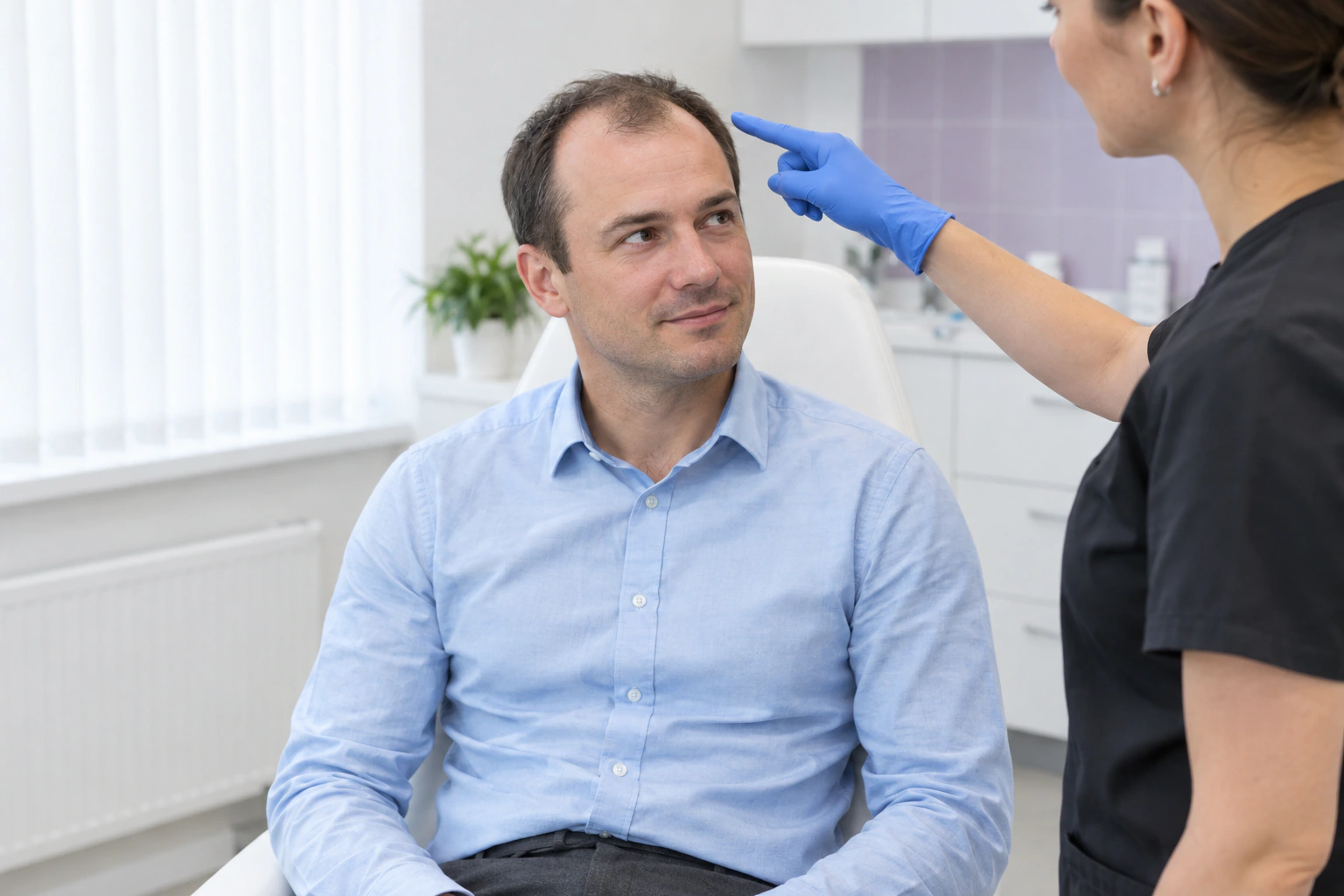

Leave a number and a coordinator will ask for photos of the thinning area in a messenger; a doctor then says whether a transplant would help you. Free, with no obligation to book an operation.

services
Counting comes before pricing: both happen at the free consultation, and the contract fixes the price.
suture-free graft extraction

$2,200$2,700
or $367/mo — 0% instalments for 6 months
Set the price nowimplantation without channels

$2,500$2,900
or $417/mo — 0% instalments for 6 months
Set the price nowcombined technique

$2,700$2,900
or $450/mo — 0% instalments for 6 months
Set the price now| A look at your scalp | Free |
|---|---|
| Eyebrow transplant, FUE | |
| Beard transplant, FUEinstalments $467/mo | |
| Hair trichopigmentation | |
| PRP therapy / session | $200 |
all included
From everything that precedes surgery to 12 months on.
No last-minute charges on the day of surgery.
two extra zones
Nothing is reinvented for other zones: grafts from the back of the head, the FUE method, only the location differs.
FUE, no incisions and no stitches

Grafts are taken from the donor area at the back of the head and moved through micro-punctures of about 1 mm, so no scars are left. The doctor agrees the shape with you before the operation, taking your facial features into account. Transplanted hair grows for life: trim and style the beard as usual.
$2,800$3,000
or $467/mo — 0% instalments for 6 months
Set the price nowFUE, no incisions and no stitches

The surgeon draws the eyebrow shape at the first consultation: you look through references together and the design takes your facial features into account. Each hair is implanted at the right angle, so the eyebrows look natural. It also helps where hairs stopped growing after years of plucking.
$1,600$1,700
an op you leave the same day, local anaesthesia
Set the price nowYour donor area is examined, the grafts are counted and the achievable result is shown. The cost is quoted at the consultation and fixed in the contract.

Message our coordinator
Free online consultation · Reply within 15 minutes
Message us on TelegramMessage us on WhatsAppBy messaging us, you agree to our Privacy Policy
Process
From consultation to going home — all in one day

During this free consultation, patients in Arusha get a clear explanation of the FUE and DHI methods, answers to their questions, and an individual surgery plan.

The date is yours after a deposit; pay with a bank card on site if that is convenient, or handle it online.

Before the operation, you'll need to complete a set of medical tests. The clinic provides a full list and instructions to guide you through it.

For patients in Arusha, local anaesthetic keeps the whole operation free of pain.

This step collects grafts from the donor zone — the back of the head or the temples — using a scarless technique.

At this point, the grafts are implanted into the balding area by the surgical team.
For a swift recovery, the clinic supplies what is needed and explains every instruction clearly.

The crusts come off, the swelling eases and the area recovers

A normal stage. Only the hairs shed, the follicles stay in place

New hairs grow in gradually, the result shows

The hair comes in fuller, the mass and the shape are apparent

The last of the volume arrives and the edge looks natural

Free, before the operation and with no obligations.
Meet a specialistdoctors

Hair transplant doctor, trichologist, surgeon
10 years in practice

Dermatovenereologist, trichologist, surgeon
11 years of experience

Plastic surgeon
9 years of experience

Plastic surgeon
9 years of experience

Assistant
9 years of experience
The doctor will review your donor area, count the grafts and say what result is possible.
Meet a specialistcoordinators
You are assigned a personal coordinator: with you from the first enquiry to recovery.
Your care coordinator
Accompanies you from the first step onward
Will chase the papers and hold your slot
Your care coordinator
Accompanies you from the first step onward
Will chase the papers and hold your slot
Your care coordinator
Accompanies you from the first step onward
Will chase the papers and hold your slot
Your care coordinator
Accompanies you from the first step onward
Will chase the papers and hold your slot













Put your questions to us and we will settle on a suitable consultation slot
Message us on WhatsApp Send the formWhat gets asked

Yes. City Medical Centre accepts patients from other cities and countries, and an online consultation is available before you decide.
FUE is $2,200 (≈ TZS 5,900,000), DHI is $2,500 (≈ TZS 6,700,000), combined DHI+FUE is $2,700 (≈ TZS 7,200,000). A free consultation with a graft count gives you the exact, contract-fixed price.
It runs for one day only, and nobody stays the night.
Local anesthesia keeps it comfortable; pain simply does not occur.
FUE is cut-free graft extraction by tweezer. DHI is direct implantation with a Choi pen, skipping channel-making. The combined technique takes grafts by FUE and places them using the DHI method.
It differs from person to person. The doctor counts grafts free of charge after examining the donor zone.
The first stage is 0–10 days of healing. Shedding at 2–4 weeks is normal. From 3–4 months hair grows again, by 6–9 months density is obvious, and at 12–18 months the result is complete.
You get a lifetime hair growth guarantee, written into the contract.
A medical licence, and care provided to the standards and clinical guidelines
of Ministry of Health.

Papers proving the qualifications behind every operation
View our paperworkAKC POMOSHCH LLC
our clinic's legal entity
1057746096924
OGRN
7728536872
INN
Any patient in Arusha can be treated with FUE or DHI. Cuts are not made, stitches are not needed, local anaesthesia is the only thing administered, and the operation is completed during a single day.
Starting in Arusha costs neither money nor effort: the online consultation costs nothing at all and the doctor, looking at photos of the area, gives a verdict on whether a transplant makes sense for you. Answers come 24/7.
Skin settles over 0-10 days. Then come 2-4 weeks, when the transplanted hairs drop out - normal, expected, and no reason to worry. Growth resumes at 3-4 months, slowly at first and then in earnest.
Prices are in US dollars; the amount in brackets is an approximate conversion to TZS at the rate of 02.10.2026. The final price is fixed in your contract.
By messaging us, you agree to our Privacy Policy
What patients write after this operation. Reviews are translated from the original language.
Andrey M.
I had the operation a month ago. Before and after surgery they were always in touch and helped with questions about my tests. The operation itself went wonderfully, the staff are polite and masters of their craft, you feel you are in safe hands. I am recovering now, and they answer all my questions. I am happy and I recommend them!
DHI hair transplant
Pavel Sinitsyn
The best clinic of all the ones I was choosing from. No regrets at all! The result is simply amazing, I am thrilled. I recommend it to everyone: these people do great work and make people happy. Once again, a huge thank you to everyone. Roman, the head of the clinic, is the best: he was personally in touch with me and looked after my recovery. Thank you for making my dream come true.
FUE hair transplant
Maria Akopyan
I thought about an eyebrow transplant for a long time and finally went for it. At first I was afraid the result would look unnatural, but when I saw my new eyebrows I was delighted! They came out full and in harmony with my face. I can hardly believe that now I just wash my face and go, I have never felt so free. For anyone tired of constant make-up, a transplant is a real lifesaver!
Eyebrow transplant (FUE)
Alexander M.
I really wanted a thick beard, but I had problems with it. I tried every home remedy and minoxidil, and nothing helped. After a long search for the best clinic I settled on this one. Thank you so much for the service, I liked everything and now I am happy! I had the beard transplant 10 months ago and I am very pleased with the result. By the way, the music in the clinic was great, as far as I remember. A friend of mine has already come to you for a transplant on my advice and was also happy with the result. I wish you every success!
Beard transplant (FUE)
Vladimir Z.
I went to the clinic to see a trichologist and had a hair transplant. I really liked the doctor's approach, and all the recommendations helped. I want to point out that nobody tries to sell you extra services: they tell you things as they are, and if some treatment is not needed, they do not push it. Cosy and clean.
DHI hair transplant
Artem Popov
This may sound obvious, but a head of hair really changes everything in your life. You feel much more confident and go through life like a winner. And it is all thanks to the doctor at this clinic and to the staff who take care of their patients. Many thanks to the clinic for a happy life with new hair, for the comfortable conditions and for the professionalism during the hair transplant.
FUE hair transplant
Page medically reviewed by Anastasia A. Kolesnik, hair transplant doctor. Review date: .
Arusha is the capital of the Arusha Region and has a population of 617,631 people. It sits below Mount Meru on the eastern edge of the eastern branch of the Great Rift Valley. People here work in tourism, diplomacy, education, farming and trade, and many of them are in front of other people all day. A frontal hair line or a beard is part of how you look in meetings, classrooms, lodges and family gatherings, so questions about hair restoration are practical ones.
This text is for residents of Arusha who are considering FUE or DHI hair transplantation and want to plan it around their own routine. You speak with the centre online from your own city. The consultation is free, and coordinators are available around the clock (24/7) on WhatsApp and Telegram, so you can ask questions in the evening after work or on a weekend.
The city is multicultural. Christian, Muslim, Sikh and Hindu families live side by side, and the people are of mixed backgrounds: indigenous African, Arab-Tanzanian and Indian-Tanzanian, plus a small European and North American minority. Hair type, skin tone and beard style differ a lot from person to person. That is why the surgeon discusses the shape with you before the operation, taking your facial features into account.
Despite being close to the equator, Arusha stands at an elevation of 1,400 metres on the southern slopes of Mount Meru. Temperatures stay relatively low and humidity is eased. Cool dry air is common for much of the year, and temperatures typically range between 10 and 30 °C. For a patient in the early healing days, this is a gentle background compared with very hot lowland cities.
The city has distinct wet and dry seasons. The long masika rains fall from March through May, the short vuli rains usually come in November and December, and the dry kiangazi season runs from June to October. Arusha has days above 32 °C, but all of them fall between November and March. Those hot months are worth keeping in mind when you pick a date.
Medical timing does not depend on the weather. The healing phase is 0–10 days, and during it the treated area needs calm and clean conditions. What changes with the season is your comfort: heat and sweat in the hot months, dust on dry days, and mud and wet streets in the rains. Your coordinator will help you match the surgery date to the weather and to your calendar.
The dry kiangazi months from June to October bring cooler, drier air and are a natural candidate for many residents. Roads are less muddy, and moving around the city, whether by car, minibus or on foot, is easier in the first days after the procedure. Dust is the thing to watch in dry spells, so protect the head as the surgeon advises.
The long rains from March to May are also workable. You can stay indoors more easily, and many people find it natural to rest at home during that time. If you live in a higher area near the slopes and the weather is cooler and wetter, plan how you will get to your check-ups and how you will keep the head dry and clean when it rains.
The hottest period, November to March, is not forbidden, but it asks for more planning around sun, sweat and headwear. Ask the surgeon which kind of covering is acceptable in the first days and when you can go out in strong sun. Whatever the month, choose a window when you can spend the first days quietly and not rush back to a demanding schedule.
Arusha is an international diplomatic hub. It hosts the African Court of the African Union and is the capital of the East African Community, and one branch of the United Nations International Residual Mechanism for Criminal Tribunals is based here. Many residents work in offices, conferences and guest-facing jobs. If your role involves frequent meetings, plan the early days so that the first visible phase of healing falls in a quieter period, for example during leave.
Tourism is the other big employer, with safari routes towards the Serengeti, Ngorongoro, Lake Manyara, Tarangire, Kilimanjaro and Arusha National Park. Guides, drivers and lodge staff spend long hours in sun, wind and dust. Talk to the surgeon openly about your working day and ask when the treated area can be exposed to the open air. Do not decide this on your own on the basis of a colleague's story.
Students are a large group too. The city has the National College of Tourism, Arusha Technical College, the Nelson Mandela African Institute of Science and Technology, Tumaini University Makumira, Mount Meru University and other institutions. A student can plan the operation around a break between terms. The healing phase is 0–10 days, followed by 2–4 weeks of normal shedding of transplanted hair, and it helps to know this before returning to lectures and social life.
The stages are clear, and it is useful to set them against your own calendar. 0–10 days are for healing. Then comes 2–4 weeks, when the transplanted hairs let go, as expected. This shedding is normal and is not a sign that something has failed.
At 3–4 months new hair comes back. At 6–9 months the hair is visibly thicker, and at 12–18 months the look has settled. The final result is judged at 12–18 months after surgery, so a wedding, graduation or conference scheduled soon after the operation should not be the benchmark for the result.
One patient wrote: «The result truly makes me very happy. From about the 4th month active, even growth began. The transplanted hair took very well, the beard now looks as natural as possible, no bald patches are left. The beard became much thicker and denser, with the shape I had thought about for a long time.» The example shows why patience through the first months pays off.
Arusha is a sporting city. It is home to the Tanzanian rugby national team and hosts international matches, Arusha FC plays league football here, the Mount Meru Marathon was held from 1985 to 2004, and the Arusha Motor Sports Club has been active since 1996. If you play, run or follow rally events, ask the surgeon exactly when you can return to training. Contact sports and heavy sweating need a separate answer from the doctor, so do not guess.
The altitude and the cool air make running and hiking attractive for many residents, with Mount Meru always in view. Ask about sun and dust exposure on the head during outdoor exercise, and about suitable headwear during recovery. If you swim in a pool or take a trip to a lake or the coast, ask the doctor when water and chlorine are allowed.
Daily habits matter as well. Sleeping position, touching the treated area, hats, helmets (including motorcycle and rally helmets) and sweaty caps are all worth discussing before the operation, not after. A coordinator can pass your list of habits to the doctor so that the instructions you receive fit your actual life in Arusha.
Arusha families mark weddings, church services, mosque gatherings, temple festivals and community celebrations, and these events can fill the calendar. Before booking a date, write down the events you cannot miss. Then discuss with the coordinator which gap is long enough for the first healing days to pass in private.
Food culture in the city is built on the produce of the surrounding highlands: bananas, coffee, cabbage, potatoes, carrots and leafy greens. A balanced diet supports general health, and there is no need for dramatic changes. Ask the surgeon for guidance on alcohol, smoking and medicines before and after the procedure, and follow the answer you receive.
Shared meals and handshakes, hugs and close contact are part of life here. In the first days, tell your family how to behave around you, for example not to pat the head or lean on it. It also helps to prepare relatives for the phase of shedding at 2–4 weeks so that nobody is alarmed when transplanted hairs fall out.
In general terms, a good candidate has enough healthy hair in the donor area at the back of the head, realistic expectations and good general health. Grafts are taken from that donor area and moved through micro-punctures of about 1 mm, so nothing scars over. The same technique is used for a beard, which many men in Arusha ask about.
Some conditions call for caution or a pause: active scalp disease, unstable chronic illness, poor healing, or hair loss that is still progressing quickly and has not been assessed. Your medicines and previous operations also matter. These points are decided by the doctor after a review of your photos and history, not by a general article.
General health plays a role. The WHO fact sheet on obesity and overweight is a reminder that body weight and lifestyle influence recovery and surgical planning. Tell the doctor honestly about your health, smoking and any medicines. The consultation is free and online, so you can clarify this before any decision.
You contact the centre on WhatsApp or Telegram from home or from work. A coordinator is available 24/7 and asks for photos of the hair line, the crown and the donor area, plus brief information on your health. The doctor then assesses them, and you receive an answer on candidacy and on the approach.
We stay with you from pre-op planning to 12 months later. Check-ups take place at months 1, 3, 6, 9 and 12, and you can send photos and ask questions between them. A coordinator will be on the phone 24/7, which matters when the question comes in the middle of the night after a long day.
Ask for a clear plan in writing and keep it. Make a list of questions for the doctor before the call and tick them off during the conversation. The next block gives a starting list.
Start with the design: how will the frontal hair line or beard shape suit my face, my hair type and my age? Ask how the donor area will look afterwards and how much hair is reasonable to plan for now and later. Transplanted hair grows for life, so the shape must still look right years from now. For a beard, ask how to trim and style it as usual.
Ask about the practical side: what care is needed in the first days, which headwear is allowed in Arusha sun and dust, when I can wash, when I can go back to the office or lectures, and when sport and swimming are allowed. Ask which medicines you must avoid and what to do if something looks unusual.
Ask about follow-up: how the check-ups at months 1, 3, 6, 9 and 12 will be done, how to send photos, who will answer in an urgent case, and what the timeline looks like for my case, from the 2–4 weeks of shedding to the settled look at 12–18 months.
Yes. You contact the centre from your own city, and the consultation is free. Coordinators are available around the clock (24/7) on WhatsApp and Telegram.
Arusha lies at 1,400 metres on the slopes of Mount Meru, with relatively low temperatures and cool dry air for much of the year. That is a comfortable background for healing, but you still follow the surgeon's rules on sun, dust and headwear.
The dry kiangazi season from June to October is a common choice, as the air is cooler and the streets are drier. The rainy months and the hotter months from November to March also work with proper planning. The decision is made together with your coordinator and doctor.
Healing takes 0–10 days. Shedding of transplanted hair for 2–4 weeks is normal, new growth starts at 3–4 months, density is visible at 6–9 months, and the final result settles at 12–18 months.
Transplanted hairs let go at 2–4 weeks, as expected, and hair comes back at 3–4 months. This is a normal stage of the process.
Yes, the same donor-area approach is used. Grafts are moved through micro-punctures of about 1 mm, the doctor discusses the shape with you beforehand, and once the result has settled you can trim and style the beard as usual.
Ask when the treated area can be exposed to sun, wind and dust, what covering is suitable, and how to handle long days at lodges or on safari routes during the first weeks.
Ask the surgeon for exact dates. Sport, sweating, helmets and contact need a personal answer, and you should follow it rather than the experience of a friend.
We stay with you from pre-op planning to 12 months later, with check-ups at months 1, 3, 6, 9 and 12. A coordinator will be on the phone 24/7.
People without enough healthy donor hair, with active scalp disease, unstable illness or unrealistic expectations may be advised to wait or choose another path. The doctor decides after reviewing your photos and history.

 Forceps
 Minimal


