



Before
by 12 months
2,800 grafts
FUE method
City Medical Centre
0% instalments
from $367/mo
Meeting and a quote — $0.
Real story
Before
by 12 months
FUE method; the skin is not cut or sewn. Graft tally and forecast worked out at no charge — before you decide.
No charge, ever, no surgery booking required
Message our coordinator
Free online consultation · Reply within 15 minutes
Message us on TelegramMessage us on WhatsAppBy messaging us, you agree to our Privacy Policy
results
Each of the cases is a real CMC patient.
Before
by 12 months
2,800 grafts
FUE method

Before
by 12 months
3,500 grafts
FUE method

Before
by 12 months
2,600 grafts
FUE method

Before
by 12 months
3,000 grafts
FUE method

Before
by 12 months
2,700 grafts
FUE method

Before
by 12 months
3,300 grafts
FUE method

Before
by 12 months
2,900 grafts
FUE method

Before
by 12 months
2,500 grafts
FUE method

Before
by 12 months
3,400 grafts
FUE method

Before
by 12 months
2,500 grafts
FUE method

Before
by 12 months
3,100 grafts
FUE method

Before
by 12 months
3,600 grafts
FUE method

Before
by 12 months
4,000 grafts
FUE method

Before
by 12 months
3,200 grafts
FUE method

Before
by 12 months
3,000 grafts
FUE method

Before
by 12 months
3,700 grafts
FUE method

Before
by 12 months
2,700 grafts
FUE method

Before
by 12 months
3,800 grafts
FUE method

Before
by 12 months
3,300 grafts
FUE method

Before
by 12 months
2,800 grafts
FUE method

Before
by 12 months
2,500 grafts
FUE method

Before
by 12 months
3,900 grafts
FUE method

Before
by 12 months
3,500 grafts
FUE method

Before
by 12 months
3,800 grafts
FUE method

Before
by 12 months
2,900 grafts
FUE method

Before
by 12 months
3,600 grafts
FUE method

Before
by 12 months
2,600 grafts
FUE method

Before
by 12 months
2,700 grafts
FUE method

Before
by 12 months
3,700 grafts
FUE method

Before
by 12 months
3,200 grafts
FUE method

Before
by 12 months
3,000 grafts
FUE method

Before
by 12 months
2,800 grafts
FUE method

Before
by 12 months
4,000 grafts
FUE method

Before
by 12 months
3,400 grafts
FUE method

Before
by 12 months
2,900 grafts
FUE method

Before
by 12 months
3,100 grafts
FUE method

Before
by 12 months
2,600 grafts
FUE method

Before
by 12 months
3,300 grafts
FUE method

Before
by 12 months
3,900 grafts
FUE method

Before
by 12 months
3,500 grafts
FUE method

Before
by 12 months
2,700 grafts
FUE method

Before
by 12 months
3,800 grafts
FUE method

Before
by 12 months
3,200 grafts
FUE method

Before
by 12 months
3,000 grafts
FUE method

Before
by 12 months
2,800 grafts
FUE method

Before
by 12 months
3,100 grafts
FUE method

Before
by 12 months
3,600 grafts
FUE method
Comparison
The clinic works with three graft transfer technologies: classic FUE, suture-free DHI and a combined protocol. Implantation technique, tissue trauma and graft survival differ, so compare before choosing.
Classic method requiring no cuts or sutures

$2,200
$2,700
Graft implantation technique
ForcepsGraft trauma
MinimalThe natural growth angle
NaturalGraft survival
98–100%Suitable for
Androgenetic alopeciaNo-stitch implantation with a Choi pen

$2,500
$2,900
Graft implantation technique
DHI pen (Choi implanter)Graft trauma
MinimalThe natural growth angle
NaturalGraft survival
98–100%Suitable for
DensificationFUE for extraction, DHI implant

$2,700
$2,900
Graft implantation technique
FUE extraction with DHI implantGraft trauma
MinimalThe natural growth angle
NaturalGraft survival
98–100%Suitable for
Densification for androgenetic alopeciaThe survival and trauma figures for each method are averages, given as a guide; exact numbers depend on the transplant area and the patient's individual traits and are clarified by the doctor at the consultation.
Speak to a specialist


















about the clinic
Modern equipment, comfortable rooms and care for all patients

We will answer your questions and arrange a consultation at a convenient time
Message us on WhatsApp Get in touchSome cases need no operation at all, and the doctor will state that during the consultation, saving you the expense. Read below about the situations where a transplant genuinely helps.
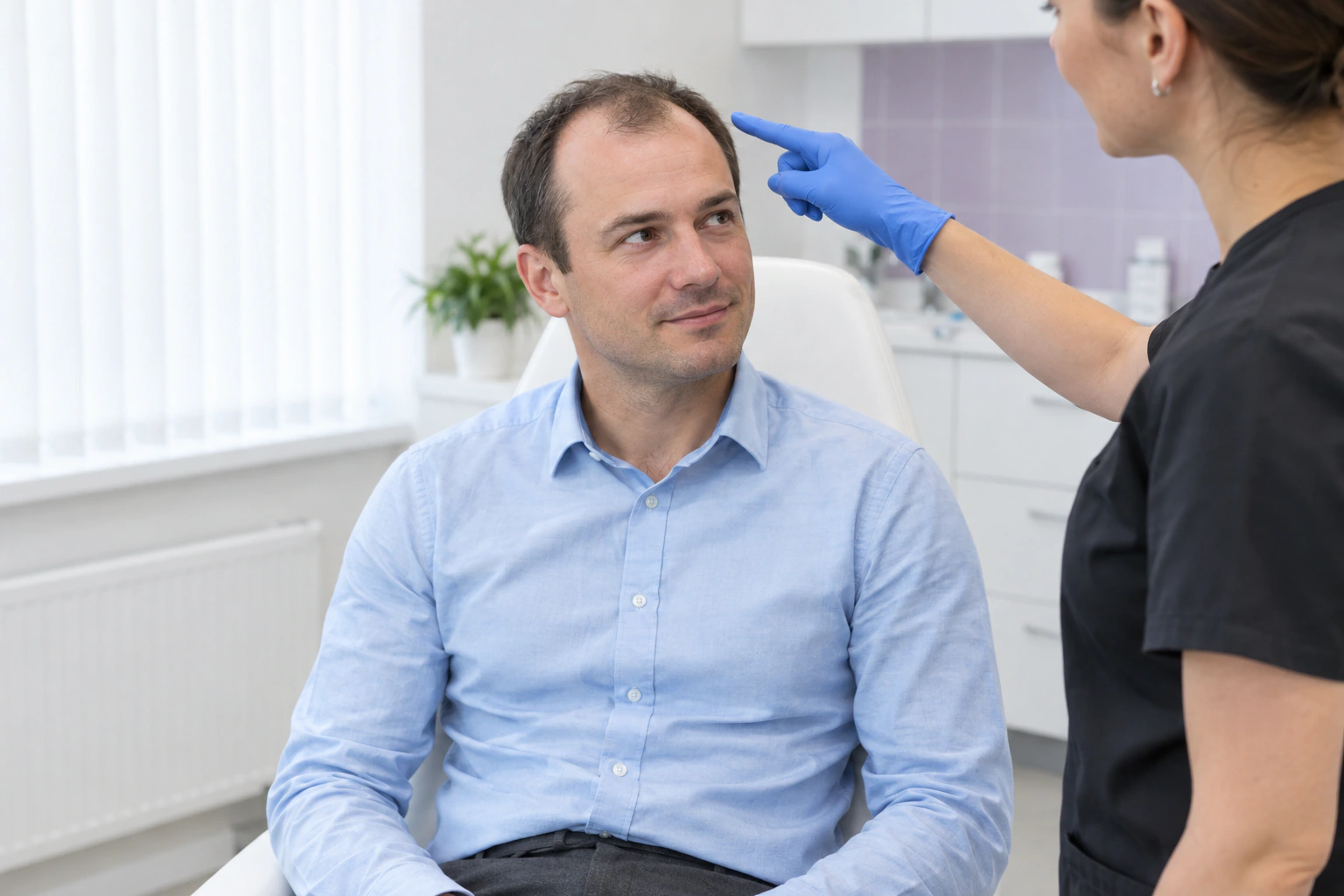

Leave your number: a coordinator asks for photos in a messenger, the doctor says if a transplant will help. No booking, no fee.

services
You hear the cost at the free consultation, after the grafts are counted; it is fixed in the contract.
suture-free graft extraction

$2,200$2,700
or $367/mo — 0% instalments for 6 months
Secure the priceimplantation without channels

$2,500$2,900
or $417/mo — 0% instalments for 6 months
Secure the pricecombined technique

$2,700$2,900
or $450/mo — 0% instalments for 6 months
Secure the price| The first assessment | Free |
|---|---|
| Eyebrow transplant, FUE | |
| Beard transplant, FUEinstalments $467/mo | |
| Hair trichopigmentation | |
| PRP therapy / session | $200 |
all included
From preparing for surgery to 12 months of follow-up.
You are not charged again on surgery day.
two further zones
A hair transplant is not confined to the scalp. Same grafts from the back of the head, same FUE method — only the area changes.
FUE, no incisions and no stitches

Donor grafts are taken at the back of the head and moved through micro-punctures of about 1 mm, leaving no scars. The doctor talks the shape over with you before the operation, allowing for your facial features. Transplanted hair grows for life, so the beard can be trimmed and styled as usual.
$2,800$3,000
or $467/mo — 0% instalments for 6 months
Secure the priceFUE, no incisions and no stitches

Before anything else the shape is agreed: the surgeon draws the brow at the first consultation, you study reference images together, and your facial proportions guide the lines. Hairs sit at the natural growth angle, so the brows pass for your own. Even growth stopped by years of plucking is no obstacle.
$1,600$1,700
an op you leave the same day, local anaesthesia
Secure the priceThe doctor looks at your donor area, counts the grafts and shows what result is achievable in your case. The price is named at the consultation and fixed in the contract.

Message our coordinator
Free online consultation · Reply within 15 minutes
Message us on TelegramMessage us on WhatsAppBy messaging us, you agree to our Privacy Policy
Process
From consultation to going home — all in one day

Here the doctor runs through what a FUE and a DHI procedure involve, answers everything you ask, and assesses the condition of your donor zone.

Fixing the date takes a deposit, and you may pay it with a card at the clinic or online, whichever is simpler.

Laboratory work precedes the surgery, and the clinic sees to it that you have the list and know what to do.

The procedure is performed under local anaesthesia, so the operation itself is painless.

Follicles are lifted out of the donor zone, at the back of the head or by the temples, and nothing is stitched.

Surgeons work the extracted grafts into the part of the scalp that has thinned.
Nothing is left for you to source; the clinic provides it all and explains every part of healing.

Crusts come off, the swelling goes, the treated skin heals steadily

Nothing to fix: hair is shed, but follicles are not

Growth is underway and the difference can be seen

The hair grows stronger, the main volume and shape show

The final density and natural hairline take shape

Free, still before the operation, with no obligation.
Speak to a specialistdoctors

Hair transplant doctor, trichologist, surgeon
10 years of experience

Dermatovenereologist, trichologist, surgeon
11 years of experience

Plastic surgeon
9 years in practice

Plastic surgeon
9 years in practice

Assistant
9 years in practice
The doctor will see your donor area, count the grafts and say what result is achievable.
Speak to a specialistcoordinators
The clinic gives every patient one coordinator who covers the whole path to recovery.
Your care specialist
Will be there before and after the surgery
Sees to all the papers and diary dates

Your care specialist
Will be there before and after the surgery
Sees to all the papers and diary dates

Your care specialist
Will be there before and after the surgery
Sees to all the papers and diary dates
Your care specialist
Will be there before and after the surgery
Sees to all the papers and diary dates













We will answer your questions and arrange a consultation at a convenient time
Message us on WhatsApp Get in touchStandard questions

Of course. City Medical Centre works with people from many cities and many countries; an online appointment is offered before anything is agreed.
Pricing starts from $2,200 (≈ ₦2,950,000) for FUE, $2,500 (≈ ₦3,350,000) for DHI, and $2,700 (≈ ₦3,600,000) for combined DHI+FUE. The exact figure is confirmed for free after a graft count and written into the contract.
Everything happens across one day, and nobody is admitted overnight.
Pain is not part of it; local anaesthesia is applied first.
With FUE, grafts are taken by tweezer with no incisions. With DHI, grafts are implanted directly using a Choi pen, without pre-made channels. The combined method mixes FUE harvesting with DHI implantation.
The free consultation includes a graft count, which the doctor bases on the state of the donor zone.
The recovery window is 0–10 days. Transplanted hairs falling out by 2–4 weeks is normal behaviour. Growth begins around 3–4 months, density is clear at 6–9 months, while 12–18 months is the final stage.
The clinic provides a lifetime guarantee on hair growth, stated in the contract.
Under a medical licence, with care provided to the standards and clinical guidelines
of Ministry of Health.

Papers that show who is qualified to operate on you
See the documentsAKC POMOSHCH LLC
our clinic's legal entity
1057746096924
OGRN
7728536872
INN
FUE and DHI are both suitable for a patient in Uyo. Neither approach calls for cuts or stitches, local anaesthesia is all the pain relief required, and the operation is finished inside one day, so the evening is already free again.
The beginning is remote and free for a patient in Uyo: photographs of the area, a look from the doctor, and a clear word on whether a transplant will help. The clinic responds 24/7.
0-10 days of healing, a normal shedding of the transplanted hairs at 2-4 weeks, and the first growth at 3-4 months: those three markers are enough for a patient to judge whether things are going exactly as they should.
Prices are in US dollars; the amount in brackets is an approximate conversion to NGN at the rate of 02.10.2026. The final price is fixed in your contract.
By messaging us, you agree to our Privacy Policy
What patients write after this operation. Reviews are translated from the original language.
Andrey M.
I had the operation a month ago. Before and after surgery they were always in touch and helped with questions about my tests. The operation itself went wonderfully, the staff are polite and masters of their craft, you feel you are in safe hands. I am recovering now, and they answer all my questions. I am happy and I recommend them!
DHI hair transplant
Pavel Sinitsyn
The best clinic of all the ones I was choosing from. No regrets at all! The result is simply amazing, I am thrilled. I recommend it to everyone: these people do great work and make people happy. Once again, a huge thank you to everyone. Roman, the head of the clinic, is the best: he was personally in touch with me and looked after my recovery. Thank you for making my dream come true.
FUE hair transplant
Maria Akopyan
I thought about an eyebrow transplant for a long time and finally went for it. At first I was afraid the result would look unnatural, but when I saw my new eyebrows I was delighted! They came out full and in harmony with my face. I can hardly believe that now I just wash my face and go, I have never felt so free. For anyone tired of constant make-up, a transplant is a real lifesaver!
Eyebrow transplant (FUE)
Alexander M.
I really wanted a thick beard, but I had problems with it. I tried every home remedy and minoxidil, and nothing helped. After a long search for the best clinic I settled on this one. Thank you so much for the service, I liked everything and now I am happy! I had the beard transplant 10 months ago and I am very pleased with the result. By the way, the music in the clinic was great, as far as I remember. A friend of mine has already come to you for a transplant on my advice and was also happy with the result. I wish you every success!
Beard transplant (FUE)
Vladimir Z.
I went to the clinic to see a trichologist and had a hair transplant. I really liked the doctor's approach, and all the recommendations helped. I want to point out that nobody tries to sell you extra services: they tell you things as they are, and if some treatment is not needed, they do not push it. Cosy and clean.
DHI hair transplant
Artem Popov
This may sound obvious, but a head of hair really changes everything in your life. You feel much more confident and go through life like a winner. And it is all thanks to the doctor at this clinic and to the staff who take care of their patients. Many thanks to the clinic for a happy life with new hair, for the comfortable conditions and for the professionalism during the hair transplant.
FUE hair transplant
Uyo is the capital of Akwa Ibom state in South South Nigeria. It became the state capital on September 23, 1987, when Akwa Ibom was created from the former Cross River State. The 2006 Nigerian Census put the population of Uyo, including Itu, at 427,873, and the greater urban area, including Uruan, at 554,906. A figure of 1,393,000 is given for 2024. It is a busy administrative, university and business city, and many people here notice how their appearance affects work and social life.
Men from Uyo usually come to a hair transplant consultation for one of three reasons: a receding frontal hair line, thinning at the crown, or a patchy beard they want to fill in. Women ask about thinning at the parting or temples. The first step is the same for everyone: send clear photos, describe how your hair has changed, and talk it through with a coordinator before deciding anything.
This text is meant to help you plan the procedure around real life in Uyo: the weather, your work, your family calendar and the way you eat and socialise. It does not replace the surgeon's assessment, which always comes first.
The consultation is free and online, and you take part from Uyo without leaving your home or office. You write to the coordinators on Telegram or Telegram. They are available around the clock, 24/7, so you can message after work, in the evening or at the weekend, whenever it suits you.
You will usually be asked for photos of the front, top, crown and sides of the head, and of the donor area at the back. If the question is about the beard, photos of the face from several angles are needed. You should also say how long the hair loss has been going on, whether it runs in your family, and which medicines or conditions you have.
After the specialists review this, you receive a preliminary opinion on whether you are a candidate, which technique may suit you (FUE or DHI), and what to prepare. The doctor discusses the shape with you before the operation and takes your facial features into account. The aim is a line that looks natural for your age and face, not a copy of someone else's.
Uyo has warm, cloudy wet seasons and hot, largely cloudy dry seasons. Temperatures range from 21 °C (70 °F) to 31 °C (88 °F), and humidity ranges from 67 to 88%. The air is damp for most of the year, and that shapes how you look after the scalp in the first days.
In humid heat, sweat and moisture on the head are the main practical concern. In the early healing period, stay in a cool, ventilated room, avoid heavy exertion and follow the surgeon's washing instructions exactly. Do not scratch or rub the scalp. Clean pillowcases and clean hands matter more than any product.
Cloud cover does not remove the sun's effect. When you go outside in the first weeks, ask the doctor which headwear is acceptable. It should be loose and clean and should not press on the grafts. During the wet season, protect the head from rain and from dirty water, and do not sit in crowded, dusty or smoky places while the skin is still healing.
Swelling of the forehead can appear after a frontal hair line operation. Sleeping with the head raised, as the doctor advises, usually helps. If you have a fan or air conditioning, keep the airflow from blowing directly on the fresh scalp.
Because Uyo is humid and warm all year, there is no perfect month. The choice depends more on your calendar than on the weather. In the wet season, the main inconvenience is rain and moisture when you need to go out. In the hot dry season, it is heat and sun exposure.
A practical approach is to choose a period when you can spend the first days quietly at home and do not have to be outdoors for long. The timeline below helps you plan: 0–10 days for healing, 2–4 weeks for normal shedding of transplanted hair, 3–4 months for new growth to start, 6–9 months for real density, and 12–18 months for the final result.
Think about the milestones you want to look good for, such as a wedding, a family celebration, a church event, a graduation or an important work meeting. Because the transplanted hairs fall out at 2-4 weeks and the hair comes back at 3-4 months, it is wise not to schedule the operation immediately before a major event.
Uyo is a city of civil servants, business people, teachers and students. The University of Uyo has its main campus in Nwaniba, with satellites on Ikpa Road, and the city has 244 primary schools, 7 secondary schools, 6 special education centres and 5 tertiary institutions. If you study or teach, plan the operation for a break in the schedule so that you can avoid crowded lecture halls during the early healing days.
Office work is usually easier to resume than work that involves dust, heavy lifting or long hours in the sun. Tell the surgeon what your job involves, and ask when you can return to it and what precautions to take. For jobs on the road or outdoors, ask which cover for the head is safe.
Plan the first days with your household. Ask someone to help with shopping and errands, and arrange transport that keeps you out of the sun and out of crowds. Your coordinator will be on the phone 24/7 if a question comes up at night or at the weekend.
Uyo has the Godswill Akpabio International Stadium, and football is part of the city's life. If you play or watch regularly, remember that sweating, contact and heading the ball are not suitable while the grafts settle. Ask the surgeon for a clear date for each activity: running, gym, football and swimming. Do not return to sport earlier than the doctor allows.
Meals and gatherings are central to social life here. In the first days, avoid crowded events with smoke, dust or physical contact. At family tables, eat normally unless the doctor has said otherwise, and drink enough water in the humid heat. Smoking and alcohol are worth discussing with the surgeon before the operation.
If you are invited to events during the shedding phase at 2-4 weeks, be ready for the fact that the transplanted hairs let go, as expected. This is a normal part of the process and does not mean the operation failed. Knowing this in advance saves a lot of anxiety.
A good candidate has enough healthy hair in the donor area at the back of the head and a stable pattern of loss. Age, the cause of the loss, general health and realistic expectations all matter. Some scalp conditions, uncontrolled chronic illness, active infections or unrealistic goals may mean the operation should be postponed or is not advisable.
Be honest with the specialists about everything you take, including supplements and traditional remedies, and about any past surgery or allergies. Weight and general fitness also affect healing and overall health. The WHO publishes general information on overweight and obesity, and it is a useful reminder that healthy habits support any surgical recovery.
The final decision on suitability is made by the surgeon after reviewing your photos and history. If the answer is not yet, you should receive a clear explanation and, if possible, a plan for what to do in the meantime.
Uyo has been a state capital only since September 23, 1987, when Akwa Ibom was carved out of the former Cross River State. A city of this age has grown fast, and its population figure has moved from 427,873 in the 2006 census, counting Itu, to an estimate of 1,393,000 for 2024. For a patient, rapid growth means a lot of new workplaces, new households and a lot of people moving between home, office and school every day.
That daily movement matters when you plan the first week after a hair transplant (FUE / DHI). Choose a period when you can stay in one quiet place instead of crossing a busy, growing city. The healing stage lasts 0–10 days, so block that time in your diary before you fix the date, and let your household know that you will not be available for errands.
Ibibio is the main indigenous language of Uyo, and family life here is built around gatherings where relatives and neighbours meet face to face. People notice a new hair line quickly, and many patients prefer to decide in advance what to say to relatives. A short, calm explanation in Ibibio or English is usually enough.
The timing is what needs care. At 2–4 weeks the transplanted hairs let go, as expected, and at 3–4 months the hair comes back. If a naming ceremony, wedding or church gathering falls in the first month, discuss it with the coordinator, who is on the phone 24/7, and consider moving the date of surgery instead of attending with a scalp in the shedding phase.
The Roman Catholic Diocese of Uyo and other congregations make weekend services a regular fixed point in many calendars. Large indoor services in humid heat mean sweat and close contact, so ask the surgeon when you may rejoin them.
Because Akwa Ibom lies close to the equator, Uyo is more prone to floods than most Nigerian cities, and heavy rain has at times left parts of the city, including Abak Road, under water and disrupted classes at the University of Uyo. If you have a check-up or a call booked, keep a plan that works indoors, since your follow-up is done remotely at months 1, 3, 6, 9 and 12 and does not depend on moving through flooded streets.
Clearer weather comes from around November 25 to around February 14, with December the least cloudy month. April is the cloudiest month. August is the windiest, with an average wind speed of 10.3 km/h, while December is calmest. Windy, dusty days are best spent inside during early healing, so a calm December window may suit people who prefer less blowing dust, though it brings more sun exposure when you go out.
Floodwater and standing water are unclean. Keep the healing scalp away from them and away from rain splashes, and never rinse the head with water of unknown quality.
Studies of Uyo have described open dumping and burning of household waste, and some areas lack regular collection. For a patient with fresh micro-punctures of about 1 mm, smoke and dust from burning refuse are a real nuisance. In the first days, keep windows on the side of the house away from burning and stay out of areas where refuse is being burned.
Ask a family member to deal with household waste and sanitation tasks for you during the first week. Keep towels, pillowcases and caps clean, as the surgeon instructs, and wash your hands before touching anything near the head.
Students and staff at the University of Uyo main campus in Nwaniba, or at the satellites on Ikpa Road, often choose a break between semesters for surgery, so that lecture halls and crowded corridors can be avoided. Heavy rain has interrupted classes before, so keep your notes available online.
Football fans who follow matches at the Godswill Akpabio International Stadium should skip crowded stands during the first weeks, because of sweat, sun and jostling. Watching at home is the safer choice until the surgeon gives you a date. The head office of Ibom Air in Uyo reflects a city of busy professionals; if your job involves long meetings in a hot room, ask when you can return to a full schedule.
Prepare your questions before the call. Ask which technique is suggested for you and why, and how the donor area will be treated. Grafts are taken from the back of the head, the donor area, and moved through micro-punctures of about 1 mm, so nothing scars over. Ask how the hair line shape will be planned for your face and how the density will be distributed.
Ask what the first days will look like, which medicines you will use, how to wash and sleep, and which signs mean you should write at once. Ask about the follow-up plan: we stay with you from pre-op planning to 12 months later, with check-ups at months 1, 3, 6, 9 and 12.
If you are considering a beard transplant, ask how the shape will be chosen. Transplanted hair grows for life, so you can trim and style the beard as usual. One patient wrote that from about the 4th month active, even growth began, that the beard looked natural, and that no bald patches were left. Individual results vary, and your doctor will tell you what is realistic for you.
Yes. The online consultation is free. You send photos and details through Telegram or Telegram from Uyo, and the coordinators reply and explain the next steps.
Coordinators are available around the clock, 24/7, on Telegram and Telegram. During the process, a coordinator will be on the phone 24/7.
The final result takes 12–18 months after surgery. The usual stages are 0–10 days for healing, 2–4 weeks for shedding, 3–4 months for new growth, 6–9 months for real density, and 12–18 months for the settled look.
Yes, and it is expected. At 2-4 weeks the transplanted hairs let go. At 3-4 months the hair comes back, and at 6-9 months it looks visibly thicker.
Humidity in Uyo ranges from 67 to 88% and temperatures from 21 °C to 31 °C. Keep the head clean and dry as instructed, avoid sweating heavily and avoid dust, and follow the surgeon's advice about headwear.
Grafts are taken from the donor area at the back of the head and moved through micro-punctures of about 1 mm, so nothing scars over. The surgeon will explain how your donor area will heal.
We stay with you from pre-op planning to 12 months later. Check-ups take place at months 1, 3, 6, 9 and 12.
Not immediately. Ask the surgeon for specific dates for sport, gym and swimming, and do not resume earlier than advised.
Yes, the same approach is used for beard areas. The doctor discusses the shape with you beforehand, and transplanted hair grows for life, so you can trim and style the beard as usual.
The surgeon decides after reviewing your photos and medical history. Candidacy depends on the donor area, the cause of the loss, your health and realistic expectations.
Humidity in Uyo ranges from 67 to 88%, so the main task is keeping the scalp clean and avoiding heavy sweating in the early days. Follow the surgeon's washing instructions and stay in a cool, ventilated room.
Wait until the surgeon agrees. Crowds, heat and close contact are not ideal early on, and the shedding phase at 2–4 weeks is another reason to plan events carefully.
Follow-up is remote, with check-ups at months 1, 3, 6, 9 and 12, and a coordinator is on the phone 24/7. You can send photos from home without going out.
Age and donor area are assessed by the surgeon from your photos. Students usually plan the operation in a break from classes and should not return to crowded halls until the surgeon allows it.
Page medically reviewed by Anastasia A. Kolesnik, hair transplant doctor. Review date: .

 Forceps
 Minimal


