



before op
12 months on
2,800 grafts
FUE method
City Medical Centre
0% instalments
from $367/mo
A chat and a costing — $0.
Real photo
before op
12 months on
FUE avoids cutting and sewing altogether. Grafts and a result forecast free of charge — before you decide.
At no cost to you, no surgery booking required
Message our coordinator
Free online consultation · Reply within 15 minutes
Message us on TelegramMessage us on WhatsAppBy messaging us, you agree to our Privacy Policy
results
All the cases are real CMC patients.
before op
12 months on
2,800 grafts
FUE method

before op
12 months on
3,500 grafts
FUE method

before op
12 months on
2,600 grafts
FUE method

before op
12 months on
3,000 grafts
FUE method

before op
12 months on
2,700 grafts
FUE method

before op
12 months on
3,300 grafts
FUE method

before op
12 months on
2,900 grafts
FUE method

before op
12 months on
2,500 grafts
FUE method

before op
12 months on
3,400 grafts
FUE method

before op
12 months on
2,500 grafts
FUE method

before op
12 months on
3,100 grafts
FUE method

before op
12 months on
3,600 grafts
FUE method

before op
12 months on
4,000 grafts
FUE method

before op
12 months on
3,200 grafts
FUE method

before op
12 months on
3,000 grafts
FUE method

before op
12 months on
3,700 grafts
FUE method

before op
12 months on
2,700 grafts
FUE method

before op
12 months on
3,800 grafts
FUE method

before op
12 months on
3,300 grafts
FUE method

before op
12 months on
2,800 grafts
FUE method

before op
12 months on
2,500 grafts
FUE method

before op
12 months on
3,900 grafts
FUE method

before op
12 months on
3,500 grafts
FUE method

before op
12 months on
3,800 grafts
FUE method

before op
12 months on
2,900 grafts
FUE method

before op
12 months on
3,600 grafts
FUE method

before op
12 months on
2,600 grafts
FUE method

before op
12 months on
2,700 grafts
FUE method

before op
12 months on
3,700 grafts
FUE method

before op
12 months on
3,200 grafts
FUE method

before op
12 months on
3,000 grafts
FUE method

before op
12 months on
2,800 grafts
FUE method

before op
12 months on
4,000 grafts
FUE method

before op
12 months on
3,400 grafts
FUE method

before op
12 months on
2,900 grafts
FUE method

before op
12 months on
3,100 grafts
FUE method

before op
12 months on
2,600 grafts
FUE method

before op
12 months on
3,300 grafts
FUE method

before op
12 months on
3,900 grafts
FUE method

before op
12 months on
3,500 grafts
FUE method

before op
12 months on
2,700 grafts
FUE method

before op
12 months on
3,800 grafts
FUE method

before op
12 months on
3,200 grafts
FUE method

before op
12 months on
3,000 grafts
FUE method

before op
12 months on
2,800 grafts
FUE method

before op
12 months on
3,100 grafts
FUE method

before op
12 months on
3,600 grafts
FUE method
Comparison
Three graft transfer technologies are at work here: classic FUE, suture-free DHI and a combined protocol. Compare implantation technique, tissue trauma and graft survival, and choose your method.
Classic method requiring no cuts or sutures

$2,200
$2,700
Graft implantation technique
ForcepsGraft trauma
MinimalNatural hair growth angle
NaturalGraft survival
98–100%Suitable for
Androgenetic alopeciaNo-stitch implantation with a Choi pen

$2,500
$2,900
Graft implantation technique
DHI, a Choi implanterGraft trauma
MinimalNatural hair growth angle
NaturalGraft survival
98–100%Suitable for
DensificationFUE for extraction, DHI implant

$2,700
$2,900
Graft implantation technique
FUE extraction plus DHI implantGraft trauma
MinimalNatural hair growth angle
NaturalGraft survival
98–100%Suitable for
Androgenetic alopecia and densificationThe numbers for survival and trauma are averaged for each method and given as a guide: exact values depend on the transplant area and the patient's individual features and are clarified by the doctor at consultation.
Plan the next step


















about the clinic
Good equipment, a pleasant room and attentive care for you

We will answer your questions and book a consultation time that suits you
Message us on WhatsApp Submit the formThe doctor speaks plainly at the consultation when an operation is unnecessary, so your budget stays intact. Set out below are the situations where a transplant genuinely delivers.
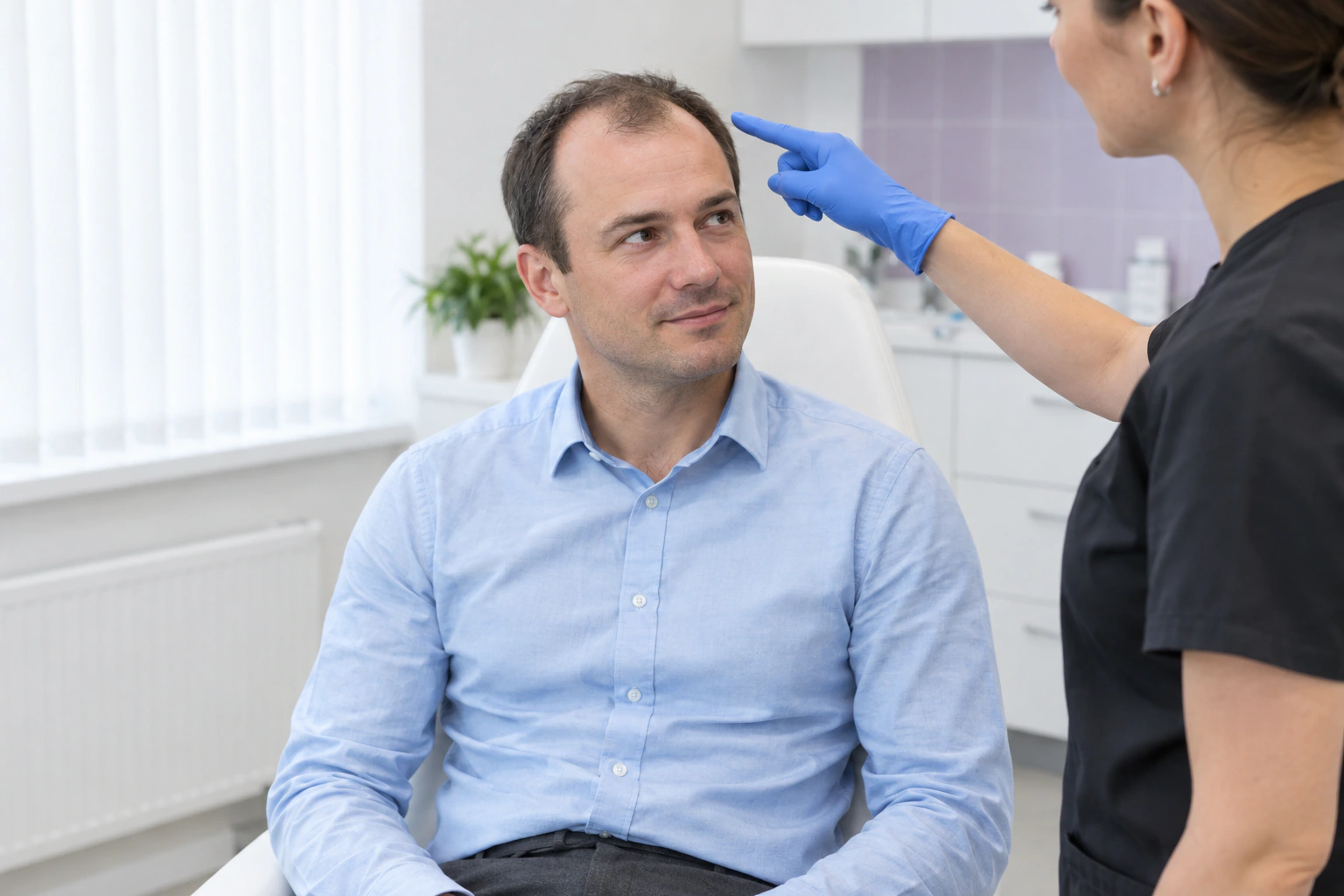

Leave your number and photos in a messenger. The doctor looks and tells you if a transplant helps. Free, nothing booked.

services
The doctor counts your grafts at the free consultation; the price named there is what the contract states.
suture-free graft extraction

$2,200$2,700
or $367/mo — 0% instalments for 6 months
Hold the cost nowimplantation without channels

$2,500$2,900
or $417/mo — 0% instalments for 6 months
Hold the cost nowcombined technique

$2,700$2,900
or $450/mo — 0% instalments for 6 months
Hold the cost now| Initial examination | Free |
|---|---|
| Eyebrow transplant, FUE | |
| Beard transplant, FUEinstalments $467/mo | |
| Hair trichopigmentation | |
| PRP therapy / session | $200 |
all included
Everything before the operation and 12 months after it.
No unexpected costs on the day of surgery.
two areas more
The scalp is just the most common case. Grafts come from the back of the head, the method is FUE, the zone can differ.
FUE, no incisions and no stitches

Grafts are harvested from the donor area at the back of the head and moved through micro-punctures of about 1 mm, without leaving scars. Before the operation the doctor settles the shape with you, taking your facial features into account. Transplanted hair grows for life and the beard is styled as usual.
$2,800$3,000
or $467/mo — 0% instalments for 6 months
Hold the cost nowFUE, no incisions and no stitches

The surgeon draws the eyebrow shape at the initial consultation: references are studied together and the design takes your facial features into account. The hairs are implanted at the natural angle of growth, so the eyebrows look natural. It also helps where years of plucking stopped growth.
$1,600$1,700
a same-day procedure with the scalp area numbed
Hold the cost nowDonor zone inspected, grafts counted, realistic outcome explained. Your cost is decided at that consultation and written down in the contract.

Message our coordinator
Free online consultation · Reply within 15 minutes
Message us on TelegramMessage us on WhatsAppBy messaging us, you agree to our Privacy Policy
Process
From consultation to going home — all in one day

During the initial consultation, the doctor explains how the FUE and DHI methods work, answers all your questions, and puts together an individual plan for the surgery. This consultation is free.

The date is held with a deposit payment, made by card at the clinic or online, and the terms are documented in a medical services contract.

This step ensures you're ready for surgery: the clinic supplies a list of required tests and clear instructions for completing them.

This part of the treatment is done under local anaesthetic and passes painlessly.

Grafts are collected from the back of the head or temples, using a technique that requires no stitches.

The surgeons then implant the harvested grafts into the balding area.
You are sent home with the required items and a complete explanation of how to heal quickly.

The crusts shed, the swelling goes down, the area gradually recovers

No cause for worry, the shafts drop and the roots are untouched

Hair appears gradually, the result starts to show

Hair becomes thicker; the main volume and contour become visible

The final thickness and natural hairline take shape

Free, before the operation, no strings at all.
Plan the next stepdoctors

Hair transplant doctor, trichologist, surgeon
10 years of experience

Dermatovenereologist, trichologist, surgeon
11 years in practice

Plastic surgeon
9 years of experience

Plastic surgeon
9 years of experience

Assistant
9 years of experience
The doctor studies the donor zone, arrives at the graft count and sets out the achievable outcome.
Plan the next stepcoordinators
You are assigned a personal coordinator, your guide from the first enquiry to recovery.

Patient support officer
Carries you through preparation and healing
Picks up all your forms and your bookings

Patient support officer
Carries you through preparation and healing
Picks up all your forms and your bookings

Patient support officer
Carries you through preparation and healing
Picks up all your forms and your bookings
Patient support officer
Carries you through preparation and healing
Picks up all your forms and your bookings













We will answer your questions and book a consultation time that suits you
Message us on WhatsApp Submit the formQueries we hear

Yes — patients from other cities and countries are welcome, and you can start with a free online consultation.
FUE is $2,200 (≈ SSP 12,500,000), DHI is $2,500 (≈ SSP 14,500,000), combined DHI+FUE is $2,700 (≈ SSP 15,500,000). A free consultation with a graft count gives you the exact, contract-fixed price.
Just a day, and then patients are on their way back home.
Not painful. The scalp stays numb under a local anesthetic.
FUE relies on tweezer harvesting with no incisions or stitches. DHI relies on Choi-pen implantation without channels. The combined DHI+FUE approach harvests by FUE and implants by DHI.
A free consultation ends with an exact graft figure, determined by the doctor from your donor zone.
The first 0–10 days are for healing. Around 2–4 weeks the new hairs let go, which is expected. Growth restarts at 3–4 months, thickness is plain at 6–9 months; everything settles by 12–18 months.
Your procedure includes a lifetime hair-growth guarantee under contract.
The clinic works under a medical licence, care follows the standards and clinical guidelines
under Ministry of Health.

The diplomas and certificates of your operating doctors
Look at the papersAKC POMOSHCH LLC
the clinic's own entity
1057746096924
OGRN
7728536872
INN
FUE and DHI both work for a patient in Juba. The skin is not cut open, there is nothing to stitch, local anaesthesia covers the session on its own, and the operation ends on the same day it began.
You can begin in Juba without leaving home: the online consultation is free, and the doctor looks at photos of the thinning area and counts how many grafts it will take. The clinic is reachable 24/7, so a message fits your schedule.
Healing is a matter of 0-10 days, the transplanted hairs shed at 2-4 weeks and that is expected, growth resumes at 3-4 months, density is obvious at 6-9 and the result is complete at 12-18. The clinic checks in at 1, 3, 6, 9 and 12 months by photo, and the growth guarantee lasts a lifetime.
Prices are in US dollars; the amount in brackets is an approximate conversion to SSP at the rate of 02.10.2026. The final price is fixed in your contract.
By messaging us, you agree to our Privacy Policy
What patients write after this operation. Reviews are translated from the original language.
Andrey M.
I had the operation a month ago. Before and after surgery they were always in touch and helped with questions about my tests. The operation itself went wonderfully, the staff are polite and masters of their craft, you feel you are in safe hands. I am recovering now, and they answer all my questions. I am happy and I recommend them!
DHI hair transplant
Pavel Sinitsyn
The best clinic of all the ones I was choosing from. No regrets at all! The result is simply amazing, I am thrilled. I recommend it to everyone: these people do great work and make people happy. Once again, a huge thank you to everyone. Roman, the head of the clinic, is the best: he was personally in touch with me and looked after my recovery. Thank you for making my dream come true.
FUE hair transplant
Maria Akopyan
I thought about an eyebrow transplant for a long time and finally went for it. At first I was afraid the result would look unnatural, but when I saw my new eyebrows I was delighted! They came out full and in harmony with my face. I can hardly believe that now I just wash my face and go, I have never felt so free. For anyone tired of constant make-up, a transplant is a real lifesaver!
Eyebrow transplant (FUE)
Alexander M.
I really wanted a thick beard, but I had problems with it. I tried every home remedy and minoxidil, and nothing helped. After a long search for the best clinic I settled on this one. Thank you so much for the service, I liked everything and now I am happy! I had the beard transplant 10 months ago and I am very pleased with the result. By the way, the music in the clinic was great, as far as I remember. A friend of mine has already come to you for a transplant on my advice and was also happy with the result. I wish you every success!
Beard transplant (FUE)
Vladimir Z.
I went to the clinic to see a trichologist and had a hair transplant. I really liked the doctor's approach, and all the recommendations helped. I want to point out that nobody tries to sell you extra services: they tell you things as they are, and if some treatment is not needed, they do not push it. Cosy and clean.
DHI hair transplant
Artem Popov
This may sound obvious, but a head of hair really changes everything in your life. You feel much more confident and go through life like a winner. And it is all thanks to the doctor at this clinic and to the staff who take care of their patients. Many thanks to the clinic for a happy life with new hair, for the comfortable conditions and for the professionalism during the hair transplant.
FUE hair transplant
Page medically reviewed by Anastasia A. Kolesnik, hair transplant doctor. Review date: .
Juba is the capital and largest city of South Sudan, set on the White Nile and also the capital of Central Equatoria State. It was established in 1920–21 by the Church Missionary Society in a small Bari village that carried the same name, and it grew quickly after 2005 and again after independence in 2011. A city that has changed so fast is full of people building careers, businesses and families, and appearance often matters in that setting. Receding temples, a thinning crown or a patchy beard can affect confidence in meetings, at university and at family gatherings.
Hair transplantation by the FUE or DHI method is one answer to this. Grafts are taken from the back of the head, the donor area, and moved through micro-punctures of about 1 mm, so nothing scars over. For a resident of Juba the practical question is how to plan such an operation around work, the weather and the rhythm of the city. This text walks through those questions step by step.
City Medical Centre works with patients from Juba through a free online consultation. Coordinators are available around the clock, 24/7, on WhatsApp and Telegram, so you can write at a moment that suits your day, and the first conversation does not require you to leave the city.
Juba has a tropical wet and dry climate and, lying near the equator, it is hot throughout the year. Little rain falls from November to March, and this is also the period with the hottest maximum temperatures, reaching 37.8 °C in February. From April to October more than 100 millimetres of rain falls per month, and the annual total is nearly 1,000 millimetres.
This matters for a transplant. In the first days the treated area is delicate, and strong sun, sweat and dust are the main irritants. In the dry, hot months you will want to avoid long spells outdoors at midday, choose shade, and ask the surgeon what kind of loose, clean headwear is acceptable and from which day. Tight caps that trap heat and rub the scalp are usually a poor choice early on.
In the rainy months the issue is different: humidity, mud and damp air. Keep the head clean, dry the scalp gently as instructed, and avoid wearing wet hats or covering the area with fabric that has not been washed. Neither season is simply better or worse; each simply needs its own habits, and your coordinator can help you match the plan to the month you choose.
Many patients from Juba ask when to have the procedure. The dry months, November to March, bring the hottest days, so the first week of healing would fall in strong heat and sun. The rainy season, April to October, brings cooler and wetter conditions but also dampness and muddy surroundings that make going out less pleasant.
The recovery timeline gives a useful frame: 0–10 days for healing, 2–4 weeks for normal shedding of transplanted hair, 3–4 months for new growth to start, 6–9 months for real density, and 12–18 months for the final result. Because the early phase is the most sensitive to sun and dirt, many people choose to spend those first days mostly indoors, in a shaded and clean space, whichever month it is.
Think also about your calendar: exams, a work project, a wedding or a family celebration. Pick a start date that leaves the first days quiet. Your coordinator will go through the dates with you and help you count the stages forward.
Juba is a city of administration, trade, banking and education. The University of Juba was founded in 1975, and several other universities operate in the city. Students, office staff, traders and people working with the public all need to think about how visible the early stage of healing will be.
In the first days there may be redness and small crusts in the treated area. Between 2 and 4 weeks the transplanted hairs let go, as expected. This shedding is a normal stage and not a failure. Anyone who works with customers or sits in lectures should plan for this stage, perhaps arranging lighter duties or some days away from public-facing work, and agreeing on this with the surgeon in advance.
If your job keeps you outdoors, for example on construction or in transport, tell the coordinator. Dust, heat and sweat are the issues, and the surgeon can tell you when it is reasonable to return to such work and how to protect the scalp until then.
Football is a daily passion for many young people in Juba, and others run or train in the cooler hours. After a transplant, heavy sweating and contact to the head are not welcome early on. Ask the surgeon exactly when light exercise is acceptable, when running and gym work can resume, and when contact sports such as football with headers become safe.
Swimming and river or pool water deserve the same question. Clean water matters for a healing scalp, so ask for a clear date for returning to the pool and avoid natural water until the surgeon agrees. Do not rely on a friend's experience; healing differs from person to person.
Follow the timeline rather than the calendar of your usual training. The long view is 12–18 months to a settled look, so a few weeks of caution cost little against that horizon.
Family life in Juba is lively, with weddings, church gatherings, funerals and shared meals bringing many people together. If you want to attend an event with your hair at its best, it helps to count backwards. The early crusts clear in the first days, the shedding comes at 2–4 weeks, and a visibly thicker look arrives at 6–9 months. An event within the first month would find you in the least settled stage.
Meals at such gatherings are often communal and spicy, with fish from the Nile, grilled meat and starchy staples. Nothing in an ordinary local diet is a problem in itself, but you should ask the surgeon about anything that may affect healing, such as alcohol, smoking and very heavy meals in the first days. Drinking enough water in the heat also helps general recovery.
Some patients prefer to tell only close relatives. Others are open about it. It is your choice, and the coordinator can explain what the first weeks will look like so that you can decide how much to say.
A good candidate usually has enough healthy hair in the donor area at the back of the head, realistic expectations and stable general health. The cause of hair loss matters: pattern baldness, scarring from old injuries, burns or infections, and patchy beards each need a different approach. The doctor will assess this from the photographs you send during the online consultation.
Situations that call for caution or a delay include uncontrolled chronic illness, active infection of the scalp, poor wound healing, and conditions that affect the skin. You should tell the doctor about every medicine you take and about any past reaction to anaesthesia. Honesty at this step protects you.
Beard restoration follows the same logic. The doctor discusses the shape with you before the operation, taking your facial features into account. Transplanted hair grows for life: trim and style the beard as usual.
The stages are clear. At 2–4 weeks transplanted hairs let go, as expected. At 3–4 months hair comes back. At 6–9 months it is visibly thicker. At 12–18 months the look has settled. Knowing this helps you to stay calm during the quiet middle months.
One patient described it this way: the result truly made him very happy. From about the 4th month active, even growth began, the transplanted hair took very well, the beard looked as natural as possible and no bald patches were left. It became much thicker and denser, with the shape he had thought about for a long time.
Support continues throughout. We stay with you from pre-op planning to 12 months later, with check-ups at months 1, 3, 6, 9 and 12. After the operation a coordinator will be on the phone 24/7.
Juba began as a small Bari village of the same name, where the Church Missionary Society opened a mission and the Nugent Memorial Intermediate School in 1920–21. In the late 1920s the town was laid out as the capital of Mongalla Province, the Governor's office moved there in 1930, and the city became the national capital on 9 July 2011. The place has had several beginnings, and many residents have a story of starting again in a new setting. A hair transplant fits this mindset well, because it is also a slow, staged project rather than a single day.
Keep that image in mind when you plan. Healing takes 0–10 days, shedding comes at 2–4 weeks, new growth begins at 3–4 months, density builds at 6–9 months, and the settled look arrives at 12–18 months. Write these stages in your phone next to the dates of your own plans, and let the coordinator check them with you.
The downtown Juba Market area and the small suburb of Hai Jalaba, once known as the Greek Quarter, still hold buildings put up in the early decades of the city. These busy parts of town are crowded, dusty and loud. In the first days after an FUE or DHI procedure the treated area should not be exposed to a crowded market, so errands there are best handed to relatives or put off until the early healing of 0–10 days is over.
The White Nile runs beside the city and many people like to spend time near the water. It is a pleasant place for a calm walk once the surgeon allows it, but do not bathe in river water or let spray and mud reach the scalp until you get a clear go-ahead. Ask for a specific date instead of guessing.
Juba is home to the University of Juba, founded in 1975, as well as the Catholic University of South Sudan, the Episcopal University of South Sudan, Kampala International University and others. The Juba Public Peace Library, opened on 1 October 2019 with over 13,000 books, gives students a quiet place to read. Reading and screen work are fine for a recovering patient, so a quiet library or study corner is a good way to spend the first days, as long as you keep the scalp clean and away from the sun on the way there.
The city is also the base of banks such as Buffalo Commercial Bank, Ivory Bank and Nile Commercial Bank, and of regional lenders and insurers. Bank and office staff meet clients face to face, so plan the shedding stage of 2–4 weeks around important meetings. A short conversation with the coordinator helps you choose the quietest dates.
Everyday tables in Juba feature kisra, asida, ugali, bamia with okra and meat, malakwang with greens and peanuts, and ful medames at breakfast. These are filling, home-style dishes, and nothing about them stops you from healing. Regular meals with enough protein, vegetables and water suit a recovering patient well, and a heavy communal meal is easy to postpone for a week or two.
Ful medames at breakfast and bamia in the evening are easy to eat quietly at home, which suits the first days when you want to stay indoors. If you are unsure about a particular food, spice or drink, put the question to the surgeon at the consultation.
You write to the coordinators on WhatsApp or Telegram, at any hour. You send clear photographs of the front, top, crown and back of the head, or of the beard, in daylight. You describe your history, any medicines and your goals. The doctor reviews this and discusses the plan, the shape and what can realistically be achieved.
Because Juba can have limits on connection quality and electricity, send photos when your signal is good and keep messages short if needed. Voice notes are fine. If a message does not go through, simply resend it; the coordinators are on duty around the clock.
The consultation is free and carries no obligation. Use it to compare your expectations with what the doctor tells you, and take the time you need before deciding.
Yes. The online consultation is free. You write on WhatsApp or Telegram, send photographs and receive the doctor's assessment without leaving the city.
At any time. Coordinators are available 24/7, so you can write in the evening after work or early in the morning.
Neither is perfect. November to March is dry and hot, with February reaching 37.8 °C, so sun and sweat need care. April to October is rainy, with more than 100 millimetres per month, so dampness and mud need care. Choose a quiet period and follow the surgeon's instructions.
Ask the surgeon when and what type. Loose, clean headwear may be allowed after a certain day, but tight caps that trap heat and sweat are usually not advised early on.
At 2–4 weeks the transplanted hairs let go, as expected. This is a normal stage, and new hair follows.
Hair comes back at 3–4 months, becomes visibly thicker at 6–9 months, and the look is settled at 12–18 months.
Grafts are taken from the back of the head, the donor area, and moved through micro-punctures of about 1 mm, so nothing scars over.
Yes. The doctor discusses the shape with you before the operation, taking your facial features into account. Transplanted hair grows for life: trim and style the beard as usual.
The first healing takes 0–10 days. Normal shedding takes 2–4 weeks, and the final result comes at 12–18 months.
We stay with you from pre-op planning to 12 months later, with check-ups at months 1, 3, 6, 9 and 12. A coordinator will be on the phone 24/7.
The rains run from April to October, with more than 100 millimetres a month. Damp air and mud call for a clean, dry scalp and washed headwear, but the season is not a barrier if you follow the surgeon's instructions.
Crowded, dusty places such as the downtown market are best avoided during the first healing period of 0–10 days. Ask relatives to help, and agree a return date with the surgeon.
Ask the surgeon at the consultation. Quiet reading is usually easy to combine with early healing, but plan for the shedding stage at 2–4 weeks if you are in front of others.
Not until the surgeon gives a clear date. Natural water is not clean enough for a healing scalp, so wait for a direct go-ahead.

 Forceps
 Minimal


