



earlier
at 12 months
2,800 grafts
FUE method
City Medical Centre
0% instalments
from $367/mo
Advice, then the price — $0.
Real person
earlier
at 12 months
No incisions, no stitches with FUE. Grafts and outcome forecast gone over and nothing owed — before you decide.
No fee at all, no surgery booking required
Message our coordinator
Free online consultation · Reply within 15 minutes
Message us on TelegramMessage us on WhatsAppBy messaging us, you agree to our Privacy Policy
results
All cases are real patients of our clinic.
earlier
at 12 months
2,800 grafts
FUE method

earlier
at 12 months
3,500 grafts
FUE method

earlier
at 12 months
2,600 grafts
FUE method

earlier
at 12 months
3,000 grafts
FUE method

earlier
at 12 months
2,700 grafts
FUE method

earlier
at 12 months
3,300 grafts
FUE method

earlier
at 12 months
2,900 grafts
FUE method

earlier
at 12 months
2,500 grafts
FUE method

earlier
at 12 months
3,400 grafts
FUE method

earlier
at 12 months
2,500 grafts
FUE method

earlier
at 12 months
3,100 grafts
FUE method

earlier
at 12 months
3,600 grafts
FUE method

earlier
at 12 months
4,000 grafts
FUE method

earlier
at 12 months
3,200 grafts
FUE method

earlier
at 12 months
3,000 grafts
FUE method

earlier
at 12 months
3,700 grafts
FUE method

earlier
at 12 months
2,700 grafts
FUE method

earlier
at 12 months
3,800 grafts
FUE method

earlier
at 12 months
3,300 grafts
FUE method

earlier
at 12 months
2,800 grafts
FUE method

earlier
at 12 months
2,500 grafts
FUE method

earlier
at 12 months
3,900 grafts
FUE method

earlier
at 12 months
3,500 grafts
FUE method

earlier
at 12 months
3,800 grafts
FUE method

earlier
at 12 months
2,900 grafts
FUE method

earlier
at 12 months
3,600 grafts
FUE method

earlier
at 12 months
2,600 grafts
FUE method

earlier
at 12 months
2,700 grafts
FUE method

earlier
at 12 months
3,700 grafts
FUE method

earlier
at 12 months
3,200 grafts
FUE method

earlier
at 12 months
3,000 grafts
FUE method

earlier
at 12 months
2,800 grafts
FUE method

earlier
at 12 months
4,000 grafts
FUE method

earlier
at 12 months
3,400 grafts
FUE method

earlier
at 12 months
2,900 grafts
FUE method

earlier
at 12 months
3,100 grafts
FUE method

earlier
at 12 months
2,600 grafts
FUE method

earlier
at 12 months
3,300 grafts
FUE method

earlier
at 12 months
3,900 grafts
FUE method

earlier
at 12 months
3,500 grafts
FUE method

earlier
at 12 months
2,700 grafts
FUE method

earlier
at 12 months
3,800 grafts
FUE method

earlier
at 12 months
3,200 grafts
FUE method

earlier
at 12 months
3,000 grafts
FUE method

earlier
at 12 months
2,800 grafts
FUE method

earlier
at 12 months
3,100 grafts
FUE method

earlier
at 12 months
3,600 grafts
FUE method
Comparison
Three technologies of graft transfer are open to you: classic FUE, suture-free DHI and a combined protocol. Judge each by implantation technique, tissue trauma and graft survival, then choose knowingly.
Classic technique without incisions or stitches

$2,200
$2,700
Graft implantation technique
ForcepsGraft trauma
MinimalNatural hair growth angle
NaturalGraft survival
98–100%Suitable for
Androgenetic alopeciaImplantation with a Choi pen, no sutures

$2,500
$2,900
Graft implantation technique
Choi implanter, DHI penGraft trauma
MinimalNatural hair growth angle
NaturalGraft survival
98–100%Suitable for
DensificationFUE extraction, DHI pen implantation

$2,700
$2,900
Graft implantation technique
Extraction by FUE, DHI implantGraft trauma
MinimalNatural hair growth angle
NaturalGraft survival
98–100%Suitable for
Densification for androgenetic alopeciaSurvival and trauma figures are method averages and only a guide: the exact numbers depend on the transplant area and the patient's individual features, and the doctor clarifies them at the consultation.
Arrange a consultation


















about the clinic
A well-equipped operating room, pleasant rooms, attentive care

We will answer your questions and find a consultation time that suits you
Message us on WhatsApp Drop us a lineThe doctor will not send you for surgery you do not need and says so at the consultation, sparing your money. Below are the situations in which a transplant truly helps.
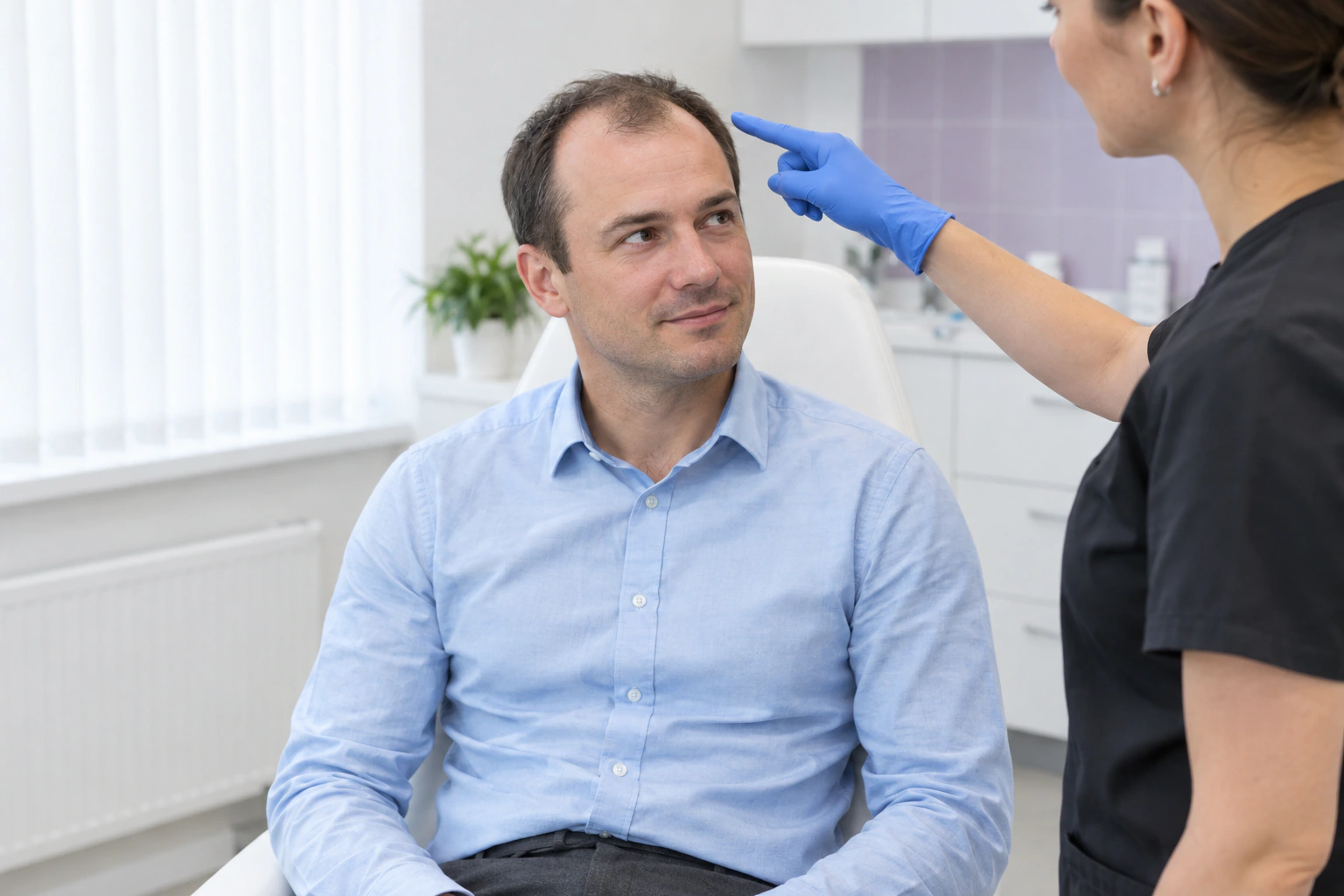

Only a number is needed from you. A coordinator gathers messenger photographs of the affected area, a doctor studies them and states whether a transplant would help. Free, and nothing is committed to.

services
The doctor counts your grafts at the free consultation; the price named there is what the contract states.
suture-free graft extraction

$2,200$2,700
or $367/mo — 0% instalments for 6 months
Fix your priceimplantation without channels

$2,500$2,900
or $417/mo — 0% instalments for 6 months
Fix your pricecombined technique

$2,700$2,900
or $450/mo — 0% instalments for 6 months
Fix your price| Your case reviewed | Free |
|---|---|
| Eyebrow transplant, FUE | |
| Beard transplant, FUEinstalments $467/mo | |
| Hair trichopigmentation | |
| PRP therapy / session | $200 |
all included
From the earliest planning to the 12-month follow-up.
No fresh charges turn up on surgery day.
two further zones
Different zone, same procedure: grafts taken from the back of the head, the FUE method, no other difference.
FUE method, no incisions or stitches

Grafts come from the donor area at the back of the head and are placed through micro-punctures of about 1 mm, leaving no scars. The doctor discusses the shape with you before surgery, taking your facial features into account. The transplanted hair grows for life, and the beard can be trimmed and styled as usual.
$2,800$3,000
or $467/mo — 0% instalments for 6 months
Fix your priceFUE method, no incisions or stitches

The surgeon maps the brow shape during the first consultation, sample photos are examined together and your face's proportions dictate the outline. Because every hair is angled the way it grows, the result passes as natural. Brows that stopped growing after long years of plucking are a good fit for it.
$1,600$1,700
an op with no ward stay, under local anaesthetic
Fix your priceThe doctor assesses what the donor zone holds, counts the grafts and explains the outcome you can expect. You are told the cost at the consultation and it goes into the contract.

Message our coordinator
Free online consultation · Reply within 15 minutes
Message us on TelegramMessage us on WhatsAppBy messaging us, you agree to our Privacy Policy
Process
From consultation to going home — all in one day

In a free initial consultation, the doctor talks you through FUE and DHI, answers your questions in full, and builds a surgical plan around your case.

After a deposit the calendar entry is yours alone. It can go through as a card payment at the clinic or online.

Preparation for the surgery includes a set of tests, and the clinic makes the process easy with a full list and instructions.

The operation brings no pain, because a local anaesthetic is used for it.

Extraction happens towards the rear of the head, or at the temples, and no suture goes into the donor zone.

Placement follows harvesting: the grafts go into the bald zone.
The clinic provides everything you need, along with complete instructions, to support a fast recovery.

The scabs come away, the puffiness dies down, the skin heals in stages

A predictable phase: hair shafts drop while the roots stay

The area gradually thickens, and the result shows

Hair becomes thicker and the main volume and contour show up

Volume and the line of the hairline are both finished

Free, prior to the operation, no commitment at all.
Arrange a consultationdoctors

Hair transplant doctor, trichologist, surgeon
10 years of experience

Dermatovenereologist, trichologist, surgeon
11 years in practice

Plastic surgeon
9 years of experience

Plastic surgeon
9 years of experience

Assistant
9 years of experience
The doctor looks over the donor zone, arrives at the number of grafts and explains what is achievable.
Arrange a consultationcoordinators
You do not deal with a queue of people: one coordinator covers everything up to recovery.
Care team coordinator
Is on hand through preparation and healing
Runs the paperwork and keeps your diary

Care team coordinator
Is on hand through preparation and healing
Runs the paperwork and keeps your diary
Care team coordinator
Is on hand through preparation and healing
Runs the paperwork and keeps your diary
Care team coordinator
Is on hand through preparation and healing
Runs the paperwork and keeps your diary













We will answer your questions and find a consultation time that suits you
Message us on WhatsApp Drop us a linePoints people raise

Yes — patients based far from one another are treated all the time, and an online session with the doctor can be booked.
FUE costs $2,200 (≈ ₦2,950,000), DHI costs $2,500 (≈ ₦3,350,000), and the combined DHI+FUE method costs $2,700 (≈ ₦3,600,000). The exact amount is confirmed at a free consultation after your grafts are counted, and it is fixed in the contract.
One working day, and you are discharged home when it ends.
No. Everything happens under local anaesthesia, without pain.
FUE relies on tweezer harvesting with no incisions or stitches. DHI relies on Choi-pen implantation without channels. The combined DHI+FUE approach harvests by FUE and implants by DHI.
The precise total is produced at the free consultation, once the doctor has assessed the donor zone.
0–10 days: healing. 2–4 weeks: the transplanted hairs shed, which is normal. 3–4 months: growth resumes. 6–9 months: density becomes noticeable. 12–18 months: the result is complete.
Your procedure includes a lifetime hair-growth guarantee under contract.
There is a medical licence, and care is provided to the standards and clinical guidelines
of the Ministry of Health.

Certificates of the doctors who perform the operation
View the documentsAKC POMOSHCH LLC
the clinic's legal entity
1057746096924
OGRN
7728536872
INN
Neither FUE nor DHI puts a patient in Ilesa through cuts or stitches. Local anaesthesia is the only preparation of that kind, and the operation runs for one day, after which the patient leaves on their own feet.
The doctor can see what is going on from photographs, so a patient in Ilesa begins online and free of charge, with a straight answer on whether a transplant helps. The clinic keeps in touch 24/7.
It heals within 0-10 days, the transplanted hairs shed at 2-4 weeks and this is the norm, growth appears at 3-4 months, density at 6-9 and the final result at 12-18. Along the way there are check-ups at 1, 3, 6, 9 and 12 months, photo tracking with a personal coordinator and a lifetime growth guarantee.
Prices are in US dollars; the amount in brackets is an approximate conversion to NGN at the rate of 02.10.2026. The final price is fixed in your contract.
By messaging us, you agree to our Privacy Policy
What patients write after this operation. Reviews are translated from the original language.
Andrey M.
I had the operation a month ago. Before and after surgery they were always in touch and helped with questions about my tests. The operation itself went wonderfully, the staff are polite and masters of their craft, you feel you are in safe hands. I am recovering now, and they answer all my questions. I am happy and I recommend them!
DHI hair transplant
Pavel Sinitsyn
The best clinic of all the ones I was choosing from. No regrets at all! The result is simply amazing, I am thrilled. I recommend it to everyone: these people do great work and make people happy. Once again, a huge thank you to everyone. Roman, the head of the clinic, is the best: he was personally in touch with me and looked after my recovery. Thank you for making my dream come true.
FUE hair transplant
Maria Akopyan
I thought about an eyebrow transplant for a long time and finally went for it. At first I was afraid the result would look unnatural, but when I saw my new eyebrows I was delighted! They came out full and in harmony with my face. I can hardly believe that now I just wash my face and go, I have never felt so free. For anyone tired of constant make-up, a transplant is a real lifesaver!
Eyebrow transplant (FUE)
Alexander M.
I really wanted a thick beard, but I had problems with it. I tried every home remedy and minoxidil, and nothing helped. After a long search for the best clinic I settled on this one. Thank you so much for the service, I liked everything and now I am happy! I had the beard transplant 10 months ago and I am very pleased with the result. By the way, the music in the clinic was great, as far as I remember. A friend of mine has already come to you for a transplant on my advice and was also happy with the result. I wish you every success!
Beard transplant (FUE)
Vladimir Z.
I went to the clinic to see a trichologist and had a hair transplant. I really liked the doctor's approach, and all the recommendations helped. I want to point out that nobody tries to sell you extra services: they tell you things as they are, and if some treatment is not needed, they do not push it. Cosy and clean.
DHI hair transplant
Artem Popov
This may sound obvious, but a head of hair really changes everything in your life. You feel much more confident and go through life like a winner. And it is all thanks to the doctor at this clinic and to the staff who take care of their patients. Many thanks to the clinic for a happy life with new hair, for the comfortable conditions and for the professionalism during the hair transplant.
FUE hair transplant
Ilesa, also written Ilesha, is a historic city in Osun State, southwest Nigeria. It is also the name of the capital of the historic Ijesha state-kingdom, ruled by a monarch who bears the title Owa Obokun Adimula of Ijesaland. In a city with this much sense of heritage, appearance matters: people attend chieftaincy occasions, naming ceremonies, weddings and community gatherings where grooming is noticed and a neat hair line or a full beard is part of how a person presents himself.
Many men in Ilesa start thinking about a hair transplant quietly, often after years of watching a hair line recede or a beard grow patchy. This text explains how FUE and DHI hair transplantation works in practice for someone living in Ilesa, how to plan around the local climate and routine, and which questions to take to your surgeon. It is general information and does not replace an individual examination.
You do not need to leave the city to begin. City Medical Centre offers a free online consultation, and coordinators are available around the clock (24/7) on Telegram and Telegram. You send clear photos of the front, top, crown, both sides and the back of the head, or of the beard area, and describe how long the loss has been going on, what you have tried and any medical conditions or medicines.
The doctor reviews the material, discusses the shape of the hair line with you before the operation, and takes your facial features into account. You learn whether you are a reasonable candidate, what the plan looks like and what the stages of recovery will be. We stay with you from pre-op planning to 12 months later, and a coordinator will be on the phone 24/7, which matters when a question comes up late in the evening after a long day in Ilesa.
Photos taken in good daylight, without a cap and with the hair dry, give the clearest picture. Take them again every few weeks before the procedure if you want to show the doctor how quickly the loss is progressing.
In both methods, grafts are taken from the back of the head, the donor area, and moved through micro-punctures of about 1 mm, so nothing scars over. FUE and DHI differ in how the grafts are placed, and the doctor will explain which one suits your hair type, the area to be covered and your expectations.
The doctor discusses the shape with you before the operation, taking your facial features into account. This is useful for men in Ilesa who want a natural frontal hair line that still looks right with a close cut, a fade or a longer style.
Transplanted hair grows for life: trim and style the beard as usual. The same applies to hair on the scalp, so barber visits do not need to change once the first weeks have passed.
Ilesa lies in southwest Nigeria, and the year here is usually divided between a rainy period and a drier, dustier one. We do not quote local weather figures, but the general lessons are clear. Strong sun, sweat and dust are the main enemies of fresh grafts, so plan the early days so you can stay in shade and indoors as far as possible.
During the dry, dusty weeks, airborne dust can irritate the recipient area, so keep outings short and follow the washing routine the clinic gives you. In the rainy period, humidity and sudden downpours make it important to keep the scalp clean and not to get caught in the rain without protection. A loose, clean, breathable cap approved by your doctor is better than a tight one, because pressure on the grafts must be avoided.
Heat also increases swelling discomfort and sweating. Sleeping in a cool room with the head slightly raised, drinking enough water and avoiding long exposure to midday sun make the first days easier. Swimming pools, rivers and any open water should be avoided until the doctor confirms that the skin has healed.
There is no single perfect month in Ilesa. The best time is the one when you can spend the first days resting, avoid heavy sun and dusty travel on the road, and keep your schedule light. Some patients choose a quieter period at work, others prefer a time when fewer family events are planned.
Think about the whole timeline rather than only the day of surgery. 0–10 days for healing, 2–4 weeks for normal shedding of transplanted hair, 3–4 months for new growth to start, 6–9 months for real density, and 12–18 months for the final result. Count forward from your chosen date and check which social events fall inside the early phases, such as weddings, festivals and religious gatherings, when you may not want to be seen with scabs or a shaved donor area.
Ilesa has schools and training institutions, including the College of Technology at Imelu, so students and young professionals are among those who ask about hair restoration. If you study or work in an office, a shop or on your feet outdoors, tell the doctor about your daily routine. Outdoor work in the sun and dust needs a different plan from desk work.
Most men prefer to take the first days off and return to work once the doctor says it is suitable. Jobs that involve heavy sweating, dust, helmets or tight headwear need special attention, and your surgeon can say when such work is safe to resume. Sport and strenuous exercise should wait until you are cleared, and contact sport later still.
If you are a student, plan the procedure around a quiet part of the academic calendar, so that the shedding phase at 2–4 weeks does not coincide with exams or presentations where you would like to feel at ease.
Food is central to social life in a Yoruba city such as Ilesa, and family gatherings tend to be large. During the early recovery, avoid crowded, hot, smoky places where you will be leaning over cooking fires or standing in heat. Avoid alcohol in the first days unless your doctor allows it, and follow the advice on diet that is given to you.
Tell close family in advance if you prefer not to explain the operation to everyone. A simple plan helps: schedule the procedure well before an important event, so that shedding and early growth are over by the date. Because new hair becomes visibly thicker at 6–9 months and settles at 12–18 months, a wedding or a title ceremony a year ahead is a realistic target.
A good candidate generally has enough healthy donor hair at the back of the head, realistic expectations and stable general health. Those whose loss is still changing quickly, who have scalp disease, uncontrolled chronic illness or unusual scarring tendencies may need further assessment or a different plan. Only the doctor can decide after reviewing your photos and history.
Useful questions for the surgeon: Which method, FUE or DHI, suits me and why? How many sessions might I need? How will the hair line be designed for my face? What should I do in the first days in Ilesa heat and dust? When can I return to work, the gym or football? What is the plan if the result is uneven? Ask also about medicines that support the donor and recipient areas.
General health matters too. Weight and metabolic health influence healing, and the World Health Organization publishes general information on overweight and obesity that is worth reading if this concerns you.
Ilesa is the capital of the historic Ijesha state-kingdom, which tradition says was founded around 1300 by Ajibogun Ajaka, known as Owa Obokun Onida Raharaha, the youngest son of Oduduwa. The ruler still carries the title Owa Obokun Adimula of Ijesaland, and accession rotates among four royal houses: Biladu, Bilagbayo, Bilaro and Bilayirere. Palace events, installations and anniversaries of the royal houses draw large crowds, and anyone who expects to attend them is wise to plan a hair transplant so that the shedding phase is finished well before the date.
One detail of local oral history is oddly relevant to head care. The story of the Owa Ajaka tells of crowns, fringes and who may wear which crown, and in Ijesaland the head has long been treated as something to present with dignity. For a man in Ilesa who wears a cap or a traditional hat at ceremonies, the practical question is when headwear is allowed. Ask your surgeon for a date after which a loose, clean hat can be worn, and do not borrow a tight ceremonial cap during the first weeks, because pressure on the grafts must be avoided.
Chieftaincy titles in the Ijesa towns, such as Odole or Risawe, are often taken by men in mid-life, just the age when a receding frontal hair line becomes a topic. If you expect a title ceremony, count forward on the timeline: 0–10 days for healing, 2–4 weeks for normal shedding, 3–4 months for new growth to start, 6–9 months for real density and 12–18 months for the final result.
In 1854 the missionary Rev. William Howard Clark wrote that for its cleanliness, regularity in breadth and the straightness of its streets, the ancient village of Ilesa far surpassed any native town he had seen in black Africa. A city with that reputation for order suits a hair transplant well, because the operation rewards tidy preparation: a written calendar, clean bedding, a prepared recovery room and a list of questions.
Ilesa is also known for gold. Geological interest in the Ilesa gold belt has grown over the last decade, and mining, trading and related services bring a mix of workers to the area. If your work is connected with mining, quarrying or outdoor site supervision, tell the doctor. Dust, helmets and heavy sweating are the points to settle before surgery, and your surgeon can say when such work is safe to resume.
The city is spoken of in two ways, Iléṣà and locally Uléṣà. Whichever name you use, send your photos and your questions in your own words to the coordinators on Telegram or Telegram; they are available 24/7 and the doctor will go through your plan with you.
Ilesa has a growing academic life. Ilesa Grammar School celebrated its 90th anniversary in 2024, the University of Ilesa was established on March 31, 2022 (formerly the College of Education), and the College of Technology stands at Imelu. Teachers, lecturers, students and alumni form a large group of young adults who ask about hair restoration, often because of early recession or a patchy beard.
For a lecturer or teacher standing before a class every day, the shedding stage at 2–4 weeks is the most awkward one. Plan the operation for a break between terms so that this stage passes in private. A student can use the same logic around exams, practical sessions and graduation photographs. By 6–9 months hair is visibly thicker, so a graduation or an alumni reunion about a year ahead is a realistic target.
Campus life includes football, athletics and crowded halls. Do not return to sport or packed, hot lecture rooms until the doctor allows it, and ask in writing which activities are permitted at the first check-up at month 1.
Ilesa has several hospitals, among them Wesley Guide Hospital, the Obafemi Awolowo Teaching Hospital complex at Oke Ayesa, Oba Adenle Memorial Hospital and Living Petals Medical Center. We do not direct patients to any of them for the operation itself, but it is sensible to know where your family doctor and nearest facility are, in case you have a general health problem such as a fever, a skin infection or a blood pressure issue during recovery.
Before the procedure, have routine health checks done locally if your doctor asks for them, and bring the results into the online consultation. Tell the remote surgeon about every medicine you use. During the months of follow-up, at months 1, 3, 6, 9 and 12, you send photos from home, and the coordinator on the phone 24/7 helps you decide whether a local review is needed.
Follow-up is built into the plan: check-ups at months 1, 3, 6, 9 and 12. You send photos from Ilesa, the doctor compares them with earlier ones, and adjusts the advice. This is helpful because the early weeks can look worrying when hairs shed, although 2–4 weeks is when transplanted hairs let go, as expected.
From 3–4 months the hair comes back, at 6–9 months it is visibly thicker, and by 12–18 months the look has settled. One patient described it this way: from about the 4th month active, even growth began, the transplanted hair took very well, and the beard looked as natural as possible with no bald patches left. Results differ from person to person, so use such stories as an illustration of the timeline, not as a promise.
Yes. The online consultation is free, and coordinators are available 24/7 on Telegram and Telegram. You send photos and information about your hair and health, and the doctor gives an assessment.
Both take grafts from the back of the head, the donor area, and move them through micro-punctures of about 1 mm. They differ in the way the grafts are placed, and the doctor will recommend one after reviewing your case.
Because the grafts are moved through micro-punctures of about 1 mm, nothing scars over. The doctor will explain what to expect in your own case.
Transplanted hairs let go at 2–4 weeks, as expected. Hair comes back at 3–4 months, looks visibly thicker at 6–9 months and has a settled look at 12–18 months.
In the early days, yes, they can irritate fresh grafts. Stay in shade, avoid dusty places, use only the headwear your doctor approves and follow the washing instructions.
Not at first. Avoid pools, rivers and strenuous exercise until the doctor confirms you may. Ask for a clear date for each activity.
Transplanted hair grows for life: trim and style the beard as usual. Use common sense in the first weeks, until the doctor allows normal grooming.
People with too little donor hair, active scalp disease, uncontrolled chronic illness or unrealistic expectations may need another plan. The doctor decides after assessing your photos and history.
We stay with you from pre-op planning to 12 months later, with check-ups at months 1, 3, 6, 9 and 12, and a coordinator will be on the phone 24/7.
Not medically, but royal and chieftaincy events in Ilesa are fixed dates that many families plan around. Count forward from the event: shedding at 2–4 weeks, new growth at 3–4 months and visible thickness at 6–9 months, and choose the operation date so these stages pass before it.
Dust, helmets and heavy sweating are the concerns. Tell the doctor your exact job during the consultation. You will be given a date for return to work, and for the early days you should keep away from dust and tight headwear.
Choose a break between terms, so that the shedding period at 2–4 weeks does not fall during exams. Ask the doctor about sport and crowded halls at the month 1 check-up.
The operation is planned remotely through City Medical Centre, and we do not name local hospitals for it. Local hospitals are useful for general health checks or unrelated medical problems, and your coordinator is on the phone 24/7 to advise.
Page medically reviewed by Anastasia A. Kolesnik, hair transplant doctor. Review date: .

 Forceps
 Minimal


