



original
12 months along
2,800 grafts
FUE method
City Medical Centre
0% instalments
from $367/mo
A look and a figure — $0.
True story
original
12 months along
FUE, carried out with no blade and no thread. Grafts and forecast counted up, you pay nothing — before you decide.
No payment at all, no surgery booking required
Message our coordinator
Free online consultation · Reply within 15 minutes
Message us on TelegramMessage us on WhatsAppBy messaging us, you agree to our Privacy Policy
results
Authentic patient results, published as they are.
original
12 months along
2,800 grafts
FUE method

original
12 months along
3,500 grafts
FUE method

original
12 months along
2,600 grafts
FUE method

original
12 months along
3,000 grafts
FUE method

original
12 months along
2,700 grafts
FUE method

original
12 months along
3,300 grafts
FUE method

original
12 months along
2,900 grafts
FUE method

original
12 months along
2,500 grafts
FUE method

original
12 months along
3,400 grafts
FUE method

original
12 months along
2,500 grafts
FUE method

original
12 months along
3,100 grafts
FUE method

original
12 months along
3,600 grafts
FUE method

original
12 months along
4,000 grafts
FUE method

original
12 months along
3,200 grafts
FUE method

original
12 months along
3,000 grafts
FUE method

original
12 months along
3,700 grafts
FUE method

original
12 months along
2,700 grafts
FUE method

original
12 months along
3,800 grafts
FUE method

original
12 months along
3,300 grafts
FUE method

original
12 months along
2,800 grafts
FUE method

original
12 months along
2,500 grafts
FUE method

original
12 months along
3,900 grafts
FUE method

original
12 months along
3,500 grafts
FUE method

original
12 months along
3,800 grafts
FUE method

original
12 months along
2,900 grafts
FUE method

original
12 months along
3,600 grafts
FUE method

original
12 months along
2,600 grafts
FUE method

original
12 months along
2,700 grafts
FUE method

original
12 months along
3,700 grafts
FUE method

original
12 months along
3,200 grafts
FUE method

original
12 months along
3,000 grafts
FUE method

original
12 months along
2,800 grafts
FUE method

original
12 months along
4,000 grafts
FUE method

original
12 months along
3,400 grafts
FUE method

original
12 months along
2,900 grafts
FUE method

original
12 months along
3,100 grafts
FUE method

original
12 months along
2,600 grafts
FUE method

original
12 months along
3,300 grafts
FUE method

original
12 months along
3,900 grafts
FUE method

original
12 months along
3,500 grafts
FUE method

original
12 months along
2,700 grafts
FUE method

original
12 months along
3,800 grafts
FUE method

original
12 months along
3,200 grafts
FUE method

original
12 months along
3,000 grafts
FUE method

original
12 months along
2,800 grafts
FUE method

original
12 months along
3,100 grafts
FUE method

original
12 months along
3,600 grafts
FUE method
Comparison
Three graft transfer technologies are at work here: classic FUE, suture-free DHI and a combined protocol. Compare implantation technique, tissue trauma and graft survival, and choose your method.
Classic technique without incisions or stitches

$2,200
$2,700
Graft implantation technique
ForcepsGraft trauma
MinimalA natural growth angle
NaturalGraft survival
98–100%Suitable for
Androgenetic alopeciaNo-stitch implantation with a Choi pen

$2,500
$2,900
Graft implantation technique
Choi implanter, DHI penGraft trauma
MinimalA natural growth angle
NaturalGraft survival
98–100%Suitable for
DensificationFUE extraction, DHI pen implantation

$2,700
$2,900
Graft implantation technique
FUE extraction with DHI implantGraft trauma
MinimalA natural growth angle
NaturalGraft survival
98–100%Suitable for
Androgenetic alopecia and densificationFor every method the survival and trauma figures are averages and serve as a guide: the precise numbers follow from the transplant area and the patient's individual features, clarified by the doctor at consultation.
Set up an assessment


















about the clinic
Care for every patient, comfortable rooms, modern equipment

We will answer your questions and find you a convenient consultation time
Message us on WhatsApp Send the formNot every case needs surgery, and you will hear so at the consultation, so no money is wasted. Below are the situations in which a transplant genuinely helps.
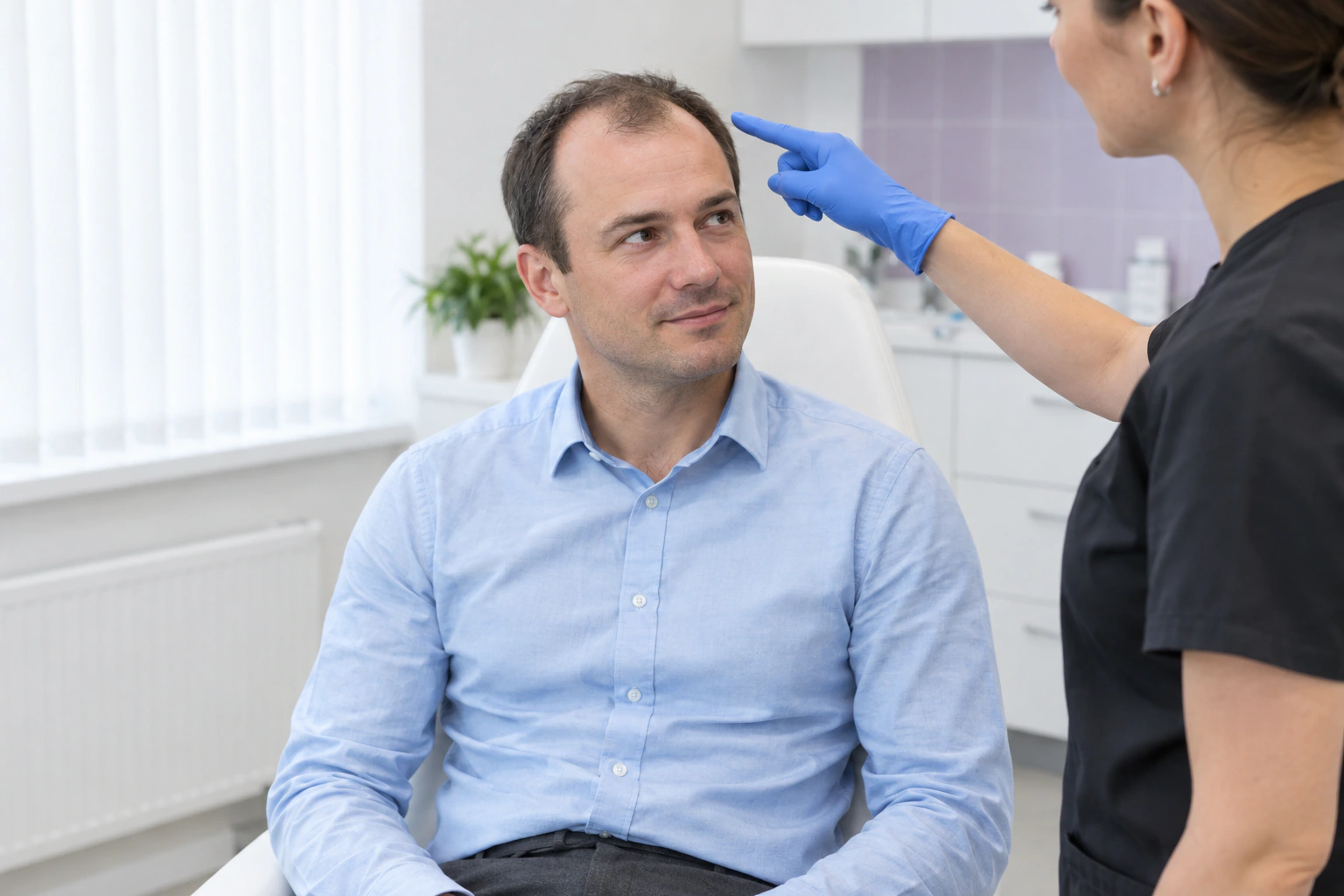

One number from you: a coordinator collects photos in a messenger, the doctor says whether a transplant helps. Free, no booking.

services
Counting comes before pricing: both happen at the free consultation, and the contract fixes the price.
suture-free graft extraction

$2,200$2,700
or $367/mo — 0% instalments for 6 months
Pin the price downimplantation without channels

$2,500$2,900
or $417/mo — 0% instalments for 6 months
Pin the price downcombined technique

$2,700$2,900
or $450/mo — 0% instalments for 6 months
Pin the price down| The first assessment | Free |
|---|---|
| Eyebrow transplant, FUE | |
| Beard transplant, FUEinstalments $467/mo | |
| Hair trichopigmentation | |
| PRP therapy / session | $200 |
all included
From surgery preparation through 12-month follow-up.
On surgery day no extra charges come up.
two extra areas
A transplant is not only about the scalp: the same grafts from the back of the head, the same FUE method, only the area changes.
FUE method, free of cuts or stitches

Grafts are taken from the donor area at the back of the head and moved through micro-punctures of about 1 mm — no scars are left. The doctor and you choose the shape before the operation, taking your facial features into account. Transplanted hair grows for life, and the beard can be trimmed and styled as usual.
$2,800$3,000
or $467/mo — 0% instalments for 6 months
Pin the price downFUE method, free of cuts or stitches

Everything starts with a drawing: the surgeon marks out the brow at the first consultation, reference images are considered one against another, and the proportions of your face steer the design. Hairs are set in at the angle they should follow, so nothing looks drawn on. Brows that quit growing under years with the tweezers respond well too.
$1,600$1,700
an outpatient op, the area numbed beforehand
Pin the price downThe doctor will check your donor area, count the grafts and show what result is realistic for you. The cost is quoted at the consultation and fixed in the contract.

Message our coordinator
Free online consultation · Reply within 15 minutes
Message us on TelegramMessage us on WhatsAppBy messaging us, you agree to our Privacy Policy
Process
From consultation to going home — all in one day

Here the doctor runs through what a FUE and a DHI procedure involve, answers everything you ask, and assesses the condition of your donor zone.

A deposit, paid by card at the clinic or transferred online, locks in the surgery date, and the arrangement is written into a medical services contract.

Ahead of surgery, a series of tests is required, and the clinic hands you the exact list along with instructions on how to complete it.

The area is treated with local anaesthesia beforehand, so the surgery itself is painless.

Grafts are collected from the back of the head or temples, using a technique that requires no stitches.

Bald areas receive the harvested grafts, placed there by the surgical team.
Recovery goes faster with everything the clinic gives and the detailed guidance that comes with it.

The crusts drop off, the swelling settles, the area recovers steadily

A normal stage. The hairs fall out, the follicles stay in place

New hairs emerge gradually, the result shows

Fullness comes through, with the volume and hairline visible

Full thickness, and a hairline that looks natural

Free, before surgery and with no obligations.
Set up an assessmentdoctors

Hair transplant doctor, trichologist, surgeon
10 years in practice

Dermatovenereologist, trichologist, surgeon
11 years in practice

Plastic surgeon
9 years in practice

Plastic surgeon
9 years in practice

Assistant
9 years in practice
Your donor area is assessed, the grafts counted, and the achievable result explained.
Set up an assessmentcoordinators
You are handed to a coordinator who stays with your case until recovery is complete.
Care team coordinator
Is with you at every step of the process
Looks after the papers and the booking
Care team coordinator
Is with you at every step of the process
Looks after the papers and the booking
Care team coordinator
Is with you at every step of the process
Looks after the papers and the booking
Care team coordinator
Is with you at every step of the process
Looks after the papers and the booking













We will answer your questions and find you a convenient consultation time
Message us on WhatsApp Send the formRegular questions

Yes — patients from other cities and countries are welcome, and you can start with a free online consultation.
Prices start at $2,200 (≈ R37,000) for FUE, $2,500 (≈ R42,000) for DHI, and $2,700 (≈ R45,500) for the combined method. Your final price is set after a free graft count and locked into the contract.
Everything happens across one day, and nobody is admitted overnight.
Not at all painful — local anaesthesia works for the full session.
FUE relies on tweezer harvesting with no incisions or stitches. DHI relies on Choi-pen implantation without channels. The combined DHI+FUE approach harvests by FUE and implants by DHI.
The doctor decides it on the basis of the donor area, and the consultation where this happens is free.
Healing takes up to 0–10 days, after which a 2–4 week shed follows, and that is normal. Growth begins in earnest at 3–4 months, density arrives near 6–9 months; the whole result comes at 12–18 months.
The clinic provides a lifetime guarantee on hair growth, stated in the contract.
The clinic works under a medical licence, care is given to the standards and clinical guidelines
of the Ministry of Health.

Documents showing the training of every operating doctor
See the documentsAKC POMOSHCH LLC
our clinic's legal entity
1057746096924
OGRN
7728536872
INN
A patient in Welkom gets a procedure that keeps things simple. FUE and DHI are performed with no cutting and no suturing, under local anaesthesia, and the operation is wrapped up in the course of one day.
You can begin in Welkom without leaving home: the online consultation is free, and the doctor looks at photos of the thinning area and counts how many grafts it will take. The clinic is reachable 24/7, so a message fits your schedule.
The first 0-10 days go on healing. Between 2-4 weeks the transplanted hairs fall out, which sounds alarming and is in fact entirely normal. Growth begins at 3-4 months and keeps going quietly from there.
Prices are in US dollars; the amount in brackets is an approximate conversion to ZAR at the rate of 02.10.2026. The final price is fixed in your contract.
By messaging us, you agree to our Privacy Policy
What patients write after this operation. Reviews are translated from the original language.
Andrey M.
I had the operation a month ago. Before and after surgery they were always in touch and helped with questions about my tests. The operation itself went wonderfully, the staff are polite and masters of their craft, you feel you are in safe hands. I am recovering now, and they answer all my questions. I am happy and I recommend them!
DHI hair transplant
Pavel Sinitsyn
The best clinic of all the ones I was choosing from. No regrets at all! The result is simply amazing, I am thrilled. I recommend it to everyone: these people do great work and make people happy. Once again, a huge thank you to everyone. Roman, the head of the clinic, is the best: he was personally in touch with me and looked after my recovery. Thank you for making my dream come true.
FUE hair transplant
Maria Akopyan
I thought about an eyebrow transplant for a long time and finally went for it. At first I was afraid the result would look unnatural, but when I saw my new eyebrows I was delighted! They came out full and in harmony with my face. I can hardly believe that now I just wash my face and go, I have never felt so free. For anyone tired of constant make-up, a transplant is a real lifesaver!
Eyebrow transplant (FUE)
Alexander M.
I really wanted a thick beard, but I had problems with it. I tried every home remedy and minoxidil, and nothing helped. After a long search for the best clinic I settled on this one. Thank you so much for the service, I liked everything and now I am happy! I had the beard transplant 10 months ago and I am very pleased with the result. By the way, the music in the clinic was great, as far as I remember. A friend of mine has already come to you for a transplant on my advice and was also happy with the result. I wish you every success!
Beard transplant (FUE)
Vladimir Z.
I went to the clinic to see a trichologist and had a hair transplant. I really liked the doctor's approach, and all the recommendations helped. I want to point out that nobody tries to sell you extra services: they tell you things as they are, and if some treatment is not needed, they do not push it. Cosy and clean.
DHI hair transplant
Artem Popov
This may sound obvious, but a head of hair really changes everything in your life. You feel much more confident and go through life like a winner. And it is all thanks to the doctor at this clinic and to the staff who take care of their patients. Many thanks to the clinic for a happy life with new hair, for the comfortable conditions and for the professionalism during the hair transplant.
FUE hair transplant
Welkom is a city in the Free State province of South Africa, about 140 kilometres northeast of Bloemfontein. It is also called Circle City and City Within A Garden, and its Sesotho name, Matjhabeng, means 'where nations meet'. A city with that kind of mixed background has patients with very different hair types, from tightly curled to straight and fine, and a good plan for a hair transplant has to start from the individual hair, not from a general picture.
Men and women in Welkom ask us the same things as people everywhere: will it look natural, how long until I can go back to work, and what happens in the first weeks. This text answers those questions with Welkom's own rhythm of life in mind, from the working week to rugby weekends and the hot summers.
City Medical Centre works with you remotely. You contact us from Welkom through a free online consultation, and coordinators are available around the clock (24/7) on Telegram and Telegram. We stay with you from pre-op planning to 12 months later.
In both methods, grafts are taken from the back of the head, the donor area, and moved through micro-punctures of about 1 mm, so nothing scars over. FUE and DHI differ in how the grafts are placed, and the doctor will explain which one suits your hair, your density goals and the size of the area to be covered.
The doctor discusses the shape with you before the operation, taking your facial features into account. For a patient in Welkom this means sending clear photos from several angles during the online consultation, in daylight, with the hair dry and unstyled.
Transplanted hair grows for life, so the new hair line is planned for the long term. A frontal hair line that looks right at 30 should still look right at 50, which is why a careful surgeon does not draw it too low or too straight.
Welkom normally receives about 401 mm to 550 mm of rain per year, with most of it in mid-summer. January is the wettest month and also the hottest, with average daily maximums around 29 °C. June has average daily maximums of 17 °C, and July is the coldest month, with night temperatures dropping to 0 °C on average.
For recovery this has practical meaning. In the hot months, strong sun on a healing scalp is the main concern: avoid long exposure, and ask your surgeon which kind of loose, clean headwear is acceptable and when. Heat also increases sweating, so plan to keep the first days calm and indoors where possible.
In winter the weather is kinder to the scalp, but cold mornings and dry air can make the skin feel tight. Soft, loose headwear that does not press on the grafts is better than a tight woollen cap, and you should ask when you may start wearing it.
The region's farmland and dry spells can also mean dust. Keep the head clean according to the washing instructions you receive, and avoid dusty work or garden jobs in the early period.
Neither season is a barrier. Winter, especially June and July, offers less sun and lower heat, which makes the first days easier. Summer is workable if you can stay out of the sun and accept more careful planning, especially around January, the hottest month.
Think about when the visible stages will fall. The medical timeline is: 0–10 days for healing, 2–4 weeks for normal shedding of transplanted hair, 3–4 months for new growth to start, 6–9 months for real density, and 12–18 months for the final result. If you want to look your best at a particular event, count back from it by at least a year.
A good question for your coordinator is how the shedding phase will overlap with your holidays or family celebrations, so there are no surprises.
Welkom's economy has its roots in the gold fields and today includes agriculture: the area is part of the Maize Triangle and is a major producer of sunflowers, poultry and beef cattle. Many people work outdoors or in physical jobs. If your work involves sun, dust or heavy effort, tell the surgeon, because it affects when you can safely return.
Office staff, teachers and people in shops usually have more flexibility, but should still plan around the visible redness and the early healing stage of 0–10 days. Students at the Central University of Technology satellite campus, the technical colleges or the nursing college can schedule the procedure around exam periods and practical sessions.
Because the care is remote, you do not need to take time off for anything beyond the operation and the early healing itself. Coordinators answer on the phone 24/7, so a question that comes up in the evening does not wait until the next day.
Welkom has a strong sporting identity. It has produced several Springbok rugby players, cricketers, footballers and athletes, and the Phakisa Freeway, an international standard motor sport venue, once hosted the South African motorcycle Grand Prix. People here take sport seriously, and a common question is when training can restart.
Contact sport such as rugby carries a particular risk for a healing scalp, as does anything that involves head knocks, helmets or heavy sweating. Do not guess: ask your surgeon for a written schedule for gym, running, swimming and team sport, and follow it even if you feel well.
If you wear a helmet for motorcycling or work, ask when and how it may be worn during recovery, and whether a different fit is needed for the first period.
Beef, poultry and braai gatherings are part of life around Welkom, and weekends often mean long outdoor meals with family. After the operation, smoke, heat and bright sun are not ideal for the scalp in the early days, so it is better to postpone the large gathering than to sit by the fire without protection.
Balanced meals support general healing. If you are thinking about weight, note that the WHO treats overweight and obesity as a general health matter, and your overall health will be part of the surgeon's assessment.
The shedding at 2–4 weeks is expected: transplanted hairs let go, as expected, and then return. Many patients are worried by this stage, so it helps to tell your family in advance, especially if you will be at events where people look closely.
In general terms, a good candidate has enough healthy hair in the donor area at the back of the head and realistic expectations. Hair loss that is still changing quickly, certain scalp conditions, and some general health problems may mean a delay or a different treatment. The doctor decides after reviewing your photos and medical history.
Beards, eyebrows and thinning areas can also be restored. One patient described the beard result like this: from about the 4th month active, even growth began, the transplanted hair took very well, the beard now looks as natural as possible, and no bald patches are left. Transplanted hair grows for life, so you can trim and style the beard as usual.
Be open about medication, previous procedures, allergies and chronic illness, since these shape the plan.
Patients in Welkom tend to start with practical questions rather than technical ones. Will colleagues notice? Can the operation be planned around shifts, lectures or a busy family calendar? How long before the hair looks normal? A good online consultation answers these one by one and puts them in the order of your own life, not in a general script.
A useful habit is to write your questions down before the first message to the coordinator. Include your age, how long the hair loss has been going on, whether relatives have the same pattern, and any medicines you take. The more complete the picture, the more precise the doctor's first assessment will be.
Coordinators are available around the clock (24/7) on Telegram and Telegram, so you can send photos and questions at the end of a long working day and have them ready for the doctor.
Because Welkom is a working city with a mining history, farming around it and a busy school and college calendar, many patients prefer to count the stages backwards from a date that matters: a wedding, a graduation, a family reunion or a sports season.
Use the medical timeline as your map. Healing takes 0–10 days. At 2–4 weeks, transplanted hairs let go, as expected. At 3–4 months hair comes back, at 6–9 months it looks visibly thicker, and 12–18 months gives the settled look.
Do not judge the result at the shedding stage. Many people feel discouraged at that point, yet it is a normal step. Agree with your coordinator on when to send progress photos so the doctor can follow the change with you at the check-ups in months 1, 3, 6, 9 and 12.
The name Matjhabeng, 'where nations meet', is a reminder that Welkom brings together people of many backgrounds. That matters for hair surgery, because curl pattern, hair thickness and skin tone all influence how grafts are taken and placed, and how the final look is planned.
When you describe your hair in the online consultation, mention how it behaves when wet and dry, whether you wear it short, long or in a particular style, and what look you want. Photos from the top, front and sides help the doctor judge the direction and angle of the new hair.
The doctor discusses the shape with you before the operation, taking your facial features into account. Ask to see how the planned hair line will sit with your own style, whether that is a close crop, a fade or longer hair.
You start with a free online consultation. Send photos, describe your history and goals, and the doctor responds with an assessment and a proposed plan. Coordinators are available 24/7 on Telegram and Telegram, so you can write when it suits your shift or study schedule.
After the operation, a coordinator will be on the phone 24/7. Check-ups are held at months 1, 3, 6, 9 and 12, and the final result is expected 12–18 months after surgery.
Questions to ask the surgeon: which technique suits me, how many grafts are realistic, how will the hair line be shaped for my face, when can I return to work, when can I play sport, how do I protect the scalp from sun, and what should I do if something looks wrong.
Yes. You can contact us from Welkom and receive a free online consultation, with coordinators available 24/7 on Telegram and Telegram.
Both take grafts from the donor area at the back of the head and use micro-punctures of about 1 mm. They differ in the way grafts are placed, and the doctor will recommend one for your case.
Grafts are moved through micro-punctures of about 1 mm, so nothing scars over. Your doctor will explain what to expect in the donor area.
2–4 weeks: transplanted hairs let go, as expected. 3–4 months: hair comes back. 6–9 months: visibly thicker. 12–18 months: settled look.
Avoid long sun exposure on the healing scalp, keep the first days calm, and ask your surgeon which headwear is suitable and when.
Not straight away. Ask the surgeon for a written schedule for each activity, particularly contact sport and anything involving head knocks.
Healing takes 0–10 days. Your return depends on your job, so discuss sun, dust and physical effort with the doctor beforehand.
Yes. Transplanted hair grows for life, so you can trim and style the beard as usual.
We stay with you from pre-op planning to 12 months later, with check-ups at months 1, 3, 6, 9 and 12, and a coordinator on the phone 24/7.
Yes. Share your dates with the coordinator, who will help you count back from them using the stages: 0–10 days healing, 2–4 weeks shedding, 3–4 months new growth, 6–9 months visible density, 12–18 months final result.
It can. Hair type affects how grafts are taken and placed, so send clear photos and describe your hair. The doctor will explain what suits your case.
Photos from several angles, your age, how long the loss has lasted, family history and any medicines or conditions. Coordinators answer 24/7 on Telegram and Telegram.
Page medically reviewed by Anastasia A. Kolesnik, hair transplant doctor. Review date: .

 Forceps
 Minimal


