



beginning
a full 12 months
2,800 grafts
FUE method
City Medical Centre
0% instalments
from $367/mo
Your first chat and sum — $0.
Real person
beginning
a full 12 months
No incisions, no stitches with FUE. Grafts and outcome forecast estimated and not billed — before you decide.
Without paying, no surgery booking required
Message our coordinator
Free online consultation · Reply within 15 minutes
Message us on TelegramMessage us on WhatsAppBy messaging us, you agree to our Privacy Policy
results
Photographs show people treated at our clinic.
beginning
a full 12 months
2,800 grafts
FUE method

beginning
a full 12 months
3,500 grafts
FUE method

beginning
a full 12 months
2,600 grafts
FUE method

beginning
a full 12 months
3,000 grafts
FUE method

beginning
a full 12 months
2,700 grafts
FUE method

beginning
a full 12 months
3,300 grafts
FUE method

beginning
a full 12 months
2,900 grafts
FUE method

beginning
a full 12 months
2,500 grafts
FUE method

beginning
a full 12 months
3,400 grafts
FUE method

beginning
a full 12 months
2,500 grafts
FUE method

beginning
a full 12 months
3,100 grafts
FUE method

beginning
a full 12 months
3,600 grafts
FUE method

beginning
a full 12 months
4,000 grafts
FUE method

beginning
a full 12 months
3,200 grafts
FUE method

beginning
a full 12 months
3,000 grafts
FUE method

beginning
a full 12 months
3,700 grafts
FUE method

beginning
a full 12 months
2,700 grafts
FUE method

beginning
a full 12 months
3,800 grafts
FUE method

beginning
a full 12 months
3,300 grafts
FUE method

beginning
a full 12 months
2,800 grafts
FUE method

beginning
a full 12 months
2,500 grafts
FUE method

beginning
a full 12 months
3,900 grafts
FUE method

beginning
a full 12 months
3,500 grafts
FUE method

beginning
a full 12 months
3,800 grafts
FUE method

beginning
a full 12 months
2,900 grafts
FUE method

beginning
a full 12 months
3,600 grafts
FUE method

beginning
a full 12 months
2,600 grafts
FUE method

beginning
a full 12 months
2,700 grafts
FUE method

beginning
a full 12 months
3,700 grafts
FUE method

beginning
a full 12 months
3,200 grafts
FUE method

beginning
a full 12 months
3,000 grafts
FUE method

beginning
a full 12 months
2,800 grafts
FUE method

beginning
a full 12 months
4,000 grafts
FUE method

beginning
a full 12 months
3,400 grafts
FUE method

beginning
a full 12 months
2,900 grafts
FUE method

beginning
a full 12 months
3,100 grafts
FUE method

beginning
a full 12 months
2,600 grafts
FUE method

beginning
a full 12 months
3,300 grafts
FUE method

beginning
a full 12 months
3,900 grafts
FUE method

beginning
a full 12 months
3,500 grafts
FUE method

beginning
a full 12 months
2,700 grafts
FUE method

beginning
a full 12 months
3,800 grafts
FUE method

beginning
a full 12 months
3,200 grafts
FUE method

beginning
a full 12 months
3,000 grafts
FUE method

beginning
a full 12 months
2,800 grafts
FUE method

beginning
a full 12 months
3,100 grafts
FUE method

beginning
a full 12 months
3,600 grafts
FUE method
Comparison
We offer three graft transfer technologies: classic FUE, suture-free DHI and a combined protocol. Set them side by side by implantation technique, tissue trauma and graft survival, and choose knowingly.
Classic technique without incisions or stitches

$2,200
$2,700
Graft implantation technique
ForcepsGraft trauma
MinimalA natural growth angle
NaturalGraft survival
98–100%Suitable for
Androgenetic alopeciaStitch-free implantation with a Choi pen

$2,500
$2,900
Graft implantation technique
DHI pen, Choi implanterGraft trauma
MinimalA natural growth angle
NaturalGraft survival
98–100%Suitable for
DensificationFUE extraction, DHI pen implantation

$2,700
$2,900
Graft implantation technique
Extraction by FUE, DHI implantGraft trauma
MinimalA natural growth angle
NaturalGraft survival
98–100%Suitable for
Densification for androgenetic alopeciaSurvival and trauma figures are averages for each method, given as a guide: the precise numbers depend on the transplant area and the patient's individual features, and the doctor clarifies them at consultation.
Book an appointment


















about the clinic
Comfortable rooms, up-to-date equipment, care for each patient

We will hear your questions out and find a convenient time for a consultation
Message us on WhatsApp Get in touchIf surgery is unnecessary in your situation, the doctor will say so during the consultation, sparing your budget. The situations where a transplant genuinely works are described below.
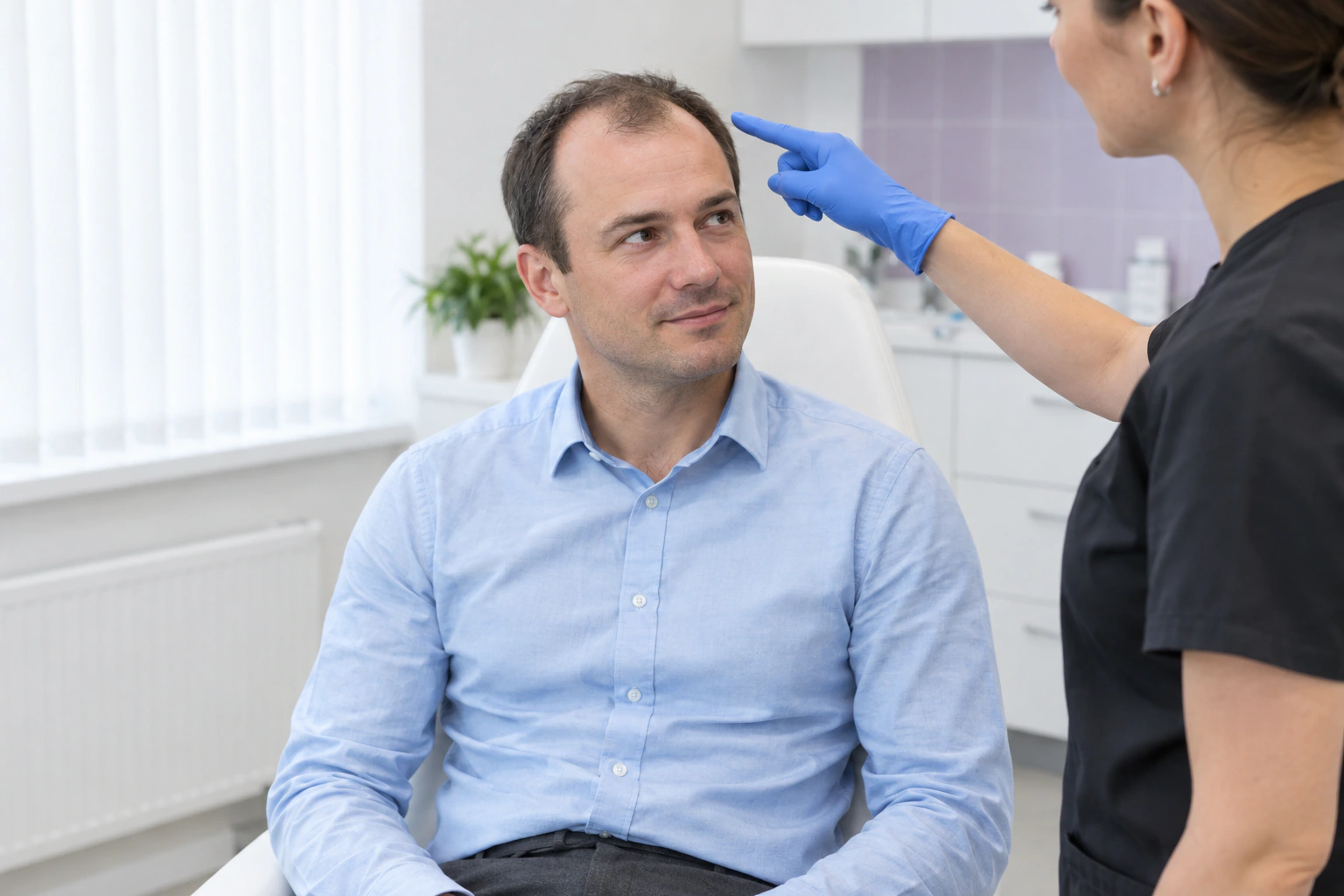

Send your number, get photos in a messenger to a coordinator, and the doctor says if a transplant helps. Free, with no booking.

services
The cost is named at the free consultation, after the graft count, and written into the contract.
suture-free graft extraction

$2,200$2,700
or $367/mo — 0% instalments for 6 months
Set the price nowimplantation without channels

$2,500$2,900
or $417/mo — 0% instalments for 6 months
Set the price nowcombined technique

$2,700$2,900
or $450/mo — 0% instalments for 6 months
Set the price now| The first assessment | Free |
|---|---|
| Eyebrow transplant, FUE | |
| Beard transplant, FUEinstalments $467/mo | |
| Hair trichopigmentation | |
| PRP therapy / session | $200 |
all included
Pre-op groundwork and a full 12 months of follow-up.
No extra payments on the day of surgery.
two added areas
One donor site, one method, several zones: grafts from the back of the head, taken by FUE.
FUE method, free of cuts or stitches

Grafts are collected from the donor area at the back of the head and moved through micro-punctures of about 1 mm, which leaves no scars. The doctor discusses the shape with you before the operation, taking your facial features into account. Transplanted hair grows for life and can be trimmed and styled as usual.
$2,800$3,000
or $467/mo — 0% instalments for 6 months
Set the price nowFUE method, free of cuts or stitches

The surgeon draws out the brow at the opening consultation, example photos are weighed up together, and the design keeps to the proportions of your face. Set at the angle of growth, the hairs give a result nobody reads as artificial. Brows that gave up growth after long years of tweezing benefit as well.
$1,600$1,700
a day-clinic operation, the scalp numbed first
Set the price nowDonor zone inspected, grafts counted, realistic outcome explained. Your cost is decided at that consultation and written down in the contract.

Message our coordinator
Free online consultation · Reply within 15 minutes
Message us on TelegramMessage us on WhatsAppBy messaging us, you agree to our Privacy Policy
Process
From consultation to going home — all in one day

The doctor uses this free first consultation to explain the FUE and DHI approaches, answer your questions, and design a plan specific to your case.

To reserve your surgery date, a deposit is made — by card at the clinic or online — and the agreement is formalized in a medical services contract.

The clinic outlines exactly what tests are needed before the operation and gives instructions to help you complete them.

Local anaesthesia numbs the area before surgery starts, keeping the entire procedure painless.

This step involves extracting grafts from the back of the head or the temples, leaving the donor area free of stitches.

For patients in Polokwane, this step means the surgeons implant the grafts into the balding zone.
The clinic sends you off with the necessary supplies and a full set of directions for a quick recovery.

The crusts come off, the swelling eases and the area recovers

Normal. Only the hairs fall out, the follicles remain in place

New hairs keep appearing, the result starts to show

Hair density climbs, the principal volume and outline are clear

The hair fills out and the hairline looks untouched

Free, before the operation and free of obligations.
Book an appointmentdoctors

Hair transplant doctor, trichologist, surgeon
10 years in practice

Dermatovenereologist, trichologist, surgeon
11 years in practice

Plastic surgeon
9 years of experience

Plastic surgeon
9 years of experience

Assistant
9 years of experience
The doctor studies the donor zone, arrives at the graft count and sets out the achievable outcome.
Book an appointmentcoordinators
A personal coordinator picks up your case at the start and stays on it through recovery.

Personal care manager
Will be with you before and after surgery
Handles the paperwork and your bookings

Personal care manager
Will be with you before and after surgery
Handles the paperwork and your bookings

Personal care manager
Will be with you before and after surgery
Handles the paperwork and your bookings
Personal care manager
Will be with you before and after surgery
Handles the paperwork and your bookings













We will hear your questions out and find a convenient time for a consultation
Message us on WhatsApp Get in touchQuestions we get

Yes, of course. People with homes in various cities and countries are part of everyday practice, and an online discussion with the doctor opens the process.
Prices start at $2,200 (≈ R37,000) for FUE, $2,500 (≈ R42,000) for DHI, and $2,700 (≈ R45,500) for the combined method. Your final price is set after a free graft count and locked into the contract.
A one-day operation, finished with a same-day discharge home.
It's a painless procedure, carried out under local anaesthesia.
FUE is cut-free graft extraction by tweezer. DHI is direct implantation with a Choi pen, skipping channel-making. The combined technique takes grafts by FUE and places them using the DHI method.
The precise total is produced at the free consultation, once the doctor has assessed the donor zone.
Expect healing inside 0–10 days and a normal shedding phase at 2–4 weeks. Growth picks up at 3–4 months, the head looks full at 6–9 months, and the last changes finish by 12–18 months.
A lifetime guarantee of hair growth is included, confirmed in your contract.
The clinic works under a medical licence, care follows the standards and clinical guidelines
under Ministry of Health.

Diplomas and certificates of our surgeons
See the paperworkAKC POMOSHCH LLC
the clinic's legal entity
1057746096924
OGRN
7728536872
INN
The choice for a patient in Polokwane lies between FUE and DHI, and either way the scalp is not cut, nothing has to be stitched, only local anaesthesia is used, and one day is all the operation takes.
It costs nothing to ask when you are in Polokwane. Send photos of the area in a message, the doctor examines them online and tells you if a transplant helps. The clinic is on the line 24/7.
First 0-10 days: healing. At 2-4 weeks the transplanted hairs are shed, and that is normal for this procedure. Growth starts at 3-4 months, which is the moment most patients have been waiting for.
Prices are in US dollars; the amount in brackets is an approximate conversion to ZAR at the rate of 02.10.2026. The final price is fixed in your contract.
By messaging us, you agree to our Privacy Policy
What patients write after this operation. Reviews are translated from the original language.
Andrey M.
I had the operation a month ago. Before and after surgery they were always in touch and helped with questions about my tests. The operation itself went wonderfully, the staff are polite and masters of their craft, you feel you are in safe hands. I am recovering now, and they answer all my questions. I am happy and I recommend them!
DHI hair transplant
Pavel Sinitsyn
The best clinic of all the ones I was choosing from. No regrets at all! The result is simply amazing, I am thrilled. I recommend it to everyone: these people do great work and make people happy. Once again, a huge thank you to everyone. Roman, the head of the clinic, is the best: he was personally in touch with me and looked after my recovery. Thank you for making my dream come true.
FUE hair transplant
Maria Akopyan
I thought about an eyebrow transplant for a long time and finally went for it. At first I was afraid the result would look unnatural, but when I saw my new eyebrows I was delighted! They came out full and in harmony with my face. I can hardly believe that now I just wash my face and go, I have never felt so free. For anyone tired of constant make-up, a transplant is a real lifesaver!
Eyebrow transplant (FUE)
Alexander M.
I really wanted a thick beard, but I had problems with it. I tried every home remedy and minoxidil, and nothing helped. After a long search for the best clinic I settled on this one. Thank you so much for the service, I liked everything and now I am happy! I had the beard transplant 10 months ago and I am very pleased with the result. By the way, the music in the clinic was great, as far as I remember. A friend of mine has already come to you for a transplant on my advice and was also happy with the result. I wish you every success!
Beard transplant (FUE)
Vladimir Z.
I went to the clinic to see a trichologist and had a hair transplant. I really liked the doctor's approach, and all the recommendations helped. I want to point out that nobody tries to sell you extra services: they tell you things as they are, and if some treatment is not needed, they do not push it. Cosy and clean.
DHI hair transplant
Artem Popov
This may sound obvious, but a head of hair really changes everything in your life. You feel much more confident and go through life like a winner. And it is all thanks to the doctor at this clinic and to the staff who take care of their patients. Many thanks to the clinic for a happy life with new hair, for the comfortable conditions and for the professionalism during the hair transplant.
FUE hair transplant
Polokwane, the capital of Limpopo Province, is the largest urban centre in South Africa north of Gauteng and was one of the host cities of the 2010 FIFA World Cup. People here live at the pace of a regional capital: work in offices and public institutions, studies at satellite campuses, family gatherings and weekends outdoors. In a city like this, appearance matters in everyday life, and thinning hair or a patchy beard is something many men think about for years before they ask a specialist.
The population was about 130,000 in 2011. That is large enough for a lively city, yet small enough that people know each other through work, church, sport and family, so a visible change in appearance is noticed. That is one reason patients here usually want a result that looks natural and does not draw questions.
This text is written for people in Polokwane who are weighing FUE or DHI hair transplantation. It covers climate, daily routines, timing, questions for the surgeon and how the free online consultation with City Medical Centre works from your own home.
Grafts are taken from the back of the head, the donor area, and moved through micro-punctures of about 1 mm, so nothing scars over. The doctor discusses the shape with you before the operation, taking your facial features into account. For a man in Polokwane this means the frontal hair line, the temples or the beard are planned around your own face, not around a standard pattern.
FUE and DHI differ in how the grafts are placed, and the surgeon will explain which method suits your case after reviewing your photos and your history. You do not need to choose before the consultation. Bring your questions and let the specialist describe the options in plain terms.
Transplanted hair grows for life: trim and style the beard as usual. In practice you can keep the same barber routine you have in Polokwane, and you do not need special products for the new hair once the early healing phase is over.
Polokwane has a semiarid climate. Despite lying on the Tropic of Capricorn, it is tempered by its position on a plateau 1230 m above sea level. Average temperatures reach around 21–22 °C in January and fall to 11 °C in July. The city has also experienced notably warmer seasons over the last decade than its long-term average, so heat should be part of your planning.
The rainy season falls in summer, with December or, less often, January the wettest month. Sweating, direct sun and crowded places are the main concerns during the first days. Avoid long hours in the sun, keep the scalp covered with the kind of headwear your surgeon approves, and do not rub or press the grafted area.
Winter is dry, with July the driest month, and mornings and evenings are cool. Dry air and dust can irritate a healing scalp, so follow the washing routine you are given and keep the area clean. Cool weather is comfortable for a loose, soft cap, but never put one on without asking the doctor when it is allowed.
Average annual rainfall of 495 mm means most of the year is dry. That is convenient for errands but makes sun protection and gentle skin care a daily habit during the early stage.
There is no single correct month, but the local climate points to some practical choices. Many patients prefer the cooler, dry months around June to August, when the sun is milder and sweating is less of a problem. Winter mornings are cold, yet days are usually dry, so you can stay indoors and rest comfortably.
Summer is also possible if you can limit time outdoors. If you choose it, plan your first days at home, avoid midday heat and keep errands for early or late in the day. Your coordinator can help you match the date to your work calendar and any family events.
Think about the whole timeline rather than just the date of surgery: 0–10 days for healing, 2–4 weeks for normal shedding of transplanted hair, 3–4 months for new growth to start, 6–9 months for real density, and 12–18 months for the final result. If a wedding, graduation or family gathering falls in the next year, count backwards from it so that the early healing days do not clash with it.
Polokwane has satellite campuses of the Tshwane University of Technology, Capricorn TVET College and the University of South Africa, and the University of Limpopo's Turfloop campus is about 30 km east of the city. Students and young professionals often ask how soon they can be seen in class or at work. Plan the first days of healing at home and talk to the surgeon about when you can go back to a desk, a lecture hall or a physical job.
Office work is usually easier to combine with recovery than outdoor or dusty work. If your job involves long hours in the sun, helmets or physical labour, tell the doctor in advance so the return date and head protection can be agreed clearly.
For sport, ask for the exact rules for running, gym, football and swimming, and follow them step by step. Polokwane was a World Cup host city and many people play sport, so patients often want to return to the pitch quickly. Sweat, contact and a ball to the head are not good for fresh grafts, so patience in the early period protects the result.
Family events, braais and church gatherings are part of life here. Choose a date that leaves you free of big social commitments for the first period, and decide in advance what you will say to relatives and colleagues. Many men simply say they had a minor procedure and need to rest.
The stages are the same for everyone, and knowing them prevents panic. 2-4 weeks: transplanted hairs let go, as expected. 3-4 months: hair comes back. 6-9 months: visibly thicker. 12-18 months: settled look.
One patient described it this way: “But now the result truly makes me very happy) From about the 4th month active, even growth began. The transplanted hair took very well, the beard now looks as natural as possible, no bald patches are left. The beard became much thicker and denser, with the shape I had thought about for a long time.”
In Polokwane, where people see each other often, the shedding phase is the one that needs mental preparation. Shedding is a normal part of the process and does not mean the operation failed. Keep photos in the same light and from the same angle each month so you can see the change that the mirror hides.
We stay with you from pre-op planning to 12 months later. Check-ups at months 1, 3, 6, 9 and 12 are done remotely, so you do not have to rearrange your work in Polokwane around appointments. You send photos, describe how you feel and receive written guidance.
If something worries you, such as redness after a hot day, itching in dry winter air or a question about a cap, a coordinator will be on the phone 24/7. You can write on Telegram or Telegram at any hour, including late evenings after work or early mornings before the day starts.
Keep a simple diary: date, what you did, how the scalp looks. It makes each check-up more precise and helps the doctor judge whether healing is going as planned.
In general terms, a good candidate has enough healthy hair in the donor area, realistic expectations and no untreated scalp disease. Hair loss that is still changing quickly, certain skin or blood conditions, or unstable general health may mean a delay or another treatment plan. Only the doctor can decide after reviewing your photos and your medical history.
Be honest about medicines, smoking, past operations and chronic illnesses. General health matters for healing, and body weight is part of overall wellbeing, so a balanced lifestyle supports any planned procedure.
Hair loss in younger men can still be progressing, so the surgeon may suggest planning for the future instead of covering everything now. A conservative plan usually looks better over the years than an aggressive one.
Polokwane means “Sanctuary” in Northern Sotho. The Voortrekkers under Andries Hendrik Potgieter first founded Zoutpansbergdorp in the 1840s, about 100 km to the north, and had to leave it. A new town was founded in 1886 and named Pietersburg. It became a city on 23 April 1992, and on 25 February 2005 the official name Polokwane was declared, a name Sepedi speakers already used.
This matters for planning because many families here know the city under both names. Some patients still say Pietersburg when they talk about old clubs, schools and golf, and the same men will tell you they have been thinking about their hair line for years. A city that has changed its name rewards patience, and so does a transplant: the result is built over 12–18 months, not in a week.
Use the consultation to tell the coordinator how long you have been losing hair and what you want to look like in a year. A plan that suits a man in a settled regional capital is one that still looks natural when he meets old school friends at a reunion.
The city is divided into seven clusters and forty-five wards. Mankweng lies 20 km east of the centre, the Molepo, Chuene and Maja cluster 20 km south, and Sebayeng and Dikgale 30 km to the north-east, while Seshego sits on the north-west outskirts. Suburbs such as Bendor, Nirvana, Westenburg, Flora Park, Welgelegen, Annadale, Ivy Park and Thornhill are home to people with very different daily routines.
For recovery, distance is a real factor. A resident of Mankweng or Sebayeng who commutes to the centre may spend a long part of the day outside, so the first days of healing are best spent at home, with check-ups handled remotely by photos instead of trips into town. Someone in Hospital Park or Ster Park with a short route to the office has an easier early period.
When you describe your schedule to the coordinator, mention where you live and how you move around the city. It helps the team choose a date when your commute, the heat of the day and your first days of rest fit together.
Polokwane is the capital of Limpopo, and its commercial area is large: the four largest banks in the country all have at least three branches here. Coca-Cola, Freshmark, a division of Shoprite Checkers, and South African Breweries are among its major industries. The city was also known for the Tempest radio and hi-fi factory in Seshego, once the largest employer in the region.
Customer-facing jobs in banks, shops and offices mean colleagues and clients see you every day. Plan the operation so that the first days of healing, and the 2–4 weeks of normal shedding, fall at a time when you can manage your visibility. Factory and warehouse work involves dust, heat and sometimes protective headwear, so ask the surgeon exactly when a helmet or cap is allowed.
Mall of the North, Savannah Mall, the Cycad Centre and The Greenery are where many people spend weekends. Busy, warm indoor spaces are best avoided in the first days, so do your shopping beforehand and stay at home while the scalp heals.
Sport here has deep roots. The Polokwane Cricket Club was established in 1902, and Nirvana hosts the annual Nirvana Premier League. Polokwane City and Baroka play football, Noordelikes Rugby Club is an amateur club, and the Pietersburg Golf Club, with a full 18 holes, dates from the late 1800s. Peter Mokaba Stadium was built for the 2010 FIFA World Cup.
Cricket and rugby players should ask the surgeon directly when contact, helmets and balls near the head are acceptable, because a knock or a tight helmet is the last thing fresh grafts need. Golfers face a different issue: long hours in strong sun. A round at the golf club should wait until the doctor confirms that sun and a hat are safe for the scalp.
Swimmers in the city's clubs should ask for the exact pool rules and follow them step by step. Whatever your sport, write down the dates the doctor gives you and tell your coach or teammates when you will be back, so nobody pressures you into returning early.
Zion City Moria, about 25 km east of the city, hosts the largest Christian gathering in South Africa twice a year, at Easter and at the September end-of-year festival. The Zion Christian Church celebrated its 100th year in September 2024. Easter and September are therefore very busy times in and around Polokwane, with many families gathering and a strong sense of community.
If you plan to attend such a gathering, or any family event, count backwards from the date. The first days after surgery are for rest at home, and the shedding of transplanted hairs at 2–4 weeks is something you may prefer to pass in private. A date well before the next big gathering gives you a calmer experience, and by the following year you can expect a visibly thicker result.
Visitors to the Bakone Malapa Open-Air Museum, the Eersteling Monuments or the Polokwane Game Reserve spend long hours walking in the sun. Keep those outings for later in your recovery, once the surgeon has cleared sun exposure.
The consultation is free and fully online. You write to the coordinators on Telegram or Telegram, send clear photos of the front, top, sides and back of the head, and answer questions about your hair history, health and goals. The doctor then proposes the plan and the method, FUE or DHI.
Because the process is remote, you can do it from home in Polokwane at an hour that suits your shift or lectures. Coordinators are available around the clock, so there is no need to wait for office hours or to take time off just to ask a question.
Take your time. Ask for answers in writing, compare them with your own notes, and decide only when every point is clear.
Yes. The online consultation is free. You contact the coordinators on Telegram or Telegram from home, send photos and receive an assessment and a suggested plan.
The final result is expected 12–18 months after surgery. Along the way, 0–10 days are for healing, 2–4 weeks for normal shedding, 3–4 months for new growth, and 6–9 months for real density.
Heat, sweat and direct sun are the main concerns in the early days. Limit time outdoors, protect the scalp as the doctor advises, and consider the cooler dry months for planning if your schedule allows.
You can discuss it, but the surgeon recommends the method after reviewing your photos and history. Both involve grafts taken from the donor area at the back of the head.
Grafts are taken from the back of the head and moved through micro-punctures of about 1 mm, so nothing scars over. The doctor also discusses the shape with you beforehand, taking your facial features into account.
Yes. Transplanted hairs let go 2-4 weeks after the procedure, as expected. New hair comes back at about 3-4 months and becomes visibly thicker at 6-9 months.
Check-ups are at months 1, 3, 6, 9 and 12 and are handled remotely from Polokwane. We stay with you from pre-op planning to 12 months later.
A coordinator will be on the phone 24/7. You can write on Telegram or Telegram at any time.
Yes, beard transplantation uses the same approach. Transplanted hair grows for life, so you trim and style the beard as usual.
Plan the first days at home, then agree a return date with the doctor depending on your job, campus schedule or sport. Office and study routines are usually easier to resume than outdoor or dusty work.
No. Just write from Polokwane, or from whichever suburb you live in. The coordinators are available 24/7 on Telegram and Telegram, and the consultation is free and online.
Not for the consultation or check-ups, which are remote. Spend the first days of healing at home, and mention your commute so the date can be chosen to suit it.
Ask the surgeon for the exact dates. A knock to the head or a tight helmet is not good for fresh grafts, so wait for clear permission. The final result takes 12–18 months.
If you plan to take part, choose a surgery date well before it. Early healing takes 0–10 days, normal shedding 2–4 weeks, and new growth begins at 3–4 months.
Page medically reviewed by Anastasia A. Kolesnik, hair transplant doctor. Review date: .

 Forceps
 Minimal


