



Before
12 months later
2,800 grafts
FUE method
City Medical Centre
0% instalments
from $367/mo
A chat and a costing — $0.
Real person
Before
12 months later
The FUE method, no incisions or stitches. Grafts and forecast assessed with no fee at all — before you decide.
It costs nothing, no surgery booking required
Message our coordinator
Free online consultation · Reply within 15 minutes
Message us on TelegramMessage us on WhatsAppBy messaging us, you agree to our Privacy Policy
results
Genuine City Medical Centre patients, every one.
Before
12 months later
2,800 grafts
FUE method

Before
12 months later
3,500 grafts
FUE method

Before
12 months later
2,600 grafts
FUE method

Before
12 months later
3,000 grafts
FUE method

Before
12 months later
2,700 grafts
FUE method

Before
12 months later
3,300 grafts
FUE method

Before
12 months later
2,900 grafts
FUE method

Before
12 months later
2,500 grafts
FUE method

Before
12 months later
3,400 grafts
FUE method

Before
12 months later
2,500 grafts
FUE method

Before
12 months later
3,100 grafts
FUE method

Before
12 months later
3,600 grafts
FUE method

Before
12 months later
4,000 grafts
FUE method

Before
12 months later
3,200 grafts
FUE method

Before
12 months later
3,000 grafts
FUE method

Before
12 months later
3,700 grafts
FUE method

Before
12 months later
2,700 grafts
FUE method

Before
12 months later
3,800 grafts
FUE method

Before
12 months later
3,300 grafts
FUE method

Before
12 months later
2,800 grafts
FUE method

Before
12 months later
2,500 grafts
FUE method

Before
12 months later
3,900 grafts
FUE method

Before
12 months later
3,500 grafts
FUE method

Before
12 months later
3,800 grafts
FUE method

Before
12 months later
2,900 grafts
FUE method

Before
12 months later
3,600 grafts
FUE method

Before
12 months later
2,600 grafts
FUE method

Before
12 months later
2,700 grafts
FUE method

Before
12 months later
3,700 grafts
FUE method

Before
12 months later
3,200 grafts
FUE method

Before
12 months later
3,000 grafts
FUE method

Before
12 months later
2,800 grafts
FUE method

Before
12 months later
4,000 grafts
FUE method

Before
12 months later
3,400 grafts
FUE method

Before
12 months later
2,900 grafts
FUE method

Before
12 months later
3,100 grafts
FUE method

Before
12 months later
2,600 grafts
FUE method

Before
12 months later
3,300 grafts
FUE method

Before
12 months later
3,900 grafts
FUE method

Before
12 months later
3,500 grafts
FUE method

Before
12 months later
2,700 grafts
FUE method

Before
12 months later
3,800 grafts
FUE method

Before
12 months later
3,200 grafts
FUE method

Before
12 months later
3,000 grafts
FUE method

Before
12 months later
2,800 grafts
FUE method

Before
12 months later
3,100 grafts
FUE method

Before
12 months later
3,600 grafts
FUE method
Comparison
We perform graft transfer by three technologies: classic FUE, suture-free DHI and a combined protocol. Compare implantation technique, tissue trauma and graft survival to make an informed choice.
Classic technique without incisions or stitches

$2,200
$2,700
Graft implantation technique
ForcepsGraft trauma
MinimalNatural hair growth angle
NaturalGraft survival
98–100%Suitable for
Androgenetic alopeciaImplantation with a Choi pen, no sutures

$2,500
$2,900
Graft implantation technique
DHI pen, Choi implanterGraft trauma
MinimalNatural hair growth angle
NaturalGraft survival
98–100%Suitable for
DensificationFUE extraction, DHI pen implantation

$2,700
$2,900
Graft implantation technique
Extraction by FUE, DHI implantGraft trauma
MinimalNatural hair growth angle
NaturalGraft survival
98–100%Suitable for
Androgenetic alopecia and densificationPer method, survival and trauma figures are averaged and given for guidance: the exact numbers depend on the transplant area and the patient's individual features, and the doctor clarifies them at the consultation.
Get expert advice


















about the clinic
Modern equipment, cosy rooms, attentive staff

Your questions are answered and a suitable appointment time is agreed
Message us on WhatsApp Ask us a questionNot every case needs surgery, and you will hear so at the consultation, so no money is wasted. Below are the situations in which a transplant genuinely helps.
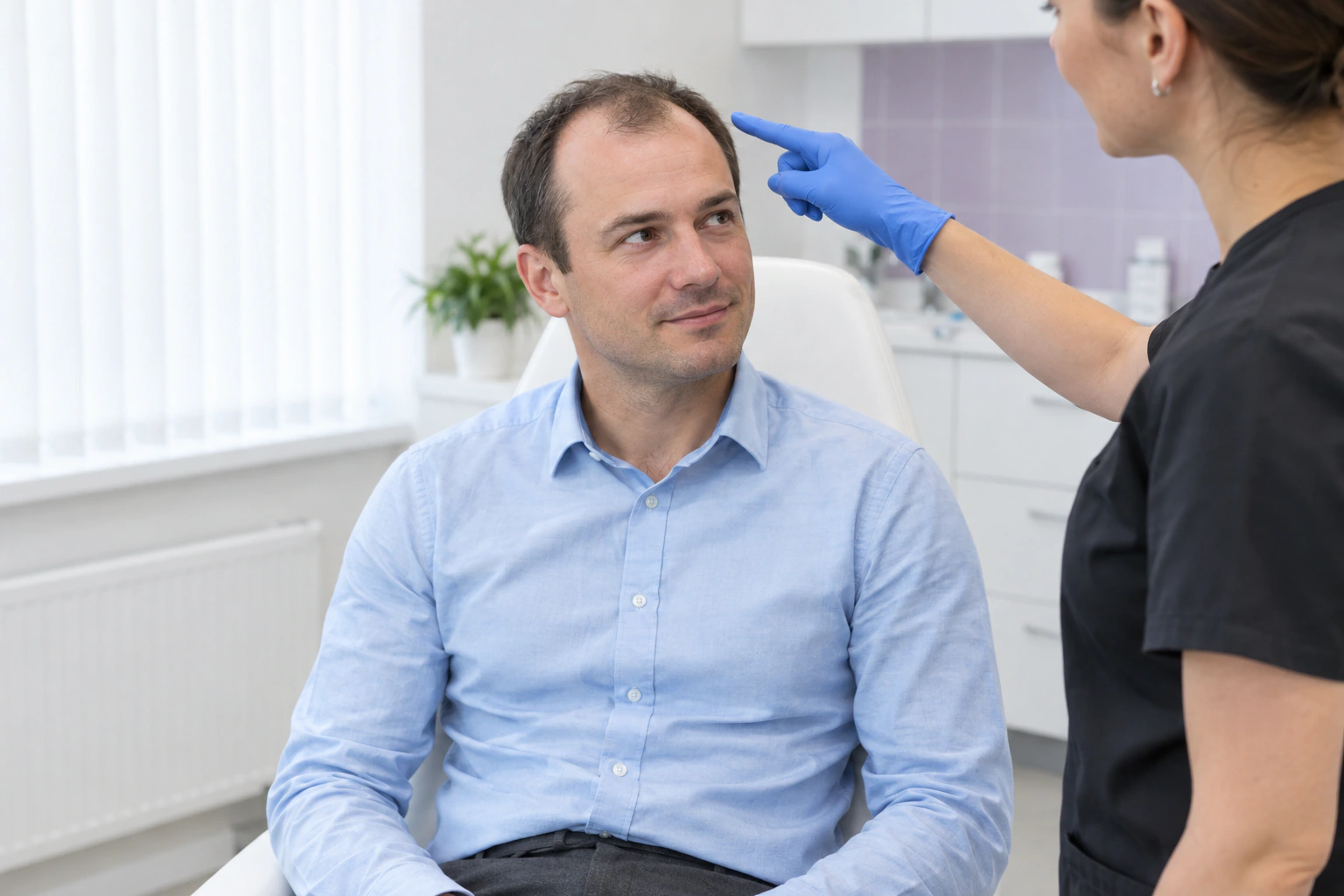

Leave your number and get the photos checked: a coordinator asks in a messenger, the doctor says if a transplant helps. Free, no booking.

services
The figure is set at the free consultation once the grafts have been counted, and the contract keeps it that way.
suture-free graft extraction

$2,200$2,700
or $367/mo — 0% instalments for 6 months
Pin your priceimplantation without channels

$2,500$2,900
or $417/mo — 0% instalments for 6 months
Pin your pricecombined technique

$2,700$2,900
or $450/mo — 0% instalments for 6 months
Pin your price| Your first meeting | Free |
|---|---|
| Eyebrow transplant, FUE | |
| Beard transplant, FUEinstalments $467/mo | |
| Hair trichopigmentation | |
| PRP therapy / session | $200 |
all included
The whole path: preparation first, then 12 months of checks.
Nothing extra is charged on the day of surgery.
another two zones
A hair transplant is not only about the scalp — the same grafts from the back of the head, the same FUE method, only the area changes.
The FUE method, no incisions used

Donor grafts are taken at the back of the head and moved through micro-punctures of about 1 mm, leaving no scars. The doctor talks the shape over with you before the operation, allowing for your facial features. Transplanted hair grows for life, so the beard can be trimmed and styled as usual.
$2,800$3,000
or $467/mo — 0% instalments for 6 months
Pin your priceThe FUE method, no incisions used

Shaping begins at the first consultation, where the surgeon outlines the brows: reference pictures are viewed together and your facial proportions guide the drawing. Each hair goes in at the right angle, so the brows look like your own. This also suits brows that stopped growing after long years of plucking.
$1,600$1,700
a procedure you go home from, numbed locally
Pin your priceThe doctor assesses the donor zone, counts the grafts and explains the outcome that can be reached. The price named at that consultation is what the contract will state.

Message our coordinator
Free online consultation · Reply within 15 minutes
Message us on TelegramMessage us on WhatsAppBy messaging us, you agree to our Privacy Policy
Process
From consultation to going home — all in one day

The doctor uses this free first consultation to explain the FUE and DHI approaches, answer your questions, and design a plan specific to your case.

Choosing the date is one thing, holding it is another: that takes a deposit, settled at the clinic by card or online.

The clinic writes out every test you need and explains how to take them, so preparation is done without guesswork.

This step uses local anaesthesia to make sure the operation is completely painless.

The back of the head, or else the temples, gives up the grafts, and no stitching is required afterwards.

The grafts are implanted, one after another, where the hair has gone.
For patients in Kira, supplies and complete directions come from the clinic to speed the healing along.

Scabs fall, swelling calms, and the skin gradually gets back to itself

Expected and temporary: the shafts go, the roots stay put

Growth is underway and the difference can be seen

The hair is becoming thicker, the volume and contour are visible

Volume is complete and the hairline reads as natural

Free, still before the operation, with no obligation.
Get expert advicedoctors

Hair transplant doctor, trichologist, surgeon
10 years of experience

Dermatovenereologist, trichologist, surgeon
11 years in practice

Plastic surgeon
9 years in practice

Plastic surgeon
9 years in practice

Assistant
9 years in practice
The doctor appraises the donor zone, sets the graft figure and explains what outcome is realistic.
Get expert advicecoordinators
You always know who to ask: one coordinator, from the first message until recovery ends.
Care and support lead
Will see you through before and after surgery
Helps with the forms and the arrangements

Care and support lead
Will see you through before and after surgery
Helps with the forms and the arrangements

Care and support lead
Will see you through before and after surgery
Helps with the forms and the arrangements
Care and support lead
Will see you through before and after surgery
Helps with the forms and the arrangements













Your questions are answered and a suitable appointment time is agreed
Message us on WhatsApp Ask us a questionAsked all the time

Yes. City Medical Centre accepts patients from other cities and countries, and an online consultation is available before you decide.
FUE: $2,200 (≈ UGX 8,700,000). DHI: $2,500 (≈ UGX 9,800,000). Combined: $2,700 (≈ UGX 11,000,000). A free consultation and graft count gives you the final, contract-fixed price with no hidden extras.
It takes just one day from start to finish, and you're free to go home afterward.
The operation is painless; local anaesthesia is used on the scalp.
In FUE, grafts are harvested with a tweezer, no cuts or stitches involved. In DHI, a Choi pen implants grafts without opening channels first. The combined method pairs FUE harvesting with DHI implantation.
An exact number comes from the doctor, at no charge, after a proper look at your donor area.
Within 0–10 days the skin is healed. The 2–4 week loss of transplanted hairs is normal. Regrowth begins at 3–4 months, becomes obvious around 6–9 months, and reaches completion at 12–18 months.
Your procedure includes a lifetime hair-growth guarantee under contract.
The clinic works under a medical licence, care meets the standards and clinical guidelines
per Ministry of Health.

Doctors who will operate: their diplomas and certificates
See the documentsAKC POMOSHCH LLC
the clinic's own entity
1057746096924
OGRN
7728536872
INN
What makes FUE and DHI right for a patient in Kira is how gentle they are: no incisions, no stitches, only local anaesthesia, and one day from the first graft to the last.
The start is possible in Kira without stepping outside: the online consultation costs nothing, the doctor looks at photos of the area and tells you straight whether a transplant will help. Messages are answered 24/7.
Healing 0-10 days, normal shedding of the transplanted hairs 2-4 weeks, first growth 3-4 months, real density 6-9, final result 12-18: that is the whole calendar. Check-ups at 1, 3, 6, 9 and 12 months with photo tracking by a personal coordinator, and a growth guarantee that lasts a lifetime.
Prices are in US dollars; the amount in brackets is an approximate conversion to UGX at the rate of 02.10.2026. The final price is fixed in your contract.
By messaging us, you agree to our Privacy Policy
What patients write after this operation. Reviews are translated from the original language.
Andrey M.
I had the operation a month ago. Before and after surgery they were always in touch and helped with questions about my tests. The operation itself went wonderfully, the staff are polite and masters of their craft, you feel you are in safe hands. I am recovering now, and they answer all my questions. I am happy and I recommend them!
DHI hair transplant
Pavel Sinitsyn
The best clinic of all the ones I was choosing from. No regrets at all! The result is simply amazing, I am thrilled. I recommend it to everyone: these people do great work and make people happy. Once again, a huge thank you to everyone. Roman, the head of the clinic, is the best: he was personally in touch with me and looked after my recovery. Thank you for making my dream come true.
FUE hair transplant
Maria Akopyan
I thought about an eyebrow transplant for a long time and finally went for it. At first I was afraid the result would look unnatural, but when I saw my new eyebrows I was delighted! They came out full and in harmony with my face. I can hardly believe that now I just wash my face and go, I have never felt so free. For anyone tired of constant make-up, a transplant is a real lifesaver!
Eyebrow transplant (FUE)
Alexander M.
I really wanted a thick beard, but I had problems with it. I tried every home remedy and minoxidil, and nothing helped. After a long search for the best clinic I settled on this one. Thank you so much for the service, I liked everything and now I am happy! I had the beard transplant 10 months ago and I am very pleased with the result. By the way, the music in the clinic was great, as far as I remember. A friend of mine has already come to you for a transplant on my advice and was also happy with the result. I wish you every success!
Beard transplant (FUE)
Vladimir Z.
I went to the clinic to see a trichologist and had a hair transplant. I really liked the doctor's approach, and all the recommendations helped. I want to point out that nobody tries to sell you extra services: they tell you things as they are, and if some treatment is not needed, they do not push it. Cosy and clean.
DHI hair transplant
Artem Popov
This may sound obvious, but a head of hair really changes everything in your life. You feel much more confident and go through life like a winner. And it is all thanks to the doctor at this clinic and to the staff who take care of their patients. Many thanks to the clinic for a happy life with new hair, for the comfortable conditions and for the professionalism during the hair transplant.
FUE hair transplant
Page medically reviewed by Anastasia A. Kolesnik, hair transplant doctor. Review date: .
Kira Town is a municipality in the Wakiso District of the Central Region of Uganda. It is the second most populous city in the country, administered by the Kira Town Council. The national census of August 2014 put the population at 317,157, and in 2020 UBOS estimated 462,900 people. That is an average growth of 6.68 percent a year between 2014 and 2020. A city this size has a lot of people who work, study and build families here, and many of them eventually ask about thinning hair, a receding frontal hair line or a patchy beard.
Kira is also described as a bedroom community for Kampala. Many residents spend long days at work and come home in the evening, so they want a plan that fits a busy schedule and does not take weeks of free time. A free online consultation with City Medical Centre suits that rhythm. You send photos, describe your history and talk with a coordinator on WhatsApp or Telegram, and coordinators are available 24/7, so a late evening after work is as good as any other time.
This text explains how hair transplantation by FUE or DHI looks from the point of view of someone living in Kira: how to prepare, what to ask, how recovery fits into local daily life and what the realistic timeline of the result is.
In both methods, grafts are taken from the back of the head, the donor area, and moved through micro-punctures of about 1 mm, so nothing scars over. The difference lies mainly in how the grafts are placed. Your surgeon will explain which approach suits your hair type, the size of the area to cover and the shape you want.
The doctor discusses the shape with you before the operation, taking your facial features into account. For a scalp this means the frontal hair line and the temples; for a beard it means the outline of the cheeks and the jaw. Residents of Kira who bring clear photos of their current state, and a picture of the look they like, make this discussion much more productive.
Transplanted hair grows for life: trim and style the beard as usual. The same applies to hair on the head, which you can cut and style according to your own taste once the healing stage has passed.
Because Kira grows quickly and serves as a home base for many people who work in the capital area, daily routines are often built around commuting, shared transport and long hours outside. When you plan a transplant, think about how many of those hours you can reduce during the first days. The healing stage runs 0–10 days, and during this period the treated area needs calm, clean conditions and no rubbing.
Think about what a normal week looks like for you. If you commute, ask the coordinator how to protect the scalp from friction in crowded transport, what kind of loose headwear is acceptable and when it can be worn. If you work from home, the first days are simpler, but dust and sun still matter whenever you step outside.
Practical preparation is simple: arrange a clean pillowcase, clear your schedule for the early days, ask relatives to help with errands and keep your coordinator's contact open. A coordinator will be on the phone 24/7, so a question about a crust, itching or sleeping position can be asked at any hour instead of waiting for the next day.
Whatever the weather in a given week, the rules for the skin are the same. Strong sun and heat can irritate a healing scalp, sweat can make the area itchy, and dust on roads and building sites can settle on fresh micro-punctures. In a growing municipality with a lot of construction and traffic, dust is something to take seriously in the early days.
General advice that your surgeon will refine: avoid long direct sun on the treated area, prefer shade, wear only the headwear your doctor approves and keep the donor area clean and untouched. Swelling is common in the first days, so sleep with the head slightly raised and follow the washing routine you are given.
Swimming pools, sea or lake water and heavy sweating in sport should wait until the surgeon allows them. Ask your coordinator for the exact timing in your case rather than guessing from what friends did. For people in Kira who enjoy weekend swimming or football with friends, this is one of the most useful questions to settle before the operation.
Kira is a place of study as well as work. Shimoni Core Primary Teachers' College opened in Kitikifumba village in January 2011, and St. Augustine International University maintains a campus at Namugongo, where its College of Agriculture and Veterinary Medicine is hosted. Students, teachers and lecturers who live around Kira often ask when it is socially comfortable to return to a classroom or lecture hall.
The honest answer is that the first days show visible marks, and the shedding stage comes later. Transplanted hairs let go 2-4 weeks after surgery, as expected. Many people therefore plan the operation for a quiet period such as a holiday between terms or a lighter stretch at work, so that the most visible phase passes privately.
Family events matter too. Weddings, naming ceremonies, graduations and religious gatherings are central in the life of any large city. If a big event is coming, tell the coordinator at the first conversation. The calendar is built backwards from that date, and you will know whether the timing is realistic or whether it is wiser to wait for the next quiet period.
Kira's public health department works on sanitation, safe drinking water, safe disposal of waste and hygiene in schools, markets and other public places. For a patient, the same idea applies on a personal scale: clean hands, clean bedding, clean towels and no touching the grafted area. Markets and crowded places are part of daily life in the city, so plan to limit visits to them in the first days.
On food, there is no special diet written into the medical facts here, so follow the written instructions your surgeon gives. In general terms, regular meals, enough water and avoiding alcohol and smoking in the early period support the body. If a family meal or a festive table is coming, ask whether any dish or habit needs to be adjusted.
Do not use home remedies, oils or traditional treatments on the grafted area unless the surgeon has approved them. Send a photo to the coordinator if something looks unusual; it is better to ask early than to guess.
The timeline is the same for everyone and worth memorising: 0–10 days for healing, 2–4 weeks for normal shedding of transplanted hair, 3–4 months for new growth to start, 6–9 months for real density, and 12–18 months for the final result. The stages read like this: at 2-4 weeks the transplanted hairs let go, at 3-4 months hair comes back, at 6-9 months it looks visibly thicker, and at 12-18 months the look has settled.
One patient described it this way: from about the 4th month active, even growth began; the transplanted hair took very well, the beard looks as natural as possible, no bald patches are left, and the beard became much thicker and denser, with the shape he had thought about for a long time. His final verdict was that the result truly made him very happy.
The centre stays with you from pre-op planning to 12 months later. Check-ups take place at months 1, 3, 6, 9 and 12, and they work well as online conversations with photos, which suits residents of Kira who do not want to rearrange their working week for each review. Final judgement belongs at 12–18 months after surgery, not earlier.
Kira Municipality is made up of three divisions, Namugongo, Kira and Bweyogere, which are further divided into six administrative parishes. A resident of Bweyogere, with its business park and stadium, lives a different weekly rhythm from a resident of Namugongo, where pilgrims, students and church life shape the days. When you plan a hair transplant (FUE or DHI), start by looking at your own division: how long your usual day outside lasts, how much dust and sun you meet, and where you can stay calm during the 0–10 days of healing.
Kira covers about 98 square kilometres and is bordered by Gayaza, Mukono, Lake Victoria, Kampala and Kasangati. People often live in one part of this area and work in another, so tell the coordinator which neighbourhood you stay in. It helps to plan which errands relatives can do for you and which days you can stay home while the treated area settles.
The Catholic Basilica of the Uganda Martyrs stands at Namugongo, in Kyaliwajjala Ward, where many of the 22 Catholic Uganda Martyrs were burned alive in the late 19th century. An Anglican shrine of the Church of Uganda lies about 5 kilometres to the east. Religious gatherings here bring large crowds, long hours in the sun and a lot of dust.
If you live near Namugongo or plan to take part in a major gathering, tell the coordinator the date at the first conversation. A crowd in strong sun is a poor setting for fresh micro-punctures of about 1 mm, and the shedding stage at 2-4 weeks is easier to pass privately. Many people choose a quiet period before or after such events and work backwards from the date.
Churches also ask for a neat appearance on important days. Remember that thicker hair comes at 6-9 months and the settled look at 12-18 months, so do not judge the result on the first festive date after surgery.
Bweyogere Ward is home to the Kampala Industrial and Business Park at Namanve, an 894-hectare development park of the Uganda Investment Authority, and to Mandela National Stadium at Namboole, the largest stadium in Uganda with a capacity of 45,202. Kiira Motors Corporation, a state enterprise, also belongs to the local economic story. People who work in factories, workshops or on site often ask whether they can return to the shift quickly.
Dust, heat near machinery and protective helmets are the real questions. Ask the surgeon when a helmet or any tight headwear is acceptable and how to protect the donor area at the back of the head, where helmet straps and pads press. Tell your employer's health contact only what you wish, and ask the coordinator for a plan that fits your shift pattern.
For football supporters, a match at Namboole means crowds, sun and cheering with friends. Put the match calendar next to your surgery plan and ask when sweating and crowds are allowed. Sport timing should come from the surgeon, not from friends.
Many young adults in Kira work in boda boda transport, and many other residents use it daily. The Kampala Northern Bypass Highway crosses Bweyogere and Kireka wards, so traffic and dust are part of the routine. A motorcycle rider wears a helmet for hours and sits in dust and sun, which is hard on a healing scalp. If this is your work, discuss with the surgeon how long you should stay off the bike and what protection is acceptable afterwards.
Passengers should also plan the first days: arrange for someone to accompany you home after the procedure and avoid pressure on the head in a crowded vehicle. The coordinator can advise by message at any hour.
Kira borders Lake Victoria to the south, and a weekend at the water is a natural plan. Lake water must wait until the surgeon allows it; ask for the date before you book any outing.
Kireka Hill, in Kireka Ward, hosts the palace of Kabaka Ronald Muwenda Mutebi II and the Nnabagereka of Buganda, Sylvia Nagginda. Royal and cultural occasions in the Buganda tradition place weight on dress and presentation, and men often consider the beard line and the frontal hair line before such days.
If you are preparing for a ceremony, plan the surgery well ahead. The first weeks show crusts and then shedding, and the real density arrives at 6-9 months. A beard transplant shaped with your surgeon before the operation can give an outline you have thought about for a long time, as one patient described, but only after the 3-4 months when growth starts.
In general terms, a good candidate has enough healthy hair in the donor area at the back of the head, realistic expectations and stable general health. Contraindications are assessed individually: some scalp conditions, unstable chronic diseases, active infections or unrealistic goals may mean waiting or choosing another plan. Only the doctor can decide after reviewing your photos and history, so be open about medicines, previous procedures and family history.
Questions worth bringing to the consultation: Which method, FUE or DHI, is more suitable for me and why? How will the frontal hair line be shaped for my face? Is the donor area enough for what I want? What does the healing stage look like day by day? When can I return to work, to sport, and to swimming? What should I do if shedding scares me at 2-4 weeks?
Write the questions down before you speak with the coordinator. Many people in a busy city like Kira forget half of them during the call, and the written list keeps the conversation focused.
You contact the coordinators on WhatsApp or Telegram, send clear photos of the scalp or beard and describe your history. The consultation is free and online, and coordinators are available 24/7, so you can choose a time that suits your working day in Kira.
Grafts are taken from the back of the head, the donor area, and moved through micro-punctures of about 1 mm, so nothing scars over. Your surgeon will still explain what to expect in your individual case.
Shedding is a normal stage. Transplanted hairs let go 2-4 weeks after the operation, as expected. It does not mean the procedure failed, and new growth follows.
Hair comes back at about 3-4 months. Visible thickening comes at 6-9 months, and the settled look appears at 12-18 months after surgery.
The healing stage is 0–10 days. During this time protect the area from friction, dust and strong sun, and follow the washing instructions you receive.
Yes. The doctor discusses the shape with you before the operation, taking your facial features into account. Bring photos of styles you like and of yourself from earlier years if you have them.
Yes. The centre stays with you from pre-op planning to 12 months later, with check-ups at months 1, 3, 6, 9 and 12. A coordinator will be on the phone 24/7 for urgent questions.
Transplanted hair grows for life: trim and style the beard as usual. Wait until the surgeon confirms that the healing stage is over before using any tools close to the treated area.
People with unstable health, active scalp problems or very unrealistic expectations may need to wait or choose another plan. The surgeon will assess this after seeing your photos and hearing your history.
Any quiet, clean place works. Residents of Namugongo, Kira and Bweyogere should choose the room and days with the least dust, sun and crowd, and keep the 0–10 days of healing calm.
Ask your surgeon before the operation. A helmet presses on the donor area at the back of the head and dust irritates the micro-punctures, so the coordinator will give timing for your case.
Tell the coordinator the date. Crowds, sun and sweat should be avoided early on, and shedding happens at 2-4 weeks, so many people book surgery well before or after such events.
Not until the surgeon allows it. Ask for the exact timing at the consultation, which is free, online and handled by coordinators available 24/7.

 Forceps
 Minimal


