



the start
12 months later on
2,800 grafts
FUE method
City Medical Centre
0% instalments
from $367/mo
Meeting and a quote — $0.
True result
the start
12 months later on
FUE moves grafts without incisions or stitches. Graft count and forecast counted up, you pay nothing — before you decide.
Charge-free, no surgery booking required
Message our coordinator
Free online consultation · Reply within 15 minutes
Message us on TelegramMessage us on WhatsAppBy messaging us, you agree to our Privacy Policy
results
Each example is drawn from a genuine patient.
the start
12 months later on
2,800 grafts
FUE method

the start
12 months later on
3,500 grafts
FUE method

the start
12 months later on
2,600 grafts
FUE method

the start
12 months later on
3,000 grafts
FUE method

the start
12 months later on
2,700 grafts
FUE method

the start
12 months later on
3,300 grafts
FUE method

the start
12 months later on
2,900 grafts
FUE method

the start
12 months later on
2,500 grafts
FUE method

the start
12 months later on
3,400 grafts
FUE method

the start
12 months later on
2,500 grafts
FUE method

the start
12 months later on
3,100 grafts
FUE method

the start
12 months later on
3,600 grafts
FUE method

the start
12 months later on
4,000 grafts
FUE method

the start
12 months later on
3,200 grafts
FUE method

the start
12 months later on
3,000 grafts
FUE method

the start
12 months later on
3,700 grafts
FUE method

the start
12 months later on
2,700 grafts
FUE method

the start
12 months later on
3,800 grafts
FUE method

the start
12 months later on
3,300 grafts
FUE method

the start
12 months later on
2,800 grafts
FUE method

the start
12 months later on
2,500 grafts
FUE method

the start
12 months later on
3,900 grafts
FUE method

the start
12 months later on
3,500 grafts
FUE method

the start
12 months later on
3,800 grafts
FUE method

the start
12 months later on
2,900 grafts
FUE method

the start
12 months later on
3,600 grafts
FUE method

the start
12 months later on
2,600 grafts
FUE method

the start
12 months later on
2,700 grafts
FUE method

the start
12 months later on
3,700 grafts
FUE method

the start
12 months later on
3,200 grafts
FUE method

the start
12 months later on
3,000 grafts
FUE method

the start
12 months later on
2,800 grafts
FUE method

the start
12 months later on
4,000 grafts
FUE method

the start
12 months later on
3,400 grafts
FUE method

the start
12 months later on
2,900 grafts
FUE method

the start
12 months later on
3,100 grafts
FUE method

the start
12 months later on
2,600 grafts
FUE method

the start
12 months later on
3,300 grafts
FUE method

the start
12 months later on
3,900 grafts
FUE method

the start
12 months later on
3,500 grafts
FUE method

the start
12 months later on
2,700 grafts
FUE method

the start
12 months later on
3,800 grafts
FUE method

the start
12 months later on
3,200 grafts
FUE method

the start
12 months later on
3,000 grafts
FUE method

the start
12 months later on
2,800 grafts
FUE method

the start
12 months later on
3,100 grafts
FUE method

the start
12 months later on
3,600 grafts
FUE method
Comparison
Three ways of transferring grafts are used here: classic FUE, suture-free DHI and a combined protocol. Weigh the implantation technique, tissue trauma and graft survival before you settle on one.
Classic technique without incisions or stitches

$2,200
$2,700
Graft implantation technique
ForcepsGraft trauma
MinimalThe natural growth angle
NaturalGraft survival
98–100%Suitable for
Androgenetic alopeciaImplantation with a Choi pen, no sutures

$2,500
$2,900
Graft implantation technique
Choi implanter, DHI penGraft trauma
MinimalThe natural growth angle
NaturalGraft survival
98–100%Suitable for
DensificationExtraction by FUE, DHI implant

$2,700
$2,900
Graft implantation technique
FUE extraction + DHI implantationGraft trauma
MinimalThe natural growth angle
NaturalGraft survival
98–100%Suitable for
Androgenetic alopecia and densificationThe numbers for survival and trauma are averaged for each method and given as a guide: exact values depend on the transplant area and the patient's individual features and are clarified by the doctor at consultation.
Arrange a consultation


















about the clinic
Care for each patient, comfortable rooms, modern equipment

Send us your questions and we will agree a convenient appointment time
Message us on WhatsApp Leave a requestWhere your case can be resolved without surgery, the doctor will say so at the consultation — and you will not waste your money. Below are the conditions in which a transplant works.
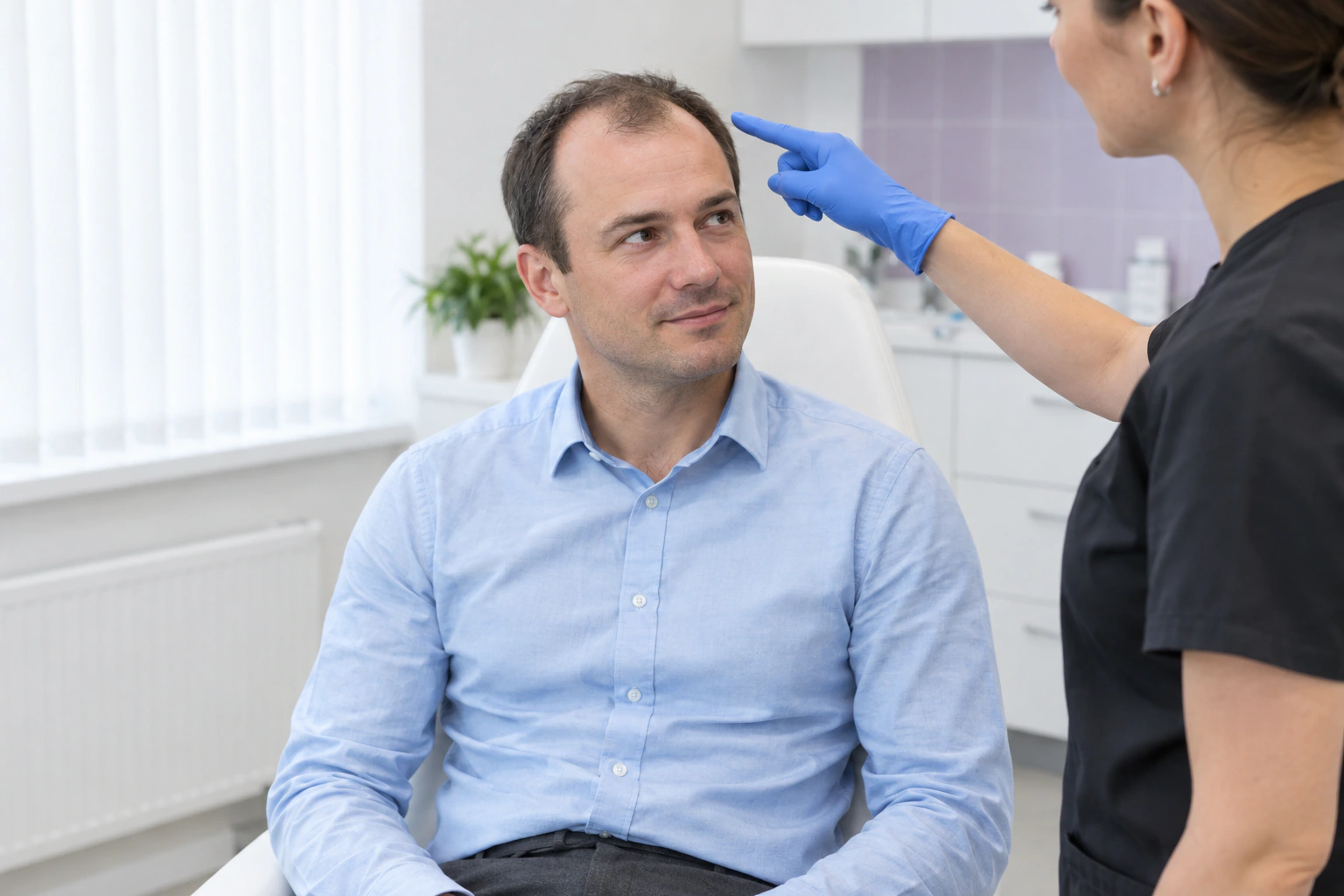

Leave your number for a free answer: photos in a messenger to a coordinator, and the doctor says if a transplant will help you.

services
The price is set after the free graft count and written into the contract.
suture-free graft extraction

$2,200$2,700
or $367/mo — 0% instalments for 6 months
Save this priceimplantation without channels

$2,500$2,900
or $417/mo — 0% instalments for 6 months
Save this pricecombined technique

$2,700$2,900
or $450/mo — 0% instalments for 6 months
Save this price| Assessing your hair | Free |
|---|---|
| Eyebrow transplant, FUE | |
| Beard transplant, FUEinstalments $467/mo | |
| Hair trichopigmentation | |
| PRP therapy / session | $200 |
all included
From getting ready for surgery to 12 months after.
No extras are slipped in on the day of surgery.
two further zones
The scalp is just the most common case. Grafts come from the back of the head, the method is FUE, the zone can differ.
FUE, no incisions and no stitches

Grafts are taken from the donor area at the back of the head and moved through micro-punctures of about 1 mm, so no scars are left. The doctor agrees the shape with you before the operation, taking your facial features into account. Transplanted hair grows for life: trim and style the beard as usual.
$2,800$3,000
or $467/mo — 0% instalments for 6 months
Save this priceFUE, no incisions and no stitches

The surgeon draws the eyebrow shape right at the initial consultation: you look through references together and the design takes your facial features into account. Hairs are implanted at the right angle, so the eyebrows look natural. It also helps when years of plucking stopped the growth.
$1,600$1,700
a same-day procedure with the scalp area numbed
Save this priceYour donor area is examined, the grafts are counted and the achievable result is shown. The cost is quoted at the consultation and fixed in the contract.

Message our coordinator
Free online consultation · Reply within 15 minutes
Message us on TelegramMessage us on WhatsAppBy messaging us, you agree to our Privacy Policy
Process
From consultation to going home — all in one day

This first step, offered free of charge, is where the doctor explains FUE and DHI, answers your questions, and drafts an individual plan for the operation.

To reserve your surgery date, a deposit is made — by card at the clinic or online — and the agreement is formalized in a medical services contract.

This step covers the tests needed before the procedure, with the clinic providing the full list and guidance for each one.

The patient receives local anaesthesia, allowing the surgery to proceed painlessly.

The donor zone, at the rear of the head or beside the temples, yields the grafts, and stitches are never needed.

Surgeons position every harvested graft within the thinning area.
Recovery wraps up the process, with the clinic offering all essentials and thorough instructions.

Crusts work loose and fall, swelling subsides, the skin quietly repairs

It is a normal stage: the hairs fall, the follicles stay in place

New hairs surface gradually, the result shows

The hair grows thicker, the main volume and contour are visible

The final density and a natural hairline appear

Free, before the surgery, with no commitment.
Arrange a consultationdoctors

Hair transplant doctor, trichologist, surgeon
10 years in practice

Dermatovenereologist, trichologist, surgeon
11 years in practice

Plastic surgeon
9 years of experience

Plastic surgeon
9 years of experience

Assistant
9 years of experience
The doctor will review your donor area, count the grafts and say what result is possible.
Arrange a consultationcoordinators
One named coordinator works with you from the moment you write until recovery is over.

Patient support lead
Stays available the whole way through
Sees to all the papers and diary dates
Patient support lead
Stays available the whole way through
Sees to all the papers and diary dates

Patient support lead
Stays available the whole way through
Sees to all the papers and diary dates
Patient support lead
Stays available the whole way through
Sees to all the papers and diary dates













Send us your questions and we will agree a convenient appointment time
Message us on WhatsApp Leave a requestStandard questions

Yes. The clinic accepts people regardless of which city or country they live in, and a remote consultation precedes the decision.
The base prices are $2,200 (≈ UGX 8,700,000) (FUE), $2,500 (≈ UGX 9,800,000) (DHI) and $2,700 (≈ UGX 11,000,000) (combined). The precise cost is determined at a free consultation and graft count, then fixed in your contract.
One day only. Patients leave for home once it is complete.
You will not feel pain — local anaesthesia covers the whole session.
FUE means tweezer-based, incision-free graft harvesting. DHI means channel-free implantation with a Choi pen. Combined DHI+FUE uses FUE for harvesting and the DHI pen for implanting.
The exact quantity is defined during the free consultation, after the doctor studies the donor area.
Healing runs 0–10 days, followed by normal hair shedding at 2–4 weeks. Growth kicks in at 3–4 months, thickens by 6–9 months, and reaches its final result at 12–18 months.
Hair growth is covered by a lifetime guarantee, fixed in the signed contract.
The clinic runs on a medical licence, care follows the standards and clinical guidelines
per Ministry of Health.

The diplomas and training papers of the operating doctors
Read the papersAKC POMOSHCH LLC
the clinic's legal name
1057746096924
OGRN
7728536872
INN
For a resident of Gulu the method matters more than the map: FUE and DHI leave no cuts and no stitches, run under local anaesthesia and take one day. Graft survival is 98-100 %, and a price from $2,200 (≈ UGX 8,700,000) is locked in the contract after a free graft count.
The photo does the work at the start for a patient in Gulu: it goes to the doctor, the online consultation is free, and the answer about whether a transplant helps comes back to you. Open 24/7.
Healing runs for 0-10 days and needs no heroics. A shedding of the transplanted hairs arrives at 2-4 weeks and is completely normal, however unsettling it may look in the mirror. Growth gets under way at 3-4 months.
Prices are in US dollars; the amount in brackets is an approximate conversion to UGX at the rate of 02.10.2026. The final price is fixed in your contract.
By messaging us, you agree to our Privacy Policy
What patients write after this operation. Reviews are translated from the original language.
Andrey M.
I had the operation a month ago. Before and after surgery they were always in touch and helped with questions about my tests. The operation itself went wonderfully, the staff are polite and masters of their craft, you feel you are in safe hands. I am recovering now, and they answer all my questions. I am happy and I recommend them!
DHI hair transplant
Pavel Sinitsyn
The best clinic of all the ones I was choosing from. No regrets at all! The result is simply amazing, I am thrilled. I recommend it to everyone: these people do great work and make people happy. Once again, a huge thank you to everyone. Roman, the head of the clinic, is the best: he was personally in touch with me and looked after my recovery. Thank you for making my dream come true.
FUE hair transplant
Maria Akopyan
I thought about an eyebrow transplant for a long time and finally went for it. At first I was afraid the result would look unnatural, but when I saw my new eyebrows I was delighted! They came out full and in harmony with my face. I can hardly believe that now I just wash my face and go, I have never felt so free. For anyone tired of constant make-up, a transplant is a real lifesaver!
Eyebrow transplant (FUE)
Alexander M.
I really wanted a thick beard, but I had problems with it. I tried every home remedy and minoxidil, and nothing helped. After a long search for the best clinic I settled on this one. Thank you so much for the service, I liked everything and now I am happy! I had the beard transplant 10 months ago and I am very pleased with the result. By the way, the music in the clinic was great, as far as I remember. A friend of mine has already come to you for a transplant on my advice and was also happy with the result. I wish you every success!
Beard transplant (FUE)
Vladimir Z.
I went to the clinic to see a trichologist and had a hair transplant. I really liked the doctor's approach, and all the recommendations helped. I want to point out that nobody tries to sell you extra services: they tell you things as they are, and if some treatment is not needed, they do not push it. Cosy and clean.
DHI hair transplant
Artem Popov
This may sound obvious, but a head of hair really changes everything in your life. You feel much more confident and go through life like a winner. And it is all thanks to the doctor at this clinic and to the staff who take care of their patients. Many thanks to the clinic for a happy life with new hair, for the comfortable conditions and for the professionalism during the hair transplant.
FUE hair transplant
Page medically reviewed by Anastasia A. Kolesnik, hair transplant doctor. Review date: .
Gulu is a city in the Northern Region of Uganda and the commercial and administrative centre of Gulu District. In 2020 the mid-year population of Gulu City was projected at 177,400, spread over four divisions: Bar Dege, Laroo, Layibi and Pece. It is a busy place with markets, offices, a university and a steady flow of people moving along the main highway between Kampala and the north, so appearance and first impressions matter in daily work.
Men and women in Gulu who look into hair transplantation by FUE or DHI usually have a similar story: thinning at the temples, a receding frontal hair line, a bald crown, or gaps in the beard that do not fill in. Some have lived with it for years and want a calm, planned solution rather than a quick fix.
City Medical Centre works with patients from Gulu through a free online consultation. Coordinators are available around the clock (24/7) on WhatsApp and Telegram, so you can ask questions in the evening after work or early in the morning before classes.
You start by writing to a coordinator on WhatsApp or Telegram. You send clear photos of the front, the temples, the crown and the donor area at the back of the head, and you describe how long the hair loss has been going on, what you have tried and what you hope to change.
A doctor reviews the photos and discusses the shape of the hair line with you before the operation, taking your facial features into account. You also talk about how many areas need work, whether the beard or eyebrows are part of the plan, and what is realistic for your hair type.
The consultation is free and does not commit you to anything. We stay with you from pre-op planning to 12 months later, and a coordinator will be on the phone 24/7. That continuity matters when you are planning from a city where you will be recovering at home among family and colleagues.
In both methods, grafts are taken from the back of the head, the donor area, and moved through micro-punctures of about 1 mm, so nothing scars over. FUE and DHI differ in how the grafts are placed, and the doctor explains which suits your case during the remote consultation.
For a patient in Gulu the practical question is usually not the technique name but what the weeks after the operation look like: how the small wounds heal, when it is safe to return to work, and how to protect the scalp during daily errands in a warm climate. The doctor can walk you through each step in advance.
Transplanted hair grows for life, and for beard work you trim and style the beard as usual. This is why patients are advised to think carefully about density and design at the planning stage, not in a hurry.
Gulu has a tropical wet and dry climate (Aw in the Köppen-Geiger classification). In practice this means a distinct rainy season and a drier, hotter one. Both affect how you look after a freshly treated scalp.
In the hot, sunny months the main concerns are direct sun, sweat and dust on the treated area. Early on, avoid long exposure to the sun and wear only the headwear your doctor approves, keeping it loose so it does not rub the grafts. Dusty roads and busy markets are best avoided during the first days of healing, within the 0–10 day healing period.
In the rainy season the concerns shift to humidity, mud and getting caught in a downpour. Keep the scalp clean as instructed, do not scratch, and ask the surgeon how to wash safely if you cannot always control the weather. Swimming pools and open water should wait until the doctor allows them, and your coordinator can confirm the timing.
There is no single perfect month in Gulu. Many patients prefer a period when they can stay mostly indoors for the first ten days, with fewer outdoor obligations and less dust. Others pick a quieter time at work or between university terms.
If you choose a hot period, plan shade, a cool resting place at home and minimal outdoor activity during early healing. If you choose the rainy period, plan your errands so that the scalp does not get wet or dirty, and ask relatives to help with anything outdoors. Discuss your own calendar with the coordinator before fixing a date.
Remember the timeline: 0–10 days for healing, 2–4 weeks for normal shedding of transplanted hair, 3–4 months for new growth to start, 6–9 months for real density, and 12–18 months for the final result. Think about weddings, graduations and family events in that window, because the shedding phase surprises many people if they are not prepared.
Gulu has a large student community, with Gulu University and other institutions in the city, as well as offices, trade and service jobs. Students and office workers often ask when they can return to normal routines. Your surgeon sets the date based on your case, and desk work generally comes back sooner than work in dust, sun or physical labour.
Sport is part of city life, from local football around Pece War Memorial Stadium to casual games between friends. Contact sport, heavy training and heavy sweating should wait until the doctor clears you. Ask specifically about football, running and gym sessions, and about when you can wear a cap or helmet.
Family gatherings and shared meals are central to social life. Be honest with relatives about the plan if you want their support, and decide in advance how you will explain the temporary redness, scabs and shedding. Meals are not a problem for healing, but avoid crowded, smoky or dusty settings in the first days.
Recovery is gradual, and knowing the stages helps you stay calm. In the first 0–10 days the small wounds heal. Between 2–4 weeks the transplanted hairs let go, as expected, which is normal shedding and not a failure.
Around 3–4 months hair comes back. By 6–9 months it looks visibly thicker, and 12–18 months is when you see the settled look. One patient described it this way: from about the 4th month active, even growth began, the transplanted hair took very well, and the beard now looks natural with no bald patches left.
Check-ups are scheduled at months 1, 3, 6, 9 and 12. You send photos and talk to the team remotely, so being in Gulu does not interrupt follow-up. If something looks unusual between check-ups, you can message the coordinator at any hour.
Good candidates generally have enough healthy hair in the donor area, a stable hair loss pattern and realistic expectations. Both men and women can be considered, and beard or eyebrow restoration may also be possible.
Caution is needed with active scalp conditions, untreated chronic illness, bleeding problems, or unrealistic hopes about density. Be open about medicines, allergies and past surgeries, since the doctor needs the full picture. Younger patients with fast-progressing loss may be advised to wait or to stabilise the loss first.
Overall health matters too, including weight and general fitness, which influence healing and anaesthesia. The WHO describes overweight and obesity as a broad health concern, and your doctor may ask about your general condition for that reason.
Gulu is the commercial and administrative centre of Gulu District, and much of the week is built around markets, offices, classes and errands in the city's four divisions: Bar Dege, Laroo, Layibi and Pece. Before you fix a date for FUE or DHI, write down which days are the busiest for you and which can be moved. The first days of healing, the 0–10 day period, go much more smoothly when you can stay calm and avoid crowds.
A practical approach is to tell your coordinator how your week looks: whether you work at a desk or outdoors, whether you commute across the city, and who at home can help with shopping or school runs. The coordinator then helps you shape a realistic plan. Being reachable 24/7 on WhatsApp and Telegram means you can ask a small question the moment it appears, without waiting for a convenient hour.
Good photos make the free online consultation far more useful. Take them in even daylight, away from direct sun, with the hair dry and combed in the usual way. Send the front, both temples, the top, the crown and the back of the head, because the back is the donor area from which grafts are taken. For beard work, add clear pictures of the cheeks, chin and jaw line.
Write a short history alongside the pictures: when the thinning began, whether it runs in the family, which treatments you have tried and any medicines you take. Mention allergies and previous operations too. The more complete the picture, the more precisely the doctor can discuss the design of the frontal hair line with you, taking your facial features into account, before any decision is made.
Once the early healing is behind you, the focus moves to patience. Between 2–4 weeks the transplanted hairs let go, as expected, and for many people in Gulu this is the moment when doubts arrive, especially at work or university where colleagues and classmates notice every change. Remember that 3–4 months is when hair comes back, and 6–9 months is when it becomes visibly thicker.
Keep a simple photo diary, taken in the same light and from the same angles each month. It helps you judge progress honestly and gives the team something concrete to review at the check-ups at months 1, 3, 6, 9 and 12. Keep sun protection in mind on the sunny days that are common in a tropical wet and dry climate, and follow the washing routine the doctor gives you rather than advice from friends.
Gulu City is projected at 177,400 people in 2020, split among Pece (53,500), Bar Dege (47,700), Layibi (43,900) and Laroo (32,300). Each division has its own pace, and that is useful when you plan a hair transplant. Someone living in busy Pece will meet more crowds on the first days of healing than someone in quieter Laroo, so the choice of where you rest at home can matter as much as the choice of date.
When you write to the coordinator, name your division and how you usually move around it. Short walks to a neighbourhood shop are easy to manage during the 0-10 day healing period. A long daily crossing of the city in sun and dust is something to discuss with the surgeon before the operation, so that a plan for staying at home is ready.
Gulu University offers agriculture, medicine, business management and conflict resolution, and the city also hosts a campus of the Uganda Management Institute and the University of the Sacred Heart Gulu. For a student, the timeline of FUE or DHI should be set against the academic calendar: 2-4 weeks of shedding are visible in lecture halls, and 3-4 months pass before hair comes back.
Many students prefer to have the operation in a break between terms and to spend the first ten days resting in their rooms or at family homes. Ask the coordinator to help you align the check-ups at months 1, 3, 6, 9 and 12 with exams and practical placements, since they are done remotely by photo and message.
Staff and lecturers at the institutions have a different concern: standing in front of a class soon after healing. Ask the surgeon how the treated area will look in the first weeks, and plan a loose, approved head covering if you must be outdoors for field work.
Gulu has three hospitals: St. Mary's Hospital Lacor, Gulu Regional Referral Hospital and Gulu Independent Hospital. The online consultation with City Medical Centre does not replace local emergency care, and it is sensible to know which facility is nearest to your home in case of any urgent general health problem during recovery.
For the hair transplant itself, the remote team guides planning and follow-up, and a coordinator will be on the phone 24/7. Tell them about any local medical visits so the doctor has the whole picture, including medicines prescribed by others.
Pece War Memorial Stadium, home of Gulu United FC, holds 3,000 people and was built by the British in 1959, with renovation starting in April 2017. Match days bring crowds, sun and shouting, exactly the conditions to avoid in the first days after FUE or DHI.
If you are a supporter or a player, mark the fixtures on your calendar before choosing a surgery date. Watching from home during the 0-10 day healing period is a small price. Ask the surgeon when you may return to the stands and, for players, when heading the ball and sweating in training are allowed.
Faith is a large part of public life in Gulu, with the Catholic Archdiocese, the Church of Uganda, Presbyterian, Baptist, Orthodox and Pentecostal communities, plus mosques. The BAPS Swaminarayan Mandir, built in 1965, was reopened on October 11, 2026. Services, weddings and funerals often bring long hours in a crowded room.
Think about which ceremonies fall within the first weeks. Some communities expect a head covering at worship, and it must be loose and approved by your doctor so the grafts are not rubbed. Ask the coordinator for advice before a major occasion, and plan to sit away from the crowd if you attend early on.
Gulu completed Phase I of its Water Supply and Sanitation Project in 2020, with storage capacity for potable water and at least 42 public toilets. Phase II plans a new intake upstream of Karuma Hydroelectric Power Station to serve 341,000 people in Gulu and neighbouring communities.
For a patient, this makes washing instructions practical: ask your doctor what kind of water and which products to use on the scalp, and prepare clean containers at home if supply is irregular in your neighbourhood. Keep clean towels ready and do not improvise with unclean water on the treated area.
Prepare a list before the call. Ask which method, FUE or DHI, suits you and why. Ask how the hair line will be designed for your face, how many grafts the donor area can safely give, and what the plan is if you need a second session later.
Ask about aftercare in a warm climate: how to protect the scalp from sun and dust, what to wear on your head, when you can wash normally, and when pools and sport are allowed. Ask what normal shedding looks like so you do not worry at weeks 2–4.
Finally, ask how follow-up works. With check-ups at months 1, 3, 6, 9 and 12 and a coordinator reachable 24/7, you should know exactly how to send photos, who answers and how fast. Clear answers at the start make the whole process calmer.
Yes. The consultation is online and free. You write to a coordinator on WhatsApp or Telegram, send photos and discuss your plan with a doctor.
Yes. Coordinators work around the clock (24/7) on WhatsApp and Telegram, and a coordinator will be on the phone 24/7.
Grafts are taken from the back of the head, the donor area, and moved through micro-punctures of about 1 mm, so nothing scars over.
Transplanted hairs let go after 2–4 weeks, hair comes back at 3–4 months, looks visibly thicker at 6–9 months, and the settled look arrives at 12–18 months.
The healing period is 0–10 days. Follow your doctor's instructions on washing, sun protection and headwear.
Yes. In the first days avoid strong sun, sweat and dust on the treated area, and keep headwear loose. Your surgeon will give exact instructions.
Not straight away. Ask the surgeon when sport is allowed, as contact and heavy sweating are usually delayed.
We stay with you from pre-op planning to 12 months later, with check-ups at months 1, 3, 6, 9 and 12.
Yes, beard restoration is possible in suitable cases. Transplanted hair grows for life, and you trim and style the beard as usual.
Describe your work or study schedule, whether you spend time outdoors in sun and dust, and who can help at home. This lets the team suggest a sensible date and aftercare plan.
Clear daylight photos of the front, temples, top, crown and the back of the head, which is the donor area. For beard work, add photos of the cheeks, chin and jaw line.
Treat 12–18 months as the settled look. Along the way, expect shedding at 2–4 weeks, regrowth at 3–4 months and visibly thicker hair at 6–9 months.
There is no single best part. Choose a calm home where you can avoid crowds and dust during the 0-10 day healing period, whether you live in Pece, Bar Dege, Layibi or Laroo.
Yes. Many students choose a break, because shedding appears at 2-4 weeks and regrowth begins at 3-4 months. Check-ups at months 1, 3, 6, 9 and 12 are done remotely.
Wait for your surgeon's clearance. Crowds, sun and sweat at a stadium are best avoided during early healing.
Ask the doctor first. Any covering should be loose and approved so it does not rub the grafts.

 Forceps
 Minimal


