



start
12 months later
2,800 grafts
FUE method
City Medical Centre
0% instalments
from $367/mo
Work-up and a number — $0.
Real patient
start
12 months later
No scalpel and no stitches in FUE. Graft count and forecast measured up and never billed — before you decide.
Free, no catch, no surgery booking required
Message our coordinator
Free online consultation · Reply within 15 minutes
Message us on TelegramMessage us on WhatsAppBy messaging us, you agree to our Privacy Policy
results
All cases are real patients of our clinic.
start
12 months later
2,800 grafts
FUE method

start
12 months later
3,500 grafts
FUE method

start
12 months later
2,600 grafts
FUE method

start
12 months later
3,000 grafts
FUE method

start
12 months later
2,700 grafts
FUE method

start
12 months later
3,300 grafts
FUE method

start
12 months later
2,900 grafts
FUE method

start
12 months later
2,500 grafts
FUE method

start
12 months later
3,400 grafts
FUE method

start
12 months later
2,500 grafts
FUE method

start
12 months later
3,100 grafts
FUE method

start
12 months later
3,600 grafts
FUE method

start
12 months later
4,000 grafts
FUE method

start
12 months later
3,200 grafts
FUE method

start
12 months later
3,000 grafts
FUE method

start
12 months later
3,700 grafts
FUE method

start
12 months later
2,700 grafts
FUE method

start
12 months later
3,800 grafts
FUE method

start
12 months later
3,300 grafts
FUE method

start
12 months later
2,800 grafts
FUE method

start
12 months later
2,500 grafts
FUE method

start
12 months later
3,900 grafts
FUE method

start
12 months later
3,500 grafts
FUE method

start
12 months later
3,800 grafts
FUE method

start
12 months later
2,900 grafts
FUE method

start
12 months later
3,600 grafts
FUE method

start
12 months later
2,600 grafts
FUE method

start
12 months later
2,700 grafts
FUE method

start
12 months later
3,700 grafts
FUE method

start
12 months later
3,200 grafts
FUE method

start
12 months later
3,000 grafts
FUE method

start
12 months later
2,800 grafts
FUE method

start
12 months later
4,000 grafts
FUE method

start
12 months later
3,400 grafts
FUE method

start
12 months later
2,900 grafts
FUE method

start
12 months later
3,100 grafts
FUE method

start
12 months later
2,600 grafts
FUE method

start
12 months later
3,300 grafts
FUE method

start
12 months later
3,900 grafts
FUE method

start
12 months later
3,500 grafts
FUE method

start
12 months later
2,700 grafts
FUE method

start
12 months later
3,800 grafts
FUE method

start
12 months later
3,200 grafts
FUE method

start
12 months later
3,000 grafts
FUE method

start
12 months later
2,800 grafts
FUE method

start
12 months later
3,100 grafts
FUE method

start
12 months later
3,600 grafts
FUE method
Comparison
Three graft transfer technologies are on the table: classic FUE, suture-free DHI and a combined protocol. Implantation technique, tissue trauma and graft survival are what you compare when choosing.
Classic method requiring no cuts or sutures

$2,200
$2,700
Graft implantation technique
ForcepsGraft trauma
MinimalHair's natural angle
NaturalGraft survival
98–100%Suitable for
Androgenetic alopeciaSuture-free placement with a Choi pen

$2,500
$2,900
Graft implantation technique
Choi implanter, DHI penGraft trauma
MinimalHair's natural angle
NaturalGraft survival
98–100%Suitable for
DensificationFUE for extraction, DHI implant

$2,700
$2,900
Graft implantation technique
FUE extraction plus DHI implantGraft trauma
MinimalHair's natural angle
NaturalGraft survival
98–100%Suitable for
Densification for androgenetic alopeciaFigures for survival and trauma are method averages and serve as a guide: the exact numbers rest on the transplant area and the patient's individual features, and the doctor explains them at the consultation.
Meet a specialist


















about the clinic
Attention to each person, pleasant rooms, good equipment

Questions are answered first, then a suitable slot for the consultation is chosen
Message us on WhatsApp Send your detailsNot every case needs surgery, and you will hear so at the consultation, so no money is wasted. Below are the situations in which a transplant genuinely helps.
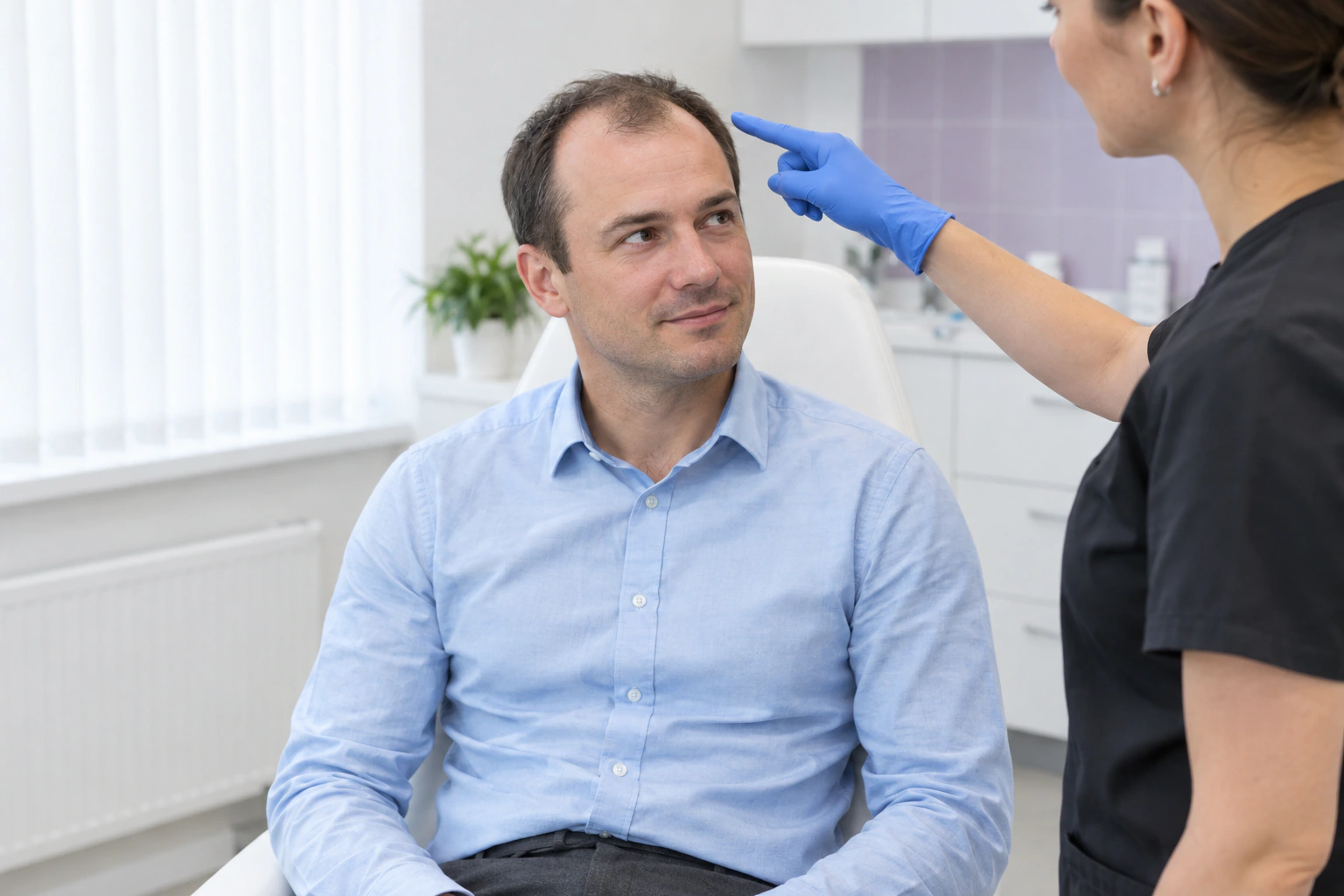

Your number is enough: a coordinator asks for photos, the doctor says if a transplant helps. Free, no booking.

services
The cost comes at the free consultation, after the graft count, and is fixed in the contract.
suture-free graft extraction

$2,200$2,700
or $367/mo — 0% instalments for 6 months
Secure the priceimplantation without channels

$2,500$2,900
or $417/mo — 0% instalments for 6 months
Secure the pricecombined technique

$2,700$2,900
or $450/mo — 0% instalments for 6 months
Secure the price| The doctor's first look | Free |
|---|---|
| Eyebrow transplant, FUE | |
| Beard transplant, FUEinstalments $467/mo | |
| Hair trichopigmentation | |
| PRP therapy / session | $200 |
all included
From preparing for the operation to 12-month follow-up.
Surgery day brings no bill you did not expect.
another two areas
The same grafts from the back of the head, the same FUE method — only the area changes: it is not only about the scalp.
FUE method, free of cuts or stitches

Donor grafts are taken at the back of the head and moved through micro-punctures of about 1 mm, leaving no scars. The doctor talks the shape over with you before the operation, allowing for your facial features. Transplanted hair grows for life, so the beard can be trimmed and styled as usual.
$2,800$3,000
or $467/mo — 0% instalments for 6 months
Secure the priceFUE method, free of cuts or stitches

The surgeon draws the eyebrow shape at the initial consultation: you look through references together and the design takes your facial features into account. The hairs are implanted at the correct angle, so the eyebrows look natural. This also helps where years of plucking stopped growth.
$1,600$1,700
a procedure with no overnight stay, numbed locally
Secure the priceDonor zone inspected, grafts counted, realistic outcome explained. Your cost is decided at that consultation and written down in the contract.

Message our coordinator
Free online consultation · Reply within 15 minutes
Message us on TelegramMessage us on WhatsAppBy messaging us, you agree to our Privacy Policy
Process
From consultation to going home — all in one day

Expect the doctor to walk you through both methods, FUE and DHI, field the questions you bring along, and study the donor area before anything is decided.

The surgery date is secured with a deposit, which can be paid by card at the clinic or sent online, and everything is confirmed in a medical services contract.

Preparing for the procedure means taking the tests on the clinic's list, following the instructions provided along the way.

The surgery proceeds under local anaesthesia, ensuring a painless experience for the patient.

Extraction is done from behind the head or from the temples, and stitches play no part in it.

For patients in Entebbe, the grafts are implanted into the thinning part of the scalp.
Healing is supported by what the clinic provides and by detailed directions on using it.

The crusts drop off, the swelling settles, the area recovers steadily

Expected, not a setback: the hair shafts go, the roots remain

New hairs arrive gradually, the result starts to show

Hair thickens, and the main volume and contour become visible

Natural hairline and final density take their shape

Free, ahead of surgery and free of any commitment.
Meet a specialistdoctors

Hair transplant doctor, trichologist, surgeon
10 years of experience

Dermatovenereologist, trichologist, surgeon
11 years of experience

Plastic surgeon
9 years in practice

Plastic surgeon
9 years in practice

Assistant
9 years in practice
The doctor studies the donor zone, arrives at the graft count and sets out the achievable outcome.
Meet a specialistcoordinators
You always know who to ask: one coordinator, from the first message until recovery ends.

Your personal manager
Supports you both before and after surgery
Deals with all your papers and time slots

Your personal manager
Supports you both before and after surgery
Deals with all your papers and time slots

Your personal manager
Supports you both before and after surgery
Deals with all your papers and time slots
Your personal manager
Supports you both before and after surgery
Deals with all your papers and time slots













Questions are answered first, then a suitable slot for the consultation is chosen
Message us on WhatsApp Send your detailsPopular questions

Yes — the centre treats people whose home is in another city or another country, and online consultations are offered at the outset.
FUE is $2,200 (≈ UGX 8,700,000), DHI is $2,500 (≈ UGX 9,800,000), combined DHI+FUE is $2,700 (≈ UGX 11,000,000). A free consultation with a graft count gives you the exact, contract-fixed price.
It is a one-day procedure — you leave for home right after.
Local anesthesia numbs everything, leaving no pain behind.
FUE is cut-free graft extraction by tweezer. DHI is direct implantation with a Choi pen, skipping channel-making. The combined technique takes grafts by FUE and places them using the DHI method.
It is determined individually: the doctor examines the donor area and names the figure at a free consultation.
Roughly 0–10 days for healing, then a normal shedding of transplanted hairs at 2–4 weeks. Growth appears around 3–4 months, becomes noticeable across 6–9 months, and completes at 12–18 months.
Your procedure includes a lifetime hair-growth guarantee under contract.
The clinic works with a medical licence, care follows the standards and clinical guidelines
under Ministry of Health.

Open access to the qualification papers of the surgeons
View the detailsAKC POMOSHCH LLC
the clinic's legal entity
1057746096924
OGRN
7728536872
INN
There is no cutting and no stitching in FUE or DHI, and local anaesthesia is all a patient in Entebbe receives. The operation fills one day and ends there, without a second appointment for the surgery itself.
Everything starts online for a patient in Entebbe: a free consultation, photos of the thinning area, and a graft count made by the doctor from those photos. The clinic is available 24/7, so there is no guessing when to write.
First 0-10 days: healing. At 2-4 weeks the transplanted hairs are shed, and that is normal for this procedure. Growth starts at 3-4 months, which is the moment most patients have been waiting for.
Prices are in US dollars; the amount in brackets is an approximate conversion to UGX at the rate of 02.10.2026. The final price is fixed in your contract.
By messaging us, you agree to our Privacy Policy
What patients write after this operation. Reviews are translated from the original language.
Andrey M.
I had the operation a month ago. Before and after surgery they were always in touch and helped with questions about my tests. The operation itself went wonderfully, the staff are polite and masters of their craft, you feel you are in safe hands. I am recovering now, and they answer all my questions. I am happy and I recommend them!
DHI hair transplant
Pavel Sinitsyn
The best clinic of all the ones I was choosing from. No regrets at all! The result is simply amazing, I am thrilled. I recommend it to everyone: these people do great work and make people happy. Once again, a huge thank you to everyone. Roman, the head of the clinic, is the best: he was personally in touch with me and looked after my recovery. Thank you for making my dream come true.
FUE hair transplant
Maria Akopyan
I thought about an eyebrow transplant for a long time and finally went for it. At first I was afraid the result would look unnatural, but when I saw my new eyebrows I was delighted! They came out full and in harmony with my face. I can hardly believe that now I just wash my face and go, I have never felt so free. For anyone tired of constant make-up, a transplant is a real lifesaver!
Eyebrow transplant (FUE)
Alexander M.
I really wanted a thick beard, but I had problems with it. I tried every home remedy and minoxidil, and nothing helped. After a long search for the best clinic I settled on this one. Thank you so much for the service, I liked everything and now I am happy! I had the beard transplant 10 months ago and I am very pleased with the result. By the way, the music in the clinic was great, as far as I remember. A friend of mine has already come to you for a transplant on my advice and was also happy with the result. I wish you every success!
Beard transplant (FUE)
Vladimir Z.
I went to the clinic to see a trichologist and had a hair transplant. I really liked the doctor's approach, and all the recommendations helped. I want to point out that nobody tries to sell you extra services: they tell you things as they are, and if some treatment is not needed, they do not push it. Cosy and clean.
DHI hair transplant
Artem Popov
This may sound obvious, but a head of hair really changes everything in your life. You feel much more confident and go through life like a winner. And it is all thanks to the doctor at this clinic and to the staff who take care of their patients. Many thanks to the clinic for a happy life with new hair, for the comfortable conditions and for the professionalism during the hair transplant.
FUE hair transplant
Page medically reviewed by Anastasia A. Kolesnik, hair transplant doctor. Review date: .
Entebbe sits on a peninsula of Lake Victoria in Central Uganda, roughly 36 kilometres southwest of Kampala. It was once the seat of government of the Protectorate of Uganda, before independence in 1962. Today it is a calm, green lakeside city with government offices, schools, hotels, small businesses and many families who have lived here for generations. The national census of 27 August 2014 put the population of Entebbe at 69,958.
People here tend to plan personal decisions carefully, and a hair transplant (FUE or DHI) is no exception. Many of our Entebbe patients are professionals, teachers, hospitality staff, civil servants and business owners. They are used to meeting people every day, and they want a natural result that does not draw attention. Others are men who want to rebuild the beard or fill in thinning areas before a wedding or a family celebration.
This text is written for those who live in Entebbe and want to understand how the operation fits into local life: the weather, the working week, sport by the lake, and the way a consultation works when everything is done remotely.
Entebbe has a tropical rainforest climate with no real dry season. The driest month is July, with about 72 millimetres of rain, and the wettest is April, with about 264 millimetres. The altitude keeps temperatures moderate: February is the warmest month at an average of 22.8 °C, and July is the coolest at 20.6 °C. For a patient after a hair transplant this is a fairly gentle background, because there are no extreme heat waves and no freezing days.
Moderate temperature does not mean the sun can be ignored. Near the equator the sun is strong even on a cloudy day, and the freshly treated scalp and donor area need protection in the first weeks. Your surgeon will explain when a loose, clean, breathable cap is acceptable and when the skin should simply stay in the shade. Tight headwear that rubs the grafts should be avoided in the early period.
Humidity is the second factor. In the wet months the air is damp, sweat dries slowly, and hygiene matters more. Follow the washing routine given to you by the medical team exactly, keep towels and pillowcases clean, and do not touch the treated area with unwashed hands. Rain itself is not a problem if you stay indoors or under a proper cover during the first days.
Since the city has no true dry season, the choice of month is less about avoiding a harsh summer and more about your own calendar. The first days of healing are the most sensitive. According to the plan, the period of 0–10 days is for healing, and during that time it is better to be at home, resting and following the care instructions.
If you choose a wetter month such as April, you will naturally spend more time indoors, which suits the early recovery well. The only point is to prepare practical things in advance: a clean place to sleep, a spare set of pillowcases, and arrangements so that you do not need to stand in crowds or in heavy rain on the way to errands. If you prefer a drier month such as July, the days are brighter, so a plan for sun protection becomes the main task.
Think also about events. Weddings, graduations, church or mosque celebrations and family gatherings are important in Uganda. The transplanted hairs let go after 2-4 weeks, which is expected, so it is wise not to schedule the operation immediately before an event where you want to look your best. Choose a date that leaves this shedding phase behind you, and remember that the settled look comes at 12–18 months.
Entebbe is a working city. Many people commute along the main highway to Kampala, some work in offices linked to government, others in tourism, hotels, trade or services by the lake. After a hair transplant, the question we hear most is when it is realistic to return to the usual routine. The healing phase is 0–10 days, and during it we advise you to arrange leave or remote work if your job allows it.
For office work the main concerns are visible redness and crusts in the first days, not physical strain. If your job requires meeting clients, it is more comfortable to plan the first days at home. For work that involves dust, heavy lifting or long hours in the sun, discuss the timing in detail with the surgeon, because sweat, dust and friction are the things to limit while the skin heals.
Students and young professionals often ask whether they can attend lectures or training soon afterwards. The answer depends on the way you feel and on the instructions given to you, but the principle is simple: protect the treated area, keep it clean, and avoid crowded, dusty places during the healing days. Your coordinator will help you build a schedule around your own week.
Life in Entebbe is closely tied to Lake Victoria. People walk along the shore, play football, run, cycle and swim in hotel pools. After a transplant, all these habits need a pause. Sweating heavily, swimming in the lake or a pool, and contact sports should only return when the surgeon allows them, following the recovery plan given to you.
Lake water and pool water are not sterile, and chlorine or lake bacteria can irritate a healing scalp. That is why we ask patients to wait and not to decide by themselves. Football and other team sports carry a risk of a knock to the head, so teammates and coaches should be told that you are in recovery. Light walking, without sun exposure on the scalp, is usually fine earlier than strenuous activity.
If you are a regular gym visitor, plan to reduce intensity first and return step by step. Ask the surgeon about the exact dates for the gym, running, swimming and contact sports, and write them down. The check-ups at months 1, 3, 6, 9 and 12 are also a good moment to ask whether anything else in your sport routine should change.
Food in Entebbe is varied: matoke, posho, beans, groundnut sauce, fresh fish from the lake, rice, vegetables and fruit, and street snacks that are part of daily life. Good, regular meals with enough protein and vegetables help the body recover. Fish, beans, eggs and groundnuts are familiar sources of protein that fit well into a recovery period.
Family events are often built around shared meals and many guests. During the first days after the procedure it is better to avoid crowded gatherings, smoky kitchens and long hours near an open fire or charcoal stove, because smoke and heat can irritate the scalp. Tell your family in advance what you are planning, so they can support you and help with simple tasks while you rest.
Alcohol and smoking are worth discussing openly with the surgeon before the operation, as they may affect healing. Likewise, tell the doctor about every medicine and supplement you take, including traditional remedies. The more complete the information, the safer the plan will be, and the easier it is to follow.
The timeline is the same for every city, but it helps to see it against local life. For the first 0–10 days the focus is healing. At 2-4 weeks the transplanted hairs let go, as expected, and many patients worry at this stage although it is a normal part of the process. At 3-4 months the hair comes back, at 6-9 months it looks visibly thicker, and at 12–18 months the look is settled.
One of our patients described the experience this way: the result truly made him very happy. From about the 4th month active, even growth began, the transplanted hair took very well, the beard looked as natural as possible and no bald patches were left. The beard became much thicker and denser, with the shape he had thought about for a long time. This shows why patience matters: the early months can look unremarkable, while the real change comes later.
For a beard transplant the same logic applies. Grafts are taken from the back of the head, the donor area, and moved through micro-punctures of about 1 mm, so nothing scars over. The doctor discusses the shape with you before the operation, taking your facial features into account. Transplanted hair grows for life: trim and style the beard as usual.
In general terms, a hair transplant suits adults whose hair loss has become stable enough to plan, and who have a healthy donor area at the back of the head with enough hair to move. Men with a receding frontal hair line, thinning at the crown, or gaps in the beard are the typical candidates. Women with localised thinning may also be considered after an individual assessment.
There are situations where the surgeon may advise waiting or choosing another approach: active scalp infections or inflammation, poorly controlled chronic diseases, bleeding disorders, very unstable hair loss that is still progressing fast, or unrealistic expectations about density. Tell the doctor honestly about your medical history, medicines and allergies.
Photos of your head from several angles, taken in good daylight, help the doctor decide. Hair in Uganda is often tightly curled, which affects how the grafts are planned and how density looks, so ask the surgeon directly about experience with your hair type and about the way the donor area will be protected.
You contact the coordinators on WhatsApp or Telegram, send photos of the scalp or beard and describe your history. The doctor reviews them, discusses the shape and the plan with you online, and the consultation is free. A coordinator will be on the phone 24/7, so you can write at any hour that suits you.
No. The consultation is online, and you stay in contact with the team from your own city. We stay with you from pre-op planning to 12 months later, with check-ups at months 1, 3, 6, 9 and 12.
Entebbe has no real dry season, and April is the wettest month. Rain is not a problem in itself. Keep the treated area covered and clean, avoid getting soaked in the first days, and follow the washing instructions of the medical team.
Even with moderate temperatures, the equatorial sun is strong. In the early weeks protect the scalp and donor area, stay in the shade and ask the surgeon which kind of loose cap is acceptable and from when.
Transplanted hairs let go after 2-4 weeks, which is expected. New growth begins at 3-4 months, the hair looks visibly thicker at 6-9 months, and the settled look comes at 12–18 months.
The healing phase takes 0–10 days. During this time stay at home when possible, avoid dust, sweat and friction, and follow every instruction on washing and sleeping position.
Not at first. Lake water, pools and sports with possible head contact should wait until the surgeon gives permission. Ask for the exact dates for swimming, the gym and team sports and note them down.
Grafts are taken from the back of the head and moved through micro-punctures of about 1 mm, so nothing scars over. The doctor also discusses the shape with you before the operation.
Ask how many sessions you may need, how the donor area will be planned, how your hair type affects the result, what to do in the first days, when you can return to work and sport, and what the schedule of check-ups looks like.
Yes. Transplanted hair grows for life, so trim and style the beard as usual once the surgeon confirms that the healing phase is over.

 Forceps
 Minimal


