



before op
12 months after
2,800 grafts
FUE method
City Medical Centre
0% instalments
from $367/mo
Advice, then the price — $0.
Real story
before op
12 months after
FUE: no surgical cuts, no stitches. Grafts and outcome forecast checked over at no charge — before you decide.
No bill for it, no surgery booking required
Message our coordinator
Free online consultation · Reply within 15 minutes
Message us on TelegramMessage us on WhatsAppBy messaging us, you agree to our Privacy Policy
results
Each result belongs to a genuine CMC patient.
before op
12 months after
2,800 grafts
FUE method

before op
12 months after
3,500 grafts
FUE method

before op
12 months after
2,600 grafts
FUE method

before op
12 months after
3,000 grafts
FUE method

before op
12 months after
2,700 grafts
FUE method

before op
12 months after
3,300 grafts
FUE method

before op
12 months after
2,900 grafts
FUE method

before op
12 months after
2,500 grafts
FUE method

before op
12 months after
3,400 grafts
FUE method

before op
12 months after
2,500 grafts
FUE method

before op
12 months after
3,100 grafts
FUE method

before op
12 months after
3,600 grafts
FUE method

before op
12 months after
4,000 grafts
FUE method

before op
12 months after
3,200 grafts
FUE method

before op
12 months after
3,000 grafts
FUE method

before op
12 months after
3,700 grafts
FUE method

before op
12 months after
2,700 grafts
FUE method

before op
12 months after
3,800 grafts
FUE method

before op
12 months after
3,300 grafts
FUE method

before op
12 months after
2,800 grafts
FUE method

before op
12 months after
2,500 grafts
FUE method

before op
12 months after
3,900 grafts
FUE method

before op
12 months after
3,500 grafts
FUE method

before op
12 months after
3,800 grafts
FUE method

before op
12 months after
2,900 grafts
FUE method

before op
12 months after
3,600 grafts
FUE method

before op
12 months after
2,600 grafts
FUE method

before op
12 months after
2,700 grafts
FUE method

before op
12 months after
3,700 grafts
FUE method

before op
12 months after
3,200 grafts
FUE method

before op
12 months after
3,000 grafts
FUE method

before op
12 months after
2,800 grafts
FUE method

before op
12 months after
4,000 grafts
FUE method

before op
12 months after
3,400 grafts
FUE method

before op
12 months after
2,900 grafts
FUE method

before op
12 months after
3,100 grafts
FUE method

before op
12 months after
2,600 grafts
FUE method

before op
12 months after
3,300 grafts
FUE method

before op
12 months after
3,900 grafts
FUE method

before op
12 months after
3,500 grafts
FUE method

before op
12 months after
2,700 grafts
FUE method

before op
12 months after
3,800 grafts
FUE method

before op
12 months after
3,200 grafts
FUE method

before op
12 months after
3,000 grafts
FUE method

before op
12 months after
2,800 grafts
FUE method

before op
12 months after
3,100 grafts
FUE method

before op
12 months after
3,600 grafts
FUE method
Comparison
Our clinic works with three graft transfer technologies: classic FUE, suture-free DHI and a combined one. Compare implantation technique, tissue trauma and graft survival, and choose with open eyes.
Classic technique without incisions or stitches

$2,200
$2,700
Graft implantation technique
ForcepsGraft trauma
MinimalHair's natural angle
NaturalGraft survival
98–100%Suitable for
Androgenetic alopeciaSuture-free implantation with a Choi pen

$2,500
$2,900
Graft implantation technique
DHI pen (Choi implanter)Graft trauma
MinimalHair's natural angle
NaturalGraft survival
98–100%Suitable for
DensificationFUE extraction, DHI pen implantation

$2,700
$2,900
Graft implantation technique
FUE extraction, DHI implantationGraft trauma
MinimalHair's natural angle
NaturalGraft survival
98–100%Suitable for
Androgenetic alopecia and densificationThe survival and trauma numbers are averaged per method and act as a guide: exact values depend on the transplant area and the patient's individual features, and the doctor specifies them at the consultation.
Discuss your options


















about the clinic
A well-equipped operating room, pleasant rooms, attentive care

We will respond to your questions and set a convenient consultation time
Message us on WhatsApp Drop us a lineIf surgery is not the answer for you, you will hear it straight at the consultation — no money wasted. The situations in which a transplant genuinely helps are listed below.
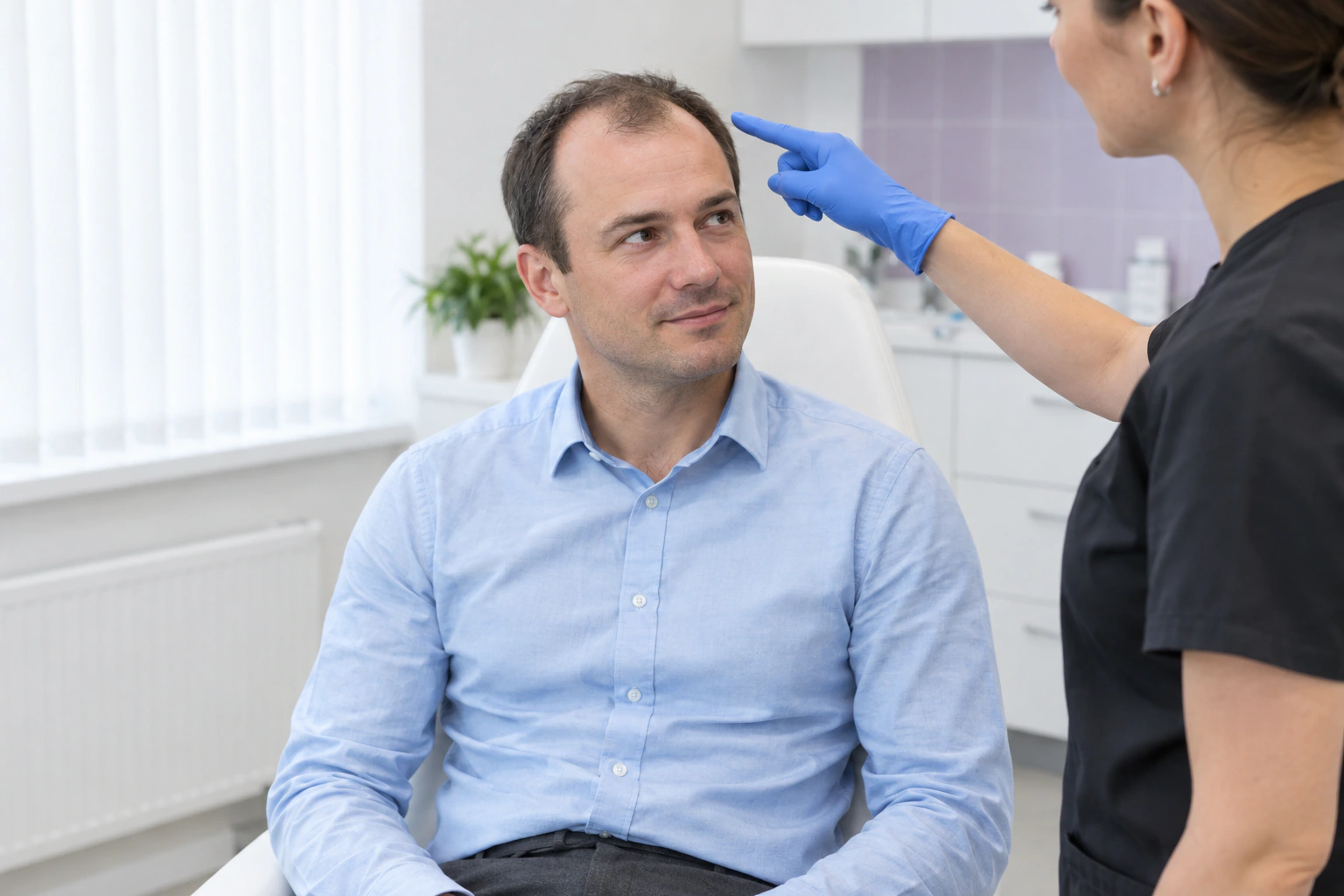

Just a number. A coordinator asks for photos in a messenger, the doctor replies whether a transplant will help you. Free, no booking.

services
The free consultation gives you a graft count and a firm figure that the contract records.
suture-free graft extraction

$2,200$2,700
or $367/mo — 0% instalments for 6 months
Claim this priceimplantation without channels

$2,500$2,900
or $417/mo — 0% instalments for 6 months
Claim this pricecombined technique

$2,700$2,900
or $450/mo — 0% instalments for 6 months
Claim this price| The doctor's first look | Free |
|---|---|
| Eyebrow transplant, FUE | |
| Beard transplant, FUEinstalments $467/mo | |
| Hair trichopigmentation | |
| PRP therapy / session | $200 |
all included
The whole path: preparation first, then 12 months of checks.
On surgery day no extra charges come up.
two further spots
The list is wider than the scalp. Donor grafts still come from the back of the head, and FUE is still the method.
FUE method, free of cuts or stitches

The grafts are taken from the donor area at the back of the head and moved through micro-punctures of about 1 mm, leaving no scars. Before the operation the doctor discusses the shape with you, taking your facial features into account. Transplanted hair grows for life: the beard is trimmed and styled as usual.
$2,800$3,000
or $467/mo — 0% instalments for 6 months
Claim this priceFUE method, free of cuts or stitches

The surgeon draws your eyebrow shape at the initial consultation: you study references together and the design is built around your facial features. Hairs are implanted at the right angle, so the eyebrows look natural. It also works where hairs have stopped growing after years of plucking.
$1,600$1,700
a same-day procedure with the scalp area numbed
Claim this priceThe doctor assesses the donor area, counts the grafts and shows what result is achievable in your case. The price is quoted at the consultation and fixed in the contract.

Message our coordinator
Free online consultation · Reply within 15 minutes
Message us on TelegramMessage us on WhatsAppBy messaging us, you agree to our Privacy Policy
Process
From consultation to going home — all in one day

At the very first step, the doctor explains FUE and DHI free of charge, answers whatever questions you bring, and prepares a surgical plan designed around you.

Once the deposit is paid — in person by card or online — the surgery date is booked and confirmed under a medical services contract.

The clinic sets the required tests out in writing and explains how to complete them ahead of the operation.

Anaesthesia at this stage is local, which keeps the operation painless for the patient.

Grafts are taken from the donor area at the back of the head or the temples, and the process leaves no stitches.

The grafts are implanted, one after another, where the hair has gone.
Supplies and full directions come from the clinic so the healing period passes quickly.

The crusts come off and the swelling goes down as the area recovers

The stage is normal: only hairs fall out, follicles stay in place

Hair thickens gradually and you can see the difference

Hair thickens, and the main volume and contour become visible

Thickness and the shape of the hairline are complete

Free, prior to surgery and with no obligations.
Discuss your optionsdoctors

Hair transplant doctor, trichologist, surgeon
10 years of experience

Dermatovenereologist, trichologist, surgeon
11 years in practice

Plastic surgeon
9 years in practice

Plastic surgeon
9 years in practice

Assistant
9 years in practice
The doctor will study your donor area, count the grafts and say what result is realistic.
Discuss your optionscoordinators
You are assigned a personal coordinator: with you from the first enquiry to recovery.

Care and support lead
Will back you up before and after surgery
Manages all your documents and your slots

Care and support lead
Will back you up before and after surgery
Manages all your documents and your slots

Care and support lead
Will back you up before and after surgery
Manages all your documents and your slots
Care and support lead
Will back you up before and after surgery
Manages all your documents and your slots













We will respond to your questions and set a convenient consultation time
Message us on WhatsApp Drop us a linePoints people raise

Yes, this is possible. An online consultation is offered so patients from other cities and countries can plan ahead.
The base prices are $2,200 (≈ UGX 8,700,000) (FUE), $2,500 (≈ UGX 9,800,000) (DHI) and $2,700 (≈ UGX 11,000,000) (combined). The precise cost is determined at a free consultation and graft count, then fixed in your contract.
Surgery is done in one day, and patients go home the same day it's finished.
No pain is felt, as the zone is numbed locally beforehand.
FUE means tweezer-based, incision-free graft harvesting. DHI means channel-free implantation with a Choi pen. Combined DHI+FUE uses FUE for harvesting and the DHI pen for implanting.
Nobody can guess it in advance; the doctor counts them at a free appointment based on your donor reserve.
Healing runs its course in 0–10 days, then transplanted hairs shed at 2–4 weeks, which is standard. Growth starts at 3–4 months, fullness follows at 6–9 months, with 12–18 months as the endpoint.
The clinic provides a lifetime guarantee on hair growth, stated in the contract.
The clinic holds a medical licence; care meets the standards and clinical guidelines
of Ministry of Health.

Qualification papers open to anyone who asks
Browse the documentsAKC POMOSHCH LLC
the clinic's own entity
1057746096924
OGRN
7728536872
INN
One day, local anaesthesia, no cuts and no stitches - that is the whole of FUE and DHI as a patient in Jinja experiences them, and the reason the methods fit people who cannot lose a week.
Everything starts online for a patient in Jinja: a free consultation, photos of the thinning area, and a graft count made by the doctor from those photos. The clinic is available 24/7, so there is no guessing when to write.
Healing takes 0-10 days. At 2-4 weeks the transplanted hairs shed, and that is the normal course of things rather than a sign of failure. Growth starts again at 3-4 months, and from that point the change becomes visible to you.
Prices are in US dollars; the amount in brackets is an approximate conversion to UGX at the rate of 02.10.2026. The final price is fixed in your contract.
By messaging us, you agree to our Privacy Policy
What patients write after this operation. Reviews are translated from the original language.
Andrey M.
I had the operation a month ago. Before and after surgery they were always in touch and helped with questions about my tests. The operation itself went wonderfully, the staff are polite and masters of their craft, you feel you are in safe hands. I am recovering now, and they answer all my questions. I am happy and I recommend them!
DHI hair transplant
Pavel Sinitsyn
The best clinic of all the ones I was choosing from. No regrets at all! The result is simply amazing, I am thrilled. I recommend it to everyone: these people do great work and make people happy. Once again, a huge thank you to everyone. Roman, the head of the clinic, is the best: he was personally in touch with me and looked after my recovery. Thank you for making my dream come true.
FUE hair transplant
Maria Akopyan
I thought about an eyebrow transplant for a long time and finally went for it. At first I was afraid the result would look unnatural, but when I saw my new eyebrows I was delighted! They came out full and in harmony with my face. I can hardly believe that now I just wash my face and go, I have never felt so free. For anyone tired of constant make-up, a transplant is a real lifesaver!
Eyebrow transplant (FUE)
Alexander M.
I really wanted a thick beard, but I had problems with it. I tried every home remedy and minoxidil, and nothing helped. After a long search for the best clinic I settled on this one. Thank you so much for the service, I liked everything and now I am happy! I had the beard transplant 10 months ago and I am very pleased with the result. By the way, the music in the clinic was great, as far as I remember. A friend of mine has already come to you for a transplant on my advice and was also happy with the result. I wish you every success!
Beard transplant (FUE)
Vladimir Z.
I went to the clinic to see a trichologist and had a hair transplant. I really liked the doctor's approach, and all the recommendations helped. I want to point out that nobody tries to sell you extra services: they tell you things as they are, and if some treatment is not needed, they do not push it. Cosy and clean.
DHI hair transplant
Artem Popov
This may sound obvious, but a head of hair really changes everything in your life. You feel much more confident and go through life like a winner. And it is all thanks to the doctor at this clinic and to the staff who take care of their patients. Many thanks to the clinic for a happy life with new hair, for the comfortable conditions and for the professionalism during the hair transplant.
FUE hair transplant
Page medically reviewed by Anastasia A. Kolesnik, hair transplant doctor. Review date: .
Jinja is a city in the Eastern Region of Uganda, on the north shore of Lake Victoria near the source of the Nile. It is a working city with a busy centre, a large market, factories, a port and a long-established social life. People here meet customers, colleagues and relatives every day, so appearance matters. A receding frontal hair line, thinning at the crown or a patchy beard is something many men in Jinja notice in photographs and in the mirror long before they say anything about it.
The 2014 national census put Jinja's population at 72,931, although the Municipality Authority contested that figure and said it under-counted the city. Whatever the exact number, Jinja is large enough that people have many questions about hair transplantation (FUE and DHI) and small enough that word of mouth carries weight. A friend's result, or a story about a bad experience, spreads quickly.
City Medical Centre does not have an office in Jinja. The consultation takes place online and is free, and coordinators are available around the clock (24/7) on WhatsApp and Telegram. You can start from your home, your workplace or a quiet corner of the market day, and you do not need to rearrange your week to ask the first questions.
You write to a coordinator on WhatsApp or Telegram at any hour. You send clear photographs of the front, the top, the crown and the back of the head in daylight, and of the beard if you are considering a beard transplant. You describe how long the loss has been going on, whether it runs in your family, and whether you take regular medication or have chronic conditions.
The doctor then reviews the material and discusses the shape with you before the operation, taking your facial features into account. For a man in Jinja this often means a practical conversation about how natural the line should look for his age, his profession and the way he wears his hair, short and tidy or a little longer.
We stay with you from pre-op planning to 12 months later. After the operation a coordinator will be on the phone 24/7. This matters in a city where a good connection can vary during the day: if a message does not go through from one place, you can try again later and the conversation continues with the same team.
Both methods use your own hair. Grafts are taken from the back of the head, the donor area, and moved through micro-punctures of about 1 mm, so nothing scars over. FUE and DHI differ in how the grafts are placed, and the doctor explains which suits your density, your hair type and the area to be covered.
Patients in Jinja often ask whether the result will look like a transplant. The answer depends on planning: the direction, angle and spacing of each graft and the design of the frontal hair line. A natural line is never perfectly straight; it has a soft, slightly irregular edge. Ask the doctor to show you how the line will be drawn and why.
Transplanted hair grows for life: trim and style the beard as usual. The same logic applies to the scalp, where the transplanted hair is cut and washed like the rest of your hair once healing is complete. Your barber in Jinja does not need special instructions after the recovery phase, but it is polite and sensible to tell him about the treated area during the first weeks.
Plan around these stages: 0–10 days for healing, 2–4 weeks for normal shedding of transplanted hair, 3–4 months for new growth to start, 6–9 months for real density, and 12–18 months for the final result. In short: 2-4 weeks, transplanted hairs let go, as expected; 3-4 months, hair comes back; 6-9 months, visibly thicker; 12-18 months, a settled look.
The shedding stage worries many people, so it helps to know about it in advance. In a city where you see the same colleagues and neighbours every week, thin patches at the three-week mark can feel awkward. Remember that this is a normal stage and not a failure. One patient described it this way: from about the 4th month active, even growth began, and the transplanted hair took very well.
Check-ups at months 1, 3, 6, 9 and 12 give you fixed points to measure progress. Put them in your phone calendar on the day the operation is planned, and send your coordinator updated photographs in similar light each time so that the comparison is fair.
Jinja lies on the shore of Lake Victoria, and daily life is outdoors: the market, the port, the walk along the water, work in the open. In the early healing period the treated area is sensitive. Direct sun, sweat and dust are the main enemies, so protect the scalp as the doctor instructs, usually with a clean, loose, breathable head covering that does not rub the grafts. Do not use a tight cap.
Heat can increase swelling and itching. Sleep with your head raised if the doctor advises it, keep the room ventilated, and do not scratch. Dust from busy roads and building work is a good reason to avoid long exposure in the first days and to follow the washing routine you are given.
Lake water, swimming pools and the river are different from a shower. Do not go into them until the surgeon tells you the skin has healed enough. The same goes for compression garments or any special headwear: use them only if the doctor prescribes them, and ask about how long and how they should be worn. Your coordinator can confirm these points by message if you are unsure on a hot afternoon.
Jinja's economy is varied: large employers such as a sugar works and a steel manufacturer, a palm oil plant, a brewery near the source of the Nile, trade in the central business district, and the port and railway. A man who works in an office or a shop has different needs from someone who cuts cane, works near furnaces or spends the day in dust and heat.
Tell the doctor honestly what your work involves. Heavy physical labour, sweating, helmets, hard hats and protective caps all affect how you protect the grafts. Many patients plan the operation for a quiet period at work and ask for a note from the coordinator about the healing stages so they can discuss time off with an employer. Do not return to a dusty or hot workplace without agreeing the date with the surgeon.
Sport in Jinja is part of city life, from football on weekends to water activities on the Nile. Ask when jogging, team games, the gym and swimming can be resumed. Family events such as weddings, funerals, graduations and religious gatherings are another reason to count the weeks carefully. Choose a date for the operation that leaves the early healing and shedding period well clear of a big occasion.
Jinja has a lively food culture, with fresh produce from its large market and the lake nearby. Good nutrition supports healing, so eat regular meals with enough protein, vegetables and fruit, and drink water. Do not make dramatic diet changes right before the operation. If you take supplements, tell the doctor, and ask what to avoid before and after the procedure. The same applies to alcohol and smoking: ask the surgeon for clear rules.
There is no universal best month. Choose a time when you can rest, avoid intense sun and keep to the care routine without pressure from work or social obligations. If you work outdoors, a period with lighter workload is more important than the weather. Think about school terms, harvest or business peaks and major family dates in your own year.
Discuss your plan with the coordinator in advance. Together you can build a calendar that includes the first ten days of healing, the shedding stage, the check-ups and the date when you want to feel confident about your appearance.
The name Jinja comes from 'ejjinja', the word for 'the stones' in both Luganda and Lusoga. It described the flat rocks around the Ripon Falls, which were submerged when the Owen Falls Dam was built in 1954. A city named after rocks that disappeared under water is a good picture of a hair transplant: what you see in the first weeks is not the final form. The transplanted hairs let go at 2-4 weeks, and the real look appears only at 12-18 months.
Jinja received city status on 1 July 2020 and grew to include the former municipality, Bugembe Town Council and the Mafubira and Budondo sub-counties. The city is now divided into Jinja North Division and Jinja South Division. When you describe your situation to the coordinator, you can simply name your ward, for example Walukuba, Mpumudde, Masese or Nalufenya, and mention whether your day is spent mostly outdoors. This helps the team understand your sun, dust and work exposure while planning aftercare.
Kakira Sugar Works employs over 7,500 people and burns bagasse to produce electricity. A steel plant employs 1,800 and a palm oil refinery processes fruit from Bugala Island. Shift work near heat, smoke or cane fields means different aftercare from an office day in the central business district. If you work in such a place, agree a return date with the surgeon in advance and ask what head protection is acceptable during the first 0–10 days of healing.
Jinja also has a student and professional population: a Makerere University campus, campuses of the Makerere University Business School, Busoga University and Kampala University, the National Forensic Sciences University, and military colleges in the Kimaka area. Students may plan the operation between terms so that shedding at 2-4 weeks falls outside lectures and exams. Officers and staff at the colleges often have strict grooming rules and fixed duty schedules, so they should discuss the healing calendar and the check-ups at months 1, 3, 6, 9 and 12 with the coordinator before choosing a date.
Secondary schools such as Busoga College, Jinja College and Wanyange Girls are well known in the city, and graduations and reunions are social moments when people want to look their best. Count back from the event: a visibly thicker result needs 6-9 months, and a settled look 12-18 months.
Jinja is known for white-water rafting, bungee jumping and the source of the Nile. These activities mean water, wind, helmets, sweat and strong sun. Do not book any of them until the surgeon confirms that the skin has healed and that water and sport are allowed. A rafting helmet or life jacket pressed on fresh grafts is exactly what you want to avoid, so ask the doctor about timing instead of guessing.
Since 2015 the Nyege Nyege Festival has been held at Discovery Beach in Njeru, near Jinja. It means crowds, dust, heat, long nights and little control over what touches your head. If you plan to attend, set the operation well before or well after it, and discuss with the doctor how much time the scalp needs before such exposure. The same applies to beach days at the lake shore and weekend gatherings.
Football is part of the local calendar, with Bul FC and Gaddafi FC in the Ugandan Super League, and cricket has produced young players from the city. Fans standing in the sun at a match and teammates on a pitch should ask specifically when sun exposure and heading a ball become acceptable.
Many men from Jinja ask about the beard, which can look patchy at the cheeks or chin. One patient wrote that from about the 4th month active, even growth began and the beard became much thicker and denser, with the shape he had thought about for a long time. The doctor discusses the shape with you, taking your facial features into account, and transplanted hair grows for life: trim and style the beard as usual.
Daily movement in the city includes crossing the Source of the Nile Bridge between Njeru and Jinja, which opened in 2018, and busy routes to Kampala along the main highway. Long hours on a motorcycle taxi or in a crowded vehicle mean wind, dust and exhaust on the head. In the first days avoid this exposure, and ask whether a loose covering is allowed.
Jinja also has an active Muslim community alongside many churches, and Friday prayers, Sunday services and festivals shape the week. Prayer caps, scarves or other head coverings may be worn for religious reasons, so ask the doctor which are safe and from which day, instead of stopping a custom or risking the grafts.
A good candidate has enough healthy hair in the donor area, realistic expectations and stable general health. Hair loss that is still changing quickly, scalp conditions, certain chronic illnesses or medicines can limit or postpone the procedure. The doctor decides after reviewing your photographs and history, and may recommend treatment first or a different plan.
Questions worth asking: How many grafts are needed for my area, and is the donor area enough for now and for later? FUE or DHI, and why? How will the frontal hair line be designed for my face? What are the aftercare steps day by day? What is normal during shedding, and what should make me write to the coordinator immediately? What happens if further thinning continues in untreated areas?
Be wary of anyone who promises something unrealistic. A serious plan explains limits as clearly as benefits. Hair transplantation moves your own hair; it does not create new donor hair, so the design must be economical and consider the years ahead.
No. City Medical Centre has no office in Jinja. The first consultation is free and online. Coordinators are available 24/7 on WhatsApp and Telegram, and you send photographs from your phone.
Plan for 12–18 months after surgery. Hair comes back at 3-4 months, becomes visibly thicker at 6-9 months, and the look settles at 12-18 months.
Yes. At 2-4 weeks transplanted hairs let go, as expected. New growth starts later, usually at 3-4 months.
Grafts are taken from the back of the head, the donor area, and moved through micro-punctures of about 1 mm, so nothing scars over. The doctor explains how the area will look as it heals.
Yes, a beard transplant is possible. The doctor discusses the shape with you, taking your facial features into account. Transplanted hair grows for life: trim and style the beard as usual.
Follow the doctor's aftercare plan. Avoid direct sun, sweat and dust, use only the head covering the surgeon allows, and keep out of the lake, river and pools until you are told the skin has healed.
The initial healing takes 0–10 days. After that you continue with normal shedding, new growth and the check-ups at months 1, 3, 6, 9 and 12.
We stay with you from pre-op planning to 12 months later. After the operation a coordinator will be on the phone 24/7, so you can send photographs and questions at any hour.
The doctor sets the dates after reviewing your job and activities. Tell the coordinator whether you work outdoors, in dust or heat, or play sport, and agree a plan before the operation.
The name comes from 'ejjinja', meaning 'the stones' in Luganda and Lusoga, after the flat rocks near the Ripon Falls that were submerged by the Owen Falls Dam in 1954.
Only when the surgeon confirms the skin has healed. Water, helmets, sweat and sun can affect fresh grafts, so ask for a date before booking.
Yes. Tell the coordinator about heat, dust and protective headwear, then agree with the doctor when you may return to work after the 0–10 days of healing.
Yes. Choose a date that keeps the shedding stage at 2-4 weeks away from big events. Visible thickness comes at 6-9 months and a settled look at 12-18 months.

 Forceps
 Minimal


