



first
after 12 months
2,800 grafts
FUE method
City Medical Centre
0% instalments
from $367/mo
The advice and a price — $0.
Real outcome
first
after 12 months
No blade, no thread — that is FUE. Graft count and outcome forecast added up, nothing to pay — before you decide.
It costs nothing, no surgery booking required
Message our coordinator
Free online consultation · Reply within 15 minutes
Message us on TelegramMessage us on WhatsAppBy messaging us, you agree to our Privacy Policy
results
These cases are all real CMC patients.
first
after 12 months
2,800 grafts
FUE method

first
after 12 months
3,500 grafts
FUE method

first
after 12 months
2,600 grafts
FUE method

first
after 12 months
3,000 grafts
FUE method

first
after 12 months
2,700 grafts
FUE method

first
after 12 months
3,300 grafts
FUE method

first
after 12 months
2,900 grafts
FUE method

first
after 12 months
2,500 grafts
FUE method

first
after 12 months
3,400 grafts
FUE method

first
after 12 months
2,500 grafts
FUE method

first
after 12 months
3,100 grafts
FUE method

first
after 12 months
3,600 grafts
FUE method

first
after 12 months
4,000 grafts
FUE method

first
after 12 months
3,200 grafts
FUE method

first
after 12 months
3,000 grafts
FUE method

first
after 12 months
3,700 grafts
FUE method

first
after 12 months
2,700 grafts
FUE method

first
after 12 months
3,800 grafts
FUE method

first
after 12 months
3,300 grafts
FUE method

first
after 12 months
2,800 grafts
FUE method

first
after 12 months
2,500 grafts
FUE method

first
after 12 months
3,900 grafts
FUE method

first
after 12 months
3,500 grafts
FUE method

first
after 12 months
3,800 grafts
FUE method

first
after 12 months
2,900 grafts
FUE method

first
after 12 months
3,600 grafts
FUE method

first
after 12 months
2,600 grafts
FUE method

first
after 12 months
2,700 grafts
FUE method

first
after 12 months
3,700 grafts
FUE method

first
after 12 months
3,200 grafts
FUE method

first
after 12 months
3,000 grafts
FUE method

first
after 12 months
2,800 grafts
FUE method

first
after 12 months
4,000 grafts
FUE method

first
after 12 months
3,400 grafts
FUE method

first
after 12 months
2,900 grafts
FUE method

first
after 12 months
3,100 grafts
FUE method

first
after 12 months
2,600 grafts
FUE method

first
after 12 months
3,300 grafts
FUE method

first
after 12 months
3,900 grafts
FUE method

first
after 12 months
3,500 grafts
FUE method

first
after 12 months
2,700 grafts
FUE method

first
after 12 months
3,800 grafts
FUE method

first
after 12 months
3,200 grafts
FUE method

first
after 12 months
3,000 grafts
FUE method

first
after 12 months
2,800 grafts
FUE method

first
after 12 months
3,100 grafts
FUE method

first
after 12 months
3,600 grafts
FUE method
Comparison
Three graft transfer technologies are on the table: classic FUE, suture-free DHI and a combined protocol. Implantation technique, tissue trauma and graft survival are what you compare when choosing.
Classic technique without incisions or stitches

$2,200
$2,700
Graft implantation technique
ForcepsGraft trauma
MinimalHair's natural angle
NaturalGraft survival
98–100%Suitable for
Androgenetic alopeciaSuture-free implantation with a Choi pen

$2,500
$2,900
Graft implantation technique
DHI, a Choi implanterGraft trauma
MinimalHair's natural angle
NaturalGraft survival
98–100%Suitable for
DensificationFUE extraction, DHI pen implantation

$2,700
$2,900
Graft implantation technique
FUE extraction plus DHI implantGraft trauma
MinimalHair's natural angle
NaturalGraft survival
98–100%Suitable for
Androgenetic alopecia and densificationPer method, survival and trauma figures are averaged and given for guidance: the exact numbers depend on the transplant area and the patient's individual features, and the doctor clarifies them at the consultation.
Start with advice


















about the clinic
A calm room, good equipment, nobody rushing you

Anything you ask about is spelled out, and a suitable hour found
Message us on WhatsApp Send us a noteThe doctor will name a non-surgical route at the consultation whenever one exists, and your budget stays untouched. Below you will find the situations where a transplant genuinely helps.
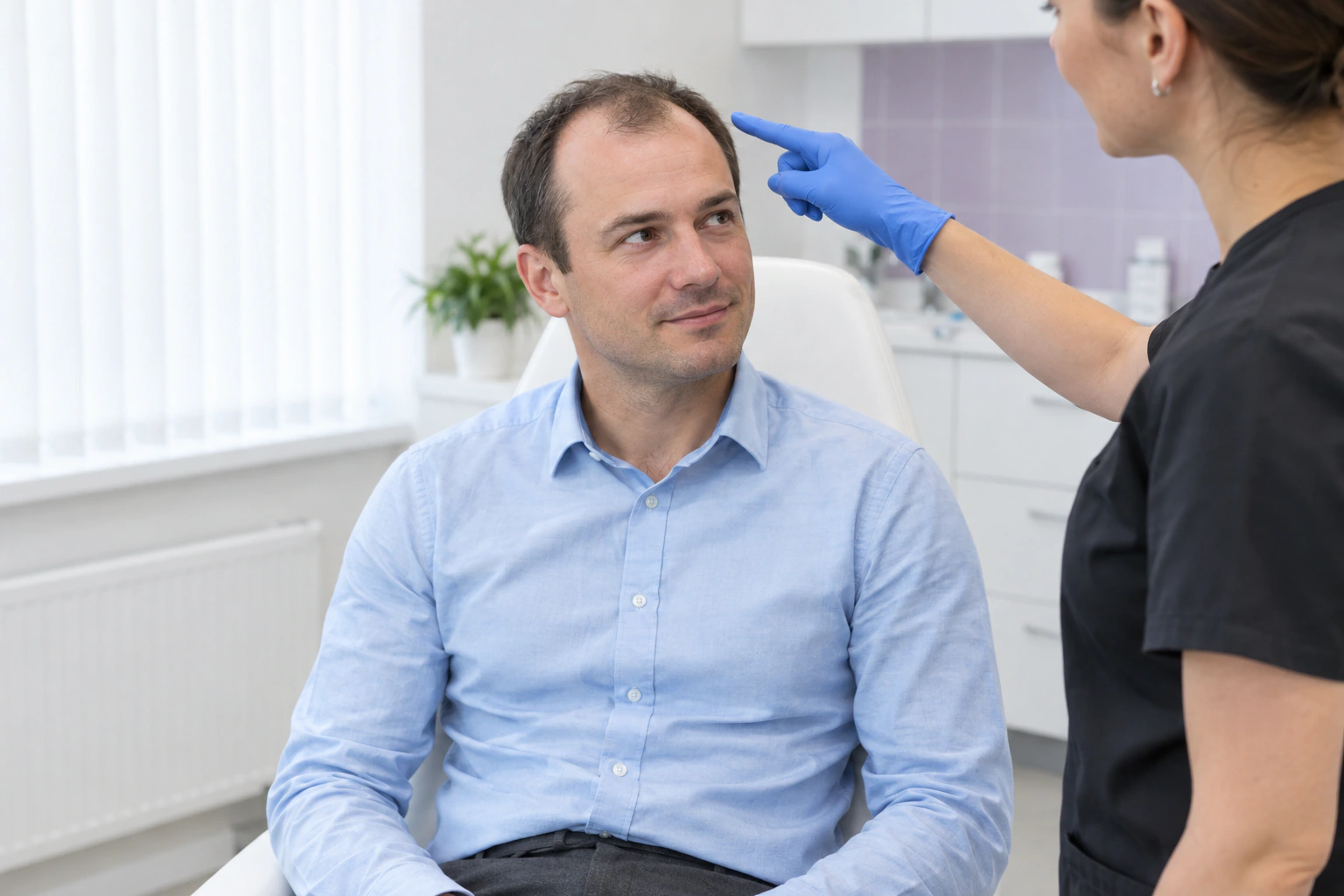

All we need is a phone number. Photos of the thinning area go to a coordinator in a messenger, a doctor examines them and answers whether a transplant would help you. Costs nothing, books nothing.

services
At the free consultation, after the grafts are counted, the cost is named and fixed in the contract.
suture-free graft extraction

$2,200$2,700
or $367/mo — 0% instalments for 6 months
Set the price nowimplantation without channels

$2,500$2,900
or $417/mo — 0% instalments for 6 months
Set the price nowcombined technique

$2,700$2,900
or $450/mo — 0% instalments for 6 months
Set the price now| The starting appraisal | Free |
|---|---|
| Eyebrow transplant, FUE | |
| Beard transplant, FUEinstalments $467/mo | |
| Hair trichopigmentation | |
| PRP therapy / session | $200 |
all included
From preparation for surgery to the 12-month check.
No add-on charges on the day of your surgery.
another two zones
Change the zone and nothing else changes: the grafts still come from the back of the head, the method is still FUE.
FUE method, free of cuts or stitches

Grafts are taken from the donor area at the back of the head and moved through micro-punctures of about 1 mm — no scars are left. The doctor and you choose the shape before the operation, taking your facial features into account. Transplanted hair grows for life, and the beard can be trimmed and styled as usual.
$2,800$3,000
or $467/mo — 0% instalments for 6 months
Set the price nowFUE method, free of cuts or stitches

The surgeon sketches the eyebrow shape during the initial consultation: you look through references together and the design follows your facial features. The hairs go in at the right angle, so the eyebrows look natural. It also helps where hairs have stopped growing after years of plucking.
$1,600$1,700
a procedure with no overnight stay, numbed locally
Set the price nowThe doctor will look at your donor area, count the grafts and show the result achievable in your case. The cost is quoted at the consultation and fixed in the contract.

Message our coordinator
Free online consultation · Reply within 15 minutes
Message us on TelegramMessage us on WhatsAppBy messaging us, you agree to our Privacy Policy
Process
From consultation to going home — all in one day

At this first appointment you hear how the FUE and DHI methods work, get answers to your questions, and have the donor zone examined by the doctor.

Book the operation by leaving a deposit; it can be paid by card during a clinic appointment or sent as an online transfer.

Patients in Mbarara prepare for the transplant by completing a set of pre-surgery tests, using the list and instructions the clinic provides.

Local anaesthetic is part of the procedure, and pain is not.

From the back of the scalp or the temples, follicles are collected, and the area heals without stitching.

Grafts are placed into the area of hair loss during this stage of the procedure.
The clinic sends you off with the necessary supplies and a full set of directions for a quick recovery.

The crusts are shed, the swelling recedes, the skin heals over

A normal stage. Only the hairs fall, the follicles stay in place

Growth arrives slowly, and you begin to notice it

Hair becomes thicker; the main volume and contour become visible

Full thickness arrives, with a natural-looking hairline

Free, before the operation, with no obligation.
Start with advicedoctors

Hair transplant doctor, trichologist, surgeon
10 years of experience

Dermatovenereologist, trichologist, surgeon
11 years in practice

Plastic surgeon
9 years in practice

Plastic surgeon
9 years in practice

Assistant
9 years in practice
The doctor will look at your donor area, count the grafts and say what result you can get.
Start with advicecoordinators
You do not deal with a queue of people: one coordinator covers everything up to recovery.

Patient support lead
Will stay with you before and after surgery
Takes care of the forms and of scheduling

Patient support lead
Will stay with you before and after surgery
Takes care of the forms and of scheduling

Patient support lead
Will stay with you before and after surgery
Takes care of the forms and of scheduling
Patient support lead
Will stay with you before and after surgery
Takes care of the forms and of scheduling













Anything you ask about is spelled out, and a suitable hour found
Message us on WhatsApp Send us a noteTypical queries

Yes, no difficulty at all. City Medical Centre treats patients from assorted cities and countries, and a consultation over the internet can be set up.
FUE costs $2,200 (≈ UGX 8,700,000), DHI costs $2,500 (≈ UGX 9,800,000), and the combined DHI+FUE method costs $2,700 (≈ UGX 11,000,000). The exact amount is confirmed at a free consultation after your grafts are counted, and it is fixed in the contract.
The surgery takes a single day, and you go home the same day.
Pain is not part of it; local anaesthesia is applied first.
FUE relies on tweezer harvesting with no incisions or stitches. DHI relies on Choi-pen implantation without channels. The combined DHI+FUE approach harvests by FUE and implants by DHI.
Grafts are counted by the doctor without any fee, and the donor zone is what the count is built upon.
Healing takes up to 0–10 days, after which a 2–4 week shed follows, and that is normal. Growth begins in earnest at 3–4 months, density arrives near 6–9 months; the whole result comes at 12–18 months.
Your procedure includes a lifetime hair-growth guarantee under contract.
The clinic holds a medical licence; care meets the standards and clinical guidelines
of the Ministry of Health.

Qualification papers of the doctors performing your surgery
View our paperworkAKC POMOSHCH LLC
the clinic's legal name
1057746096924
OGRN
7728536872
INN
A person in Mbarara keeps an ordinary week around the procedure. FUE and DHI need no cuts and no stitches, they are performed under local anaesthesia, and the whole operation occupies a single day.
A patient in Mbarara starts with photos, not with a trip: the free online consultation lets the doctor see the thinning area and count the grafts. Every day the clinic is available 24/7, so questions are answered without waiting for morning.
The wounds close in 0-10 days, the transplanted hairs fall out at 2-4 weeks as they are supposed to, growth starts at 3-4 months, visible density comes at 6-9 and the final picture at 12-18. Reviews are held at 1, 3, 6, 9 and 12 months by photo with a personal coordinator, under a lifetime growth guarantee.
Prices are in US dollars; the amount in brackets is an approximate conversion to UGX at the rate of 02.10.2026. The final price is fixed in your contract.
By messaging us, you agree to our Privacy Policy
What patients write after this operation. Reviews are translated from the original language.
Andrey M.
I had the operation a month ago. Before and after surgery they were always in touch and helped with questions about my tests. The operation itself went wonderfully, the staff are polite and masters of their craft, you feel you are in safe hands. I am recovering now, and they answer all my questions. I am happy and I recommend them!
DHI hair transplant
Pavel Sinitsyn
The best clinic of all the ones I was choosing from. No regrets at all! The result is simply amazing, I am thrilled. I recommend it to everyone: these people do great work and make people happy. Once again, a huge thank you to everyone. Roman, the head of the clinic, is the best: he was personally in touch with me and looked after my recovery. Thank you for making my dream come true.
FUE hair transplant
Maria Akopyan
I thought about an eyebrow transplant for a long time and finally went for it. At first I was afraid the result would look unnatural, but when I saw my new eyebrows I was delighted! They came out full and in harmony with my face. I can hardly believe that now I just wash my face and go, I have never felt so free. For anyone tired of constant make-up, a transplant is a real lifesaver!
Eyebrow transplant (FUE)
Alexander M.
I really wanted a thick beard, but I had problems with it. I tried every home remedy and minoxidil, and nothing helped. After a long search for the best clinic I settled on this one. Thank you so much for the service, I liked everything and now I am happy! I had the beard transplant 10 months ago and I am very pleased with the result. By the way, the music in the clinic was great, as far as I remember. A friend of mine has already come to you for a transplant on my advice and was also happy with the result. I wish you every success!
Beard transplant (FUE)
Vladimir Z.
I went to the clinic to see a trichologist and had a hair transplant. I really liked the doctor's approach, and all the recommendations helped. I want to point out that nobody tries to sell you extra services: they tell you things as they are, and if some treatment is not needed, they do not push it. Cosy and clean.
DHI hair transplant
Artem Popov
This may sound obvious, but a head of hair really changes everything in your life. You feel much more confident and go through life like a winner. And it is all thanks to the doctor at this clinic and to the staff who take care of their patients. Many thanks to the clinic for a happy life with new hair, for the comfortable conditions and for the professionalism during the hair transplant.
FUE hair transplant
Mbarara is a city in the Western Region of Uganda and the second largest city in the country after Kampala. It is the main commercial centre for most of the south western districts and hosts the district headquarters. City status was granted in May 2019 and took effect on 1 July 2020. For many residents a hair transplant is a practical question tied to a working life in a busy commercial hub: how to plan the procedure, how to manage recovery and how to protect the result.
The national census of August 2014 put the population at 195,013, and today the city is home to about 221,300 inhabitants. A city of this size has many people who deal with thinning at the temples, a receding frontal hair line, a bald crown or gaps in the beard, and most of them want a clear, honest explanation before deciding anything.
The procedure is done with the FUE or DHI technique. Grafts are taken from the back of the head, the donor area, and moved through micro-punctures of about 1 mm, so nothing scars over. This text is written for people in Mbarara who want to understand the whole path, from the first online conversation to the settled result.
You do not need to leave the city for the first stage. The consultation is free and online, and coordinators are available around the clock, 24/7, on Telegram and Telegram. You send clear photos of the front, the temples, the crown and the back of the head, and you describe your history of hair loss, any medication and any chronic conditions.
The doctor reviews the photos and discusses the shape with you before the operation, taking your facial features into account. This matters for a man who wants a natural frontal hair line, and for a woman who wants more density without changing the look of her face. Because you write from home, your family can join the conversation, which many people in Mbarara value before a personal decision.
The care is continuous. We stay with you from pre-op planning to 12 months later, with check-ups at months 1, 3, 6, 9 and 12. After the operation a coordinator will be on the phone 24/7, so a worry that appears in the evening or at the weekend does not have to wait.
Mbarara has a tropical savanna climate (Aw). The annual temperature varies by only about 2.4 °C, so there is no cold season to plan around and no dramatic switch between winter and summer. The difference in precipitation between the driest and wettest months is 94 mm. October has the most rainy days, around 22, and July the fewest, around 4.
For recovery this has practical consequences. In the first days the scalp is sensitive, so strong sun is the main thing to manage. A loose, clean, breathable cap recommended by your doctor and avoiding long hours in direct sun are sensible general rules. November is the most humid month, at about 77%, so keep the scalp clean and follow the washing instructions you are given.
In drier months, particularly around July when humidity is lowest at about 54%, the scalp and skin can feel drier, and your coordinator can explain how to care for the treated area. Heavy sweating, dusty roads and crowded public transport are best avoided during the early healing period, which is 0–10 days.
Because temperature barely changes through the year, the choice of season in Mbarara depends more on rain, sun and your own calendar than on cold or heat. Some patients prefer a period with fewer rainy days so that they are not walking long distances in wet weather with a healing scalp, while others prefer a rainy month because the sun is less intense.
The deciding factor is usually time. The first 0–10 days are for healing, so plan them in a quiet period. Then comes the stage when transplanted hairs let go, which is expected 2–4 weeks after the procedure. Choose a date that leaves room for these phases before a wedding, a graduation or an important meeting.
Ask the coordinator to help you build a calendar from your date. It should show the healing days, the shedding phase and the first visible growth, so you can see which events fall in which phase.
Mbarara is a commercial centre, so many people work in trade, services, administration and transport. Others study. The city is home to Mbarara University of Science and Technology, one of the nine public universities in Uganda, as well as University of Saint Joseph Mbarara, Bishop Stuart University and other institutions. Students and young professionals often want to fit the procedure into a break between terms or a quieter stretch at work.
For office work, the main question is how visible the early healing will be. For work outdoors, on the road or in a market, sun, dust and sweat are the main concerns. Talk to the doctor about your exact job: a shop assistant, a teacher, a driver and a farmer need slightly different plans.
The city has a 14 kilometre bypass around its northern half, and busy main roads mean many people commute daily. During the early days it is wise to avoid dusty, crowded journeys and to protect your head from knocks, for example when getting in and out of vehicles.
Patients in Mbarara often ask when they will see a result. The stages are: 0–10 days for healing, 2–4 weeks for normal shedding of transplanted hair, 3–4 months for new growth to start, 6–9 months for real density, and 12–18 months for the final result. The shedding is not a failure; the transplanted hairs let go, as expected, and then the hair comes back.
One patient wrote about his beard transplant: the result made him very happy, even growth began from about the 4th month, the transplanted hair took very well, no bald patches were left, and the beard became much thicker and denser, with the shape he had thought about for a long time. Every person is different, but this gives a useful picture of how the stages feel.
Transplanted hair grows for life, so you can trim and style the beard as usual. The settled look arrives at 12–18 months, and the check-ups at months 1, 3, 6, 9 and 12 let the team follow your progress step by step, all by remote contact from your home.
Sport and physical work are part of daily life for many, from football with friends to school sports at the city's boarding schools. After a transplant, avoid activities that cause heavy sweating, impact or friction on the scalp during the early healing period. Ask your coordinator exactly when you can return to training and which kinds of exercise to introduce first.
Family events such as weddings, church gatherings and graduations are an important part of social life, and gatherings often involve long hours outdoors and shared meals. Plan the operation so that the first visible stages do not coincide with a major event, or decide in advance how you will protect your head from the sun with a suitable cap.
Balanced meals support general health. It is sensible to avoid alcohol and smoking in the recovery period, following the instructions you receive. Drink enough water in warm weather, eat regular meals, and ask the doctor if you have any dietary concerns.
The name Mbarara comes from a colonial mispronunciation of Emburara, a tall grass that once covered the whole area. The place grew from that grassland into a city that came from behind and overtook Entebbe, Masaka, Gulu and Jinja. People here are used to planning for the long term, and a hair transplant (FUE / DHI) suits that habit: the final look takes 12–18 months, so it is a project to organise step by step, not a quick fix.
Since 2000 the centre has gained malls, arcades, plazas and hotels. Many residents work in these places, in customer-facing jobs where appearance counts. A man with a receding frontal hair line or a woman who wants more density often asks how the 0–10 days of healing can fit around a shop or hotel shift. Agree the plan with your employer or family before you choose the date.
Mbarara City has 6 divisions, Kakoba, Kamukuzi, Nyamitanga, Biharwe, Kakiika and Nyakayojo, and 23 wards. Some patients live close to the centre and others on the edges, near farmland, and the daily journey is different for each. Someone from Nyamitanga Hill or Kakoba, where universities are located, has a short walk. Someone from Kakiika or Biharwe may spend longer on the road.
For the first 0–10 days, plan your journeys in advance. Ask a relative to run errands, and when you must go out, keep to short trips with a clean, loose cap if the doctor advises it. Because the consultation and follow-up are remote, with check-ups at months 1, 3, 6, 9 and 12, you do not have to organise extra travel across the divisions to take part.
Mbarara lies at about 1,147 metres above sea level, and the sun at this height can feel strong even when the air is mild. The city draws its water from the River Rwizi, and the government has borrowed funds to bring water from the Kagera River because supply is not enough for the growing population. For a patient this means one practical step: before the operation, ask your coordinator how to wash the scalp, and keep clean water stored at home in case of supply interruptions during the early healing days.
July is the driest month, with only about 4 rainy days and the lowest humidity, about 54%. Dry air and dust from unpaved side roads are a reason to stay indoors more during the first days. October, with around 22 rainy days, brings mud and wet streets, so avoid long walks then. Neither month is forbidden, but each needs a different routine.
Mbarara has a Nile Breweries plant, a Coca-Cola bottling company, a steel plant, a roofing manufacturer, Lato Milk and a bakery. Factory and plant staff may deal with heat, dust and machinery, and long-distance trucks heading to Rwanda, Burundi and the Democratic Republic of the Congo use the roads around the city. If you work in production or logistics, describe your tasks to the doctor, so that you return to work only when safe for the treated area and the donor area at the back of the head.
Market traders and office staff face other questions: standing in the sun, sweating, or wearing a helmet or hard hat. Ask specifically when headwear is acceptable. The shedding of transplanted hair, expected 2–4 weeks after the procedure, can be planned around a quieter trading period, so you are not worried when it happens.
The city hosts Mbarara University of Science and Technology, founded in 1989, University of Saint Joseph, Bishop Stuart University, a Makerere University Business School campus and well-known boarding schools such as Ntare School, Mbarara High School and Maryhill High School. A student or young teacher often wants the procedure in a break between terms, so that the healing and early shedding fall outside lectures and sports days.
Mbarara also has a regional referral hospital that serves as a teaching hospital, and several private hospitals. Health professionals in the city tend to ask detailed questions about technique, so do the same: ask which method suits you, how many grafts the donor area can give, and how the 1 mm micro-punctures heal, and keep the answers in writing from your online chat.
In general terms, a good candidate has stable hair loss, enough healthy hair in the donor area at the back of the head, realistic expectations and good general health. Uncontrolled chronic illness, active scalp disease or a lack of donor hair may mean the procedure is not suitable or needs to wait. The doctor decides after reviewing your photos and history.
Body weight and general health also matter for any elective surgery. The WHO fact sheet on obesity and overweight explains why weight is a health factor worth discussing with a doctor beforehand.
Questions to ask the surgeon: which technique, FUE or DHI, suits me and why; how will the frontal hair line be designed for my face; how large is the donor area available; how should I care for the scalp in Mbarara's sun and rain; when can I return to work and sport; what happens at the check-ups at months 1, 3, 6, 9 and 12; and who do I contact at night if I am worried.
Yes. The consultation is free and online. You send photos and your history on Telegram or Telegram, and coordinators are available 24/7.
Grafts are taken from the back of the head, the donor area, and moved through micro-punctures of about 1 mm, so nothing scars over.
Transplanted hairs let go 2–4 weeks after the procedure, as expected. Hair comes back at 3–4 months, looks visibly thicker at 6–9 months, and the settled look comes at 12–18 months.
The first 0–10 days are for healing. Plan this time in a quiet period for work or study.
Avoid long direct sun exposure in the early period and use a loose, breathable cap if your doctor advises it. Follow the washing and care instructions you receive.
Temperature varies little through the year, so choose by rain, sun and your calendar. Leave time for the healing and shedding phases before important events.
Yes. Transplanted hair grows for life, so you can trim and style the beard as usual once your doctor allows it.
We stay with you from pre-op planning to 12 months later, with check-ups at months 1, 3, 6, 9 and 12. After the operation a coordinator will be on the phone 24/7.
People with unstable hair loss, too little donor hair, active scalp disease or uncontrolled health conditions may need to wait or choose another approach. The doctor decides after a review.
It can in the first 0–10 days. Avoid crowded, dusty journeys, keep the scalp clean as instructed and ask your coordinator which trips can wait.
Often yes. A break between terms leaves room for healing and for the shedding that is expected 2–4 weeks after the operation, so you can return to classes calmer.
Store clean water before the operation and ask your coordinator for the washing routine, so you can follow it even if the supply is interrupted.
July is driest, with low humidity and more dust, and October has the most rainy days. Each needs a different routine, which your coordinator can explain.
Page medically reviewed by Anastasia A. Kolesnik, hair transplant doctor. Review date: .

 Forceps
 Minimal


