



Before
12 months by now
2,800 grafts
FUE method
City Medical Centre
0% instalments
from $367/mo
Meeting and a quote — $0.
Real story
Before
12 months by now
The FUE method, no incisions or stitches. Grafts and forecast estimated and not billed — before you decide.
At no cost to you, no surgery booking required
Message our coordinator
Free online consultation · Reply within 15 minutes
Message us on TelegramMessage us on WhatsAppBy messaging us, you agree to our Privacy Policy
results
All cases come from real CMC patients.
Before
12 months by now
2,800 grafts
FUE method

Before
12 months by now
3,500 grafts
FUE method

Before
12 months by now
2,600 grafts
FUE method

Before
12 months by now
3,000 grafts
FUE method

Before
12 months by now
2,700 grafts
FUE method

Before
12 months by now
3,300 grafts
FUE method

Before
12 months by now
2,900 grafts
FUE method

Before
12 months by now
2,500 grafts
FUE method

Before
12 months by now
3,400 grafts
FUE method

Before
12 months by now
2,500 grafts
FUE method

Before
12 months by now
3,100 grafts
FUE method

Before
12 months by now
3,600 grafts
FUE method

Before
12 months by now
4,000 grafts
FUE method

Before
12 months by now
3,200 grafts
FUE method

Before
12 months by now
3,000 grafts
FUE method

Before
12 months by now
3,700 grafts
FUE method

Before
12 months by now
2,700 grafts
FUE method

Before
12 months by now
3,800 grafts
FUE method

Before
12 months by now
3,300 grafts
FUE method

Before
12 months by now
2,800 grafts
FUE method

Before
12 months by now
2,500 grafts
FUE method

Before
12 months by now
3,900 grafts
FUE method

Before
12 months by now
3,500 grafts
FUE method

Before
12 months by now
3,800 grafts
FUE method

Before
12 months by now
2,900 grafts
FUE method

Before
12 months by now
3,600 grafts
FUE method

Before
12 months by now
2,600 grafts
FUE method

Before
12 months by now
2,700 grafts
FUE method

Before
12 months by now
3,700 grafts
FUE method

Before
12 months by now
3,200 grafts
FUE method

Before
12 months by now
3,000 grafts
FUE method

Before
12 months by now
2,800 grafts
FUE method

Before
12 months by now
4,000 grafts
FUE method

Before
12 months by now
3,400 grafts
FUE method

Before
12 months by now
2,900 grafts
FUE method

Before
12 months by now
3,100 grafts
FUE method

Before
12 months by now
2,600 grafts
FUE method

Before
12 months by now
3,300 grafts
FUE method

Before
12 months by now
3,900 grafts
FUE method

Before
12 months by now
3,500 grafts
FUE method

Before
12 months by now
2,700 grafts
FUE method

Before
12 months by now
3,800 grafts
FUE method

Before
12 months by now
3,200 grafts
FUE method

Before
12 months by now
3,000 grafts
FUE method

Before
12 months by now
2,800 grafts
FUE method

Before
12 months by now
3,100 grafts
FUE method

Before
12 months by now
3,600 grafts
FUE method
Comparison
The clinic works with three graft transfer technologies: classic FUE, suture-free DHI and a combined protocol. Implantation technique, tissue trauma and graft survival differ, so compare before choosing.
Classic technique without incisions or stitches

$2,200
$2,700
Graft implantation technique
ForcepsGraft trauma
MinimalHair's natural angle
NaturalGraft survival
98–100%Suitable for
Androgenetic alopeciaImplantation with a Choi pen, no sutures

$2,500
$2,900
Graft implantation technique
DHI pen (Choi implanter)Graft trauma
MinimalHair's natural angle
NaturalGraft survival
98–100%Suitable for
DensificationFUE extraction, DHI pen implantation

$2,700
$2,900
Graft implantation technique
FUE extraction, DHI implantationGraft trauma
MinimalHair's natural angle
NaturalGraft survival
98–100%Suitable for
Densification for androgenetic alopeciaSurvival and trauma values are average figures for each method, shown as a guide: the exact numbers depend on the transplant area and the patient's own features, and the doctor confirms them at the consultation.
Set up an assessment


















about the clinic
Unhurried care, comfortable rooms and current equipment

Nothing is left unclear, and the consultation is arranged for a suitable hour
Message us on WhatsApp Leave a requestNobody will push you towards an operation you do not need — the doctor says it at the consultation, and nothing is spent for nothing. The situations where a transplant genuinely helps are set out below.
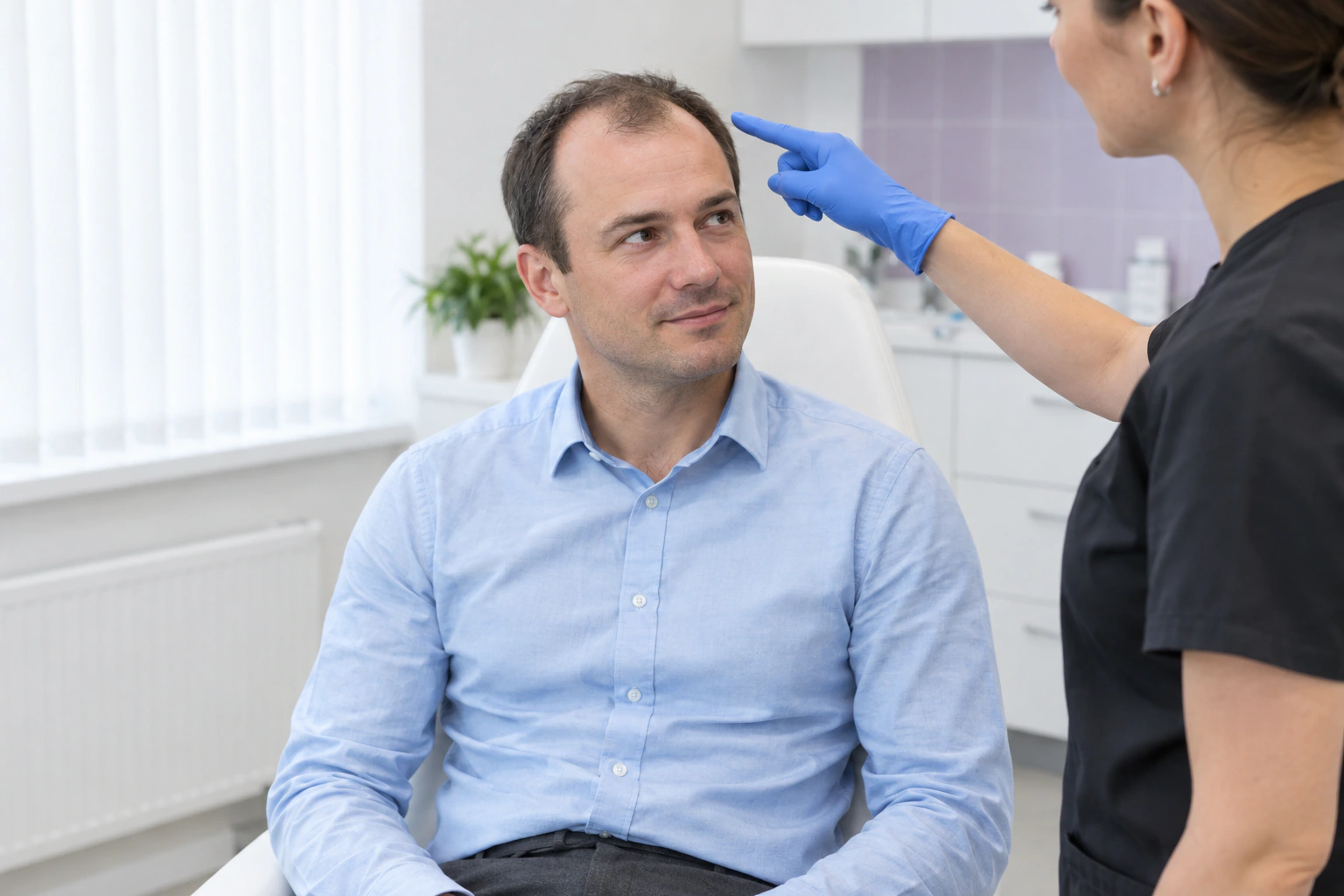

Nothing but a number is required. A coordinator will request pictures of the thinning zone in a messenger and a doctor will answer whether a transplant would help. Free, and no operation is arranged.

services
At the free consultation the grafts are counted, the cost is quoted and fixed in the contract.
suture-free graft extraction

$2,200$2,700
or $367/mo — 0% instalments for 6 months
Hold your priceimplantation without channels

$2,500$2,900
or $417/mo — 0% instalments for 6 months
Hold your pricecombined technique

$2,700$2,900
or $450/mo — 0% instalments for 6 months
Hold your price| The first sit-down | Free |
|---|---|
| Eyebrow transplant, FUE | |
| Beard transplant, FUEinstalments $467/mo | |
| Hair trichopigmentation | |
| PRP therapy / session | $200 |
all included
From surgery preparation to 12 months of follow-up.
No unexpected surcharges on the day of surgery.
two extra zones
A hair transplant is not just the scalp. The same grafts from the back of the head, the same FUE method — only the area changes.
The FUE method, no incisions used

The donor area is the back of the head; grafts move from there through micro-punctures of about 1 mm and no scars are left. The shape is decided together with the doctor before the operation, taking your facial features into account. Transplanted hair grows for life: the beard can be trimmed and styled as usual.
$2,800$3,000
or $467/mo — 0% instalments for 6 months
Hold your priceThe FUE method, no incisions used

At the first appointment the surgeon draws the contour, you compare references together and your facial proportions guide the design. Implanting hairs at the natural growth angle is what makes brows convincing. It also helps brows thinned by years of plucking.
$1,600$1,700
an op you walk out of, under local anaesthesia
Hold your priceThe doctor will examine your donor area, count the grafts and show what result is achievable in your case. The cost is named at the consultation and fixed in the contract.

Message our coordinator
Free online consultation · Reply within 15 minutes
Message us on TelegramMessage us on WhatsAppBy messaging us, you agree to our Privacy Policy
Process
From consultation to going home — all in one day

The initial consultation is where the doctor explains FUE and DHI in detail, answers your questions, and creates a personal operation plan. It's completely free.

The date is yours after a deposit; pay with a card at the clinic if that is convenient, or handle it online.

The clinic tells you which tests are required and how to go about them, so nothing is missed before the operation.

Local anaesthetic is administered, and from then on the operation is painless.

The harvesting stage takes grafts from either the back of the head or the temples, with no need for stitches.

For patients in Ijebu Ode, the surgeons implant the grafts directly into the balding area.
Healing is not left to chance: the clinic provides the supplies and explains how they are used.

The crusts come off, the swelling subsides, the area slowly heals

A normal stage. Only the hairs shed, the follicles stay in place

Fresh hairs push up slowly, the difference becomes clear

The hair grows stronger, the main volume and shape show

Final density and a natural hairline are in place

Free, before the operation and free of obligations.
Set up an assessmentdoctors

Hair transplant doctor, trichologist, surgeon
10 years in practice

Dermatovenereologist, trichologist, surgeon
11 years in practice

Plastic surgeon
9 years in practice

Plastic surgeon
9 years in practice

Assistant
9 years in practice
The doctor will examine your donor area, count the grafts and say what result is possible.
Set up an assessmentcoordinators
Your own coordinator handles everything from the first enquiry to full recovery.

Patient support officer
Is on hand through preparation and healing
Helps with the forms and the arrangements

Patient support officer
Is on hand through preparation and healing
Helps with the forms and the arrangements

Patient support officer
Is on hand through preparation and healing
Helps with the forms and the arrangements
Patient support officer
Is on hand through preparation and healing
Helps with the forms and the arrangements













Nothing is left unclear, and the consultation is arranged for a suitable hour
Message us on WhatsApp Leave a requestStandard questions

Yes. City Medical Centre has patients scattered across several countries, and you are offered a consultation online beforehand.
FUE is $2,200 (≈ ₦2,950,000), DHI is $2,500 (≈ ₦3,350,000), combined DHI+FUE is $2,700 (≈ ₦3,600,000). A free consultation with a graft count gives you the exact, contract-fixed price.
One day, nothing more, and you are home when it is done.
No. Local anesthesia is administered and the session is painless.
FUE is cut-free graft extraction by tweezer. DHI is direct implantation with a Choi pen, skipping channel-making. The combined technique takes grafts by FUE and places them using the DHI method.
The count is personal to each patient, determined free of charge by the doctor after a donor zone review.
Skin healing: 0–10 days. Then, at 2–4 weeks, transplanted hairs shed as expected. Regrowth is evident from 3–4 months, density is apparent by 6–9 months, so the outcome is final at 12–18 months.
A contract-backed, lifetime guarantee of hair growth comes with every procedure.
The clinic holds a medical licence, care is provided to the standards and clinical guidelines
of the Ministry of Health.

The diplomas and certificates of the operating doctors
Check our paperworkAKC POMOSHCH LLC
the clinic's legal entity
1057746096924
OGRN
7728536872
INN
Two methods are used for a resident of Ijebu Ode, FUE and DHI, and both go without cuts and stitches, under local anaesthesia, within one day. Graft survival is 98-100 %, and a price from $2,200 (≈ ₦2,950,000) appears in the contract after a free count of the grafts.
Nothing is signed and nothing is paid at the start in Ijebu Ode. The online consultation is free: the doctor sees pictures of the affected zone and tells you if a transplant helps. The clinic is in touch 24/7.
Afterwards it goes like this: 0-10 days of healing, 2-4 weeks to the normal shedding of the transplanted hairs, 3-4 months to first growth, 6-9 to density and 12-18 to the final result. Check-ups at 1, 3, 6, 9 and 12 months, photos with a personal coordinator, growth guaranteed for life.
Prices are in US dollars; the amount in brackets is an approximate conversion to NGN at the rate of 02.10.2026. The final price is fixed in your contract.
By messaging us, you agree to our Privacy Policy
What patients write after this operation. Reviews are translated from the original language.
Andrey M.
I had the operation a month ago. Before and after surgery they were always in touch and helped with questions about my tests. The operation itself went wonderfully, the staff are polite and masters of their craft, you feel you are in safe hands. I am recovering now, and they answer all my questions. I am happy and I recommend them!
DHI hair transplant
Pavel Sinitsyn
The best clinic of all the ones I was choosing from. No regrets at all! The result is simply amazing, I am thrilled. I recommend it to everyone: these people do great work and make people happy. Once again, a huge thank you to everyone. Roman, the head of the clinic, is the best: he was personally in touch with me and looked after my recovery. Thank you for making my dream come true.
FUE hair transplant
Maria Akopyan
I thought about an eyebrow transplant for a long time and finally went for it. At first I was afraid the result would look unnatural, but when I saw my new eyebrows I was delighted! They came out full and in harmony with my face. I can hardly believe that now I just wash my face and go, I have never felt so free. For anyone tired of constant make-up, a transplant is a real lifesaver!
Eyebrow transplant (FUE)
Alexander M.
I really wanted a thick beard, but I had problems with it. I tried every home remedy and minoxidil, and nothing helped. After a long search for the best clinic I settled on this one. Thank you so much for the service, I liked everything and now I am happy! I had the beard transplant 10 months ago and I am very pleased with the result. By the way, the music in the clinic was great, as far as I remember. A friend of mine has already come to you for a transplant on my advice and was also happy with the result. I wish you every success!
Beard transplant (FUE)
Vladimir Z.
I went to the clinic to see a trichologist and had a hair transplant. I really liked the doctor's approach, and all the recommendations helped. I want to point out that nobody tries to sell you extra services: they tell you things as they are, and if some treatment is not needed, they do not push it. Cosy and clean.
DHI hair transplant
Artem Popov
This may sound obvious, but a head of hair really changes everything in your life. You feel much more confident and go through life like a winner. And it is all thanks to the doctor at this clinic and to the staff who take care of their patients. Many thanks to the clinic for a happy life with new hair, for the comfortable conditions and for the professionalism during the hair transplant.
FUE hair transplant
Ijebu Ode is a city and Local government area in Ogun State, South West Nigeria, close to the A121 highway. It lies 110 km by road northeast of Lagos and within 100 km of the Atlantic Ocean, in the eastern part of Ogun State. The city has an estimated population of 394,246 (2024). For a procedure such as FUE or DHI hair transplantation, this means a busy regional centre where many people balance work, family and community life, and where a planned procedure has to fit around all three.
Ijebu Ode has been the capital of the Ijebu kingdom since pre-colonial times, and by the 16th century it was established as the chief town. People from Ijebu Ode share a nationwide reputation as natural entrepreneurs. Many patients here run a business, a shop or a trade, and their first question is usually practical: how many days away from the counter, and when will the result look natural?
City Medical Centre works with patients from Ijebu Ode through a free online consultation. You send photos of the donor area and the areas of thinning, describe your history and goals, and a coordinator answers on Telegram or Telegram. Coordinators are available 24/7, so you can write after the shop closes or late in the evening.
Ijebu Ode has a tropical savanna climate (Köppen: Aw) and a warm tropical climate overall. For a hair transplant, the main climate questions are sun, heat, sweat and dust. During the first days after FUE or DHI, the treated area should be protected from direct sun, and you should follow the surgeon's advice on headwear: loose, clean and breathable, nothing that rubs the grafts.
Heat makes sweating and swelling feel worse. Plan the first days indoors in a cool, ventilated room, sleep with the head slightly raised if the surgeon advises it, and avoid strenuous outdoor work while the skin heals. The medical plan allows 0–10 days for healing, and a hot, bright day is a good reason to stay in during that window.
Dust on roads and building sites is part of daily life in many Nigerian towns. Keep the scalp clean as instructed, avoid dusty places in the early phase, and ask the surgeon exactly when washing, wearing a cap and returning to normal activity are acceptable.
The city's climate is warm throughout the year, so there is no perfect season, only a sensible one. Choose a period when you can rest for the first days, avoid long hours in the sun, and keep your calendar free of major obligations. Many people prefer a quieter stretch in their work or trading year.
Think also about the milestones that follow. Transplanted hairs let go after 2-4 weeks, as expected, and hair comes back after 3-4 months. If you have a wedding, a naming ceremony, a festival or a family gathering in the diary, count back from that date and keep in mind that a settled look takes 12–18 months.
During the online consultation, the coordinator helps you place the procedure on a realistic timeline, so that the early shedding phase does not coincide with an event where you want to feel fully at ease.
Ijebu Ode's cultural food is Ikokore, a dish many families prepare for gatherings. Shared meals and community events are a big part of local life, and patients often want to know how soon they can attend them comfortably. Plan the procedure so that the first days of healing do not fall on a major family occasion.
For work, the answer depends on your job. Desk work and shop work in a shaded place are easier to resume than work that involves heat, dust, heavy lifting or heavy sweating. Tell the surgeon exactly what you do all day, and ask for a return-to-work plan matched to it rather than a general one.
Students and young professionals should consider the same points: clean headwear that suits the setting, a plan for the visible early phase, and a realistic view of when the hair will look thicker. Visible thickening comes at 6-9 months, so patience is part of the plan.
The most common questions are about naturalness, the donor area and the beard. Grafts are taken from the back of the head, the donor area, and moved through micro-punctures of about 1 mm, so nothing scars over. The doctor discusses the shape with you before the operation, taking your facial features into account.
Another frequent question is whether the result lasts. Transplanted hair grows for life: for a beard transplant, trim and style the beard as usual. Another is the timeline: 0–10 days for healing, 2–4 weeks for normal shedding of transplanted hair, 3–4 months for new growth to start, 6–9 months for real density, and 12–18 months for the final result.
One patient described the outcome like this: the result truly made him very happy. From about the 4th month active, even growth began, the transplanted hair took very well, the beard looked as natural as possible, no bald patches were left, and the beard became much thicker and denser, with the shape he had thought about for a long time.
A good candidate has a healthy donor area that can supply enough grafts, realistic goals and a clear understanding of the timeline. The same logic applies to beard and eyebrow work. The surgeon decides after reviewing photos and your medical history.
Some conditions call for caution or postponement: unstable scalp conditions, poorly controlled chronic illness, or ongoing hair loss that has not yet been assessed. Be open about medicines, previous operations and allergies. A responsible surgeon will tell you if waiting, or a different approach, is the better choice.
Weight and general health also matter for any operation. The WHO fact sheet on obesity and overweight is a reminder that general health is part of planning surgery, and you should discuss it openly with the medical team.
Prepare your questions before the call. Ask how many grafts the plan involves, how the front line will be designed for your face, and why FUE or DHI suits your case. Ask who performs each stage and what happens if growth is uneven.
Ask for the aftercare in writing: washing, sleeping position, sun and sweat, headwear, and when to avoid dusty places. Ask when you can resume work, exercise and swimming, whether in a pool or in the sea, since the Atlantic coast is within 100 km of the city.
Ask also about follow-up. We stay with you from pre-op planning to 12 months later, with check-ups at months 1, 3, 6, 9 and 12, and a coordinator will be on the phone 24/7.
Preparation starts well before the operation day. Ijebu Ode is a city with a warm tropical climate, and that shapes small decisions: which loose shirts you will wear so nothing is pulled over the scalp, which clean cap suits the setting, and where you will rest in the coolest part of the home. Settle these details early so that the healing days are calm.
Gather your own information too. Write down the medicines you take, any allergies, earlier operations and how long hair loss has been going on. Take clear photos in daylight of the front, top, crown and back of the head. A coordinator on Telegram or Telegram, available 24/7, can tell you if any photo needs to be retaken.
Talk to your household as well. Relatives who know the schedule can help with errands, cover a shift at the shop and answer visitors, which lets you keep the head protected and the routine simple during the first days.
Life in Ijebu Ode is social. A city that has been the capital of the Ijebu kingdom since pre-colonial times keeps strong family and community ties, and visits, gatherings and ceremonies are a natural part of the year. That is why it helps to think about who will see you and when.
The early phase is the one people notice most. The 0–10 days of healing show small scabs and redness, and the normal shedding at 2-4 weeks can make the area look thinner for a while. This is expected and does not mean the procedure failed. Knowing it in advance spares you worry and unnecessary comments from curious relatives.
If a major event is close, ask the surgeon whether to move the date. A calm plan is better than a rushed one, and the coordinator can help you compare the calendar with the stages of growth.
The middle months are where most patients need support. New growth starts at 3-4 months, but the hair is thin at first, and real density comes at 6-9 months. The settled look needs 12–18 months. Mark these stages in your phone so you judge progress against the right milestone, not against a photo from last week.
Keep a simple photo diary: same light, same angles, once a month. Photos make slow change visible and give the surgeon something concrete at the check-ups at months 1, 3, 6, 9 and 12.
Entrepreneurial habits help here: treat the process like a project with milestones, review it at each stage and ask questions early when something looks unusual.
Ijebu Ode is made up of three parts: Iwade, Ijasi and Porogun. Italupe is a ward within Iwade. Around the town sit many smaller settlements known as Egure, such as Odo-Agamegi, Ogbo, Imomo, Imawen, Erunwon and Ibefun. Many people live in one of these areas and work in another, so a patient's week often involves moving between them.
When you plan a hair transplant (FUE or DHI), map your own week across these areas. Note which days involve the most walking, waiting in the sun or sitting in a crowded vehicle. Choose the first 0–10 days of healing for a time when you can stay in one quiet place close to home, and tell relatives in your ward when you will be resting.
Neighbours in a close-knit ward notice a change quickly. A short, friendly explanation that you are having a medical procedure and will look a little different for some weeks is usually enough.
Ijebu Ode is the trade centre of a farming region where yam, cassava, grain, tobacco and cotton are grown. Traders, buyers, transporters and farmers pass through the town, and many patients work in this chain, in the open air or in busy market surroundings.
That kind of work is the main planning question after a hair transplant. Heavy loading, long hours in direct sun and dusty yards are all poor companions for freshly treated skin. Ask the surgeon for a clear date for returning to each task, and consider handing the heaviest part of the job to a colleague or relative for the early phase.
If your income depends on being present, plan the operation for a slower point in your trading cycle, so you can let the hairs shed at 2-4 weeks without pressure to meet customers every day.
Ojude Oba is held two days after the Ileya festival, and horses with vintage carts are paraded through the streets in the morning before riding to the palace of the king. It is regarded as one of the biggest festivals in West Africa, and people of Ijebu come together to honour their king. Many dress with great care for it and want to look their best.
Agemo comes out every July, when the 16 Agemos meet at Ijebu-Ode before moving to Imodi Mosan. The city fills with visitors and relatives.
Count back from these dates. Hair comes back after 3-4 months and looks visibly thicker at 6-9 months, so an operation done shortly before a festival means you would attend during the shedding phase. For the festival you want to enjoy fully, plan the procedure many months ahead and aim for the following year.
Sungbo's Eredo, one of the largest ramparts in West Africa, and Imagbon are among the places that give Ijebu Ode its historical character. Walking the earthworks or visiting such places means hours outdoors in the sun.
Once the surgeon confirms the healing window has passed, such outings can return to your weekends, with a clean breathable cap and sun protection as advised. Until then, look at photos instead. Keep these plans as a small goal that makes the waiting easier.
Students and teachers from schools such as Ijebu Ode Grammar School can use the school calendar in the same way: choose a break, keep the early weeks calm and return when the scalp looks settled.
You contact the coordinator on Telegram or Telegram from home. You send clear photos of the front, top, crown and back of the head, and answer questions about your health. The consultation is free and does not commit you to anything.
The medical team reviews the case, explains whether the procedure suits you, and outlines the method, the expected stages and the follow-up schedule. You can ask as many questions as you need, at any hour, and bring family members into the conversation.
After the operation, you stay in touch with the coordinator, who helps with questions during the shedding phase and at each check-up. This continuous contact is especially useful in the months when the scalp looks unfinished and reassurance matters.
Yes. The online consultation is free. Write to a coordinator on Telegram or Telegram and send photos of the donor area and the thinning zones.
Yes. A coordinator will be on the phone 24/7, so you can write at any hour.
Grafts are taken from the back of the head, the donor area, and moved through micro-punctures of about 1 mm, so nothing scars over.
Heat, sun, sweat and dust call for care. Protect the area, wear loose clean headwear as advised and rest in a cool place during the 0–10 days of healing.
Transplanted hairs let go after 2-4 weeks, as expected. Hair comes back after 3-4 months.
Visible thickening is expected at 6-9 months, and the settled look at 12–18 months.
Transplanted hair grows for life. For a beard transplant, trim and style the beard as usual.
The doctor discusses the shape with you before the operation, taking your facial features into account.
We stay with you from pre-op planning to 12 months later, with check-ups at months 1, 3, 6, 9 and 12.
Yes. You can bring a family member into the conversation on Telegram or Telegram so that questions about the stages and aftercare are heard by everyone who will help you.
Clear daylight photos of the front, top, crown and back of the head, so the team can assess the donor area and the thinning zones.
Yes. Transplanted hairs let go after 2-4 weeks, as expected, and hair comes back after 3-4 months.
Choose a period away from Ojude Oba, Agemo in July and other major gatherings, with a quiet spell at work. The settled look takes 12–18 months, so a calm start matters more than the exact month.
Ask the surgeon for a return-to-work plan matched to your tasks. Heat, dust, heavy lifting and sweat call for extra care during the 0–10 days of healing.
Better to plan so that the festival does not fall in the early phase. Transplanted hairs let go after 2-4 weeks, and hair comes back after 3-4 months.
No. Whether you live in Iwade, Ijasi, Porogun or a nearby settlement, you contact the coordinator on Telegram or Telegram, available 24/7.
Page medically reviewed by Anastasia A. Kolesnik, hair transplant doctor. Review date: .

 Forceps
 Minimal


