



before op
12 months on
2,800 grafts
FUE method
City Medical Centre
0% instalments
from $367/mo
First talk and pricing — $0.
Our case
before op
12 months on
FUE method, no incisions or stitches. Grafts and outcome forecast totted up at no cost to you — before you decide.
With no fee, no surgery booking required
Message our coordinator
Free online consultation · Reply within 15 minutes
Message us on TelegramMessage us on WhatsAppBy messaging us, you agree to our Privacy Policy
results
Every one of these is a real CMC patient.
before op
12 months on
2,800 grafts
FUE method

before op
12 months on
3,500 grafts
FUE method

before op
12 months on
2,600 grafts
FUE method

before op
12 months on
3,000 grafts
FUE method

before op
12 months on
2,700 grafts
FUE method

before op
12 months on
3,300 grafts
FUE method

before op
12 months on
2,900 grafts
FUE method

before op
12 months on
2,500 grafts
FUE method

before op
12 months on
3,400 grafts
FUE method

before op
12 months on
2,500 grafts
FUE method

before op
12 months on
3,100 grafts
FUE method

before op
12 months on
3,600 grafts
FUE method

before op
12 months on
4,000 grafts
FUE method

before op
12 months on
3,200 grafts
FUE method

before op
12 months on
3,000 grafts
FUE method

before op
12 months on
3,700 grafts
FUE method

before op
12 months on
2,700 grafts
FUE method

before op
12 months on
3,800 grafts
FUE method

before op
12 months on
3,300 grafts
FUE method

before op
12 months on
2,800 grafts
FUE method

before op
12 months on
2,500 grafts
FUE method

before op
12 months on
3,900 grafts
FUE method

before op
12 months on
3,500 grafts
FUE method

before op
12 months on
3,800 grafts
FUE method

before op
12 months on
2,900 grafts
FUE method

before op
12 months on
3,600 grafts
FUE method

before op
12 months on
2,600 grafts
FUE method

before op
12 months on
2,700 grafts
FUE method

before op
12 months on
3,700 grafts
FUE method

before op
12 months on
3,200 grafts
FUE method

before op
12 months on
3,000 grafts
FUE method

before op
12 months on
2,800 grafts
FUE method

before op
12 months on
4,000 grafts
FUE method

before op
12 months on
3,400 grafts
FUE method

before op
12 months on
2,900 grafts
FUE method

before op
12 months on
3,100 grafts
FUE method

before op
12 months on
2,600 grafts
FUE method

before op
12 months on
3,300 grafts
FUE method

before op
12 months on
3,900 grafts
FUE method

before op
12 months on
3,500 grafts
FUE method

before op
12 months on
2,700 grafts
FUE method

before op
12 months on
3,800 grafts
FUE method

before op
12 months on
3,200 grafts
FUE method

before op
12 months on
3,000 grafts
FUE method

before op
12 months on
2,800 grafts
FUE method

before op
12 months on
3,100 grafts
FUE method

before op
12 months on
3,600 grafts
FUE method
Comparison
Our work relies on three graft transfer technologies: classic FUE, suture-free DHI and a combined protocol. Compare implantation technique, tissue trauma and graft survival, then choose knowingly.
Classic method requiring no cuts or sutures

$2,200
$2,700
Graft implantation technique
ForcepsGraft trauma
MinimalA natural angle for hair
NaturalGraft survival
98–100%Suitable for
Androgenetic alopeciaStitch-free implantation with a Choi pen

$2,500
$2,900
Graft implantation technique
Choi implanter, DHI penGraft trauma
MinimalA natural angle for hair
NaturalGraft survival
98–100%Suitable for
DensificationExtraction by FUE, DHI implant

$2,700
$2,900
Graft implantation technique
Extraction by FUE, DHI implantGraft trauma
MinimalA natural angle for hair
NaturalGraft survival
98–100%Suitable for
Androgenetic alopecia and densificationSurvival and trauma figures are averaged per method and given as a guide: the exact numbers follow the transplant area and the patient's individual features, and the doctor clarifies them at the consultation.
Book an appointment


















about the clinic
New equipment, quiet rooms and attention for every patient

We will answer your questions and find a consultation time that suits you
Message us on WhatsApp Make an enquiryIf surgery is not the answer for you, you will hear it straight at the consultation — no money wasted. The situations in which a transplant genuinely helps are listed below.
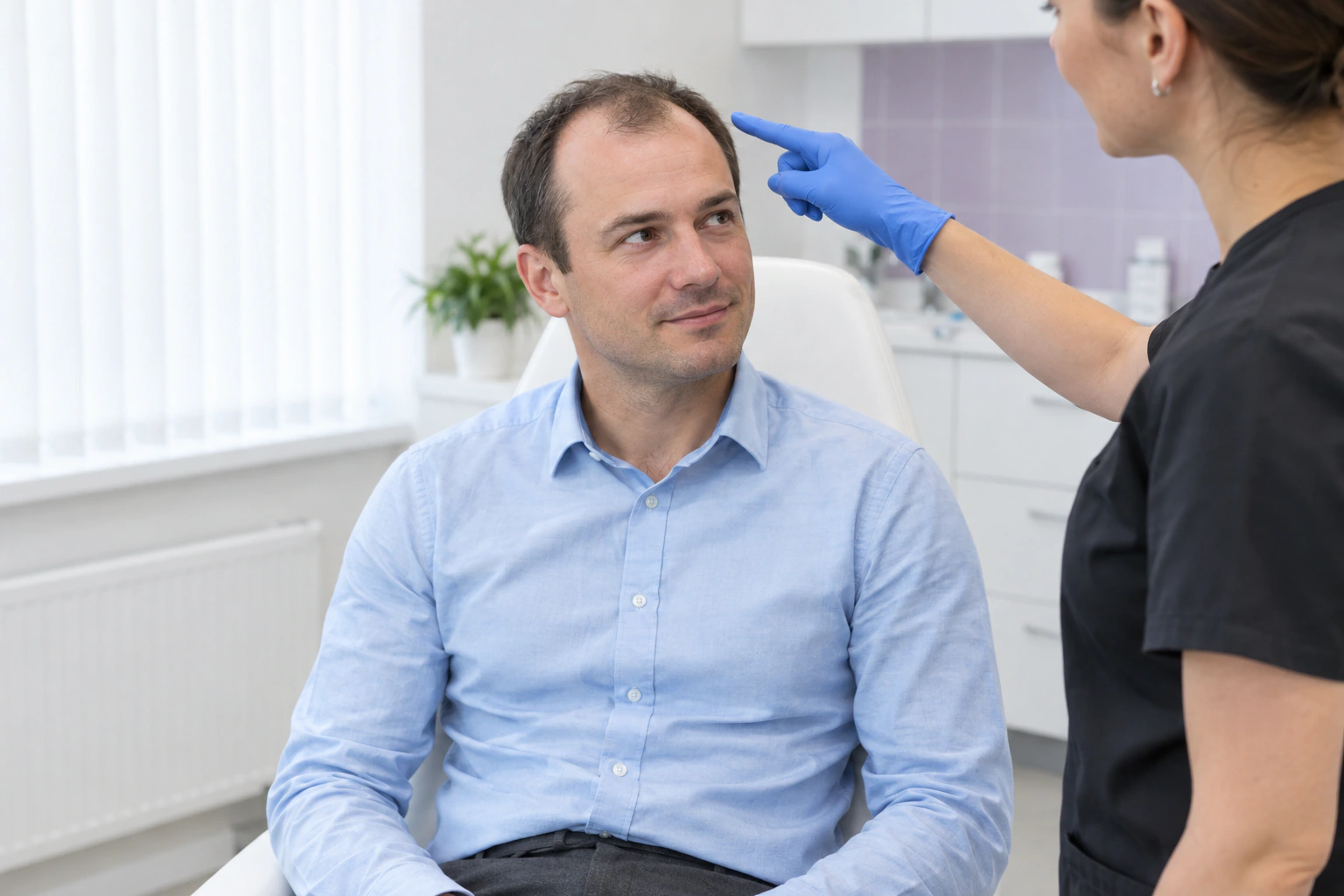

Leave a number: photos go to a coordinator in a messenger, the doctor looks and says if a transplant will help you. Free, no booking.

services
The figure is set at the free consultation once the grafts have been counted, and the contract keeps it that way.
suture-free graft extraction

$2,200$2,700
or $367/mo — 0% instalments for 6 months
Freeze your quoteimplantation without channels

$2,500$2,900
or $417/mo — 0% instalments for 6 months
Freeze your quotecombined technique

$2,700$2,900
or $450/mo — 0% instalments for 6 months
Freeze your quote| The doctor's first look | Free |
|---|---|
| Eyebrow transplant, FUE | |
| Beard transplant, FUEinstalments $467/mo | |
| Hair trichopigmentation | |
| PRP therapy / session | $200 |
all included
From preparing for surgery to 12 months of follow-up.
No one asks you to pay anything else that day.
two added zones
Scalp or another zone, the source is still the back of the head and the technique is still FUE.
FUE method, free of cuts or stitches

Grafts taken from the back of the head, the donor area, move through micro-punctures of about 1 mm, with no scars left. The doctor discusses the shape with you before the operation, taking your facial features into account. The hair grows for life once transplanted; the beard can be trimmed and styled as usual.
$2,800$3,000
or $467/mo — 0% instalments for 6 months
Freeze your quoteFUE method, free of cuts or stitches

Shape first, hairs second: at the first consultation the surgeon draws the brow line, reference photos are reviewed with you, and your facial proportions define the line. Each hair sits at the growth angle, which is why the brows look genuine. It also suits growth lost to long years of plucking.
$1,600$1,700
a procedure you go home from, numbed locally
Freeze your quoteThe donor zone is examined and measured in grafts, and the realistic outcome is described to you. The figure comes at the end of the consultation and goes straight into the contract.

Message our coordinator
Free online consultation · Reply within 15 minutes
Message us on TelegramMessage us on WhatsAppBy messaging us, you agree to our Privacy Policy
Process
From consultation to going home — all in one day

You sit down with the doctor, hear what FUE and what DHI involve, raise any questions you like, and have your donor zone assessed.

Patients in Eldoret reserve their date by paying a deposit, either by card at the clinic or online, with the terms set in a medical services contract.

The clinic tells you which tests are required and how to go about them, so nothing is missed before the operation.

This step numbs the treatment area with local anaesthesia, making the operation painless.

Extraction is done from behind the head or from the temples, and stitches play no part in it.

The surgical team fits the harvested grafts into the area without hair.
This step supports fast healing, with the clinic providing all the necessary items and full instructions.

The crusts go, the swelling goes down, the area gradually recovers

Normal stage. Only the hairs fall out, the follicles remain in place

Growth arrives slowly, and you begin to notice it

The hair is becoming thicker, the volume and contour are visible

Here the final density and natural hairline form

Free, before surgery, with nothing binding you.
Book an appointmentdoctors

Hair transplant doctor, trichologist, surgeon
10 years in practice

Dermatovenereologist, trichologist, surgeon
11 years of experience

Plastic surgeon
9 years of experience

Plastic surgeon
9 years of experience

Assistant
9 years of experience
The doctor examines the donor zone, counts what is available and explains the outcome you can expect.
Book an appointmentcoordinators
We assign you a personal coordinator: they guide you from the first enquiry to recovery.
Patient support lead
Stays available the whole way through
Gets the forms done and the times fixed
Patient support lead
Stays available the whole way through
Gets the forms done and the times fixed
Patient support lead
Stays available the whole way through
Gets the forms done and the times fixed
Patient support lead
Stays available the whole way through
Gets the forms done and the times fixed













We will answer your questions and find a consultation time that suits you
Message us on WhatsApp Make an enquiryRegular questions

Yes. The clinic's doors are open to people from far-off cities and other countries, and an online consultation can be arranged.
Prices start at $2,200 (≈ KES 285,000) for FUE, $2,500 (≈ KES 325,000) for DHI, and $2,700 (≈ KES 350,000) for the combined method. Your final price is set after a free graft count and locked into the contract.
The procedure is completed within a single day, after which you head home.
There is no pain; the area is numbed with local anaesthesia.
FUE means tweezer-based, incision-free graft harvesting. DHI means channel-free implantation with a Choi pen. Combined DHI+FUE uses FUE for harvesting and the DHI pen for implanting.
The number follows from your donor area, and the doctor works it out at no cost whatsoever.
The wounds heal across 0–10 days. The drop-out of grafted hairs near 2–4 weeks is normal. Hair grows again from 3–4 months, looks heavy at 6–9 months, and the outcome is settled at 12–18 months.
The clinic provides a lifetime guarantee on hair growth, stated in the contract.
The clinic works under a medical licence, and care meets the standards and clinical guidelines
of the Ministry of Health.

Papers proving the qualifications behind every operation
Go through the papersAKC POMOSHCH LLC
the clinic's own entity
1057746096924
OGRN
7728536872
INN
People in Eldoret usually ask how heavy the surgery is: FUE and DHI need no cuts and no stitches and run on local anaesthesia, and one day covers it. Graft survival is 98-100 %, with a price from $2,200 (≈ KES 285,000) fixed in the contract after a free graft count.
Home is a fine place to begin in Eldoret. No fee is charged for the online consultation, the doctor inspects photographs of the area and answers the main question - will a transplant help. Open 24/7.
The head heals in 0-10 days, the transplanted hairs fall at 2-4 weeks as a normal part of the cycle, growth starts at 3-4 months, density arrives at 6-9 and the result is final at 12-18. Photo check-ups with a personal coordinator at 1, 3, 6, 9 and 12 months, plus a lifetime growth guarantee.
Prices are in US dollars; the amount in brackets is an approximate conversion to KES at the rate of 02.10.2026. The final price is fixed in your contract.
By messaging us, you agree to our Privacy Policy
What patients write after this operation. Reviews are translated from the original language.
Andrey M.
I had the operation a month ago. Before and after surgery they were always in touch and helped with questions about my tests. The operation itself went wonderfully, the staff are polite and masters of their craft, you feel you are in safe hands. I am recovering now, and they answer all my questions. I am happy and I recommend them!
DHI hair transplant
Pavel Sinitsyn
The best clinic of all the ones I was choosing from. No regrets at all! The result is simply amazing, I am thrilled. I recommend it to everyone: these people do great work and make people happy. Once again, a huge thank you to everyone. Roman, the head of the clinic, is the best: he was personally in touch with me and looked after my recovery. Thank you for making my dream come true.
FUE hair transplant
Maria Akopyan
I thought about an eyebrow transplant for a long time and finally went for it. At first I was afraid the result would look unnatural, but when I saw my new eyebrows I was delighted! They came out full and in harmony with my face. I can hardly believe that now I just wash my face and go, I have never felt so free. For anyone tired of constant make-up, a transplant is a real lifesaver!
Eyebrow transplant (FUE)
Alexander M.
I really wanted a thick beard, but I had problems with it. I tried every home remedy and minoxidil, and nothing helped. After a long search for the best clinic I settled on this one. Thank you so much for the service, I liked everything and now I am happy! I had the beard transplant 10 months ago and I am very pleased with the result. By the way, the music in the clinic was great, as far as I remember. A friend of mine has already come to you for a transplant on my advice and was also happy with the result. I wish you every success!
Beard transplant (FUE)
Vladimir Z.
I went to the clinic to see a trichologist and had a hair transplant. I really liked the doctor's approach, and all the recommendations helped. I want to point out that nobody tries to sell you extra services: they tell you things as they are, and if some treatment is not needed, they do not push it. Cosy and clean.
DHI hair transplant
Artem Popov
This may sound obvious, but a head of hair really changes everything in your life. You feel much more confident and go through life like a winner. And it is all thanks to the doctor at this clinic and to the staff who take care of their patients. Many thanks to the clinic for a happy life with new hair, for the comfortable conditions and for the professionalism during the hair transplant.
FUE hair transplant
Eldoret is a city in the Rift Valley region of Kenya and the capital of Uasin Gishu County. At the 2019 population census it had 475,716 people, which made it the fifth most populated urban area in the country after Nairobi, Mombasa, Nakuru and Ruiru. It was conferred city status on 15 August 2024. People here tend to plan big personal decisions carefully, and a hair transplant by FUE or DHI is one of them: it needs a clear idea of the result, a realistic timeline and a surgeon you trust.
Eldoret is also the second largest medical destination in Kenya after Nairobi, so residents are used to comparing medical options and asking detailed questions. City Medical Centre works with patients in Eldoret through a free online consultation. Coordinators are available around the clock (24/7) on Telegram and Telegram, so you can start from home without rearranging your working day.
You write to a coordinator on Telegram or Telegram and send clear photos of the front, the crown and the back of the head. The doctor studies the pattern of loss, the density of the donor area and your goals. For beard or eyebrow work, photos of that area are used in the same way. The consultation is free and does not commit you to anything.
The doctor discusses the shape with you before the operation and takes your facial features into account. You get an explanation of the method, whether FUE or DHI suits your case, and what a realistic result looks like. We stay with you from pre-op planning to 12 months later, and a coordinator will be on the phone 24/7. For a busy person in Eldoret, whether a farmer, a trader, a lecturer or a student, written answers that you can reread in the evening are often easier than a rushed conversation.
Grafts are taken from the back of the head, the donor area, and moved through micro-punctures of about 1 mm, so nothing scars over. This is why many patients choose FUE and DHI over older methods. The doctor plans the direction and angle of each hair so the new growth blends with what you already have.
Transplanted hair grows for life: trim and style the beard as usual. The same logic applies to the scalp, where you can cut, style and wash the transplanted hair normally once healing has finished. Your doctor will tell you when to resume each habit, and it is worth writing the instructions down before the operation.
Eldoret has a subtropical highland climate and lies over 2,000 m (6,600 ft) above sea level. It is moderate to cool, nights are noticeably colder, and in the cold season (May–August) temperatures are regularly in the single digits Celsius. The warm season is the driest and the cool season is the wettest. For recovery, the cool air is a comfort: you are less likely to sweat heavily under a head covering.
The altitude means strong sun can still be a concern on clear dry days, especially in the warm season. In the first days after surgery, avoid direct sun on the treated area and follow the doctor's advice on a loose, clean cap or other headwear. In the wet months, keep the head dry and be careful with rain, mud and dust on roads and farm tracks. Cold nights are not a problem in themselves, but avoid rubbing the scalp on rough pillows or hoods.
There is no single correct month in Eldoret. The dry warm season makes it easier to move around, keep the area clean and avoid mud. The cool rainy season means less sun exposure but more attention to keeping the head dry. Choose the period when your work is calmer and you can spend the first days at home.
Think about the calendar too. The first stage of healing is 0–10 days, so keep those days free of field work, dusty sites, crowded markets and major family gatherings. If you want the beard or scalp to look settled for a particular event, remember that the final look comes at 12–18 months, not in the first weeks.
Eldoret's economy rests on grain, dairy and horticultural farming and on manufacturing, and the city has a large student population. People who work outdoors should discuss with the surgeon when they can return to dust, sun and heavy sweating. Office, shop and lecture-hall work is easier to combine with the early days, though the surgeon decides when you are ready to go back to work.
Eldoret is famous for distance running, and the high-altitude training around the city draws athletes. Runners, footballers and rugby players ask about sport more than anyone. Do not return to training until the doctor says so, because sweat, impact and friction can disturb the healing area. Ask separately about swimming pools and contact sport, and follow the doctor's timeline rather than a friend's experience.
Food culture matters less than rest, but a plain, balanced diet, enough water and avoiding alcohol in the early days help you feel steady. Plan family meals and celebrations around your recovery rather than the other way round.
Healing takes 0–10 days. At 2–4 weeks the transplanted hairs let go, which is expected shedding and not a failure. At 3–4 months hair comes back. At 6–9 months it is visibly thicker, and at 12–18 months the look has settled.
One patient described it this way: the result truly made him very happy, from about the 4th month active, even growth began, the transplanted hair took very well, and the beard now looks as natural as possible with no bald patches left. The beard became much thicker and denser, with the shape he had thought about for a long time. Results differ from person to person, so use this as an example of the timeline, not as a promise.
Check-ups take place at months 1, 3, 6, 9 and 12. You send photos, the doctor compares them with the plan, and the coordinator answers questions between check-ups. The timeline is easier to stay calm about when you know shedding comes first.
Good candidates have a stable pattern of loss and enough healthy donor hair at the back of the head. Younger patients whose loss is still progressing may be advised to wait or to start with other treatment. Chronic illness, scalp disease, blood-clotting problems and unrealistic expectations are reasons for the doctor to look more carefully, and sometimes to postpone.
Tell the doctor about every medicine you take, any allergy and any previous surgery. Honest answers at the start protect you more than any promise of a quick result.
People in Eldoret tend to ask practical questions first. How many photos are needed? Who reads my messages? Can I keep my job and my routine while I plan? The answer is that a coordinator replies on Telegram or Telegram around the clock (24/7), and you can send photos whenever it suits you, in the evening after work or between lectures.
The next group of questions is about the shape. Men ask about the frontal hair line, the temples and the beard line, and some ask how a transplanted beard will look next to hair that is already grey. The doctor discusses the shape with you before the operation, taking your facial features into account, so bring reference photos and say plainly what you do not want.
Write your questions down before the call. Ask which method, FUE or DHI, the doctor recommends for you and why. Ask how the donor area at the back of the head will look afterwards, how the frontal hair line will be designed, and what you should do in the first 0–10 days of healing.
Ask about the timeline too: when the transplanted hairs will let go (2–4 weeks), when new growth should start (3–4 months), and when you can judge density (6–9 months). Ask what the doctor wants to see in your photos at the check-ups at months 1, 3, 6, 9 and 12. A good surgeon answers these questions in plain language and does not hurry you.
Eldoret has a busy public calendar: the Eldoret City Marathon, the Sepetuka Sevens rugby leg in June and other sporting events draw crowds into the city. Large gatherings mean dust, sun, crowding and a risk of knocks to the head, so avoid them in the early days of recovery, even if you enjoy being at the stadium.
If you plan to attend a wedding, graduation or family celebration, count back from the date and remember that shedding at 2–4 weeks is normal and the settled look comes at 12–18 months. Choose a date for surgery that leaves a quiet stretch at home, with the coordinator available on the phone 24/7 if a question comes up.
The name Eldoret comes from the Maasai word eldore, meaning stony river, a reference to the bed of the Sosiani River that runs through the town. In its early colonial years the place was called Farm 64, or Sisibo, after its distance of 103 kilometres from the Londiani railhead. A post office in 1910 laid the foundation of the town, and the name Eldoret was adopted after 1912. A place that grew step by step from a numbered farm suits a step-by-step approach to a hair transplant: first photos, then the doctor's plan, then the operation, then check-ups at months 1, 3, 6, 9 and 12.
The railway arrived in 1924, piped water from the Sosiani in 1928 and electricity in 1933. Each stage came after careful preparation, and the same order works for FUE or DHI. Decide on the shape of the frontal hair line with the doctor before the date is fixed, not after.
Eldoret is divided into thirteen wards, with estates such as Elgon View, Langas, Kapsoya, Huruma, Kimumu, Pioneer and Hillside, and each has its own character. Someone living in a quiet estate may find the first 0–10 days of healing easy to spend indoors. Someone who lives near a busy junction or market should plan to stay away from dust and crowds while the treated area heals.
Think about your own daily route, not the city in general. If you usually walk through Market ward or wait for a matatu in a crowded stage, arrange a lift or stay at home at first. Tell the coordinator on Telegram or Telegram how your week looks, and ask the doctor to adjust the instructions to it.
Eldoret has a large manufacturing sector. Textile employers such as Ken Knit and Rivatex, the Kenya Pipeline Company, creameries and grain and pyrethrum factories all sit in or near the town. Safaricom opened a call centre here in 2019 that employs 800 people, many of them interns from local universities. Staff on a factory floor with dust, heat from machines or protective caps should ask the surgeon when a helmet or cap may be worn again. Call-centre and office staff wearing a headset should ask when the band may touch the treated area.
The city also hosts the largest university student population outside Nairobi, with Moi University, whose Town Campus has the School of Medicine, and the University of Eldoret. Students can send photos between lectures and plan surgery for a quiet break, so that the weeks of shedding at 2–4 weeks pass without exams or graduation photos.
Eldoret and its suburb Elgon View are known as the training ground of many Kenyan distance runners. The Kipchoge Keino Stadium, the arboretum with its Wall of Fame and the Champions Monument are reminders of this culture, and runners can be seen on the roads most mornings. For a runner, the question is when training can restart. Heavy sweat, impact and friction can disturb the healing area, so agree a date with the doctor for easy jogging and a separate date for hard sessions.
Football and rugby players linked to clubs such as Eldoret KCC, Rivatex or Eldoret RFC should ask about headers, tackles and scrums separately. Contact sport is a different question from running, and the answer should be written down by your coordinator so the team and the coach know it.
Eldoret sits among prime farmland, and the town is known for its large market and for dairy products such as cheese. Fresh produce is easy to find, so a simple, balanced diet is easy to keep up at home in the first days. Send a relative to the market for you rather than going yourself, because crowds, dust and jostling are not helpful while the treated area heals.
Eating out, hotel conferences and evenings in town can wait until the doctor says that normal social life is fine. Shedding at 2–4 weeks is part of the process, so choose a quiet period before a wedding or graduation and let the settled look arrive at 12–18 months.
Eldoret has a number of medical facilities, including Moi Teaching and Referral Hospital, the second largest national referral hospital in Kenya, and several private institutions. If a general health question arises, such as an infection, fever or an unrelated condition, local care is available. For anything concerning the transplant, write to your coordinator first and send a photo, so the surgeon can guide you.
Keep the coordinator's chat open during recovery, and report swelling, redness or pain that is getting worse instead of waiting.
Yes. The online consultation is free. You send photos to a coordinator on Telegram or Telegram and the doctor reviews them.
Planning, the doctor's assessment, the questions and the check-ups at months 1, 3, 6, 9 and 12 are handled online and by phone. A coordinator will be on the phone 24/7.
Both use grafts taken from the donor area at the back of the head. The doctor explains which one suits your hair, your goals and the area being treated.
Grafts are moved through micro-punctures of about 1 mm, so nothing scars over. The doctor will explain what to expect in your case.
Shedding at 2-4 weeks is expected. New hair comes back at 3-4 months, is visibly thicker at 6-9 months, and the look settles at 12-18 months.
The cool air makes it easier to avoid sweating under headwear. Still, protect the area from strong highland sun, rain, mud and dust, and follow the doctor's instructions.
Only when the doctor allows it. Sweat, impact and friction can disturb healing, so ask for a clear date for each activity.
Transplanted hair grows for life: trim and style the beard as usual, once the doctor confirms healing is complete.
The healing period is 0-10 days, the final result comes at 12-18 months. We stay with you from pre-op planning to 12 months later.
Yes. Clear photos of the front, crown and back of the head, taken in daylight, are enough for the first assessment. Send them to a coordinator on Telegram or Telegram.
In the first 0–10 days of healing, yes. Crowds bring dust, sun and the chance of a knock to the head. Ask the doctor for a date when normal social life is fine.
We stay with you from pre-op planning to 12 months later. A coordinator will be on the phone 24/7, and check-ups take place at months 1, 3, 6, 9 and 12.
Not medically, but a town that grew step by step from Farm 64 is a good reminder to plan in stages: photos, doctor's plan, operation, then check-ups at months 1, 3, 6, 9 and 12.
Ask the surgeon for a date. Dust, machine heat, caps, helmets and headset bands can touch the treated area, so the doctor decides when each is safe. Keep the coordinator informed on Telegram or Telegram.
Choose a quiet break with no exams. The first healing stage is 0–10 days, shedding comes at 2–4 weeks, and hair comes back at 3–4 months, so plan around those stages.
Only when the doctor allows it. Ask for separate dates for easy running, hard sessions and contact sport, because sweat, impact and friction can disturb healing.
Page medically reviewed by Anastasia A. Kolesnik, hair transplant doctor. Review date: .

 Forceps
 Minimal


