



the start
12 months out
2,800 grafts
FUE method
City Medical Centre
0% instalments
from $367/mo
The advice and a price — $0.
Real patient
the start
12 months out
Graft count and outcome forecast with FUE — no incisions, no stitches counted without any fee — before you decide.
Charge-free, no surgery booking required
Message our coordinator
Free online consultation · Reply within 15 minutes
Message us on TelegramMessage us on WhatsAppBy messaging us, you agree to our Privacy Policy
results
Every photograph shows a genuine CMC patient.
the start
12 months out
2,800 grafts
FUE method

the start
12 months out
3,500 grafts
FUE method

the start
12 months out
2,600 grafts
FUE method

the start
12 months out
3,000 grafts
FUE method

the start
12 months out
2,700 grafts
FUE method

the start
12 months out
3,300 grafts
FUE method

the start
12 months out
2,900 grafts
FUE method

the start
12 months out
2,500 grafts
FUE method

the start
12 months out
3,400 grafts
FUE method

the start
12 months out
2,500 grafts
FUE method

the start
12 months out
3,100 grafts
FUE method

the start
12 months out
3,600 grafts
FUE method

the start
12 months out
4,000 grafts
FUE method

the start
12 months out
3,200 grafts
FUE method

the start
12 months out
3,000 grafts
FUE method

the start
12 months out
3,700 grafts
FUE method

the start
12 months out
2,700 grafts
FUE method

the start
12 months out
3,800 grafts
FUE method

the start
12 months out
3,300 grafts
FUE method

the start
12 months out
2,800 grafts
FUE method

the start
12 months out
2,500 grafts
FUE method

the start
12 months out
3,900 grafts
FUE method

the start
12 months out
3,500 grafts
FUE method

the start
12 months out
3,800 grafts
FUE method

the start
12 months out
2,900 grafts
FUE method

the start
12 months out
3,600 grafts
FUE method

the start
12 months out
2,600 grafts
FUE method

the start
12 months out
2,700 grafts
FUE method

the start
12 months out
3,700 grafts
FUE method

the start
12 months out
3,200 grafts
FUE method

the start
12 months out
3,000 grafts
FUE method

the start
12 months out
2,800 grafts
FUE method

the start
12 months out
4,000 grafts
FUE method

the start
12 months out
3,400 grafts
FUE method

the start
12 months out
2,900 grafts
FUE method

the start
12 months out
3,100 grafts
FUE method

the start
12 months out
2,600 grafts
FUE method

the start
12 months out
3,300 grafts
FUE method

the start
12 months out
3,900 grafts
FUE method

the start
12 months out
3,500 grafts
FUE method

the start
12 months out
2,700 grafts
FUE method

the start
12 months out
3,800 grafts
FUE method

the start
12 months out
3,200 grafts
FUE method

the start
12 months out
3,000 grafts
FUE method

the start
12 months out
2,800 grafts
FUE method

the start
12 months out
3,100 grafts
FUE method

the start
12 months out
3,600 grafts
FUE method
Comparison
We offer three graft transfer technologies: classic FUE, suture-free DHI and a combined protocol. Set them side by side by implantation technique, tissue trauma and graft survival, and choose knowingly.
Classic method requiring no cuts or sutures

$2,200
$2,700
Graft implantation technique
ForcepsGraft trauma
MinimalA natural growth angle
NaturalGraft survival
98–100%Suitable for
Androgenetic alopeciaSuture-free implantation with a Choi pen

$2,500
$2,900
Graft implantation technique
DHI, a Choi implanterGraft trauma
MinimalA natural growth angle
NaturalGraft survival
98–100%Suitable for
DensificationExtraction by FUE, DHI implant

$2,700
$2,900
Graft implantation technique
FUE extraction with DHI implantGraft trauma
MinimalA natural growth angle
NaturalGraft survival
98–100%Suitable for
Androgenetic alopecia and densificationEach method has averaged survival and trauma figures, given for orientation: the exact numbers depend on the transplant area and the patient's individual features, and the doctor clarifies them at the consultation.
Meet a specialist


















about the clinic
Modern equipment, comfortable rooms and care for every patient

We explain whatever is unclear and arrange the consultation when it suits you
Message us on WhatsApp Leave a requestIf the issue calls for no operation at all, the doctor states it during the consultation, so your money is not touched. Read below about the situations in which a transplant genuinely works.
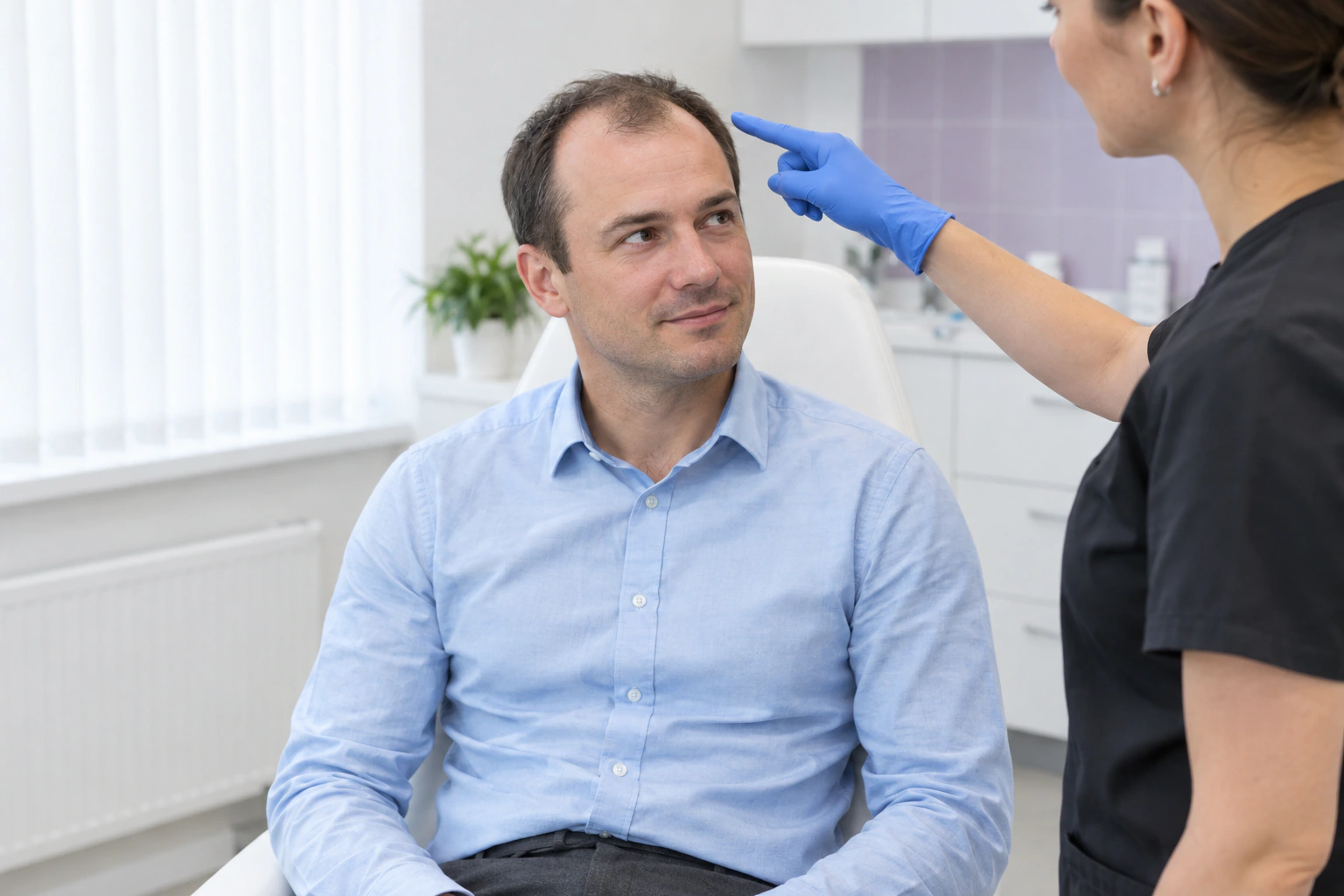

Leave your number. A coordinator asks for photos in a messenger, the doctor looks and says if a transplant helps. Free, no surgery booking.

services
The doctor counts your grafts at the free consultation; the price named there is what the contract states.
suture-free graft extraction

$2,200$2,700
or $367/mo — 0% instalments for 6 months
Save this priceimplantation without channels

$2,500$2,900
or $417/mo — 0% instalments for 6 months
Save this pricecombined technique

$2,700$2,900
or $450/mo — 0% instalments for 6 months
Save this price| Your case reviewed | Free |
|---|---|
| Eyebrow transplant, FUE | |
| Beard transplant, FUEinstalments $467/mo | |
| Hair trichopigmentation | |
| PRP therapy / session | $200 |
all included
From preparation for surgery to the 12-month check.
Unforeseen sums do not appear on surgery day.
two extra zones
The same grafts from the back of the head, the same FUE method — only the area changes: it is not only about the scalp.
FUE, no incisions and no stitches

Grafts are taken from the donor area at the back of the head and moved through micro-punctures of about 1 mm; scars are not left. Before the operation the doctor discusses what shape to give the beard, allowing for your facial features. Transplanted hair grows for life and is trimmed and styled as usual.
$2,800$3,000
or $467/mo — 0% instalments for 6 months
Save this priceFUE, no incisions and no stitches

The eyebrow shape is drawn by the surgeon at the initial consultation; references are looked through together and the design takes your facial features into account. The hairs are implanted at the right angle, so the eyebrows look natural, and it helps where plucking stopped hair growth.
$1,600$1,700
a walk-in, walk-out op under local anaesthesia
Save this priceThe doctor goes over the donor zone, puts a number on the grafts and shows what outcome that allows. The consultation also ends with a price, and the contract fixes it.

Message our coordinator
Free online consultation · Reply within 15 minutes
Message us on TelegramMessage us on WhatsAppBy messaging us, you agree to our Privacy Policy
Process
From consultation to going home — all in one day

Before anything else the doctor explains the workings of the DHI and FUE methods, responds to whatever you ask, and inspects the donor area.

A deposit, paid by card at the clinic or transferred online, locks in the surgery date, and the arrangement is written into a medical services contract.

Surgery is preceded by laboratory tests; every one of them appears on a list the clinic gives you, with guidance attached.

This part of the treatment is done under local anaesthetic and passes painlessly.

Harvesting happens in the donor zone at the back of the scalp or the temples; stitching is not part of it.

The grafts are implanted into the balding area, completing the surgical part of the procedure.
This step supports fast healing, with the clinic providing all the necessary items and full instructions.

Crusts come off, swelling goes down, and the area gradually recovers

This shedding is expected; the roots are not affected

Fresh hairs push up slowly, the difference becomes clear

The hair fills in, with volume and hairline clearly visible

You see the full volume and a convincingly natural edge

Free, before the operation and with no obligations.
Meet a specialistdoctors

Hair transplant doctor, trichologist, surgeon
10 years of experience

Dermatovenereologist, trichologist, surgeon
11 years of experience

Plastic surgeon
9 years of experience

Plastic surgeon
9 years of experience

Assistant
9 years of experience
Your donor zone is looked over, the grafts are calculated and the outcome is described plainly.
Meet a specialistcoordinators
The clinic gives every patient one coordinator who covers the whole path to recovery.

Recovery care manager
Will guide you before and after the surgery
Will sort your papers and book you the slot
Recovery care manager
Will guide you before and after the surgery
Will sort your papers and book you the slot

Recovery care manager
Will guide you before and after the surgery
Will sort your papers and book you the slot
Recovery care manager
Will guide you before and after the surgery
Will sort your papers and book you the slot













We explain whatever is unclear and arrange the consultation when it suits you
Message us on WhatsApp Leave a requestQuestions we get

It is possible. Requests reach the clinic from cities near and far, and a doctor will consult you online before you decide anything.
The base prices are $2,200 (≈ GHS 25,500) (FUE), $2,500 (≈ GHS 29,000) (DHI) and $2,700 (≈ GHS 31,500) (combined). The precise cost is determined at a free consultation and graft count, then fixed in your contract.
Everything happens across one day, and nobody is admitted overnight.
There is no pain; the area is numbed with local anaesthesia.
FUE is cut-free graft extraction by tweezer. DHI is direct implantation with a Choi pen, skipping channel-making. The combined technique takes grafts by FUE and places them using the DHI method.
The precise total is produced at the free consultation, once the doctor has assessed the donor zone.
Healing occupies 0–10 days. The 2–4 week shedding of transplanted hair is normal and temporary. Regrowth starts from 3–4 months, real volume appears at 6–9 months, then the result matures at 12–18 months.
Your procedure includes a lifetime hair-growth guarantee under contract.
We work under a medical licence, and care follows the standards and clinical guidelines
of Ministry of Health.

Diplomas and certificates of the doctors doing the surgery
Go through the papersAKC POMOSHCH LLC
the firm's legal entity
1057746096924
OGRN
7728536872
INN
Everything a resident of Cape Coast needs to know about the operation fits in a line: FUE and DHI, no cuts, no stitches, local anaesthesia, one day. Graft survival is 98-100 %, and a price from $2,200 (≈ GHS 25,500) is fixed in the contract after a free graft count.
Home is a fine place to begin in Cape Coast. No fee is charged for the online consultation, the doctor inspects photographs of the area and answers the main question - will a transplant help. Open 24/7.
The skin settles in 0-10 days, the transplanted hairs drop out at 2-4 weeks as part of the process, growth appears at 3-4 months, thickness at 6-9 and the final result at 12-18. Follow-ups at 1, 3, 6, 9 and 12 months with photo tracking by a personal coordinator and a lifetime growth guarantee.
Prices are in US dollars; the amount in brackets is an approximate conversion to GHS at the rate of 02.10.2026. The final price is fixed in your contract.
By messaging us, you agree to our Privacy Policy
What patients write after this operation. Reviews are translated from the original language.
Andrey M.
I had the operation a month ago. Before and after surgery they were always in touch and helped with questions about my tests. The operation itself went wonderfully, the staff are polite and masters of their craft, you feel you are in safe hands. I am recovering now, and they answer all my questions. I am happy and I recommend them!
DHI hair transplant
Pavel Sinitsyn
The best clinic of all the ones I was choosing from. No regrets at all! The result is simply amazing, I am thrilled. I recommend it to everyone: these people do great work and make people happy. Once again, a huge thank you to everyone. Roman, the head of the clinic, is the best: he was personally in touch with me and looked after my recovery. Thank you for making my dream come true.
FUE hair transplant
Maria Akopyan
I thought about an eyebrow transplant for a long time and finally went for it. At first I was afraid the result would look unnatural, but when I saw my new eyebrows I was delighted! They came out full and in harmony with my face. I can hardly believe that now I just wash my face and go, I have never felt so free. For anyone tired of constant make-up, a transplant is a real lifesaver!
Eyebrow transplant (FUE)
Alexander M.
I really wanted a thick beard, but I had problems with it. I tried every home remedy and minoxidil, and nothing helped. After a long search for the best clinic I settled on this one. Thank you so much for the service, I liked everything and now I am happy! I had the beard transplant 10 months ago and I am very pleased with the result. By the way, the music in the clinic was great, as far as I remember. A friend of mine has already come to you for a transplant on my advice and was also happy with the result. I wish you every success!
Beard transplant (FUE)
Vladimir Z.
I went to the clinic to see a trichologist and had a hair transplant. I really liked the doctor's approach, and all the recommendations helped. I want to point out that nobody tries to sell you extra services: they tell you things as they are, and if some treatment is not needed, they do not push it. Cosy and clean.
DHI hair transplant
Artem Popov
This may sound obvious, but a head of hair really changes everything in your life. You feel much more confident and go through life like a winner. And it is all thanks to the doctor at this clinic and to the staff who take care of their patients. Many thanks to the clinic for a happy life with new hair, for the comfortable conditions and for the professionalism during the hair transplant.
FUE hair transplant
Cape Coast is a city and the capital of the Cape Coast Metropolitan District and the Central Region of Ghana. As of the 2010 census it had a population of 108,374 people, and the figure grew to 189,925 by 2021. It is one of the most historically significant settlements in Ghana, and most residents are Fante. People here live in public view: in lecture halls, markets, churches and mosques, on the stadium terraces and at festivals. Hair and beard shape how a person looks in all of these places, so questions about thinning hair and patchy beards come up often.
A hair transplant by FUE or DHI is a planned procedure with a long timeline, and it suits people who think ahead. This text walks through the procedure with the rhythm of Cape Coast in mind: its climate, its festivals, its study and work calendar and its everyday habits. The aim is to help you ask better questions before you decide anything.
Grafts are taken from the back of the head, the donor area, and moved through micro-punctures of about 1 mm, so nothing scars over. The doctor discusses the shape with you before the operation, taking your facial features into account. That conversation matters most for the frontal hair line, where a natural look depends on a soft, slightly irregular edge and not a straight, drawn one.
FUE and DHI differ in how the grafts are placed, and the surgeon should explain which approach suits your hair type, the density of your donor area and the area to be covered. The same logic applies to a beard or a moustache. Transplanted hair grows for life, so you can trim and style the beard as usual once it has settled.
For a resident of Cape Coast the first step is simple. You write to the coordinators on Telegram or Telegram, send photos and describe your history, and the medical team prepares a first assessment. The consultation is free and online.
Cape Coast has a tropical savanna climate with two rainy seasons, peaking in May to June and in October. The dry harmattan period runs from November to February. Average temperatures are around 24 to 32 °C and relative humidity is between 60% and 80%. Each of these conditions touches recovery in a different way.
Heat and humidity are the main everyday factors. Sweat, a tight cap and long hours in the sun irritate a healing scalp, so plan the first days indoors, in the shade and with loose, clean, breathable headwear that the surgeon has approved. Direct sun on the recipient area deserves particular care, and your surgeon should tell you how long to protect it and what to use.
The harmattan brings dry air and dust, which can dry the skin and make the scalp feel tight and itchy. Ask how to keep the area clean and comfortable without disturbing the grafts. The rainy months bring wet streets and crowded transport, and a wet cap or a muddy commute is not what a fresh transplant needs. Think about each season before you choose a date.
No month is perfect in Cape Coast. The dry period from November to February has less rain, but dust and dry air call for extra scalp care. The rainy peaks in May to June and in October make travel around town slower and the air heavier. Hot, humid weather is always present, so your plan should rest on how much calm time you can give the first days and not on the calendar alone.
Think about your own year as well. Students at the University of Cape Coast and Cape Coast Technical University have exam periods and breaks. Staff and teachers have busy terms. Many families plan around Fetu Afahye, which takes place on the first Saturday of September every year, and around PANAFEST. If you want the early healing phase to pass before a big public event, count backwards from the date with your coordinator.
A useful principle: the first 0–10 days are for healing, and you should keep them clear of crowds, heavy work and long hours in the sun.
Recovery follows a known sequence: 0–10 days for healing, 2–4 weeks for normal shedding of transplanted hair, 3–4 months for new growth to start, 6–9 months for real density, and 12–18 months for the final result. Between 2 and 4 weeks the transplanted hairs let go, as expected. This is normal and not a failure. From 3 to 4 months the hair comes back, by 6 to 9 months it looks visibly thicker, and after 12 to 18 months the look has settled.
One patient described it this way: from about the 4th month active, even growth began, the transplanted hair took very well, the beard looked as natural as possible, no bald patches were left, and the beard became much thicker and denser, with the shape he had thought about for a long time. Your own pace may differ, so judge progress against the timeline and not against other people.
The shedding phase is the one that worries people most, especially in a city where you meet acquaintances at the market, at church or on campus. Decide in advance how you will handle questions and whether a light cap, if your surgeon allows it, helps you feel comfortable.
Cape Coast is an educational hub, and many people here are students, lecturers or administrative staff. Desk and classroom work usually allows an earlier return than outdoor labour, but you should confirm the timing with your surgeon for your own case. People who work outside, in fishing, trading or on the road, face more sun, sweat and dust and should plan more protection and a longer pause.
Sport is part of local life, from football around the Cape Coast Sports Stadium to casual games between friends. Ask exactly when you can resume running, football and gym work, and when you can swim in the sea or a pool. Sweat, contact and salt water all affect a healing scalp, so do not guess. Get the answer in writing from the medical team.
Family events and food are social anchors here. If you plan a wedding, a funeral service or a festival gathering, put the date next to your surgery plan so that nothing important falls in the early healing days.
In general terms, a good candidate has enough healthy hair in the donor area at the back of the head, realistic expectations and a stable pattern of hair loss. A younger person whose loss is still changing may be advised to wait or to start with medical treatment, because the hair line must still look right in the years ahead.
Contraindications are decided by a doctor and often include certain scalp conditions, active infections, some chronic illnesses, unmanaged bleeding or healing problems, and unrealistic goals. Be honest about your medical history, your medicines and any earlier procedures when you send your first photos.
For a beard, the same check applies: the donor area must have enough hair, and the plan for the shape should suit your face and your age.
Prepare a short list before the online consultation. Ask which method, FUE or DHI, suits you and why. Ask how the hair line or beard shape will be designed for your face. Ask how many sessions you may need and what the donor area can realistically provide. Ask how to protect the scalp from sun, dust and humidity in Cape Coast conditions.
Ask also about follow-up. We stay with you from pre-op planning to 12 months later, with check-ups at months 1, 3, 6, 9 and 12, and a coordinator will be on the phone 24/7. Find out how to send photos at each stage and how quickly you get an answer if something looks unusual.
If you need local medical help, Cape Coast has two principal hospitals, so ask what information to carry so that a local doctor can understand your treatment.
The traditional name of the city is Oguaa, from the Guan Awutu word Gua, meaning market. The early Portuguese navigators called the place Cabo Corso, the short cape, and the British later turned this into Cape Coast. A city that began as a trading place still has trade at its centre, and that matters when you plan a hair transplant: in a market town, people see each other every day, and a change in your hair line or beard is noticed quickly.
Use this to plan the early weeks. If your daily routine passes through busy trading areas, decide beforehand who will cover for you during the first 0–10 days of healing, and how you will explain a cap or a change in your appearance. The shedding between 2 and 4 weeks is easier to live through when your calendar is already arranged.
Kotokuraba Market is the largest market in Cape Coast. The triangular market was developed in the late 1930s by the colonial government and employs about 35% of the female employed population, according to the city facts. Its name comes from Koto-Kuraba, the crab hamlet. Traders spend long hours on their feet in heat, noise and dust, and many traders, sewing workers and carvers have little control over shade.
Fishing is the livelihood of most residents of the southern fishing communities. Work on the shore means strong sun, sweat and salt water, which is exactly what a fresh transplant must avoid early on. If you fish, trade in the open or carve outdoors, ask the surgeon how long you should stay away from the shore and the stall, what headwear is acceptable, and when salt water becomes safe again. Do not return to the sea until you have a clear answer.
About a quarter of the employed population works in services such as wholesale and retail. For shop and counter staff, indoor work can allow an earlier return, but confirm the timing for your own case.
Cape Coast is an educational hub. The University of Cape Coast was founded in 1962 as a university college and became a full university in 1971. Cape Coast Technical University opened in 1986. The city also has many secondary and technical schools, including St. Augustine's College, founded in 1936. Students, lecturers and school staff make up a large part of the people asking about thinning hair or a patchy beard.
For a student, the safest plan is to fit the first 0–10 days into a break between terms. Counting forward, the shedding at 2–4 weeks and the return of hair at 3–4 months should not collide with presentations, graduation photos or interviews. For teachers, a quiet school holiday works well. Ask the coordinators to help build the schedule backwards from your key dates.
The main festival of the Oguaa Traditional Area is Fetu Afahye, held on the first Saturday of September every year. PANAFEST and the crowds who come to Cape Coast Castle, a World Heritage Site, add to the busy public calendar. Big gatherings mean close crowds, heat, long hours outdoors and many photographs.
If you want to appear at Fetu Afahye with a settled look, remember that the final result takes 12–18 months, and visible thickness comes at 6–9 months. A realistic aim is to attend the festival comfortably, not with a finished result. Plan the operation so that the early healing days and the shedding phase fall well before the festival, and ask your surgeon what to wear on the head in a crowd.
The city is hilly, with valleys of streams between the hills, and the city sits south of the main Accra–Takoradi highway, where congestion is a known problem. Most residents do not own a car and rely on taxis and minibuses. A crowded minibus in humid heat is a poor place for a healing scalp, because of sweat, contact and touching.
In the first days, arrange a lift or a quiet taxi, avoid peak hours and climbing the hills on foot in midday sun. With relative humidity between 60% and 80%, carry a clean spare cap if your surgeon allows one. Keep photos for your check-ups at months 1, 3, 6, 9 and 12 in good daylight.
You start in Telegram or Telegram with the coordinators, who answer around the clock. You send clear photos of the front, top, sides and back of the head, or of the beard area, and note your age, medical history and goals. A doctor reviews the material, discusses the shape and the plan with you, and answers your questions at no charge.
Plan the conversation at a calm moment, ideally somewhere with a stable connection. Many people in the city rely on mobile data, so short voice messages and good daylight photos work well. Take your time, compare the answers, and decide only when every question is clear.
Yes. The consultation is free and online, and the coordinators are available on Telegram and Telegram around the clock.
The final result usually settles 12–18 months after surgery. Hair comes back at 3–4 months, looks visibly thicker at 6–9 months, and the look is settled at 12–18 months.
Yes. Between 2 and 4 weeks the transplanted hairs let go, as expected, and new growth follows later.
Heat and humidity do not stop growth, but sweat, tight caps and strong sun irritate a healing scalp. Follow the surgeon's advice on protection and cleaning, especially in the first days.
From November to February the air is dry and dusty. Ask the surgeon how to keep the scalp clean and comfortable without disturbing the grafts.
Grafts are taken from the back of the head and moved through micro-punctures of about 1 mm, so nothing scars over.
Yes. Transplanted hair grows for life, so you can trim and style the beard as usual once it has settled.
We stay with you from pre-op planning to 12 months later, with check-ups at months 1, 3, 6, 9 and 12. A coordinator will be on the phone 24/7.
The first 0–10 days are for healing. Desk work usually allows an earlier return than outdoor work, and sport and swimming should wait until the surgeon gives you a clear go-ahead.
Yes. Outdoor trading and fishing mean sun, sweat, dust and salt water. Ask the surgeon how long to pause and when sea work is safe.
A break between terms suits best, so the first 0–10 days of healing and the shedding at 2–4 weeks do not meet exams or presentations.
The final look settles at 12–18 months, with visible thickness at 6–9 months. Plan the operation well before the festival and ask about headwear.
Avoid crowded minibuses and peak hours, choose a quiet taxi or a lift, and stay out of midday sun while the scalp heals.
Page medically reviewed by Anastasia A. Kolesnik, hair transplant doctor. Review date: .

 Forceps
 Minimal


