



at first
12 months out
2,800 grafts
FUE method
City Medical Centre
0% instalments
from $367/mo
A chat and a costing — $0.
Our case
at first
12 months out
FUE method; the skin is not cut or sewn. Graft tally and forecast reckoned up without paying — before you decide.
Without paying, no surgery booking required
Message our coordinator
Free online consultation · Reply within 15 minutes
Message us on TelegramMessage us on WhatsAppBy messaging us, you agree to our Privacy Policy
results
Actual patients of City Medical Centre, all of them.
at first
12 months out
2,800 grafts
FUE method

at first
12 months out
3,500 grafts
FUE method

at first
12 months out
2,600 grafts
FUE method

at first
12 months out
3,000 grafts
FUE method

at first
12 months out
2,700 grafts
FUE method

at first
12 months out
3,300 grafts
FUE method

at first
12 months out
2,900 grafts
FUE method

at first
12 months out
2,500 grafts
FUE method

at first
12 months out
3,400 grafts
FUE method

at first
12 months out
2,500 grafts
FUE method

at first
12 months out
3,100 grafts
FUE method

at first
12 months out
3,600 grafts
FUE method

at first
12 months out
4,000 grafts
FUE method

at first
12 months out
3,200 grafts
FUE method

at first
12 months out
3,000 grafts
FUE method

at first
12 months out
3,700 grafts
FUE method

at first
12 months out
2,700 grafts
FUE method

at first
12 months out
3,800 grafts
FUE method

at first
12 months out
3,300 grafts
FUE method

at first
12 months out
2,800 grafts
FUE method

at first
12 months out
2,500 grafts
FUE method

at first
12 months out
3,900 grafts
FUE method

at first
12 months out
3,500 grafts
FUE method

at first
12 months out
3,800 grafts
FUE method

at first
12 months out
2,900 grafts
FUE method

at first
12 months out
3,600 grafts
FUE method

at first
12 months out
2,600 grafts
FUE method

at first
12 months out
2,700 grafts
FUE method

at first
12 months out
3,700 grafts
FUE method

at first
12 months out
3,200 grafts
FUE method

at first
12 months out
3,000 grafts
FUE method

at first
12 months out
2,800 grafts
FUE method

at first
12 months out
4,000 grafts
FUE method

at first
12 months out
3,400 grafts
FUE method

at first
12 months out
2,900 grafts
FUE method

at first
12 months out
3,100 grafts
FUE method

at first
12 months out
2,600 grafts
FUE method

at first
12 months out
3,300 grafts
FUE method

at first
12 months out
3,900 grafts
FUE method

at first
12 months out
3,500 grafts
FUE method

at first
12 months out
2,700 grafts
FUE method

at first
12 months out
3,800 grafts
FUE method

at first
12 months out
3,200 grafts
FUE method

at first
12 months out
3,000 grafts
FUE method

at first
12 months out
2,800 grafts
FUE method

at first
12 months out
3,100 grafts
FUE method

at first
12 months out
3,600 grafts
FUE method
Comparison
Grafts are transferred by one of three technologies: classic FUE, suture-free DHI and a combined protocol. Compare implantation technique, tissue trauma and graft survival and choose with open eyes.
Classic technique without incisions or stitches

$2,200
$2,700
Graft implantation technique
ForcepsGraft trauma
MinimalHair's natural angle
NaturalGraft survival
98–100%Suitable for
Androgenetic alopeciaSuture-free placement with a Choi pen

$2,500
$2,900
Graft implantation technique
DHI, a Choi implanterGraft trauma
MinimalHair's natural angle
NaturalGraft survival
98–100%Suitable for
DensificationFUE extraction, DHI pen implant

$2,700
$2,900
Graft implantation technique
FUE extraction plus DHI implantGraft trauma
MinimalHair's natural angle
NaturalGraft survival
98–100%Suitable for
Densification for androgenetic alopeciaThe survival and trauma numbers are averaged per method and act as a guide: exact values depend on the transplant area and the patient's individual features, and the doctor specifies them at the consultation.
Speak to a specialist


















about the clinic
Pleasant rooms, current equipment and an attentive approach

Every query is handled and the consultation booked at an hour that suits
Message us on WhatsApp Get in touchA verdict that surgery is unnecessary is given openly during the consultation, with nothing spent for nothing. Below are the situations in which a transplant is genuinely justified.
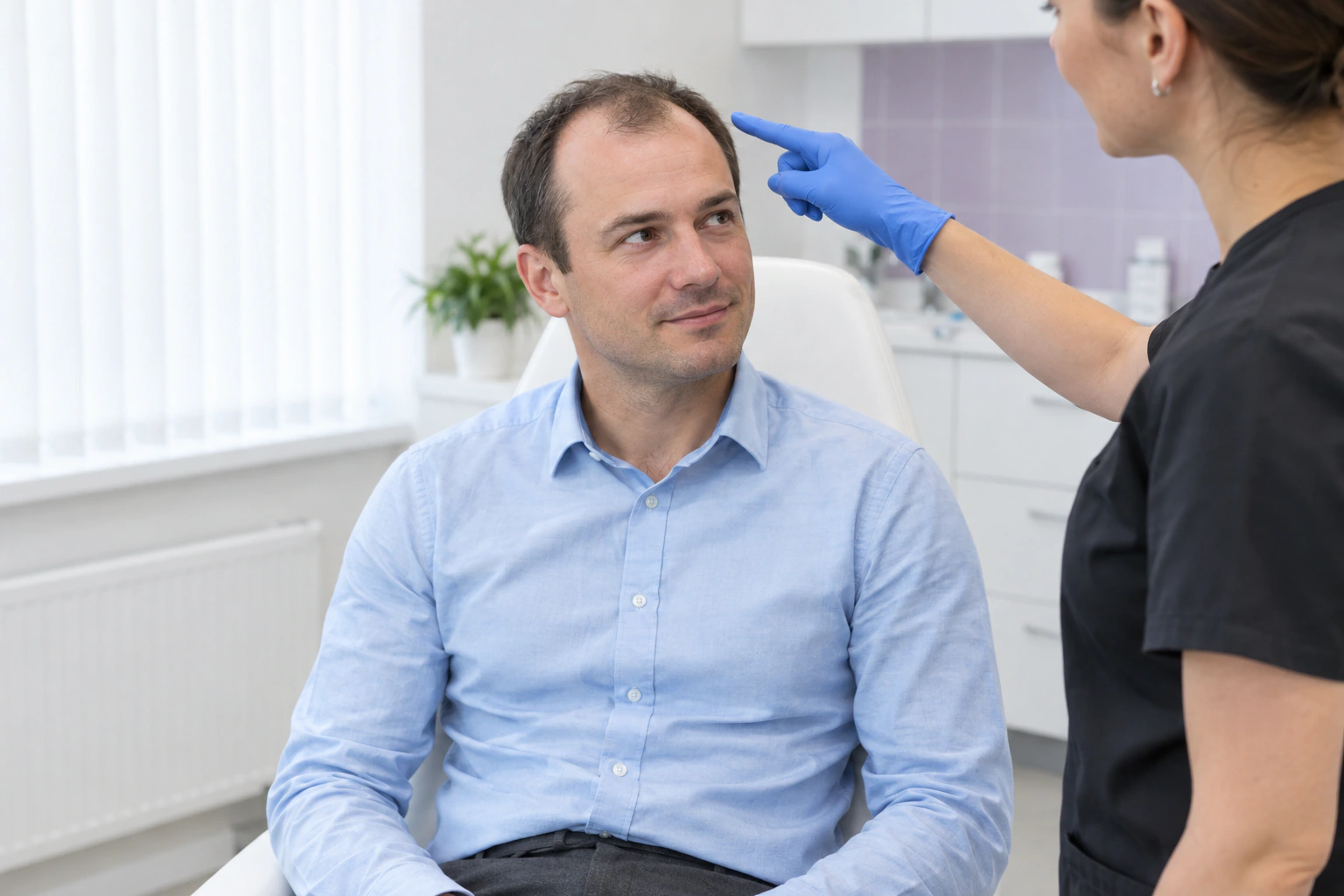

Leave your number and a coordinator will ask for photos of the affected area in a messenger; a doctor reviews them and tells you whether a transplant would help. It is free and commits you to nothing.

services
The grafts are counted at the free consultation, the cost is quoted and fixed in the contract.
suture-free graft extraction

$2,200$2,700
or $367/mo — 0% instalments for 6 months
Nail down the priceimplantation without channels

$2,500$2,900
or $417/mo — 0% instalments for 6 months
Nail down the pricecombined technique

$2,700$2,900
or $450/mo — 0% instalments for 6 months
Nail down the price| Assessing your hair | Free |
|---|---|
| Eyebrow transplant, FUE | |
| Beard transplant, FUEinstalments $467/mo | |
| Hair trichopigmentation | |
| PRP therapy / session | $200 |
all included
From the run-up to surgery to 12 months of follow-up.
The sum agreed stands on the day of surgery.
two extra patches
Beyond the scalp too: the same grafts from the back of the head, the same FUE method — only the area changes.
FUE method, no cuts or stitches

Grafts are taken from the back of the head, the donor area, and moved through micro-punctures of about 1 mm, so no scars are left. The doctor discusses the shape with you before the operation, taking your facial features into account. Transplanted hair grows for life: trim and style the beard as usual.
$2,800$3,000
or $467/mo — 0% instalments for 6 months
Nail down the priceFUE method, no cuts or stitches

At your first meeting the surgeon settles the brow shape: references are turned over together and the proportions of your face underpin the design. Angled correctly, the implanted hairs give brows that read as natural. Growth stopped by long years of plucking is covered as well.
$1,600$1,700
a procedure with no overnight stay, numbed locally
Nail down the priceThe doctor will weigh up your donor area, count the grafts and show the result achievable for you. The cost is quoted at the consultation and fixed in the contract.

Message our coordinator
Free online consultation · Reply within 15 minutes
Message us on TelegramMessage us on WhatsAppBy messaging us, you agree to our Privacy Policy
Process
From consultation to going home — all in one day

First comes the consultation: an account of FUE, an account of DHI, answers to your questions, and an examination of the donor area by the doctor.

Patients in Ondo confirm the operating day by paying a deposit, either with a card at the clinic or over the internet.

Before the transplant is due to begin, the tests are completed according to the clinic's written list and directions.

Local anaesthesia is used throughout, keeping the surgery painless from start to finish.

Grafts are harvested from the donor area at the back of the head or the temples, without any stitches.

The surgical team implants each graft into the balding zone with precision.
The clinic hands over everything the healing period calls for, along with guidance on each point.

The crusts leave, the swelling goes down, the area gradually recovers

A normal step. Only the hairs fall out, the follicles stay in place

Hair returns little by little, and the change is obvious

The hair looks heavier now, the volume and the outline stand out

The hairline looks natural and density is final

Free, before surgery and with no obligation at all.
Speak to a specialistdoctors

Hair transplant doctor, trichologist, surgeon
10 years in practice

Dermatovenereologist, trichologist, surgeon
11 years in practice

Plastic surgeon
9 years in practice

Plastic surgeon
9 years in practice

Assistant
9 years in practice
The doctor will assess your donor area, count the grafts and say the result you can reach.
Speak to a specialistcoordinators
The coordinator assigned to you is the person you write to at any time until recovery ends.
Your patient adviser
Is by your side from preparation to healing
Deals with all your papers and time slots
Your patient adviser
Is by your side from preparation to healing
Deals with all your papers and time slots
Your patient adviser
Is by your side from preparation to healing
Deals with all your papers and time slots
Your patient adviser
Is by your side from preparation to healing
Deals with all your papers and time slots













Every query is handled and the consultation booked at an hour that suits
Message us on WhatsApp Get in touchCommon questions

Yes. The clinic works with patients from other cities and countries, and an online consultation is available first.
Prices start at $2,200 (≈ ₦2,950,000) for FUE, $2,500 (≈ ₦3,350,000) for DHI, and $2,700 (≈ ₦3,600,000) for the combined method. Your final price is set after a free graft count and locked into the contract.
Nothing more than one day is required before you are home.
No. With the scalp numbed locally, patients feel no pain.
FUE is the classic method: grafts are harvested with tweezers, with no cuts or stitches. DHI implants grafts without channels, using a Choi pen. A combined method harvests grafts by FUE and implants them with the DHI pen.
Only after the donor zone is measured can the doctor state the number, and that measurement costs nothing.
Plan for 0–10 days of healing. A shedding period at 2–4 weeks is part of the process. Growth appears from 3–4 months, noticeable fullness comes at 6–9 months, the definitive result at 12–18 months.
You get a lifetime hair growth guarantee, written into the contract.
The clinic has a medical licence and provides care to the standards and clinical guidelines
per Ministry of Health.

Qualification certificates of our surgeons
See the paperworkAKC POMOSHCH LLC
the clinic's legal name
1057746096924
OGRN
7728536872
INN
The choice for a patient in Ondo lies between FUE and DHI, and either way the scalp is not cut, nothing has to be stitched, only local anaesthesia is used, and one day is all the operation takes.
You can begin in Ondo without leaving home: the online consultation is free, and the doctor looks at photos of the thinning area and counts how many grafts it will take. The clinic is reachable 24/7, so a message fits your schedule.
Healing is done with in 0-10 days. At 2-4 weeks the transplanted hairs shed - normal, predicted and harmless. Growth starts at 3-4 months, and anything you see before that tells you very little.
Prices are in US dollars; the amount in brackets is an approximate conversion to NGN at the rate of 02.10.2026. The final price is fixed in your contract.
By messaging us, you agree to our Privacy Policy
What patients write after this operation. Reviews are translated from the original language.
Andrey M.
I had the operation a month ago. Before and after surgery they were always in touch and helped with questions about my tests. The operation itself went wonderfully, the staff are polite and masters of their craft, you feel you are in safe hands. I am recovering now, and they answer all my questions. I am happy and I recommend them!
DHI hair transplant
Pavel Sinitsyn
The best clinic of all the ones I was choosing from. No regrets at all! The result is simply amazing, I am thrilled. I recommend it to everyone: these people do great work and make people happy. Once again, a huge thank you to everyone. Roman, the head of the clinic, is the best: he was personally in touch with me and looked after my recovery. Thank you for making my dream come true.
FUE hair transplant
Maria Akopyan
I thought about an eyebrow transplant for a long time and finally went for it. At first I was afraid the result would look unnatural, but when I saw my new eyebrows I was delighted! They came out full and in harmony with my face. I can hardly believe that now I just wash my face and go, I have never felt so free. For anyone tired of constant make-up, a transplant is a real lifesaver!
Eyebrow transplant (FUE)
Alexander M.
I really wanted a thick beard, but I had problems with it. I tried every home remedy and minoxidil, and nothing helped. After a long search for the best clinic I settled on this one. Thank you so much for the service, I liked everything and now I am happy! I had the beard transplant 10 months ago and I am very pleased with the result. By the way, the music in the clinic was great, as far as I remember. A friend of mine has already come to you for a transplant on my advice and was also happy with the result. I wish you every success!
Beard transplant (FUE)
Vladimir Z.
I went to the clinic to see a trichologist and had a hair transplant. I really liked the doctor's approach, and all the recommendations helped. I want to point out that nobody tries to sell you extra services: they tell you things as they are, and if some treatment is not needed, they do not push it. Cosy and clean.
DHI hair transplant
Artem Popov
This may sound obvious, but a head of hair really changes everything in your life. You feel much more confident and go through life like a winner. And it is all thanks to the doctor at this clinic and to the staff who take care of their patients. Many thanks to the clinic for a happy life with new hair, for the comfortable conditions and for the professionalism during the hair transplant.
FUE hair transplant
Ondo Town is the second largest city in Ondo State, Nigeria, and the trade centre for the surrounding region. People here work in markets, farming trade, education and public service, and many are on their feet and outdoors for much of the day. When a resident of Ondo thinks about a hair transplant, the first questions are usually practical: how many days away from the daily routine, how soon the head can be covered, and when the result will look natural.
A hair transplant by FUE or DHI takes grafts from the back of the head, the donor area, and moves them through micro-punctures of about 1 mm, so nothing scars over. The doctor discusses the shape with you before the operation, taking your facial features into account. This text is written for people in Ondo who want to understand the process calmly, before any decision, and to prepare good questions for the specialist.
The consultation itself is free and online. You contact City Medical Centre from Ondo, and coordinators are available around the clock (24/7) on Telegram and Telegram. You can send photos, describe your history and ask questions at a time that suits your working day.
Ondo Town is described as the largest producer of cocoa products in the region, and commercial crops such as yams, cassava, grain, tobacco and cotton are grown around it. Trade and agricultural business mean that many people deal with customers, suppliers and travelling traders every week. If your work involves open-air markets or dusty loading areas, plan the first days of healing so that you are not exposed to dust, crowds and heavy physical effort.
Your role matters in the schedule. A shop owner or an office employee can often arrange quiet days more easily than someone who works in the field or on a building site. Tell the coordinator exactly what your workday looks like, and the doctor can advise how to protect the treated area in that setting.
Remember the healing frame from the medical facts: 0–10 days for healing. Count this period from the day of the operation and keep your calendar light, with no big deliveries, no long outdoor shifts and no events where you will be pressed in a crowd.
Ondo lies in southwestern Nigeria, where the year is generally divided into a wetter and a drier season, with warm weather throughout. General advice is simple. In hot, sunny weather, avoid direct sun on the scalp during the early healing and ask the surgeon what kind of loose, clean headwear is suitable and from when. Tight caps that rub the grafts are not a good idea.
Sweating and dust are the practical enemies of a fresh transplant. Heat makes you sweat, and dust settles on the head. Keep the head clean exactly as the doctor instructs, avoid touching the area with unwashed hands and do not scratch, even when itching begins. During the rainy part of the year, humidity and sudden downpours call for a clean cover and a dry head when you go out.
Swimming pools, rivers and heavy exercise should wait for the doctor's permission. Do not decide this yourself because a friend recovered quickly; ask for the dates in writing from your own care plan.
There is no single perfect month for Ondo. Think about your own calendar instead. A quieter period in your work, fewer ceremonies and fewer long journeys on dusty roads make the early days easier. If you have a family event, a wedding or a naming ceremony, plan the procedure so that the first weeks do not coincide with it.
Remember that 2–4 weeks is the stage when the transplanted hairs let go, as expected. Many people are surprised by this and think the procedure has failed. It has not; it is a normal stage. If you have an important public occasion within the first month, you should know about this in advance and discuss it with the coordinator.
The new growth then follows a known path: 3–4 months for hair to come back, 6–9 months for visibly thicker hair, and 12–18 months for the settled look. So an operation done now will look its best only after more than a year, which is worth bearing in mind when you plan photographs or big family celebrations.
Ondo has a lot of educational life: Ondo State University of Medical Sciences, Wesley University, Adeyemi Federal University of Education, Ondo City Polytechnic and over 200 public and private schools in the town. Students and teachers who think about a transplant often ask about lectures, exams and appearing in front of a class. Arrange the procedure for a gap between sessions, when you can stay home during the early healing.
For an office, school or university job, the main question is how visible the signs are in the first days. Discuss with the doctor what to expect in your case, and plan to wear what he allows. Do not improvise with hats, helmets or head wraps.
Sport is another frequent question. Football on a dusty pitch, running in the heat and gym work all cause sweat, impact and friction. Ask the surgeon in writing when each activity is allowed, and do not return earlier than he says. Contact sports and heading a ball deserve a separate question.
Nigerian family life is full of gatherings, and food is central to them. Around a transplant, nothing exotic is needed: balanced meals, enough water and the avoidance of anything the doctor has told you to avoid. If the doctor advises you to limit alcohol or smoking for a period, tell your family in advance so they do not press you at the table.
Crowded parties are best avoided at the start. Large gatherings mean hugs, pushing, heat and dust, all of which are poor for fresh grafts. You can still join the family in a calm way, but plan to keep a distance from crowds and avoid anyone touching your head.
Weight and general health matter for any elective procedure. If you have questions about your general health, mention them to the coordinator during the consultation. The WHO fact sheet on obesity and overweight is a useful general reference on why overall health deserves attention before elective surgery.
In general terms, a good candidate has enough healthy hair in the donor area at the back of the head, realistic expectations and no untreated condition that affects the scalp or healing. Hair loss has several causes, and the doctor needs to understand which one applies to you before recommending FUE or DHI.
Some situations call for caution or for waiting: active scalp disease, chronic illnesses that are not under control, certain blood conditions and unrealistic expectations about density. Be honest about your medications and your history during the online consultation; this protects you.
Transplanted hair grows for life, but it does not stop other hair from thinning if the underlying cause continues. Ask the surgeon how the existing hair will be looked after and whether supporting treatment is advisable. Men who want to restore a beard should also discuss shape, and they can trim and style the beard as usual.
Ondo is ruled by a monarch with the title Osemawe, and the story told about the origin of the name is one of the best-known pieces of local history: the first king, surprised by the birth of twins, exclaimed 'Ese omo re', which over time became 'Osemawe'. The present monarch, Dr. Adesimbo Victor Kiladejo, was crowned in September 2006. For a resident, this means the town has a living royal tradition, and public ceremonies connected with the palace are part of the social year.
If you expect to attend or take part in a palace function, a chieftaincy celebration or a procession, do not schedule your operation close to it. Formal occasions in Ondo often mean traditional headwear, long hours standing outdoors and many greetings and handshakes. In the first stage, which the plan gives as 0–10 days for healing, you should not wear anything tight on the head or stand for hours in a crowd.
Ask the surgeon in advance what kind of cap or traditional head covering, if any, can be worn and from what date. Then you can plan the first formal appearance after the shedding stage, when 2–4 weeks have passed and the transplanted hairs have let go as expected.
Cotton grown around Ondo is often used to weave Aso Oke, the culturally significant cloth that local people commonly make into clothing. For weddings and naming ceremonies, many families order Aso Oke outfits well ahead, and tailors fix fitting dates. Many men also wear a matching cap with such an outfit.
Put your fittings and your transplant on the same calendar. A cap fitted before the operation may press on grafts afterwards, so ask the doctor when a cap is acceptable and whether the tailor should leave extra room. Do not try on tight caps in the first days.
A good plan is to hold the operation well before a major ceremony, because the full picture develops slowly: 3–4 months for hair to come back, 6–9 months for visibly thicker hair and 12–18 months for the settled look. For a beard transplant, the same logic applies to the shape you choose, which the doctor discusses with you before the operation.
Ondo has Ondo State University of Medical Sciences, established in 2015, Wesley University, Adeyemi Federal University of Education, Ondo City Polytechnic and the National Institute for Educational Planning and Administration, set up in 1992 as a sub-regional staff college. Ondo Boys' High School, founded in 1919, is counted among the oldest schools in Africa. This gives the town many young adults, teachers, trainers and administrators who think about appearance before graduation, interviews and public speaking.
If you are a student, choose a gap between exams or practical sessions for the operation, and avoid dates for clinical placements where you wear caps or helmets. Staff of training institutes who run workshops should ask the coordinator how soon speaking in front of a group is realistic, given the 0–10 days healing frame.
Health-minded people in a medical university town often ask detailed questions. That is welcome: write them down, send them to the coordinator and ask the doctor to explain the donor area, the micro-punctures of about 1 mm and the follow-up check-ups at months 1, 3, 6, 9 and 12.
As the largest producer of cocoa products in its region and a trade centre for yams, cassava, grain and tobacco, Ondo has a working rhythm tied to the harvest and the market. Traders and buyers are busiest at peak times, so choose a quieter week of your own business for the operation rather than a harvest rush.
Work around drying cocoa, loading sacks or moving goods raises dust, sweat and the need to lift and bend. All of this is unsuitable for a fresh scalp. If you manage a farm or a trading business, delegate loading and field visits during the first days and keep to calls and paperwork from home.
Ask the surgeon when you may return to outdoor work and what covering is allowed there. Your coordinator is available 24/7, so a question about a dusty day or an unexpected delivery can be sent at once rather than guessed.
Ondo is the home town of well-known figures, among them the juju musician King Sunny Adé, the media figure Mo Abudu and the actress Omotola Jalade Ekeinde, and a statue of Brigadier Samuel Ademulegun stands at the Ife Roundabout. Such names make public image a regular topic of conversation, and some patients bring photos of celebrities as a reference.
A reference photo is useful for a discussion, but the doctor designs the shape for your own face, taking your facial features into account. Your donor area and hair type set the limits, so ask what is realistic rather than copying a picture exactly.
Musicians, performers, event hosts and church or community leaders in Ondo often appear on stage. If you are among them, plan the operation away from performance dates, and remember that the settled look comes at 12–18 months.
You write to the coordinators on Telegram or Telegram from Ondo. They collect photos of the head from several angles, ask about your history and explain the next steps. The consultation is free, and a coordinator will be on the phone 24/7, so you can ask at any hour, including after work or late evening.
The doctor then assesses the donor area and the areas to be treated and discusses the shape with you before the operation, taking your facial features into account. The centre stays with you from pre-op planning to 12 months later, with check-ups at months 1, 3, 6, 9 and 12. You can send photos at each stage and ask whether what you see is normal.
One patient described the result like this: from about the 4th month active, even growth began, the transplanted hair took very well, the beard looks as natural as possible and no bald patches are left. Your own timeline will follow your own body, so use such stories only as an illustration of the stages.
Yes. The online consultation is free. You write on Telegram or Telegram from Ondo, and coordinators are available around the clock (24/7).
Both take grafts from the back of the head, the donor area, and place them through micro-punctures of about 1 mm, so nothing scars over. The doctor will explain which technique suits your case after seeing your photos.
The medical plan gives 0–10 days for healing. Plan quiet days in Ondo, away from dust, crowds and heavy work during this time.
Yes, and it is expected. At 2–4 weeks the transplanted hairs let go. New growth begins at 3–4 months.
Hair comes back at 3–4 months and looks visibly thicker at 6–9 months. The settled look comes at 12–18 months.
It depends on your job. Office and classroom work is usually easier to arrange than dusty outdoor work. Discuss your specific schedule with the coordinator and follow the doctor's written instructions.
Ask the surgeon for exact dates. Sweat, friction and impact can disturb fresh grafts, so do not return to sport earlier than allowed.
Transplanted hair grows for life. Other hair can still thin if the cause of hair loss continues, so ask about long-term care.
Yes. We stay with you from pre-op planning to 12 months later, with check-ups at months 1, 3, 6, 9 and 12, and a coordinator will be on the phone 24/7.
Ask about the donor area, the planned shape, headwear in sunny weather, when you can wash normally, when sport is allowed and what a normal shedding stage looks like.
Not medically, but ceremonies mean crowds, long standing outdoors and traditional headwear. Keep the first 0–10 days of healing free of them and ask the surgeon when a cap is allowed.
Do it well before the fittings or the event. Ask when a cap may be worn, because the full result develops over 12–18 months, with hair coming back at 3–4 months.
A gap between exams or placements is best, because the first 0–10 days need quiet healing and the shedding stage at 2–4 weeks is normal and visible.
Ask the surgeon for written dates. Dust, sweat and heavy lifting are unsuitable early on, so delegate physical work at first and keep in touch with the coordinator, available 24/7.
Page medically reviewed by Anastasia A. Kolesnik, hair transplant doctor. Review date: .

 Forceps
 Minimal


