



Before
just 12 months on
2,800 grafts
FUE method
City Medical Centre
0% instalments
from $367/mo
Talk it over, costed — $0.
Our case
Before
just 12 months on
A method that spares cuts and stitches: FUE. Graft count, forecast done for you, free of fee — before you decide.
No payment at all, no surgery booking required
Message our coordinator
Free online consultation · Reply within 15 minutes
Message us on TelegramMessage us on WhatsAppBy messaging us, you agree to our Privacy Policy
results
Not one image is stock: only genuine patients.
Before
just 12 months on
2,800 grafts
FUE method

Before
just 12 months on
3,500 grafts
FUE method

Before
just 12 months on
2,600 grafts
FUE method

Before
just 12 months on
3,000 grafts
FUE method

Before
just 12 months on
2,700 grafts
FUE method

Before
just 12 months on
3,300 grafts
FUE method

Before
just 12 months on
2,900 grafts
FUE method

Before
just 12 months on
2,500 grafts
FUE method

Before
just 12 months on
3,400 grafts
FUE method

Before
just 12 months on
2,500 grafts
FUE method

Before
just 12 months on
3,100 grafts
FUE method

Before
just 12 months on
3,600 grafts
FUE method

Before
just 12 months on
4,000 grafts
FUE method

Before
just 12 months on
3,200 grafts
FUE method

Before
just 12 months on
3,000 grafts
FUE method

Before
just 12 months on
3,700 grafts
FUE method

Before
just 12 months on
2,700 grafts
FUE method

Before
just 12 months on
3,800 grafts
FUE method

Before
just 12 months on
3,300 grafts
FUE method

Before
just 12 months on
2,800 grafts
FUE method

Before
just 12 months on
2,500 grafts
FUE method

Before
just 12 months on
3,900 grafts
FUE method

Before
just 12 months on
3,500 grafts
FUE method

Before
just 12 months on
3,800 grafts
FUE method

Before
just 12 months on
2,900 grafts
FUE method

Before
just 12 months on
3,600 grafts
FUE method

Before
just 12 months on
2,600 grafts
FUE method

Before
just 12 months on
2,700 grafts
FUE method

Before
just 12 months on
3,700 grafts
FUE method

Before
just 12 months on
3,200 grafts
FUE method

Before
just 12 months on
3,000 grafts
FUE method

Before
just 12 months on
2,800 grafts
FUE method

Before
just 12 months on
4,000 grafts
FUE method

Before
just 12 months on
3,400 grafts
FUE method

Before
just 12 months on
2,900 grafts
FUE method

Before
just 12 months on
3,100 grafts
FUE method

Before
just 12 months on
2,600 grafts
FUE method

Before
just 12 months on
3,300 grafts
FUE method

Before
just 12 months on
3,900 grafts
FUE method

Before
just 12 months on
3,500 grafts
FUE method

Before
just 12 months on
2,700 grafts
FUE method

Before
just 12 months on
3,800 grafts
FUE method

Before
just 12 months on
3,200 grafts
FUE method

Before
just 12 months on
3,000 grafts
FUE method

Before
just 12 months on
2,800 grafts
FUE method

Before
just 12 months on
3,100 grafts
FUE method

Before
just 12 months on
3,600 grafts
FUE method
Comparison
The clinic works with three graft transfer technologies: classic FUE, suture-free DHI and a combined protocol. Implantation technique, tissue trauma and graft survival differ, so compare before choosing.
Classic method requiring no cuts or sutures

$2,200
$2,700
Graft implantation technique
ForcepsGraft trauma
MinimalA natural growth angle
NaturalGraft survival
98–100%Suitable for
Androgenetic alopeciaSuture-free implantation with a Choi pen

$2,500
$2,900
Graft implantation technique
DHI, a Choi implanterGraft trauma
MinimalA natural growth angle
NaturalGraft survival
98–100%Suitable for
DensificationFUE for extraction, DHI implant

$2,700
$2,900
Graft implantation technique
FUE extraction plus DHI implantGraft trauma
MinimalA natural growth angle
NaturalGraft survival
98–100%Suitable for
Densification for androgenetic alopeciaAveraged for each method, the survival and trauma figures are a guide only: the exact numbers depend on the transplant area and the patient's individual features and are clarified by the doctor at the consultation.
Meet a specialist


















about the clinic
Well equipped, comfortable, attentive to each patient

Tell us what is unclear and we will fix a slot that works for you
Message us on WhatsApp Drop us a lineWhere the problem can be settled without an operation, the consultation gives you that answer straight away — your money stays in your pocket. Below are the situations in which a transplant genuinely works.
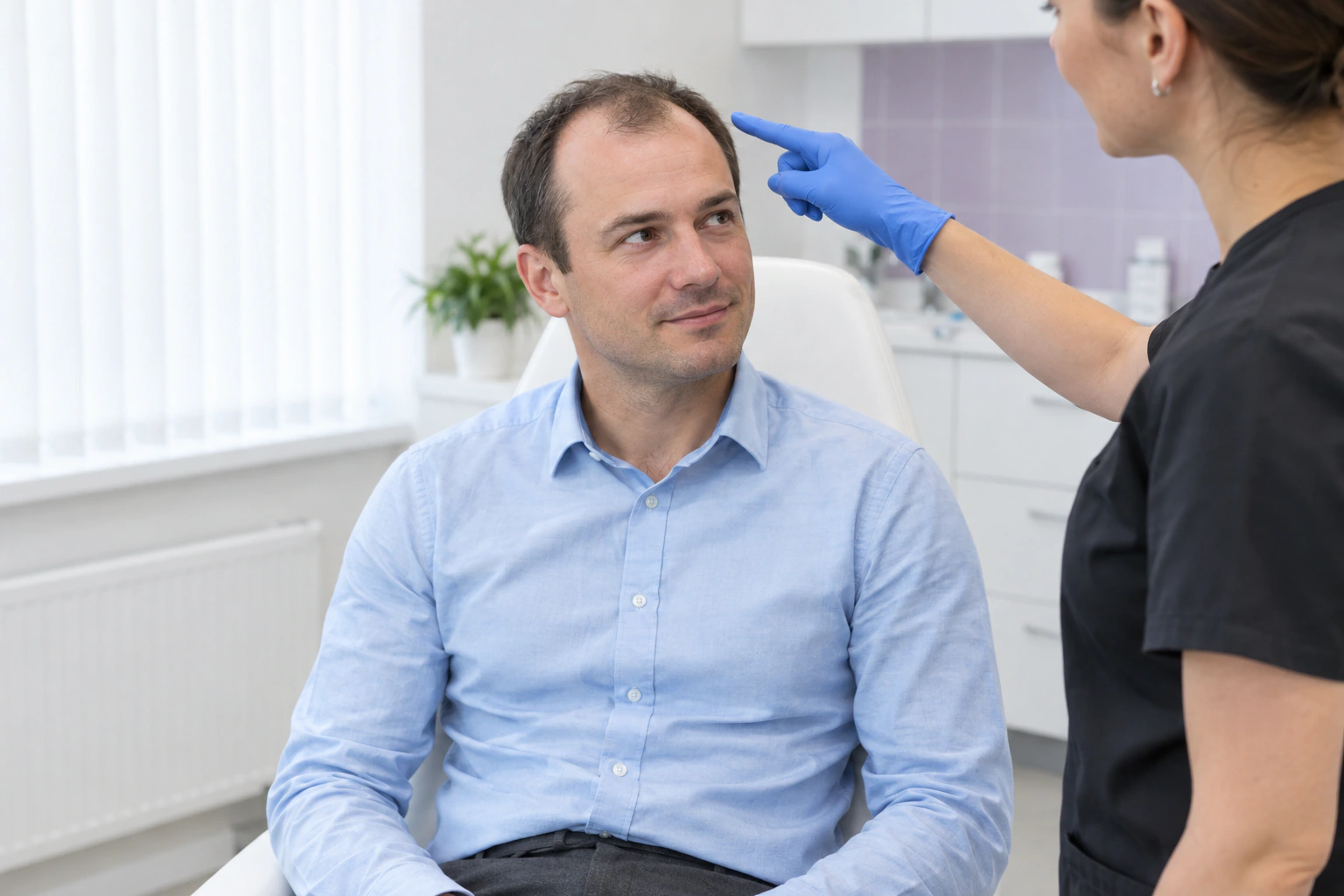

Leave your number and a coordinator will ask for photos of the affected area in a messenger; a doctor reviews them and tells you whether a transplant would help. It is free and commits you to nothing.

services
The price is set after the free graft count and written into the contract.
suture-free graft extraction

$2,200$2,700
or $367/mo — 0% instalments for 6 months
Hold your priceimplantation without channels

$2,500$2,900
or $417/mo — 0% instalments for 6 months
Hold your pricecombined technique

$2,700$2,900
or $450/mo — 0% instalments for 6 months
Hold your price| The first sit-down | Free |
|---|---|
| Eyebrow transplant, FUE | |
| Beard transplant, FUEinstalments $467/mo | |
| Hair trichopigmentation | |
| PRP therapy / session | $200 |
all included
Everything from the pre-op stage to 12 months of care.
No unexpected extra charges on the day of surgery.
another two zones
The scalp is only one option. Donor grafts still come from the back of the head, the method is still FUE, and only the treated zone differs.
FUE method, no cuts or stitches

The donor area is the back of the head; grafts move from there through micro-punctures of about 1 mm and no scars are left. The shape is decided together with the doctor before the operation, taking your facial features into account. Transplanted hair grows for life: the beard can be trimmed and styled as usual.
$2,800$3,000
or $467/mo — 0% instalments for 6 months
Hold your priceFUE method, no cuts or stitches

At the first consultation the surgeon draws the shape of the eyebrows: references are looked through together and the design respects your facial features. The hairs are implanted at the right angle, so the brows look natural. It also helps where plucking over years has stopped hair growth.
$1,600$1,700
a procedure with no overnight stay, numbed locally
Hold your priceThe doctor studies the donor zone, settles on a graft number and shows what outcome it will give. Pricing follows straight after, and the contract keeps it unchanged.

Message our coordinator
Free online consultation · Reply within 15 minutes
Message us on TelegramMessage us on WhatsAppBy messaging us, you agree to our Privacy Policy
Process
From consultation to going home — all in one day

Everything opens with a consultation. The doctor describes both FUE and DHI, deals with your questions, and checks the state of the donor area.

The clinic holds your chosen day once the deposit arrives, by card at the desk or as an online payment.

Getting ready for surgery means completing the required tests, and the clinic supplies the list and instructions to make it straightforward.

Patients in Klerksdorp are given a local anaesthetic, so the surgery brings no pain.

Collection takes place behind the head or by the temples, and the donor zone closes without stitches.

The collected units are implanted by surgeons into the thinning scalp.
The necessary items are given out by the clinic, with instructions that cover the whole healing period.

The crusts come off and the swelling goes down as the area recovers

A normal stage. Only the hairs leave, the follicles stay in place

The area gradually thickens, and the result shows

Density rises and the main volume and the hairline become clear

Thickness and the shape of the hairline are complete

Free, ahead of the operation, with no commitment.
Meet a specialistdoctors

Hair transplant doctor, trichologist, surgeon
10 years in practice

Dermatovenereologist, trichologist, surgeon
11 years in practice

Plastic surgeon
9 years in practice

Plastic surgeon
9 years in practice

Assistant
9 years in practice
The doctor judges the donor zone, puts a figure on the grafts and sets out the outcome you can expect.
Meet a specialistcoordinators
One coordinator, one point of contact, from the first question to the end of recovery.
Care and support lead
Sees your case through from start to finish
Picks up all your forms and your bookings
Care and support lead
Sees your case through from start to finish
Picks up all your forms and your bookings

Care and support lead
Sees your case through from start to finish
Picks up all your forms and your bookings
Care and support lead
Sees your case through from start to finish
Picks up all your forms and your bookings













Tell us what is unclear and we will fix a slot that works for you
Message us on WhatsApp Drop us a lineThings people ask

Yes. Patients whose address is in a different country are routine for the practice, and you may consult a doctor online first.
Pricing starts from $2,200 (≈ R37,000) for FUE, $2,500 (≈ R42,000) for DHI, and $2,700 (≈ R45,500) for combined DHI+FUE. The exact figure is confirmed for free after a graft count and written into the contract.
The session runs a single day and ends with you going home.
Not painful. The scalp stays numb under a local anesthetic.
FUE relies on tweezer harvesting with no incisions or stitches. DHI relies on Choi-pen implantation without channels. The combined DHI+FUE approach harvests by FUE and implants by DHI.
Only an assessment of the donor zone gives the answer, and the doctor performs that at no cost.
Give it 0–10 days for healing. Transplanted hairs fall at 2–4 weeks and that is meant to happen. Growth resumes by 3–4 months, density shows at 6–9 months, while the finished head arrives at 12–18 months.
Your procedure includes a lifetime hair-growth guarantee under contract.
Care is provided under a medical licence, to the standards and clinical guidelines
of the Ministry of Health.

Diplomas and certificates of the doctors performing it
View our paperworkAKC POMOSHCH LLC
the firm's legal entity
1057746096924
OGRN
7728536872
INN
The two methods offered to a patient in Klerksdorp, FUE and DHI, leave no cuts and no stitches, work under local anaesthesia and finish within one day. Graft survival is 98-100 %, and a price from $2,200 (≈ R37,000) is fixed in the contract after a free graft count.
A free online consultation is open to anyone in Klerksdorp, and it needs only pictures of the affected zone: the doctor looks and says whether a transplant will help. Contact runs 24/7, without days off.
Expect healing inside 0-10 days. The transplanted hairs shed at 2-4 weeks, which is normal and passes on its own. From 3-4 months the growth begins, and the difference grows clearer with every passing week.
Prices are in US dollars; the amount in brackets is an approximate conversion to ZAR at the rate of 02.10.2026. The final price is fixed in your contract.
By messaging us, you agree to our Privacy Policy
What patients write after this operation. Reviews are translated from the original language.
Andrey M.
I had the operation a month ago. Before and after surgery they were always in touch and helped with questions about my tests. The operation itself went wonderfully, the staff are polite and masters of their craft, you feel you are in safe hands. I am recovering now, and they answer all my questions. I am happy and I recommend them!
DHI hair transplant
Pavel Sinitsyn
The best clinic of all the ones I was choosing from. No regrets at all! The result is simply amazing, I am thrilled. I recommend it to everyone: these people do great work and make people happy. Once again, a huge thank you to everyone. Roman, the head of the clinic, is the best: he was personally in touch with me and looked after my recovery. Thank you for making my dream come true.
FUE hair transplant
Maria Akopyan
I thought about an eyebrow transplant for a long time and finally went for it. At first I was afraid the result would look unnatural, but when I saw my new eyebrows I was delighted! They came out full and in harmony with my face. I can hardly believe that now I just wash my face and go, I have never felt so free. For anyone tired of constant make-up, a transplant is a real lifesaver!
Eyebrow transplant (FUE)
Alexander M.
I really wanted a thick beard, but I had problems with it. I tried every home remedy and minoxidil, and nothing helped. After a long search for the best clinic I settled on this one. Thank you so much for the service, I liked everything and now I am happy! I had the beard transplant 10 months ago and I am very pleased with the result. By the way, the music in the clinic was great, as far as I remember. A friend of mine has already come to you for a transplant on my advice and was also happy with the result. I wish you every success!
Beard transplant (FUE)
Vladimir Z.
I went to the clinic to see a trichologist and had a hair transplant. I really liked the doctor's approach, and all the recommendations helped. I want to point out that nobody tries to sell you extra services: they tell you things as they are, and if some treatment is not needed, they do not push it. Cosy and clean.
DHI hair transplant
Artem Popov
This may sound obvious, but a head of hair really changes everything in your life. You feel much more confident and go through life like a winner. And it is all thanks to the doctor at this clinic and to the staff who take care of their patients. Many thanks to the clinic for a happy life with new hair, for the comfortable conditions and for the professionalism during the hair transplant.
FUE hair transplant
Klerksdorp sits in the North West Province, about 165 km southeast of Mahikeng, the provincial capital. It was once the first capital of the Transvaal Republic and grew into a trading town linking Kimberley to Johannesburg. Today it is a place where farmers, mine workers, teachers, bankers and public servants share the same streets, and many of them ask the same practical question about hair: how do I fix a thinning crown or a receding temple without disrupting a working life that is already full?
FUE and DHI are the two techniques most people from the city ask about. In both, grafts are taken from the back of the head, the donor area, and moved through micro-punctures of about 1 mm, so nothing scars over. The difference is mainly in how the grafts are placed, and the surgeon will explain which approach suits your hair density, your hair line and your expectations.
City Medical Centre works with patients from Klerksdorp through a free online consultation. You send photos, describe your history and goals, and a coordinator answers on Telegram or Telegram. Coordinators are available around the clock (24/7), which suits shift workers and people who can only write late in the evening.
Klerksdorp has a semi-arid climate, with warm to hot summers and cool, dry winters. The average annual precipitation is 482 mm, and most of the rain falls in summer. For a hair transplant this matters mainly because of sun and dust, not because of humidity.
In the first days after surgery the scalp is sensitive and the grafts are settling. Strong sun on a healing scalp is a poor idea, so plan the first period so that you are not working outdoors under the open sky. A loose, clean, breathable cap that your surgeon approves is usually more sensible than a tight hat, which can press on the recipient area. Ask the team exactly when you can start wearing headwear and which kind.
Dust is the second factor. On windy dry days in the farming district, avoid dusty yards, grain stores and building sites while the scalp is healing. If your day involves dust, speak to the surgeon about when it is reasonable to return to those tasks.
Winter is dry and cool, which many patients find comfortable for healing: less sweat, less direct sun, and a hat or hood looks natural. Summer is possible too, but it demands stricter sun discipline and more shade.
Klerksdorp is one of the hubs of the South African gold mining industry, even if its importance has been decreasing in recent years. Together with Rustenburg it forms the economic heart of North West Province. It is also a notable medical, retail and educational centre for the province and the Northern Free State, and its farming district grows maize, sorghum, groundnuts and sunflower.
That mix means very different recovery needs. An office worker, a bank employee or someone in a public department can often plan a quieter first stretch at home and return to a desk sooner. A person whose work involves heavy lifting, heat, dust or protective helmets needs a more careful conversation with the surgeon. Helmets and hard hats press on the scalp, so ask when they can safely be worn again.
The healing timeline gives you a frame for planning: 0–10 days for healing, 2–4 weeks for normal shedding of transplanted hair, 3–4 months for new growth to start, 6–9 months for real density, and 12–18 months for the final result. Take that to your employer or farm manager in simple terms, and decide in advance who covers your duties during the first days.
Patients are often surprised by the shedding phase. At 2-4 weeks the transplanted hairs let go, as expected. This is a normal part of the process and does not mean the operation failed. The follicles remain under the skin and start producing hair again later.
At 3-4 months hair comes back. At 6-9 months it looks visibly thicker. At 12-18 months you see the settled look. One patient described it this way: from about the 4th month active, even growth began, the transplanted hair took very well, and the result looked as natural as possible with no bald patches left.
For someone in Klerksdorp this timeline is worth putting against the calendar. If a wedding, a school event, a graduation or a family gathering is coming, count the months. Attending the event in the shedding phase is perfectly possible, but you may feel more comfortable with a cap or a quiet day, so decide beforehand.
There is no single correct month, only the one that fits your life. Cool dry winters reduce sweating and make protective headwear unremarkable. Hot summers call for more shade and a lower outdoor workload during the first days.
Think about your own year as well. Farming has seasons of heavy activity, mining and retail have their peaks, and schools have term breaks and exam periods. Many parents and teachers in a city with so many primary and secondary schools prefer to schedule around a holiday so that routines are not disturbed.
Also consider sport. The Harry Oppenheimer Stadium hosts athletics competitions for bigger schools, and plenty of local residents run, play rugby or football, or walk the Oudorp hiking trail. Do not plan vigorous activity until the surgeon clears it, and ask exactly when sweating, contact sport and swimming in a dam or pool become acceptable.
Food in a farming and cattle district tends to be hearty, with a strong braai and family-gathering culture. Around surgery the practical points are simple: eat regular, balanced meals, drink enough water, and follow the surgeon's instructions on alcohol and smoking. Ask for these rules in writing so that relatives who cook and host know them too.
Social life can be the harder part. Invitations arrive at short notice, and a cap in a warm room can be uncomfortable. Tell close friends and family that you are recovering and need a calm few days. If you share a home with children, ask how to keep the scalp from being knocked while sleeping and playing.
For men who want a beard transplant, the same logic applies. Transplanted hair grows for life: trim and style the beard as usual. One patient reported that the beard became much thicker and denser, with the shape he had thought about for a long time. The doctor discusses the shape with you before the operation, taking your facial features into account.
In general terms, a good candidate has a stable pattern of hair loss, enough healthy hair in the donor area, and realistic expectations. Someone whose loss is still changing quickly may be advised to wait or to start a medical treatment first. Ongoing scalp conditions, certain chronic illnesses and some medicines can also be reasons for delay.
Be honest in the online consultation about your medical history, medicines, allergies, smoking and any previous procedures. Your general health matters. Weight and metabolic health are part of overall fitness for surgery; the World Health Organization describes obesity and overweight as a major public health topic, and your surgeon may ask about them as part of a general assessment.
Photos should be taken in natural light from the front, the top, the sides and the back of the head. Clear photos allow the doctor to judge the donor area and discuss the hair line properly.
Klerksdorp was founded in 1837 or 1838 when Voortrekkers settled on the banks of the Schoonspruit, the “Clear stream” that still flows through the town. It is the oldest European settlement north of the Vaal River. Hendrik Grobler's farm Elandsheuwel, about 160 km2, was the starting point, and the name Klerksdorp honours the first landdrost, Jacob de Clercq. A city with this much history tends to produce people who plan carefully and think in long periods, which is the right attitude to a hair transplant.
The town was officially proclaimed in 1888, though people had called it a town for decades. In the same spirit, treat your own decision as a process rather than a single day. Use the free online consultation to ask questions over several evenings, compare the plan with your photos, and only then fix a date. A coordinator replies on Telegram or Telegram around the clock (24/7), so your questions do not have to wait for office hours.
Many residents like a walk along the Oudorp hiking trail, a 12 km route through the oldest parts of town. It is a good yardstick for planning: use the quiet first days to rest, and come back to long outdoor walks only when the surgeon confirms that the scalp is ready.
After gold was found in the district in November 1885, thousands of fortune-seekers arrived, and the village briefly had 70 taverns and its own stock exchange, opened in 1888. The exchange building later became a cinema in 1912 and was demolished in 1958. The story is a reminder that a quick decision made under excitement can age badly.
Apply that lesson to hair restoration. A sound plan starts with the donor area, the pattern of loss and the shape of the frontal hair line, not with a promotion or a rush. Ask the surgeon how many grafts your plan needs, how the hair line will be designed, and what the timeline looks like: 2-4 weeks for shedding, 3-4 months for hair to come back, 6-9 months for visibly thicker hair, and 12-18 months for the settled look.
The mining past also left a working culture of shifts and early starts. If you work shifts, tell the coordinator, so that the days of rest after surgery and the follow-up messages at months 1, 3, 6, 9 and 12 can be arranged around your rota.
Klerksdorp is divided into 35 suburbs, and daily life differs from one to the next. Jouberton, laid out from 1949 and named after councillor Jan Joubert, is a large residential area with its own busy rhythm of taxis, shops and family life. Alabama was surveyed in 1956. Ellaton and Neserhof lie where the old township once stood. People in all of these areas ask the same thing: can I keep my routine during recovery?
Commuting is a real planning point. If you rely on shared transport or walk to work in the sun, plan the first days at home. A loose clean cap approved by the surgeon is better than a tight one, and crowded transport is best avoided until the grafts have settled. Ask when it is safe to travel in a crowd and when you can lean your head on a seat or window.
The wider KOSH area, with Orkney, Stilfontein and Hartbeesfontein, gives a population of more than 350,000 in the greater city area. With so many people nearby, you may meet acquaintances quickly after surgery. Decide in advance what you will say, because the shedding phase at 2-4 weeks is normal and you may prefer to explain it calmly.
Matlosana Mall, the largest shopping centre in the North West Province, with 145 stores, is where many people spend weekends. It is also the place where you will most likely buy what you need for recovery: soft clean caps, a gentle shampoo recommended by your surgeon, and a travel-style neck pillow for sleeping. Make that shopping list before the operation, not after.
The city has many public and private schools, from Klerksdorp Primary School and Hoërskool Klerksdorp to Curro Castle and Klerksdorp Christian Academy. Teachers and parents who drop children off every morning face daily social contact. Plan the first days of healing around a school holiday if you can, and tell the children simply that the head needs rest and must not be bumped.
Sport is part of school life too. The Harry Oppenheimer Stadium hosts athletics meetings, and rugby and cricket are loved locally. If you coach or play, ask the surgeon when contact, sweating and heading a ball are acceptable, rather than guessing.
Klerksdorp has four private hospitals, a public Klerksdorp/Tshepong complex and a reputation as a medical centre for the province. For a hair transplant this is useful for general health checks, blood tests and routine questions before surgery. Bring any local results to the online consultation so the surgeon sees the full picture.
The farming district, home to Senwes, the largest agricultural co-op in the Southern Hemisphere, and to Sussex cattle herds, means many patients work outdoors. Harvest and planting seasons for maize, sorghum, groundnuts and sunflower shape the year. Choose a quieter period on the farm for surgery, and arrange who will handle feed, machinery and dusty tasks while you recover.
Lake outings are common: the Johan Neser Dam, about 10 km outside the city, and the Faan Meintjies Nature Reserve, with 150 bird species, are popular for weekends. Keep these for later. Ask your surgeon when swimming and long hours in the sun are allowed, and keep your coordinator informed at each check-up.
The first step is free and online. You write to a coordinator on Telegram or Telegram, send photos and answer questions about your hair loss, health and goals. A coordinator will be on the phone 24/7, so there is no need to adapt your day to office hours.
The surgeon then proposes a plan: technique, shape of the hair line, and the area to cover. We stay with you from pre-op planning to 12 months later, with check-ups at months 1, 3, 6, 9 and 12. These check-ups let you send updates and ask whether shedding, regrowth and density follow the expected course.
If you prefer to compare options in Klerksdorp, which has four private hospitals and a good reputation as a medical centre in the province, you can still use the online consultation as a second opinion. Ask any question before you decide, and take your time.
Yes. The first consultation with a coordinator is free. You send photos and information through Telegram or Telegram, and a coordinator will be on the phone 24/7.
Both take grafts from the donor area at the back of the head and place them through micro-punctures of about 1 mm. They differ mainly in how the grafts are implanted. The surgeon will recommend one after reviewing your photos.
Grafts are moved through micro-punctures of about 1 mm, so nothing scars over. Ask your surgeon to explain what you can expect in your case.
At 2-4 weeks the transplanted hairs let go, as expected. This is normal shedding, and new hair follows.
At 3-4 months hair comes back, at 6-9 months it looks visibly thicker, and the settled look appears at 12-18 months.
The healing phase is 0–10 days. Follow the surgeon's instructions on washing, sleeping position and activity during this time.
Klerksdorp has warm to hot summers, so protect the scalp from direct sun while it heals. Ask the surgeon which headwear is acceptable and for how long.
Dust and strong sun are not friendly to a healing scalp. Describe your job in the consultation and ask when you can safely resume each task, including wearing a helmet.
We stay with you from pre-op planning to 12 months later, with check-ups at months 1, 3, 6, 9 and 12.
Yes. Transplanted hair grows for life, so you can trim and style the beard as usual. The doctor discusses the shape with you beforehand, taking your facial features into account.
Plan to stay home for the first days of healing, which run 0–10 days. Ask the surgeon when it is safe to travel in a crowd and what headwear you may wear. Send your questions to the coordinator, who is on the phone 24/7.
It depends on how dusty and sunny your tasks are. Describe your work in the online consultation and ask the surgeon when you can return to each task. Choose a quieter farm period for the operation if possible.
Yes. Klerksdorp has private and public hospitals where you can do general health checks. Send the results to the surgeon during the free online consultation.
At 2-4 weeks the transplanted hairs let go, as expected. If you meet many people in your suburb or at work, plan a quiet period and decide beforehand what to say. New hair follows at 3-4 months.
Page medically reviewed by Anastasia A. Kolesnik, hair transplant doctor. Review date: .

 Forceps
 Minimal


