


























Hair transplantUnited Kingdom6 min read
Did Dean McCullough have a hair transplant? Yes, and he filmed it
In April 2024 BBC Radio 1 presenter Dean McCullough showed his followers the first days after a hair transplant, swelling and all, and later shared his results at three months. Here is what he said and what the procedure involves for anyone considering it.
By messaging us, you agree to our Privacy Policy
Key facts about the procedure
- Stay in clinicSame day
- Final result12–18 months
- AnaesthesiaLocal
- Price
$2,700from $2,200
Profile
Dean McCullough
- Country
- United Kingdom
- Who
- Radio presenter and TikTok personality
- Year of operation
- 2024
- Quote source
- The Sun, 17 April 2024
What did Dean McCullough say about his hair transplant?
BBC Radio 1 presenter Dean McCullough documented his hair transplant on TikTok in April 2024, before and after photos included. The Sun reported on 17 April 2024 what he told his followers on the third day: “Day 3 of my hair transplant journey and I’m trusting the process, zero pain or major discomfort and apparently the swelling is normal.” He joked about the swelling around his eyes and called it his “Avatar era”.
A few months later he shared the progress. As The Sun later recalled, he wrote: “I had a FUE hair transplant 3 months ago and I’m buzzing with the results so far.” In the same posts he laughed that he had not realised a hair transplant came with “new cheek bones as well” — a reference to the temporary facial swelling.
That is what this article relies on. McCullough named the method (FUE) himself; other details of his treatment we do not guess. Where the text below explains techniques, timelines and prices, it describes hair transplantation in general and the service at City Medical Centre.
What his posts show about the first days
Most celebrity hair stories skip straight to the final photo. McCullough did the opposite and showed the unglamorous part: a swollen forehead and puffy eyes a few days after surgery. That is useful, because swelling of the forehead and around the eyes is a common, temporary reaction after a transplant.
It usually peaks in the first days and goes down within about a week, and it does not mean something went wrong.
His comment about “zero pain or major discomfort” also matches what many patients describe once the local anaesthetic has worked: the injections at the start are the most noticeable part. Everyone’s experience is different, though, and the doctor explains in advance what is normal and what is a reason to call the clinic.
Hair transplant abroad: choose a city and clinic
Prices, the clinic and a free online consultation for each city:
How a hair transplant works today
A modern hair transplant is an outpatient operation under local anaesthesia. Follicles are taken one by one from the donor area, usually the back of the head and the temples, where hair is resistant to genetic thinning, and implanted where hair is missing. The two main techniques are:
- FUE — grafts are extracted individually through tiny punctures and placed into channels the surgeon prepares in advance. There is no linear scar and no stitches.
- DHI — grafts are implanted with a special pen (Choi implanter) without pre-made channels, which gives fine control over angle and direction.
How grafts are placed
- FUE
- Into channels prepared in advance
- DHI
- Directly with an implanter pen
Anaesthesia
- FUE
- Local
- DHI
- Local
Stitches
- FUE
- None
- DHI
- None
Typical use
- FUE
- Larger areas, more grafts
- DHI
- Hairline and dense packing of smaller areas
Price at City Medical Centre
- FUE
- $2,200
- DHI
- $2,500
A combined approach (FUE extraction with DHI implantation) is also used. Which option fits depends on the extent of hair loss and the donor area, so the choice is made at a consultation, not from a celebrity story.
Who is a good candidate, and how to prepare
A transplant works best when the donor area is dense enough to give grafts and the hair loss has a stable pattern. Typical reasons people consider it:
- a receding hairline or thinning temples;
- thinning at the crown or overall low density;
- hair loss after trauma, burns or scarring along the hairline.
There are also contraindications, including patchy (focal) alopecia, age under 18, trichotillomania, body dysmorphic disorder, severe heart disease, diabetes mellitus, epilepsy and intolerance to anaesthetics. The surgeon checks these before a date is booked. Before the operation you usually stop alcohol and blood-thinning medicines for the period the doctor names, and the hair at the donor area is trimmed short on the day.
What recovery and results look like
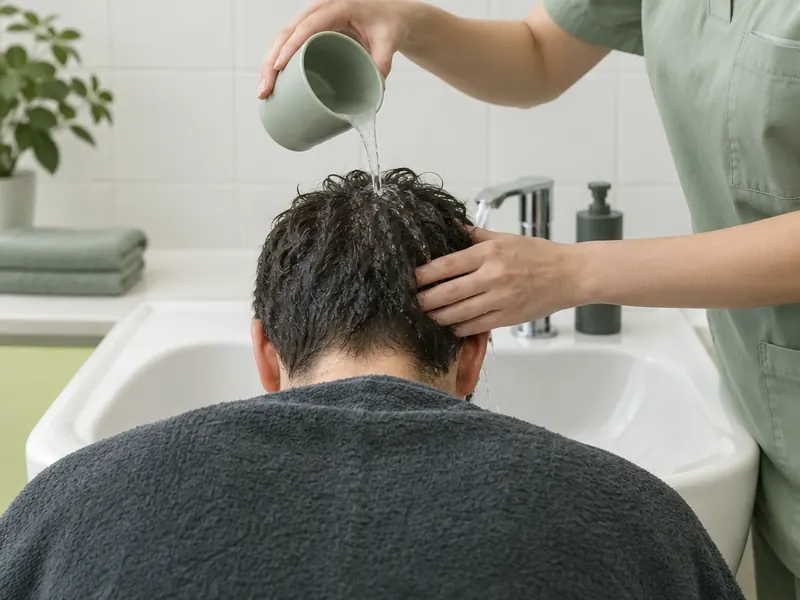
You go home on the day of surgery. Over the first ten days the scalp heals and small crusts fall off; the doctor explains how to wash the hair and how to sleep so the grafts are not disturbed. Itching is common and should not be scratched.
Transplanted hairs usually shed in weeks two to four — that is normal, the follicles stay under the skin — and new growth starts after three to four months. Density becomes clearly visible at six to nine months, and the final result is judged at 12–18 months, which is why patience matters more than the first photos.
McCullough’s update at three months fits that picture: early growth is visible by then, but the full density only arrives later.
How hair transplant results usually develop
- Day of surgeryLocal anaesthesia, grafts are taken and implanted; you go home the same day.
- Days 1–10The scalp heals and small crusts fall off; you follow the washing and sleeping instructions.
- Weeks 2–4Transplanted hairs shed. This is expected: the follicles remain under the skin.
- Months 3–4New hair begins to grow, often fine at first.
- Months 6–9Density becomes clearly visible.
- Months 12–18The final result can be assessed.
A hair transplant at City Medical Centre
City Medical Centre performs FUE, DHI and combined hair transplants for international patients, including patients from London. The first consultation is free and can be held online: the doctor assesses photos of the hair and the donor area, estimates the number of grafts and names the price, which is then fixed in the contract. Current prices start at $2,200 for FUE, $2,500 for DHI and $2,700 for the combined method.
Planning the procedure from your city? Read more: FUE & DHI Hair Transplant in Milwaukee, Hair Transplant Clinic in Fort Worth and FUE & DHI Hair Transplant in Seattle.
The price includes follow-up appointments at 1, 3, 6, 9 and 12 months, and the clinic gives a lifetime guarantee of hair growth. More details are on the hair transplant page and the page for patients from London.
To be clear: City Medical Centre has no connection with Dean McCullough or his treatment. His words are quoted here only because Dean chose to talk about the procedure openly.
Hair transplant prices in this article are the current offer, valid until 31 October 2026. Regular prices: FUE $2,700, DHI $2,900, combined method $2,900. The price that applies to you is confirmed at the consultation.
Frequently asked questions
When did Dean McCullough have his hair transplant?
He shared the first days after the procedure on TikTok in April 2024, as The Sun reported on 17 April 2024.
Which method did Dean McCullough use?
He said himself that he had a FUE hair transplant, in which grafts are taken one by one from the donor area and implanted into prepared channels.
Is swelling after a hair transplant normal?
Swelling of the forehead and around the eyes in the first days is a common, temporary reaction. It usually settles within about a week; the doctor explains which symptoms are a reason to get in touch.
Is a hair transplant permanent?
Transplanted follicles come from the back of the head, where hair is resistant to genetic hair loss, so they usually keep growing for life. Native hair around them can still thin over the years, which the doctor takes into account when planning.
How much does a hair transplant cost at City Medical Centre?
Prices start at $2,200 for FUE, $2,500 for DHI and $2,700 for the combined method. The final price is given after the free consultation and fixed in the contract.
Does a hair transplant hurt?
The operation is done under local anaesthesia. The injections of the anaesthetic are the most noticeable part; afterwards patients usually describe tightness, itching and mild discomfort for a few days.
Sources
What the article says about the celebrity is based only on these public statements.
Considering the same operation? Get a free consultation
We reply right in the chat — you can send photos
- The first consultation is free, online consultations are available
- The doctor names the cost after the assessment, and it is fixed in the contract
- A personal coordinator guides you from the first message to recovery
In other cities
Read also
 Hair transplant
Did Calum Best have a hair transplant? Yes, and he said so himself
Calum Best said in 2023 he had his sixth hair transplant, this time using patches of beard hair. His words, how the procedure works and recovery.
 Hair transplant
Did Chloe Goodman have a hair transplant? Yes, and she explained why
Chloe Goodman had a hair transplant in 2025 after losing hair following pregnancy. Her own words, how the procedure works and what recovery involves.
 Hair transplant
Gaz Beadle on his beard transplant: “I LOVE IT”
Gaz Beadle told his 3.6 million followers he had a beard transplant after years of patchy stubble. His own words, and how a hair or beard transplant works today.
 Hair transplant
Hair Transplant Recovery Timeline: Day by Day, Week by Week and Month by Month
Hair transplant recovery day by day and week by week: healing, shedding, first growth and final result, plus washing, sleeping, exercise, work and flying home.