



earlier
after 12 months
2,800 grafts
FUE method
City Medical Centre
0% instalments
from $367/mo
The first session, priced — $0.
Real story
earlier
after 12 months
Under FUE nothing is cut or sewn. Graft numbers and outcome forecast counted up, you pay nothing — before you decide.
At no charge, no surgery booking required
Message our coordinator
Free online consultation · Reply within 15 minutes
Message us on TelegramMessage us on WhatsAppBy messaging us, you agree to our Privacy Policy
results
Every person pictured came through our clinic.
earlier
after 12 months
2,800 grafts
FUE method

earlier
after 12 months
3,500 grafts
FUE method

earlier
after 12 months
2,600 grafts
FUE method

earlier
after 12 months
3,000 grafts
FUE method

earlier
after 12 months
2,700 grafts
FUE method

earlier
after 12 months
3,300 grafts
FUE method

earlier
after 12 months
2,900 grafts
FUE method

earlier
after 12 months
2,500 grafts
FUE method

earlier
after 12 months
3,400 grafts
FUE method

earlier
after 12 months
2,500 grafts
FUE method

earlier
after 12 months
3,100 grafts
FUE method

earlier
after 12 months
3,600 grafts
FUE method

earlier
after 12 months
4,000 grafts
FUE method

earlier
after 12 months
3,200 grafts
FUE method

earlier
after 12 months
3,000 grafts
FUE method

earlier
after 12 months
3,700 grafts
FUE method

earlier
after 12 months
2,700 grafts
FUE method

earlier
after 12 months
3,800 grafts
FUE method

earlier
after 12 months
3,300 grafts
FUE method

earlier
after 12 months
2,800 grafts
FUE method

earlier
after 12 months
2,500 grafts
FUE method

earlier
after 12 months
3,900 grafts
FUE method

earlier
after 12 months
3,500 grafts
FUE method

earlier
after 12 months
3,800 grafts
FUE method

earlier
after 12 months
2,900 grafts
FUE method

earlier
after 12 months
3,600 grafts
FUE method

earlier
after 12 months
2,600 grafts
FUE method

earlier
after 12 months
2,700 grafts
FUE method

earlier
after 12 months
3,700 grafts
FUE method

earlier
after 12 months
3,200 grafts
FUE method

earlier
after 12 months
3,000 grafts
FUE method

earlier
after 12 months
2,800 grafts
FUE method

earlier
after 12 months
4,000 grafts
FUE method

earlier
after 12 months
3,400 grafts
FUE method

earlier
after 12 months
2,900 grafts
FUE method

earlier
after 12 months
3,100 grafts
FUE method

earlier
after 12 months
2,600 grafts
FUE method

earlier
after 12 months
3,300 grafts
FUE method

earlier
after 12 months
3,900 grafts
FUE method

earlier
after 12 months
3,500 grafts
FUE method

earlier
after 12 months
2,700 grafts
FUE method

earlier
after 12 months
3,800 grafts
FUE method

earlier
after 12 months
3,200 grafts
FUE method

earlier
after 12 months
3,000 grafts
FUE method

earlier
after 12 months
2,800 grafts
FUE method

earlier
after 12 months
3,100 grafts
FUE method

earlier
after 12 months
3,600 grafts
FUE method
Comparison
Three graft transfer technologies are at work here: classic FUE, suture-free DHI and a combined protocol. Compare implantation technique, tissue trauma and graft survival, and choose your method.
Classic technique without incisions or stitches

$2,200
$2,700
Graft implantation technique
ForcepsGraft trauma
MinimalHair's natural angle
NaturalGraft survival
98–100%Suitable for
Androgenetic alopeciaStitch-free implantation with a Choi pen

$2,500
$2,900
Graft implantation technique
DHI pen, Choi implanterGraft trauma
MinimalHair's natural angle
NaturalGraft survival
98–100%Suitable for
DensificationFUE extraction, DHI pen implant

$2,700
$2,900
Graft implantation technique
FUE extraction plus DHI implantGraft trauma
MinimalHair's natural angle
NaturalGraft survival
98–100%Suitable for
Densification for androgenetic alopeciaEach method has averaged survival and trauma figures, given for orientation: the exact numbers depend on the transplant area and the patient's individual features, and the doctor clarifies them at the consultation.
Discuss your options


















about the clinic
Comfortable rooms, up-to-date equipment, care for each patient

Your questions will be answered and a convenient consultation time found
Message us on WhatsApp Fill in the formWhen surgery is not needed in your case, the doctor will say so at the consultation — and you will not waste your money. Below are the conditions in which a transplant really works.
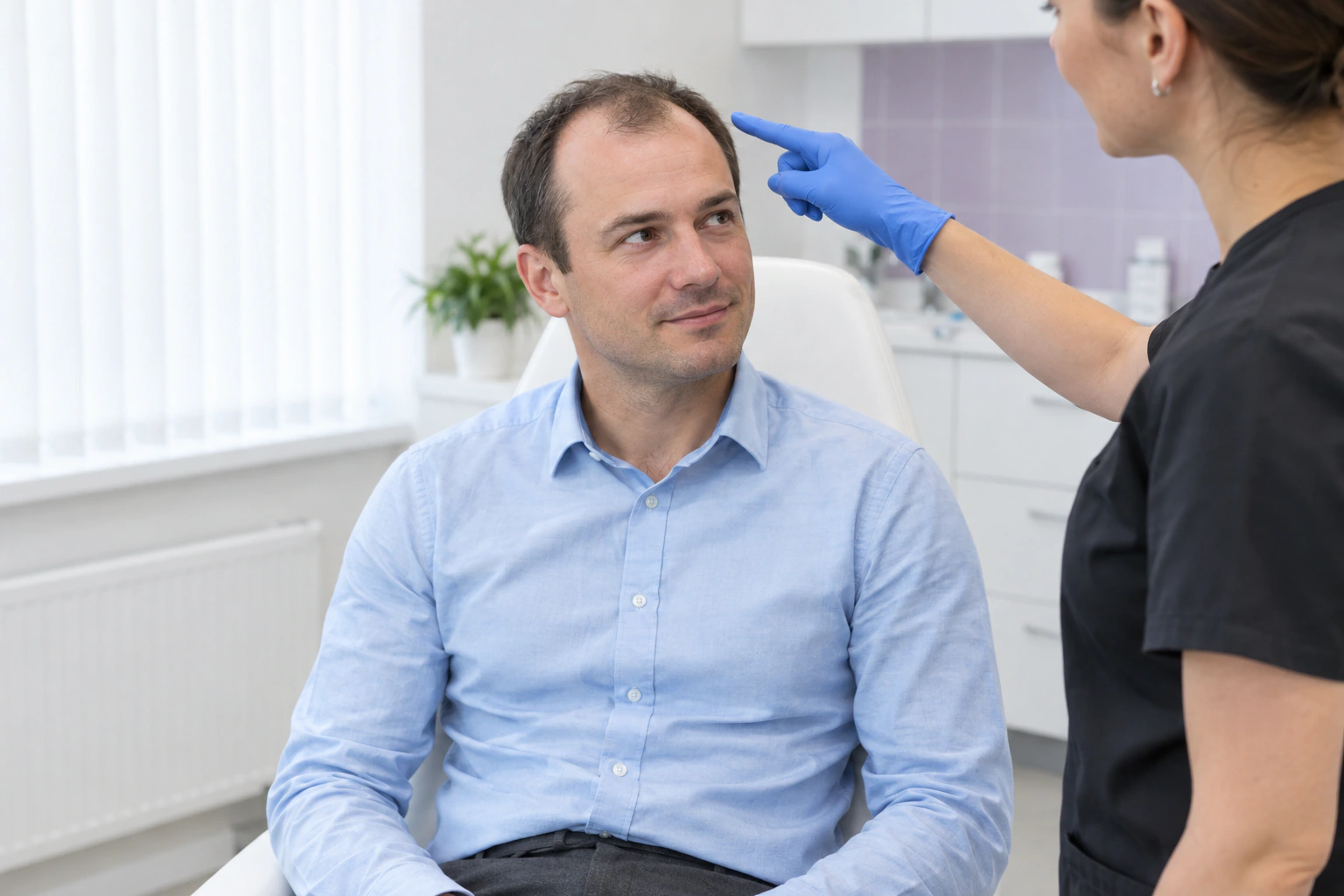

Leave your number and get the photos checked: a coordinator asks in a messenger, the doctor says if a transplant helps. Free, no booking.

services
The cost follows the graft count at the free consultation and is fixed in the contract.
suture-free graft extraction

$2,200$2,700
or $367/mo — 0% instalments for 6 months
Freeze the priceimplantation without channels

$2,500$2,900
or $417/mo — 0% instalments for 6 months
Freeze the pricecombined technique

$2,700$2,900
or $450/mo — 0% instalments for 6 months
Freeze the price| Opening appointment | Free |
|---|---|
| Eyebrow transplant, FUE | |
| Beard transplant, FUEinstalments $467/mo | |
| Hair trichopigmentation | |
| PRP therapy / session | $200 |
all included
Accompanied at every step and for 12 months afterwards.
On surgery day the price stays where it was.
two other areas
Change the zone and nothing else changes: the grafts still come from the back of the head, the method is still FUE.
FUE method, no cuts or stitches

Grafts are taken from the donor area at the back of the head and go in through micro-punctures of about 1 mm — no scars are left. The doctor discusses the shape with you ahead of the operation, taking your facial features into account. Transplanted hair grows for life: trim and style the beard as usual.
$2,800$3,000
or $467/mo — 0% instalments for 6 months
Freeze the priceFUE method, no cuts or stitches

Contour first: the surgeon draws it at the first appointment, references are lined up for comparison, and the design follows your facial proportions. Hairs set at the growth angle make the brows look natural up close. Where years of plucking stopped growth, this is the answer.
$1,600$1,700
an operation under local anaesthetic, no stay
Freeze the priceThe doctor will study your donor area, count the grafts and show the result achievable in your case. The cost is named at the consultation and fixed in the contract.

Message our coordinator
Free online consultation · Reply within 15 minutes
Message us on TelegramMessage us on WhatsAppBy messaging us, you agree to our Privacy Policy
Process
From consultation to going home — all in one day

Patients in Addis Ababa start with a free consultation, where the doctor explains the FUE and DHI methods, answers questions, and builds a personalized surgical plan.

Booking involves reserving the surgery date with a deposit — card payment at the clinic or an online transfer — under a medical services contract.

The clinic tells you which tests are required and how to go about them, so nothing is missed before the operation.

With the scalp numbed by a local anaesthetic, the surgery causes nothing to be felt.

The donor supply lies behind the head or around the temples, and grafts come from there without any stitching.

The surgeons work through the balding area, implanting the grafts one by one.
The clinic makes sure you have the necessary items and understand precisely how recovery works.

The crusts come off, the swelling fades, the skin heals day by day

A predictable phase: hair shafts drop while the roots stay

The first new hairs arrive and the effect is noticeable

The hair is becoming thicker, the volume and contour are visible

The hair reaches its full volume and a natural edge

Free, ahead of surgery and with no obligations.
Discuss your optionsdoctors

Hair transplant doctor, trichologist, surgeon
10 years in practice

Dermatovenereologist, trichologist, surgeon
11 years of experience

Plastic surgeon
9 years of experience

Plastic surgeon
9 years of experience

Assistant
9 years of experience
The doctor evaluates your donor area, counts the grafts and names the achievable result.
Discuss your optionscoordinators
A personal coordinator picks up your case at the start and stays on it through recovery.
Your personal manager
Helps at the preparation stage and in recovery
Helps with the forms and the arrangements

Your personal manager
Helps at the preparation stage and in recovery
Helps with the forms and the arrangements

Your personal manager
Helps at the preparation stage and in recovery
Helps with the forms and the arrangements
Your personal manager
Helps at the preparation stage and in recovery
Helps with the forms and the arrangements













Your questions will be answered and a convenient consultation time found
Message us on WhatsApp Fill in the formPoints people raise

Yes. Anyone from a different city, or a different country, can be treated, and the consultation itself can happen online.
Prices start at $2,200 (≈ ETB 360,000) for FUE, $2,500 (≈ ETB 410,000) for DHI, and $2,700 (≈ ETB 440,000) for the combined method. Your final price is set after a free graft count and locked into the contract.
One day sees the whole operation through, and then it is home.
There is no pain; the area is numbed with local anaesthesia.
With FUE, grafts are taken by tweezer with no incisions. With DHI, grafts are implanted directly using a Choi pen, without pre-made channels. The combined method mixes FUE harvesting with DHI implantation.
Your donor reserve sets the number, which the doctor calculates during a consultation charged at nothing.
Healing takes up to 0–10 days, after which a 2–4 week shed follows, and that is normal. Growth begins in earnest at 3–4 months, density arrives near 6–9 months; the whole result comes at 12–18 months.
A lifetime guarantee of hair growth is included, confirmed in your contract.
The clinic works under a medical licence, care meets the standards and clinical guidelines
of Ministry of Health.

Diplomas and certificates of the doctors who operate on you
Study the documentsAKC POMOSHCH LLC
the clinic's own entity
1057746096924
OGRN
7728536872
INN
The two methods available to a patient in Addis Ababa are FUE and DHI. Both leave the skin unbroken by any cut and need no stitching afterwards, both rely on local anaesthesia alone, and both take a single day from beginning to end.
Nothing has to be arranged in advance to start in Addis Ababa. The online consultation is free: the doctor studies photos of the thinning area and counts the grafts needed. The clinic is in touch 24/7, so you write when it suits you.
It heals within 0-10 days, the transplanted hairs shed at 2-4 weeks and this is the norm, growth appears at 3-4 months, density at 6-9 and the final result at 12-18. Along the way there are check-ups at 1, 3, 6, 9 and 12 months, photo tracking with a personal coordinator and a lifetime growth guarantee.
Prices are in US dollars; the amount in brackets is an approximate conversion to ETB at the rate of 02.10.2026. The final price is fixed in your contract.
By messaging us, you agree to our Privacy Policy
What patients write after this operation. Reviews are translated from the original language.
Andrey M.
I had the operation a month ago. Before and after surgery they were always in touch and helped with questions about my tests. The operation itself went wonderfully, the staff are polite and masters of their craft, you feel you are in safe hands. I am recovering now, and they answer all my questions. I am happy and I recommend them!
DHI hair transplant
Pavel Sinitsyn
The best clinic of all the ones I was choosing from. No regrets at all! The result is simply amazing, I am thrilled. I recommend it to everyone: these people do great work and make people happy. Once again, a huge thank you to everyone. Roman, the head of the clinic, is the best: he was personally in touch with me and looked after my recovery. Thank you for making my dream come true.
FUE hair transplant
Maria Akopyan
I thought about an eyebrow transplant for a long time and finally went for it. At first I was afraid the result would look unnatural, but when I saw my new eyebrows I was delighted! They came out full and in harmony with my face. I can hardly believe that now I just wash my face and go, I have never felt so free. For anyone tired of constant make-up, a transplant is a real lifesaver!
Eyebrow transplant (FUE)
Alexander M.
I really wanted a thick beard, but I had problems with it. I tried every home remedy and minoxidil, and nothing helped. After a long search for the best clinic I settled on this one. Thank you so much for the service, I liked everything and now I am happy! I had the beard transplant 10 months ago and I am very pleased with the result. By the way, the music in the clinic was great, as far as I remember. A friend of mine has already come to you for a transplant on my advice and was also happy with the result. I wish you every success!
Beard transplant (FUE)
Vladimir Z.
I went to the clinic to see a trichologist and had a hair transplant. I really liked the doctor's approach, and all the recommendations helped. I want to point out that nobody tries to sell you extra services: they tell you things as they are, and if some treatment is not needed, they do not push it. Cosy and clean.
DHI hair transplant
Artem Popov
This may sound obvious, but a head of hair really changes everything in your life. You feel much more confident and go through life like a winner. And it is all thanks to the doctor at this clinic and to the staff who take care of their patients. Many thanks to the clinic for a happy life with new hair, for the comfortable conditions and for the professionalism during the hair transplant.
FUE hair transplant
Page medically reviewed by Anastasia A. Kolesnik, hair transplant doctor. Review date: .
Addis Ababa is the capital and largest city of Ethiopia, with an estimated 6,287,000 inhabitants as of 2025. It is a federally chartered city and a cultural, artistic, financial and administrative centre, and it is the headquarters of the African Union. People here work in trade, manufacturing, civil administration, transport, education, health care, hotels and catering, so many of them meet clients, colleagues and officials every day. Hair, and for men the beard as well, is part of that daily impression, and this is often what lies behind a first question about FUE or DHI.
Residents of the city usually come to the idea after a long period of watching a thinning crown, a receding frontal hair line or patchy areas in the beard. The first step is not booking anything. It is understanding what the procedure does: grafts are taken from the back of the head, the donor area, and moved through micro-punctures of about 1 mm, so nothing scars over. The doctor discusses the shape with you before the operation, taking your facial features into account.
City Medical Centre works with patients from Addis Ababa through a free online consultation. Coordinators are available around the clock (24/7) on WhatsApp and Telegram, so you can send your questions in the evening after work or early in the morning, without rearranging your day.
Addis Ababa lies in the Ethiopian Highlands at an elevation of 2,355 metres, and the climate is subtropical highland. The altitude keeps temperatures moderate all year, and no month has a mean temperature above 22 °C. For someone recovering after a hair transplant this is a calm background: you are rarely exposed to the lasting heat that makes a healing scalp uncomfortable.
The dry season runs from mid-November to January. Daytime highs are usually not more than 23 °C, while nights can be cold, with minimums between 5 °C and 10 °C and occasionally dropping to freezing. The air is dry, so the question is mostly about keeping the scalp comfortable, avoiding irritation from rough headwear and following the washing routine the team gives you.
The short rainy season is from February to May, with warm temperatures and pleasant rainfall. The long wet season is from June to mid-September and is the coldest period, with frequent rain, hail, cloud cover and fewer hours of sunshine. Damp days call for clean, soft and loosely fitting headwear. Never put on anything that presses on the grafts or that has been in contact with dust or moisture. Ask your surgeon exactly what to wear and when.
Even though the air feels cool, the city sits high above sea level, and clear days can still be bright. General advice after any hair transplant is to protect the treated area from direct sun in the early period and to follow the doctor's instructions on headwear. Ask how long you should avoid direct sunlight and what kind of covering is acceptable.
Addis Ababa is a busy city in a construction boom, with tall buildings rising in many places and heavy movement of buses, light rail and taxis. Construction and traffic mean dust. In the first days plan your movements so that you spend little time in dusty places, and ask the coordinator how to keep the area clean and what to do if something gets on the grafts.
Practical planning helps: arrange for someone to accompany you on the way home after the operation, avoid crowded public transport during the first days if you can, and keep your head from being bumped. These are general precautions; your surgeon will tell you what applies in your case.
The capital has a large working population in trade, civil administration, education and services, and a large student community around Addis Ababa University and the many public universities and private colleges. For office workers and students the main question is how visible the early period will be. Redness and small scabs are part of normal healing, and the healing phase is 0–10 days. Many patients choose a quieter stretch in their work or study calendar for this stage.
The follow-up schedule is also easy to plan around. Check-ups come at months 1, 3, 6, 9 and 12, and we stay with you from pre-op planning to 12 months later. Because the consultations are online, you can attend them from home or from your workplace.
If your job involves meetings, customers or public appearances, tell the surgeon at the start. Together you can plan the date so that the first weeks fall at a convenient moment and so that you know when the shedding period will happen, to avoid surprises.
Addis Ababa is known for running. The city hosts the Jan Meda International Cross Country and the annual 10 km Great Ethiopian Run, which began in late October 2000, and it has stadiums such as Abebe Bikila Stadium. Many residents run, train or play football, so a typical question is when sport can be resumed.
The answer comes from your surgeon and depends on the technique and on how your scalp heals. In general terms, heavy sweating, helmets, tight caps and contact sport put pressure on the freshly treated area, so ask for a clear written plan: when to start gentle walking, when to return to running, when to go back to team sport and when to use a cap or headband.
If you are preparing for a race or a competition, plan the operation well before it and tell the doctor your date. Do not decide on your own to speed up your return to training, because the early weeks are about protecting the grafts.
Addis Ababa is a melting pot: Amhara, Oromo, Gurage, Tigrayan, Silt'e, Gamo and other communities live side by side, and the city's religious life includes Ethiopian Orthodox, Muslim and Protestant believers. Fasting periods, holidays, weddings and family gatherings are important parts of the year, and many people want the result to look good for such events.
Think about the timeline honestly. 2–4 weeks after the procedure the transplanted hairs let go, as expected. Hair comes back at 3–4 months, becomes visibly thicker at 6–9 months, and the look is settled at 12–18 months. If a wedding or a big family occasion is in your plans, do not schedule the operation right before it. Leave time for healing and for the shedding stage to pass.
About food: during recovery, follow the instructions you receive on diet, alcohol and smoking, and ask your coordinator whether any change to your usual eating or fasting is needed. Do not change medicines or start supplements without asking the doctor.
Because Addis Ababa temperatures are so constant, you have more freedom than in a city with extreme heat. The dry season from mid-November to January has cool nights and generally clear days; the short rains from February to May are mild; the long wet season from June to mid-September is the coldest, with rain, hail and cloud.
Each period has small practical points. In the dry season, protect the scalp from dryness and dust. In the rains, avoid getting the head wet without instructions and plan comfortable transport. In the cold months, pick headwear that is soft and loose. None of these is a barrier, so the right time is the one in which you can rest during the first days and attend your check-ups calmly.
Discuss your calendar with the coordinator: work peaks, exams, holidays and sport events. The doctor will then suggest a realistic date.
A good candidate usually has enough healthy hair in the donor area at the back of the head, realistic expectations and good general health. Conditions that affect healing, active scalp disease, unstable chronic illnesses, certain medicines and unrealistic wishes can be reasons to postpone or to decide against the operation. The doctor decides after reviewing your photos and medical history.
Questions to bring to the online consultation: Which technique, FUE or DHI, suits me and why? How will the frontal hair line be designed for my face? Which donor area will be used? What will the first days look like? When does shedding happen? How is the follow-up organised? Whom do I contact at night if something worries me?
Remember what you can rely on: a coordinator will be on the phone 24/7, and the team stays with you from pre-op planning to 12 months later. Be open about your medical history, because general health matters for any surgery.
You write to the coordinators on WhatsApp or Telegram, send clear photos of the front, top, crown and back of the head, and describe your goals, previous treatments and medical conditions. The online consultation is free. A doctor then reviews the material and explains what is realistic.
After the operation, the check-ups at months 1, 3, 6, 9 and 12 are held remotely, with photos and discussion, so you can follow how the hair develops. The overall stages are: 0–10 days for healing, 2–4 weeks for normal shedding of transplanted hair, 3–4 months for new growth to start, 6–9 months for real density, and 12–18 months for the final result.
One patient described it this way: the result truly made him very happy; from about the 4th month active, even growth began, the transplanted hair took very well, the beard looked as natural as possible and no bald patches were left. The beard became much thicker and denser, with the shape he had thought about for a long time. Your own experience may differ, which is why individual planning matters.
Yes. The online consultation is free for patients from Addis Ababa. You send photos and questions to the coordinators on WhatsApp or Telegram, and a doctor gives an opinion.
Coordinators are available around the clock (24/7). A coordinator will be on the phone 24/7, which is useful when you have a question late in the evening or early in the morning.
Grafts are taken from the back of the head, the donor area, and moved through micro-punctures of about 1 mm, so nothing scars over. The doctor discusses the shape with you before the operation, taking your facial features into account.
Transplanted hairs let go 2–4 weeks after the operation, as expected. Hair comes back at 3–4 months, becomes visibly thicker at 6–9 months, and the settled look comes at 12–18 months. Healing takes 0–10 days.
The moderate temperatures, with no month above 22 °C in mean temperature, are comfortable for a healing scalp. You still need to protect the area from sun, dust and rain as the doctor instructs.
Not immediately. Sweat, pressure and knocks can harm the grafts. Ask the surgeon for a written plan with dates for walking, running and team sport.
Yes, FUE and DHI are also used for the beard. Transplanted hair grows for life: trim and style the beard as usual. The doctor will plan the shape with you.
We stay with you from pre-op planning to 12 months later, with check-ups at months 1, 3, 6, 9 and 12.
Plan the operation well ahead. Shedding happens in the 2–4 week period, and the full result takes 12–18 months, so do not schedule the procedure just before the event.

 Forceps
 Minimal


