



original
12 months out
2,800 grafts
FUE method
City Medical Centre
0% instalments
from $367/mo
Your first chat and sum — $0.
Honest case
original
12 months out
FUE technique, free of incisions or stitches. Grafts and forecast free of charge — before you decide.
Nothing is owed, no surgery booking required
Message our coordinator
Free online consultation · Reply within 15 minutes
Message us on TelegramMessage us on WhatsAppBy messaging us, you agree to our Privacy Policy
results
Each of the cases is a real CMC patient.
original
12 months out
2,800 grafts
FUE method

original
12 months out
3,500 grafts
FUE method

original
12 months out
2,600 grafts
FUE method

original
12 months out
3,000 grafts
FUE method

original
12 months out
2,700 grafts
FUE method

original
12 months out
3,300 grafts
FUE method

original
12 months out
2,900 grafts
FUE method

original
12 months out
2,500 grafts
FUE method

original
12 months out
3,400 grafts
FUE method

original
12 months out
2,500 grafts
FUE method

original
12 months out
3,100 grafts
FUE method

original
12 months out
3,600 grafts
FUE method

original
12 months out
4,000 grafts
FUE method

original
12 months out
3,200 grafts
FUE method

original
12 months out
3,000 grafts
FUE method

original
12 months out
3,700 grafts
FUE method

original
12 months out
2,700 grafts
FUE method

original
12 months out
3,800 grafts
FUE method

original
12 months out
3,300 grafts
FUE method

original
12 months out
2,800 grafts
FUE method

original
12 months out
2,500 grafts
FUE method

original
12 months out
3,900 grafts
FUE method

original
12 months out
3,500 grafts
FUE method

original
12 months out
3,800 grafts
FUE method

original
12 months out
2,900 grafts
FUE method

original
12 months out
3,600 grafts
FUE method

original
12 months out
2,600 grafts
FUE method

original
12 months out
2,700 grafts
FUE method

original
12 months out
3,700 grafts
FUE method

original
12 months out
3,200 grafts
FUE method

original
12 months out
3,000 grafts
FUE method

original
12 months out
2,800 grafts
FUE method

original
12 months out
4,000 grafts
FUE method

original
12 months out
3,400 grafts
FUE method

original
12 months out
2,900 grafts
FUE method

original
12 months out
3,100 grafts
FUE method

original
12 months out
2,600 grafts
FUE method

original
12 months out
3,300 grafts
FUE method

original
12 months out
3,900 grafts
FUE method

original
12 months out
3,500 grafts
FUE method

original
12 months out
2,700 grafts
FUE method

original
12 months out
3,800 grafts
FUE method

original
12 months out
3,200 grafts
FUE method

original
12 months out
3,000 grafts
FUE method

original
12 months out
2,800 grafts
FUE method

original
12 months out
3,100 grafts
FUE method

original
12 months out
3,600 grafts
FUE method
Comparison
Our work relies on three graft transfer technologies: classic FUE, suture-free DHI and a combined protocol. Compare implantation technique, tissue trauma and graft survival, then choose knowingly.
Classic technique without incisions or stitches

$2,200
$2,700
Graft implantation technique
ForcepsGraft trauma
MinimalThe natural growth angle
NaturalGraft survival
98–100%Suitable for
Androgenetic alopeciaImplantation with a Choi pen, no sutures

$2,500
$2,900
Graft implantation technique
Choi implanter, DHI penGraft trauma
MinimalThe natural growth angle
NaturalGraft survival
98–100%Suitable for
DensificationFUE for extraction, DHI implant

$2,700
$2,900
Graft implantation technique
FUE extraction plus DHI implantGraft trauma
MinimalThe natural growth angle
NaturalGraft survival
98–100%Suitable for
Densification for androgenetic alopeciaSurvival and trauma data are averaged by method and offered as a guide: the exact numbers depend on the transplant area and on the patient's individual features, which the doctor clarifies at the consultation.
Learn more


















about the clinic
Attentive care, cosy rooms and equipment that is up to date

Tell us what is unclear and we will fix a slot that works for you
Message us on WhatsApp Send the formAn unnecessary operation will be ruled out at the consultation itself, sparing you the expense. Just below are the situations in which a transplant genuinely helps.
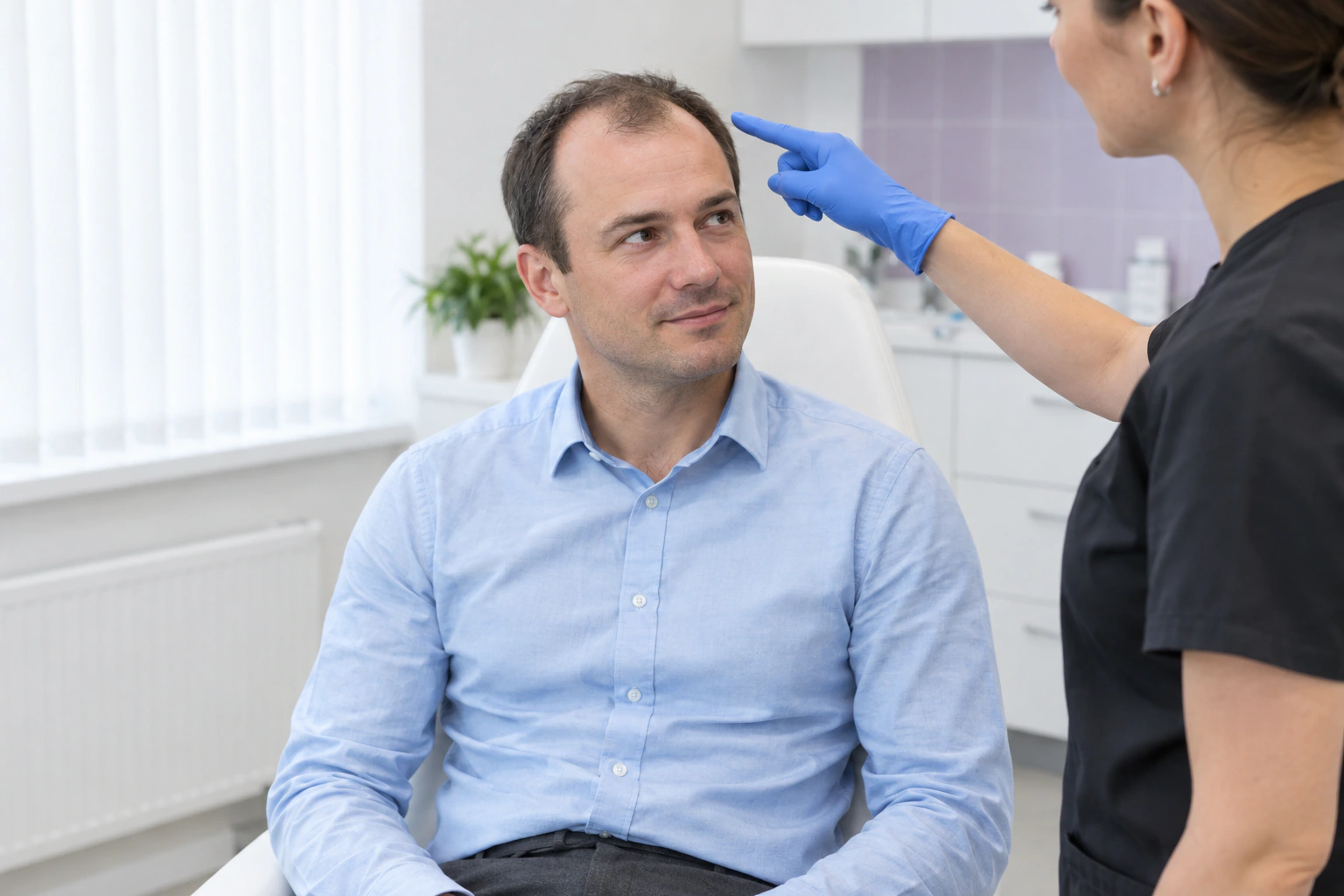

A phone number is all it takes. The coordinator collects close-up pictures through a messenger, a doctor reviews them and says whether a transplant would help. No fee, and no operation is booked.

services
At the free consultation, after the grafts are counted, the cost is named and fixed in the contract.
suture-free graft extraction

$2,200$2,700
or $367/mo — 0% instalments for 6 months
Hold the priceimplantation without channels

$2,500$2,900
or $417/mo — 0% instalments for 6 months
Hold the pricecombined technique

$2,700$2,900
or $450/mo — 0% instalments for 6 months
Hold the price| The first sit-down | Free |
|---|---|
| Eyebrow transplant, FUE | |
| Beard transplant, FUEinstalments $467/mo | |
| Hair trichopigmentation | |
| PRP therapy / session | $200 |
all included
Starting with pre-op planning, running 12 months on.
Nothing unexpected lands on your bill that day.
two further spots
The same donor grafts from the back of the head, the same FUE method — only the area changes, not just the scalp.
The FUE method, no incisions used

Grafts are taken from the donor area at the back of the head and moved through micro-punctures of roughly 1 mm — no scars are left. You and the doctor discuss the shape before the operation, taking your facial features into account. Transplanted hair grows for life: the beard can be trimmed and styled as usual.
$2,800$3,000
or $467/mo — 0% instalments for 6 months
Hold the priceThe FUE method, no incisions used

The brow contour is the surgeon's work at the first appointment: references are compared with you, and your facial proportions decide the design. Hairs implanted at the growth angle give brows that hold up close. Where tweezers have stopped the growth over the years, it works.
$1,600$1,700
a day-clinic operation, the scalp numbed first
Hold the priceA check of the donor zone, a graft number, and a frank answer about the outcome. The price you are quoted at the consultation is the price in the contract.

Message our coordinator
Free online consultation · Reply within 15 minutes
Message us on TelegramMessage us on WhatsAppBy messaging us, you agree to our Privacy Policy
Process
From consultation to going home — all in one day

The first appointment is where FUE and DHI get explained properly, where you can ask anything that worries you, and where the doctor looks closely at the donor zone.

This step confirms the date through a deposit paid by card at the clinic or online, with the arrangement recorded in a medical services contract.

Nothing begins until the analyses are done. The clinic supplies a complete list and explains each requirement.

Patients in Lubumbashi are given a local anaesthetic, so the surgery brings no pain.

Harvesting grafts from the back of the head or the temples happens without stitches at this stage.

Surgeons move the collected grafts across to where hair has been lost.
The clinic equips you with all the necessary supplies and full instructions for a smooth, fast recovery.

Scabs clear off, the swelling settles, the skin returns to normal

Losing the shafts is normal, and the roots are not lost

Growth comes on steadily, and the change becomes clear

Density builds up and the main volume and the hairline show

Natural hairline and final density take their shape

Free, before surgery and binding you to nothing.
Learn moredoctors

Hair transplant doctor, trichologist, surgeon
10 years in practice

Dermatovenereologist, trichologist, surgeon
11 years of experience

Plastic surgeon
9 years of experience

Plastic surgeon
9 years of experience

Assistant
9 years of experience
The doctor assesses your donor zone, gives a graft figure and explains the outcome that can be reached.
Learn morecoordinators
You get a personal coordinator who guides you from the first enquiry through to recovery.
Patient services lead
Supports you before and after the surgery
Runs the paperwork and keeps your diary
Patient services lead
Supports you before and after the surgery
Runs the paperwork and keeps your diary
Patient services lead
Supports you before and after the surgery
Runs the paperwork and keeps your diary
Patient services lead
Supports you before and after the surgery
Runs the paperwork and keeps your diary













Tell us what is unclear and we will fix a slot that works for you
Message us on WhatsApp Send the formQueries we hear

Yes, of course. People with homes in various cities and countries are part of everyday practice, and an online discussion with the doctor opens the process.
FUE: $2,200 (≈ CDF 5,100,000). DHI: $2,500 (≈ CDF 5,800,000). Combined: $2,700 (≈ CDF 6,300,000). A free consultation and graft count gives you the final, contract-fixed price with no hidden extras.
A day — that is the full length, and then you head back home.
It's a painless procedure, carried out under local anaesthesia.
FUE relies on tweezer harvesting with no incisions or stitches. DHI relies on Choi-pen implantation without channels. The combined DHI+FUE approach harvests by FUE and implants by DHI.
The doctor names the exact quantity at a free appointment, after looking at what the donor zone offers.
0–10 days for healing, 2–4 weeks for normal shedding of transplanted hair, 3–4 months for new growth to start, 6–9 months for real density, and 12–18 months for the final result.
Hair growth is covered by a lifetime guarantee, fixed in the signed contract.
The clinic works under a medical licence, and care meets the standards and clinical guidelines
of the Ministry of Health.

Qualification certificates of our surgeons
Read the documentsAKC POMOSHCH LLC
our clinic's legal entity
1057746096924
OGRN
7728536872
INN
A person in Lubumbashi keeps an ordinary week around the procedure. FUE and DHI need no cuts and no stitches, they are performed under local anaesthesia, and the whole operation occupies a single day.
Nothing is signed and nothing is paid at the start in Lubumbashi. The online consultation is free: the doctor sees pictures of the affected zone and tells you if a transplant helps. The clinic is in touch 24/7.
Healing occupies 0-10 days. At 2-4 weeks the transplanted hairs shed, which is normal and temporary. Growth starts at 3-4 months, density by 6-9 and the final result at 12-18. Your personal coordinator checks progress by photo at 1, 3, 6, 9 and 12 months, with a lifetime growth guarantee.
Prices are in US dollars; the amount in brackets is an approximate conversion to CDF at the rate of 02.10.2026. The final price is fixed in your contract.
By messaging us, you agree to our Privacy Policy
What patients write after this operation. Reviews are translated from the original language.
Andrey M.
I had the operation a month ago. Before and after surgery they were always in touch and helped with questions about my tests. The operation itself went wonderfully, the staff are polite and masters of their craft, you feel you are in safe hands. I am recovering now, and they answer all my questions. I am happy and I recommend them!
DHI hair transplant
Pavel Sinitsyn
The best clinic of all the ones I was choosing from. No regrets at all! The result is simply amazing, I am thrilled. I recommend it to everyone: these people do great work and make people happy. Once again, a huge thank you to everyone. Roman, the head of the clinic, is the best: he was personally in touch with me and looked after my recovery. Thank you for making my dream come true.
FUE hair transplant
Maria Akopyan
I thought about an eyebrow transplant for a long time and finally went for it. At first I was afraid the result would look unnatural, but when I saw my new eyebrows I was delighted! They came out full and in harmony with my face. I can hardly believe that now I just wash my face and go, I have never felt so free. For anyone tired of constant make-up, a transplant is a real lifesaver!
Eyebrow transplant (FUE)
Alexander M.
I really wanted a thick beard, but I had problems with it. I tried every home remedy and minoxidil, and nothing helped. After a long search for the best clinic I settled on this one. Thank you so much for the service, I liked everything and now I am happy! I had the beard transplant 10 months ago and I am very pleased with the result. By the way, the music in the clinic was great, as far as I remember. A friend of mine has already come to you for a transplant on my advice and was also happy with the result. I wish you every success!
Beard transplant (FUE)
Vladimir Z.
I went to the clinic to see a trichologist and had a hair transplant. I really liked the doctor's approach, and all the recommendations helped. I want to point out that nobody tries to sell you extra services: they tell you things as they are, and if some treatment is not needed, they do not push it. Cosy and clean.
DHI hair transplant
Artem Popov
This may sound obvious, but a head of hair really changes everything in your life. You feel much more confident and go through life like a winner. And it is all thanks to the doctor at this clinic and to the staff who take care of their patients. Many thanks to the clinic for a happy life with new hair, for the comfortable conditions and for the professionalism during the hair transplant.
FUE hair transplant
Page medically reviewed by Anastasia A. Kolesnik, hair transplant doctor. Review date: .
Lubumbashi is the second-largest city in the Democratic Republic of the Congo and the capital of Haut-Katanga Province. It lies in the southeasternmost part of the country, near the border with Zambia, and it is the centre of mining in the region. The population of the urban area is estimated at around 2,584,000 in 2021. In a city of this size, with mining companies, banks, a brewery, universities and international schools, many people work in settings where a neat, confident appearance matters, and that is one reason questions about hair restoration come up more and more often.
Men in Lubumbashi usually ask about two things: a receding frontal hair line or thinning at the crown, and gaps in the beard. Women ask less often, but some come with questions about a thinning parting or about hair lost after tension or styling. This text explains how FUE and DHI hair transplantation works, how it fits into life in Lubumbashi, and what to prepare before you decide.
City Medical Centre works with patients from Lubumbashi through a free online consultation. Coordinators are available around the clock (24/7) on WhatsApp and Telegram, so you can send questions and photos from home at a time that suits your working day.
Grafts are taken from the back of the head, the donor area, and moved through micro-punctures of about 1 mm, so nothing scars over. This is the core idea of both FUE and DHI: hair that is naturally resistant at the back of the scalp is relocated to the thinning zone. The doctor discusses the shape with you before the operation, taking your facial features into account.
The difference between the two techniques lies mostly in how the grafts are placed. With DHI, the grafts are implanted with a special pen-like tool, while with classic FUE the channels are opened first and the grafts are then placed in them. Which method suits you depends on the area to be covered, the density you want and the condition of your donor area. The doctor makes this decision after reviewing your photos and your history, not before.
For a patient in Lubumbashi this means the first step costs nothing and needs no visit anywhere: you send clear photos of the front, top, crown and back of the head, and you describe how your hair loss developed. From there the plan is built step by step.
Lubumbashi lies at around 1,208 m above sea level. The altitude cools a climate that would otherwise be very hot. The city has a dry-winter humid subtropical climate, with warm rainy summers and pleasant, dry winters. Annual average rainfall is 1,238 mm. For a hair transplant these conditions matter in practical ways.
The dry winter months are generally comfortable for the early recovery. Days are pleasant, and there is less sweating and less need to be out in strong sun. The warm rainy summer brings humidity, sudden downpours and muddy roads, so you should plan how to protect the treated area from rain and dirt during the first days, when the micro-punctures are healing. Ask your coordinator which headwear is suitable and when it may be worn, because a tight cap too early can disturb the grafts.
Sun is the other point. At this altitude sunlight can be strong even when the air feels mild. In general terms, avoid long direct sun on the scalp while it is healing, and follow the surgeon's instructions on protection. Dust from roads and from industrial activity around a mining city is also a reason to keep the scalp clean exactly as instructed and not to touch it with unwashed hands.
There is no single correct month, but the local calendar helps you choose. The dry winter gives calmer conditions for the first days, with fewer rain-related inconveniences. The rainy season is also possible if you organise your days so that you stay mostly indoors at the start and have a covered way to move around.
Think also about your own diary: a work project, a shift pattern in a mining company, an exam period at the university, a family celebration or a school event. The first days after surgery are the time when swelling and small scabs are most visible, so many people prefer to leave a quiet window and not plan a public event right after the procedure.
The healing stage covers 0–10 days. After that the timeline continues, and it is worth marking it in your calendar before you fix the date, so that important occasions do not fall in the awkward phases.
Patients in Lubumbashi, as everywhere, ask when they will see the result. The honest answer is in stages. 0–10 days are for healing, 2–4 weeks for normal shedding of transplanted hair, 3–4 months for new growth to start, 6–9 months for real density, and 12–18 months for the final result.
In short: at 2-4 weeks the transplanted hairs let go, as expected. At 3-4 months hair comes back. At 6-9 months it looks visibly thicker. At 12-18 months you have a settled look. The shedding is a normal part of the process and is not a sign that the operation has failed, so it is better to know about it in advance and not to panic when it happens.
One patient described it this way: «But now the result truly makes me very happy) From about the 4th month active, even growth began. The transplanted hair took very well, the beard now looks as natural as possible, no bald patches are left. The beard became much thicker and denser, with the shape I had thought about for a long time.» This is one person's experience, and every case develops at its own pace, but it shows the typical rhythm of waiting and then gradual improvement.
Lubumbashi is a working city. People are employed in mining, trade, banking, manufacturing, education and services, and many cannot disappear for a long time. Before the operation, speak with your employer or colleagues in general terms if needed, and plan the first days at home. If your work is office-based, you can often return to your tasks sooner than if it involves dust, heat or heavy physical effort. Ask the surgeon what applies to your specific job.
Students at the University of Lubumbashi, the Protestant University or the Graduate Institute of Health Sciences face a similar question: how to schedule lectures and exams around the visible early phase. Parents of children at the Belgian, French or British schools in the city may also want to plan school events and photographs with the healing period in mind.
Sport and the swimming pool need a clear answer from the surgeon before you restart. Football, running, gym work and swimming all involve sweat, friction or water, and the timing for returning to each is part of your personal plan. Do not decide it yourself on the basis of how you feel; ask at the check-up and in the chat with the coordinator.
Lubumbashi has a lively social life: family gatherings, celebrations, meals shared with friends, and cultural events such as the Biennale of Lubumbashi, held every two years across the city. The city is also known for Tembo beer, brewed locally. Social events often involve food and drink, and it is sensible to plan the operation so that you are not under pressure to attend crowded, hot or smoky gatherings in the first days.
In general terms, a balanced diet, enough water and good sleep support healing. Ask the surgeon about alcohol and smoking in the period around the operation and follow the advice you receive. If you are used to heavy, salty meals at family events, remember that swelling can be affected by general habits, so moderate choices are wise in the early days.
Daily habits such as wearing a helmet on a motorbike, a hard hat at a mining site or a tight cap are also worth discussing. Pressure and friction on the scalp are exactly what the grafts do not need at the start, so tell the doctor what you wear at work.
In general terms, a good candidate has stable hair loss, a sufficient donor area at the back of the head and realistic expectations. Younger patients whose hair loss is still progressing may be advised to wait or to start with other measures, because the pattern can change and the transplanted area may later look isolated.
Contraindications are decided individually. General health matters, as do scalp conditions, blood-clotting problems, chronic illnesses and medicines you take. Be completely open with the doctor about your history. Some conditions simply require a delay or extra preparation, not a refusal.
Body weight and overall health can also influence how well you tolerate any procedure. The World Health Organization treats excess weight as a public health matter, and it is reasonable to mention your general condition during the consultation so the medical team can plan safely.
The modern city was founded in 1910 under the name Élisabethville, in honour of Queen Elisabeth, and it was renamed Lubumbashi in 1966. The location was chosen because of its closeness to a copper mine and a smelting oven on the nearby Lubumbashi River. Many families here still remember both names, and older relatives often speak of the old city with real attachment. If an older parent or uncle is part of your decision, it helps to talk the plan through with them before the operation.
A city built around copper has always valued people who work hard and look presentable. Many residents come from families that moved here for employment, and that background shapes how people think about investing in their appearance: as a considered, practical choice and not a whim. Writing down your own reasons before the first consultation makes your goals clearer to the doctor.
Lubumbashi has distinct neighbourhoods. Kamalondo, formerly called Quartier Albert, lies south of the centre, and Kenia, Katuba and Ruashi grew later as main suburbs. Daily life in each differs: some residents move through busy markets and dusty lanes, others spend most of the day in offices in the centre.
This matters for the first days after the operation. If your route to work or to a market passes through crowded, dusty or muddy areas, discuss with the coordinator how to cover and protect the scalp and how long to stay indoors. Someone living in a quieter street may manage the early days at home more easily than someone who shares a busy courtyard with many visitors.
Kiswahili is the main shared language of the city, French is official, and Kiluba, Chokwe, Bemba and Kisanga are also heard. When you write to the coordinators you can describe your case in whichever language you are most comfortable with and then confirm key points in writing, so that nothing about your goals or medicines is misunderstood.
Music runs through city life, from soukous to urban sounds, and the Biennale of Lubumbashi fills the city with art every two years. Concerts and festivals mean crowds, heat and shared space. If you are a singer, performer or simply a regular at concerts at Ciné Bétamax, mark the date of the event and plan the operation so the healing period of 0–10 days does not fall on it.
Football is the most popular sport in Lubumbashi, with TP Mazembe, FC Saint Eloi Lupopo and CS Don Bosco rooted in the city. Match days bring packed stands, sun and noise. Men who play on neighbourhood pitches or follow the clubs closely should ask the surgeon exactly when running, heading the ball and crowded stadium days are acceptable again.
The city has also produced well-known basketball players, and young people take the game seriously. Teammates notice a new look quickly, so decide in advance what you will say. Many patients simply explain that they are in a recovery phase and will return when the surgeon allows.
Lubumbashi is the mining capital of the country, a base for many large companies, and it also hosts a major bank and manufacturing such as textiles, printing and brewing. Office staff, engineers, traders and technicians all meet clients and managers face to face, and appearance counts.
If your job involves a hard hat, dust or heat on a mining or industrial location, say so during the consultation. Ask when protective headwear may be worn again and whether a temporary change of duties is possible. For desk work, a short quiet period at home may be enough, and the coordinator can help you think it through.
The process is simple. You write to the coordinators on WhatsApp or Telegram, send photos and answer questions about your hair loss, your health and your goals. The free online consultation then gives you an assessment of the area, the likely number of grafts and the choice between FUE and DHI. A coordinator will be on the phone 24/7, so you can ask even if it is the middle of the night.
We stay with you from pre-op planning to 12 months later. Check-ups are at months 1, 3, 6, 9 and 12, so you are not left alone during the long waiting period. At each point you send photos, and the team compares them with the expected stage.
Prepare before the call: take clear photos in daylight, write down the medicines you use, note any allergies and previous operations, and list your questions. The results are expected over 12–18 months after surgery, so patience is part of the plan.
Yes. The consultation from Lubumbashi is free. You contact the coordinators on WhatsApp or Telegram, send photos and receive an assessment.
Yes, and this is normal. In the 2-4 weeks after surgery the transplanted hairs let go, as expected. New hair comes back at 3-4 months.
Growth starts at 3-4 months, you see visibly thicker hair at 6-9 months, and the settled look comes at 12-18 months.
Grafts are taken from the back of the head and moved through micro-punctures of about 1 mm, so nothing scars over.
Yes, beard transplantation is possible. The doctor discusses the shape with you before the operation, taking your facial features into account. Transplanted hair grows for life, so you can trim and style the beard as usual.
The healing stage is 0–10 days. Plan this period at home, away from dust, rain and crowded events.
It can. Summers are warm and rainy, so you need to protect the treated area from rain and dirt in the first days. The dry winter is generally more comfortable for early recovery.
We stay with you from pre-op planning to 12 months later, with check-ups at months 1, 3, 6, 9 and 12.
A coordinator will be on the phone 24/7, and you can also write on WhatsApp or Telegram.
The timing is individual. Ask the surgeon and the coordinator before returning to football, gym work or the pool, and follow the plan given to you.
Yes, avoid placing the first healing days of 0–10 days on a crowded event. Stadium days and festivals mean sun, dust and contact with the head.
You can describe your case in the language you know best on WhatsApp or Telegram, and confirm medicines and goals in writing. A coordinator will be on the phone 24/7.
Ask when a hard hat may be worn again, how to protect the scalp from dust, and whether your duties can be adjusted at first. The surgeon gives advice for your exact job.
It can. Crowded, dusty or muddy surroundings need more protection and more time at home early on. Discuss your daily route with the coordinator before choosing a date.

 Forceps
 Minimal


